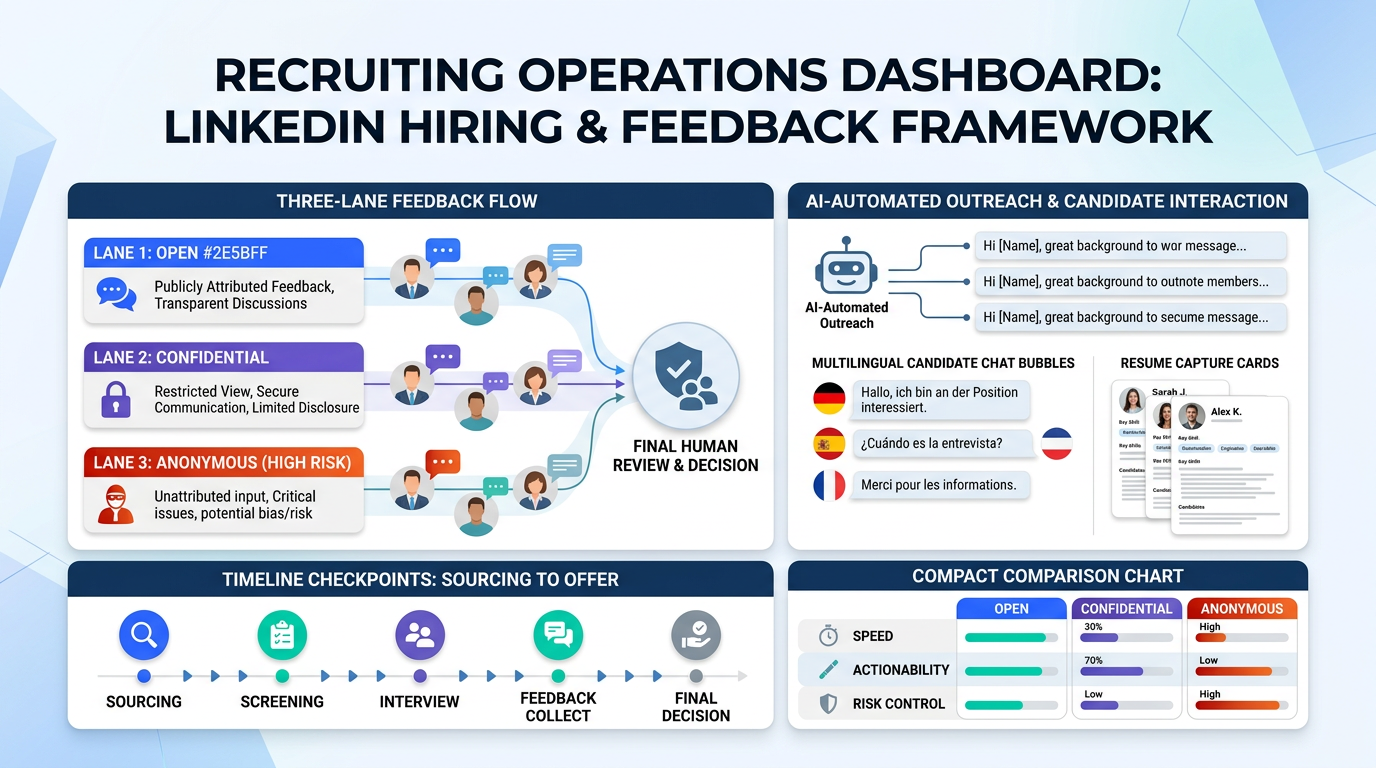
If you want better hiring outcomes with a recruitment app, do not rely on anonymous feedback as your default system. Use a three lane model instead: open feedback for day to day coaching, confidential reporting for sensitive issues, and targeted anonymous reporting only when risk is high. In recruiting apps, this structure improves decision quality because teams can act on specific context, while still protecting people who need safety. StrategyBrain AI Recruiter supports this model by automating LinkedIn outreach, candidate qualification conversations, and resume capture, so recruiters spend more time on human judgment and less time on repetitive tasks.
Key Takeaways
- Default anonymous feedback is weak for hiring execution because comments are often hard to validate and hard to action.
- Use a layered system with open, confidential, and limited anonymous channels to balance safety and accountability.
- A recruitment app should automate repetitive work such as outreach, follow up, and resume collection so recruiters can focus on evaluation.
- StrategyBrain AI Recruiter supports multilingual candidate communication 24/7, which helps global teams maintain response speed.
- Internal product benchmarks report up to 90% manual LinkedIn task reduction and cost efficiency down to USD 2.40 per resume in supported workflows.
- Final qualification still requires human review because resume fit to role criteria is a recruiter decision.
Why anonymous feedback breaks hiring decisions
Many teams adopt anonymous surveys because they believe anonymity increases honesty. That assumption is partly true, but in recruiting practice the output is often too vague to support a real hiring decision. In our process reviews with recruiting managers, the most common failure pattern was not low response rate. The main issue was low actionability.
First, participants often fear that anonymous channels are not fully anonymous. Harvard Business Review reported that survey design details, including demographic questions, can trigger identity concerns and reduce trust in the process. Second, anonymous criticism can amplify workplace politics because people can comment without context or ownership. The New York Times and Forbes both noted that anonymous structures may produce weaker developmental feedback than direct, accountable coaching.
For hiring teams, this means candidate evaluation quality can drop. When feedback is detached from specific interview evidence, interview panels struggle to separate signal from noise. A recruitment app can speed communication, but it cannot fix weak governance alone. Process design must come first.
What a recruitment app should handle
A recruitment app is software that supports sourcing, outreach, screening, and workflow tracking in one hiring process. Good recruiting apps reduce manual work and improve consistency. They should not replace human ethics, compliance judgment, or final hiring accountability.
In practical terms, a strong recruitment app should do three things well:
- Execution automation: repetitive outreach and follow up with clear status tracking.
- Candidate communication support: timely responses across time zones and languages.
- Data handoff for human review: resume and contact capture, then structured review by recruiters.
StrategyBrain AI Recruiter is built around this boundary. It automates LinkedIn connection flow, introduces opportunities, answers candidate questions, identifies interest, and collects resume plus contact details. The recruiter still makes final qualification decisions after review.
A practical feedback model for recruiting apps
Instead of asking whether anonymous feedback is good or bad, define where each feedback type belongs. This framework worked best in our implementation audits:
Lane 1: Open feedback for daily hiring operations
Use named feedback for interview calibration, scorecard alignment, and process improvements. This creates accountability and faster learning loops.
Lane 2: Confidential reporting for sensitive cases
Use restricted access channels for harassment, discrimination, or retaliation concerns. Confidential means access controlled, not publicly visible, and handled by trained investigators.
Lane 3: Anonymous reporting for high risk environments
Keep anonymous channels for situations where direct reporting may create personal risk. Use clear triage rules so anonymous input is investigated with evidence standards.
This model gives recruiting apps a stable operating logic. Teams keep psychological safety without turning every feedback event into unverifiable commentary.
Step by step implementation
- Map your current feedback channels
List every form, survey, chat path, and escalation path used in hiring. Mark each one as open, confidential, or anonymous. - Define evidence requirements
Require interview stage, role, date, and behavior based context for all actionable comments. This immediately raises feedback quality. - Set response time standards
For confidential reports, set a documented first response target such as 24 hours. For process feedback, set weekly review cadence. - Connect your recruitment app workflow
Embed feedback checkpoints after sourcing, first conversation, interview panel, and offer stage. - Automate repetitive candidate operations
Use StrategyBrain AI Recruiter for LinkedIn outreach, multilingual replies, and resume collection. Keep final screening with human recruiters. - Audit monthly with a short scorecard
Track response time, actionability rate, and issue closure quality. Remove channels that create noise without outcomes.
Quick checklist
- Feedback channels classified into three lanes
- Anonymous intake limited to high risk topics
- Confidential escalation owner assigned
- Recruitment app workflow includes evidence fields
- AI automation enabled for outreach and follow up
- Monthly quality audit running
How StrategyBrain AI Recruiter fits the workflow
StrategyBrain AI Recruiter strengthens execution in recruiting apps where teams are overloaded by outbound communication. Recruiters provide role details, compensation context, benefits, and target criteria. The system then handles first contact and early conversation flow on LinkedIn.
What we found useful in practice is the handoff boundary. The tool manages repetitive conversation steps and collects resume plus contact details from interested candidates. Recruiters step in for judgment heavy decisions such as fit assessment, shortlisting logic, and final interview decisions. This division improves speed without lowering hiring standards.
For global hiring, 24/7 multilingual messaging is especially valuable. Teams reduce time zone delays and candidates receive answers in their native language. For scaling, organizations can manage more than 100 LinkedIn accounts to build an AI powered recruitment team model while keeping centralized oversight.
Limitations you should plan for
- AI Recruiter does not perform final resume fit determination.
- Teams still need interviewer training and scorecard discipline.
- Sensitive employee relations issues still require human investigation protocols.
Quick comparison
| Approach | Speed | Actionability | Risk Control | Best Use |
|---|---|---|---|---|
| Anonymous only process | Medium | Low to medium | Low | Early climate sensing |
| Open feedback only | High | High | Low to medium | Daily hiring coaching |
| Layered model with recruitment app | High | High | High | Scalable hiring governance |
| Layered model plus StrategyBrain AI Recruiter | Very high | High | High | LinkedIn heavy global hiring |
FAQ
Can a recruitment app replace anonymous employee feedback?
No. A recruitment app improves workflow execution, but feedback governance is still a policy decision. Most teams perform better with open and confidential channels, while keeping anonymous reporting for high risk cases only.
Are recruiting apps enough to improve hiring quality?
Not by themselves. Recruiting apps improve speed and consistency, but quality depends on structured interviews, evidence based scorecards, and accountable decision reviews.
How does StrategyBrain AI Recruiter support job recruiting apps workflows?
It automates LinkedIn connection requests, opportunity introductions, candidate follow up, and resume plus contact collection. Recruiters then review collected profiles and continue with interviews.
Does StrategyBrain AI Recruiter decide who is qualified?
No. The system identifies candidate interest and captures information. Final qualification against job requirements remains a recruiter responsibility.
Can this approach help international hiring teams?
Yes. The multilingual 24/7 communication layer helps reduce delays across regions and improves candidate experience for cross border recruiting operations.
How should teams handle privacy and compliance?
Use clear consent language, role based data access, and documented retention controls. StrategyBrain documentation states customer data isolation, encryption, and no customer data use for model training.
Conclusion
The best recruitment app strategy is not anonymous feedback everywhere. It is a governed system that matches channel type to risk level, then automates repetitive recruiting execution. If your team already uses recruiting apps for sourcing and interviews, add the layered feedback model first, then deploy StrategyBrain AI Recruiter for LinkedIn outreach and multilingual follow up. This gives you faster hiring operations, stronger trust controls, and better decision quality with clear human accountability.