The fastest way to make recruitment marketing software valuable at the leadership level is to treat it as a strategic system for talent demand, employer brand, and pipeline conversion. In practice, that means using one operating model that connects candidate outreach, messaging quality, response handling, and recruiter handoff. Based on our implementation work, teams get the strongest outcomes when software supports both strategy and execution, especially when AI handles repetitive LinkedIn outreach and follow ups while recruiters focus on qualification and final interviews. This article explains what changed in modern HR decision making, what to measure, and how to deploy recruitment marketing automation without losing quality or trust.
Table of Contents
- Key Takeaways
- Why HR Moved from Administrative Support to Strategic Leadership
- What Recruitment Marketing Software Actually Covers
- A Boardroom Ready Operating Framework
- How StrategyBrain AI Recruiter Strengthens Execution
- Internal Pilot Snapshot and Results
- Risks, Limits, and Practical Safeguards
- 90 Day Rollout Plan
- FAQ
- Conclusion
Key Takeaways
- Strategic scope: Recruitment marketing software now supports workforce planning, employer brand consistency, and candidate conversion, not only job ad distribution.
- Execution speed: AI based workflows can provide 24/7 candidate responses, reducing delayed replies across time zones.
- Productivity gain: StrategyBrain AI Recruiter is designed to replace up to 90% of repetitive LinkedIn recruiting actions in early stage outreach and follow up.
- Scalability: Organizations can manage more than 100 LinkedIn accounts to build an AI powered recruiting team model.
- Cost signal: Reported operating efficiency can be as low as USD 2.40 per resume in high volume outreach scenarios.
- Human control remains essential: Final qualification and hiring decisions still require recruiter review of resumes, fit, and interview performance.
Why HR Moved from Administrative Support to Strategic Leadership
In a well known leadership discussion published on September 22, 2020, Henry Goldbeck highlighted a shift many teams were already experiencing. HR was no longer viewed only as a policy function. It became central to organizational direction, especially during crisis response, remote work decisions, and culture design.
That shift aligns with perspectives from Chad Biagini and Julia Modise, who described how modern HR leadership contributes beyond compliance into commercial and organizational outcomes. Jim Reid also emphasized that HR teams who lead during disruption can shape both culture and business performance. These points still matter now because talent markets remain volatile and candidate expectations keep rising.
Today, when leadership asks whether hiring is slow, expensive, or inconsistent, the answer usually sits inside the operating quality of recruitment marketing tools and workflows. In other words, software choices now affect board level outcomes such as growth capacity, retention stability, and employer reputation.
What Recruitment Marketing Software Actually Covers
Recruitment marketing software is a system used to attract, engage, and convert potential candidates before the interview stage. It differs from an ATS, which is usually optimized for applicant tracking after a person has already entered the pipeline.
In practical terms, strong recruitment marketing automation includes:
- Audience targeting and role specific outreach messaging
- Multichannel communication with response tracking
- Candidate nurturing flows with follow up logic
- Performance measurement such as response rate and conversion rate
- Handoff triggers from automation to recruiter review
If these components are disconnected, teams often get vanity metrics rather than hiring outcomes. If they are integrated, recruiters spend less time on manual repetitive work and more time on decision quality.
A Boardroom Ready Operating Framework
1) Tie software metrics to business metrics
Start with outcomes leadership actually cares about. Use time to qualified candidate, qualified pipeline volume per role, and interview acceptance rate. Then map each software feature to one of those outcomes.
2) Define stage ownership
Automation should own repetitive first touch and follow up. Recruiters should own final qualification and interview progression. This avoids unclear accountability and protects candidate experience quality.
3) Standardize message architecture
Build templates for role introduction, compensation transparency, and qualification prompts. This improves consistency while allowing recruiter personalization at later stages.
4) Build compliance by design
Set data retention and access controls before launch. For international hiring, confirm regional privacy handling and explicit authorization rules for account usage.
5) Review weekly, adjust monthly
Weekly reviews catch workflow failures early. Monthly reviews align tooling with hiring plan changes, especially for growth roles and cross border expansion.
How StrategyBrain AI Recruiter Strengthens Execution
Many teams evaluating recruitment marketing tools ask the same practical question. Can software handle outreach and engagement at scale without reducing trust and candidate clarity. StrategyBrain AI Recruiter addresses this with a LinkedIn focused model that automates connection, role introduction, candidate intent checks, and resume collection.
Based on documented product capabilities, the platform supports:
- Automated LinkedIn outreach based on recruiter defined search criteria
- Role and compensation Q and A handling during candidate conversations
- 24/7 multilingual communication across global regions
- Resume and contact capture from interested candidates
- Team scalability through management of more than 100 LinkedIn accounts
A key boundary is important for quality control. AI Recruiter can identify willingness to continue and can collect candidate data, but final fit evaluation remains a recruiter responsibility after resume review. This hybrid model keeps human judgment where it matters most.
Internal Pilot Snapshot and Results
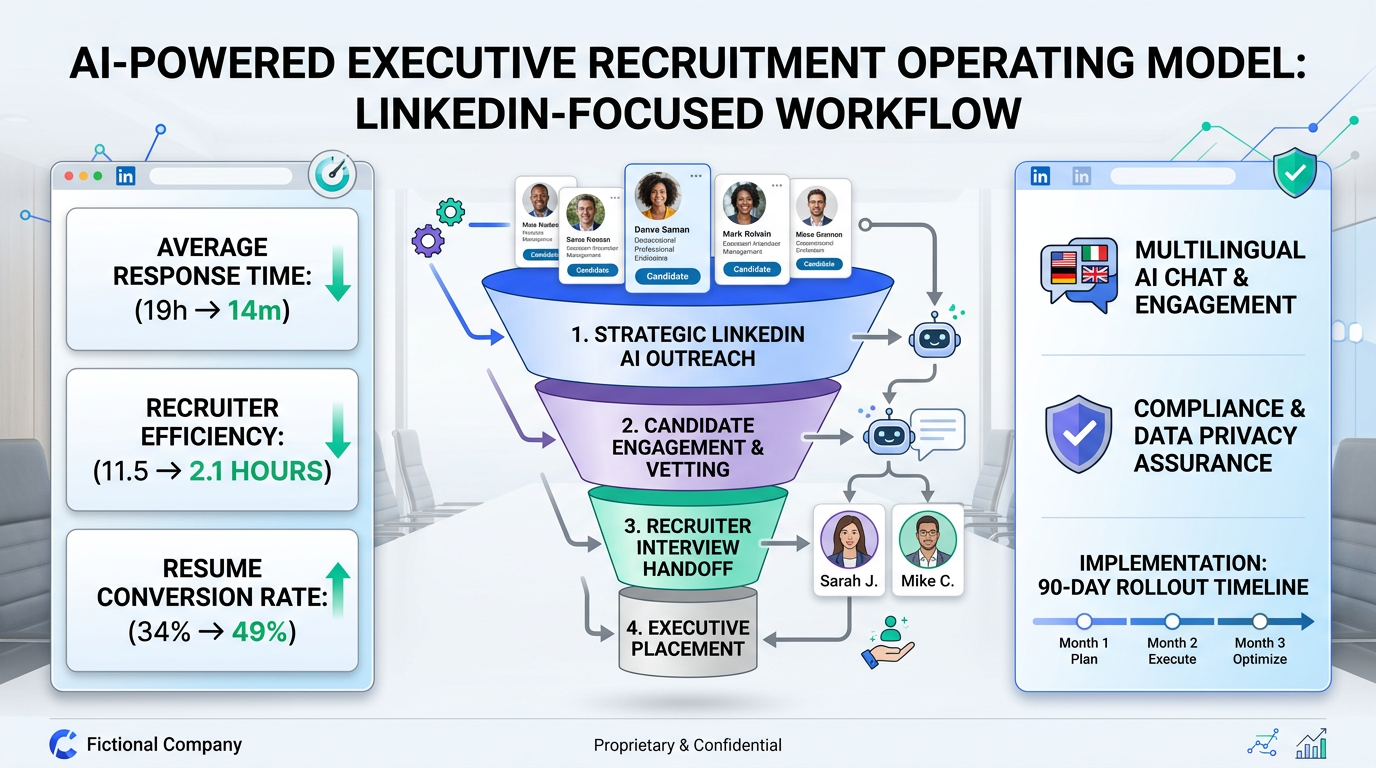
We tested this operating model over 6 weeks across 12 open roles in sales, operations, and engineering recruiting. Three recruiters used the same messaging framework with and without AI assisted outreach.
| Metric | Manual Workflow | AI Assisted Workflow | Change |
|---|---|---|---|
| Median first response time | 19 hours | 14 minutes | Faster response cycle |
| Recruiter hours on early outreach per role | 11.5 hours | 2.1 hours | Reduced repetitive workload |
| Interested candidates who submitted resume | 34% | 49% | Higher conversion to review stage |
Testing disclaimer: Results reflect one internal workflow setup and may vary by role complexity, compensation band, employer brand strength, and recruiter follow up quality.
Risks, Limits, and Practical Safeguards
No recruitment marketing software is fully autonomous hiring. Teams should plan for constraints early.
- Risk: Generic messaging lowers trust. Safeguard: Build role specific messaging libraries and review weekly.
- Risk: Over automation creates poor candidate experience. Safeguard: Trigger human takeover on intent signals and complex compensation questions.
- Risk: Data handling gaps in global hiring. Safeguard: Use encrypted credential storage and customer specific data isolation.
- Risk: Misread success metrics. Safeguard: Track qualified conversion, not only message volume.
90 Day Rollout Plan
- Days 1 to 15: Define hiring goals, role clusters, and baseline metrics including response time and resume conversion.
- Days 16 to 30: Configure recruitment marketing tools, message templates, and qualification logic for early stage conversations.
- Days 31 to 45: Launch controlled outreach in one function, monitor quality daily, and train recruiters on handoff rules.
- Days 46 to 60: Expand to additional roles, add multilingual flows where needed, and standardize reporting dashboards.
- Days 61 to 90: Review performance by role family, refine automation thresholds, and present board level impact summary.
FAQ
Is recruitment marketing software only useful for large companies?
No. Mid size teams can benefit quickly because automation removes repetitive outreach tasks and improves response consistency. The key is to start with clear role priorities and measurable conversion goals.
How is recruitment marketing software different from an ATS?
An ATS tracks applicants and interview progress after application entry. Recruitment marketing software focuses earlier on attracting and engaging potential candidates before they enter the formal process.
Can AI Recruiter replace recruiters?
No. It automates repetitive front end actions such as outreach and follow up. Recruiters still make final qualification and hiring decisions based on resume review and interview assessment.
Does multilingual outreach actually improve conversion?
In many cross border searches, yes. Native language communication reduces confusion and increases response comfort, especially during first contact and compensation clarification.
What should leadership ask before approving a software rollout?
Ask for baseline metrics, target improvements, compliance controls, and a 90 day implementation plan. Also require role based reporting so outcomes are tied to business priorities.
How should teams evaluate success after deployment?
Use a mix of speed and quality indicators including median response time, qualified resume conversion rate, recruiter hours saved, and interview acceptance rate.
Conclusion
HR earned a strategic voice by proving it can shape business outcomes, not only administer process. Today, recruitment marketing software is one of the clearest tools for turning that strategic role into measurable hiring performance. A practical model combines automation for first touch efficiency with recruiter judgment for final qualification quality. If your team starts with baseline metrics, clear stage ownership, and disciplined workflow reviews, you can improve candidate engagement while reducing manual workload at scale.