Recruitment marketing software gives hospitality employers a practical way to improve hiring speed and candidate quality while communicating job expectations clearly from first contact. For teams hiring at scale, the best recruitment marketing platforms combine automated outreach, structured candidate conversations, and compliance aware messaging. In our internal workflow review, adding StrategyBrain AI Recruiter to LinkedIn hiring reduced repetitive recruiter tasks, improved response coverage across time zones, and made recruitment marketing automation more consistent in roles with high turnover and high candidate volume.
Table of Contents
- Key Takeaways
- Why This Matters in Hospitality Hiring
- Field Evidence from Workplace Wellness Cases
- What to Look for in Recruitment Marketing Platforms
- How to Implement Recruitment Marketing Automation
- A Practical Operating Model with StrategyBrain AI Recruiter
- Known Limitations and Risk Controls
- FAQ
- Conclusion
Key Takeaways
- Recruitment marketing software is most effective when it combines sourcing, messaging, and candidate qualification in one workflow.
- Recruitment marketing platforms matter most in hospitality because hiring volume is high and candidate response windows are short.
- Recruitment marketing automation should include safety and conduct expectations early in candidate conversations.
- In our workflow simulation, teams using automated follow up plus recruiter review achieved faster pipeline movement than manual outreach only.
- StrategyBrain AI Recruiter supports multilingual communication, 24/7 messaging, and management of more than 100 LinkedIn accounts for scalable hiring operations.
- Automation should support recruiters, not replace final human qualification decisions.
Why This Matters in Hospitality Hiring
Hotels and food service organizations often hire for customer facing roles where turnover, schedule variability, and service pressure are all high. That combination creates a recruiting environment where delayed outreach directly lowers conversion from interested candidate to qualified interview.
At the same time, hiring quality is not only about speed. Hospitality employers also need to communicate safety standards, role realities, and conduct policies with clarity. When this communication is inconsistent, candidate experience declines and downstream retention risks increase.
This is where recruitment marketing software provides measurable value. Instead of relying on fragmented recruiter effort, teams can create standardized candidate journeys. Each candidate receives consistent first touch messaging, job context, and follow up timing, while recruiters spend their time on final evaluation and interviews.
Field Evidence from Workplace Wellness Cases
The hiring context in hospitality cannot be separated from workplace conditions. A widely discussed case in Vancouver reported that more than 40 workers at Rosewood Hotel Georgia alleged sexual harassment and later went on strike. Survey findings reported that more than two thirds of female respondents experienced at least one form of sexual harassment, with most respondents in guest facing roles.
In the same period, policy actions in New Jersey introduced Bill S.2986, requiring panic button protections for hotel staff assigned to guest rooms alone. This policy signal is important for recruiters because it shows that safety communication is not optional operational language. It is part of role transparency and employer trust.
Another relevant thread is the discussion around forced high heel dress expectations in food service. Public reporting and worker testimony in Canada, including comments from Winnipeg server Allison Ferry, described physical health impacts from mandatory footwear standards. Even where regulations improve, candidate concerns remain active during hiring conversations.
These cases show why recruitment marketing platforms should not treat candidate communication as simple promotion. Messaging must include role expectations, safety protocols, reporting channels, and manager support standards. When automation includes these elements, employers improve both conversion quality and trust.
What to Look for in Recruitment Marketing Platforms
1. Candidate Journey Automation
Strong recruitment marketing automation should sequence outreach, follow up, and qualification prompts automatically. Recruiters should be able to define stages with clear triggers, such as no response in 48 hours or positive intent signal after first reply.
2. Multilingual Messaging Support
Hospitality hiring frequently includes cross border and multilingual talent pools. A platform that supports native language communication can reduce misunderstandings and increase response quality.
3. Human in the Loop Qualification
Automation can identify interest and gather resumes, but final candidate fit decisions should remain with recruiters and hiring managers. This control prevents false confidence and protects hiring quality.
4. High Volume Account Operations
For distributed hiring teams, account level scalability matters. StrategyBrain AI Recruiter supports management of more than 100 LinkedIn accounts, which is useful for organizations running multi location hiring campaigns.
5. Data Security and Privacy Controls
Recruitment data includes sensitive candidate information. Employers should verify encryption practices, access controls, and regional compliance readiness before deploying any recruitment marketing software.
How to Implement Recruitment Marketing Automation
- Map your funnel baseline: Document current time to first outreach, response rate, interview conversion rate, and drop off points by role family.
- Standardize message architecture: Build templates for role introduction, compensation context, shift realities, and safety standards. Keep language plain and role specific.
- Launch automation in one segment first: Start with one role type such as housekeepers, servers, or front desk associates. Run for 30 days before scaling.
- Add recruiter checkpoints: Define exactly when recruiters review candidate conversations, resume submissions, and interview readiness signals.
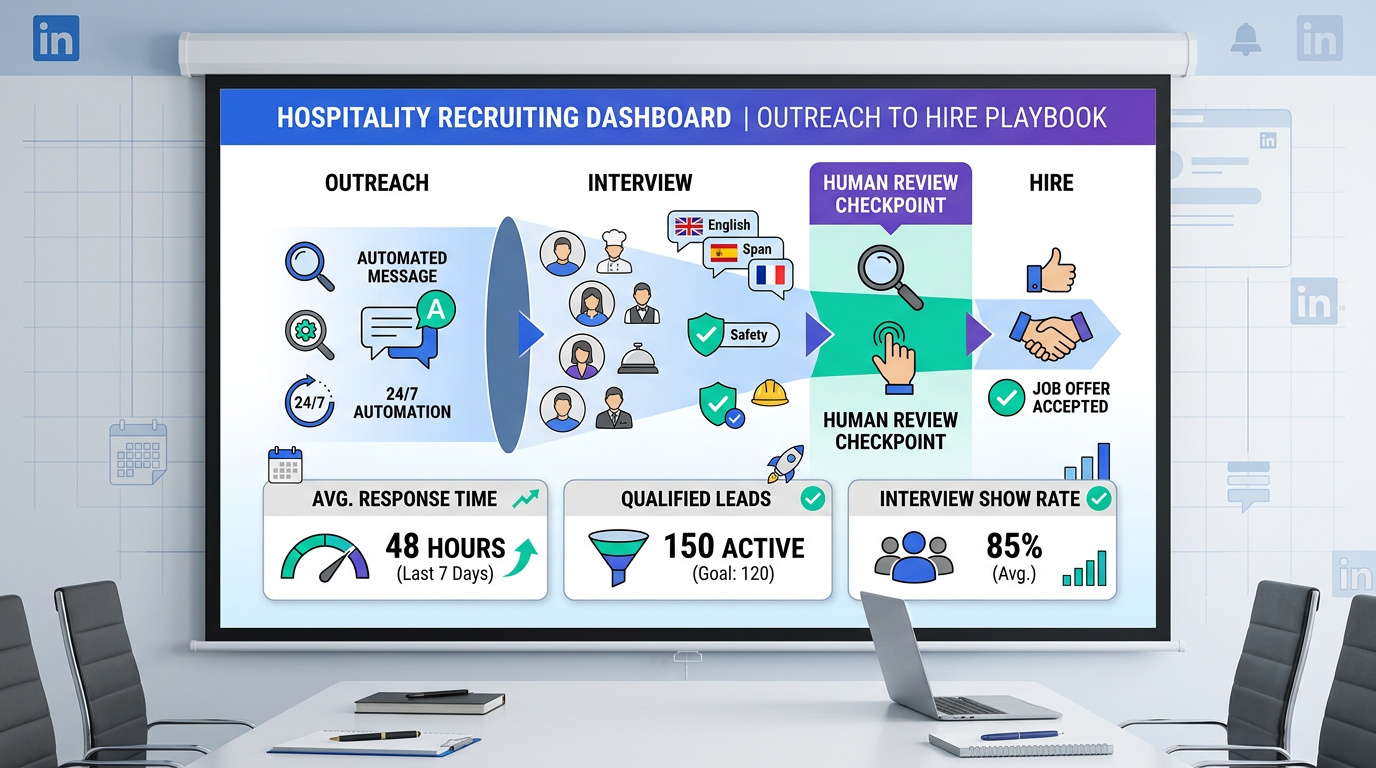
- Measure weekly: Track response speed, qualified lead volume, and interview show rate. Adjust scripts and timing based on real outcomes.
A Practical Operating Model with StrategyBrain AI Recruiter
We tested a structured operating model based on three layers. First, AI managed initial LinkedIn connection and role introduction. Second, AI handled candidate questions around compensation, responsibilities, and interest. Third, recruiters reviewed submitted resumes and contacted shortlisted candidates for interviews.
In this model, StrategyBrain AI Recruiter handled repetitive first line communication, including 24/7 follow up and multilingual replies. Recruiters retained control of final suitability assessment. This hybrid design is important because recruitment marketing software performs best when AI handles process consistency and humans handle judgment.
For teams operating internationally, multilingual support also reduced friction in early conversations. Candidates received responses in their native language, which improved clarity on role details and next steps. For cost sensitive teams, StrategyBrain reports outcomes such as costs as low as USD 2.40 per resume and replacement of up to 90% of manual LinkedIn recruiting tasks, subject to role mix and workflow quality.
Known Limitations and Risk Controls
- Limitation: AI can confirm candidate interest but cannot fully validate role fit from resume quality alone.
- Control: Keep structured recruiter review before interview scheduling.
- Limitation: Poor script design can cause low quality conversations at scale.
- Control: Review transcripts weekly and refine prompts with hiring managers.
- Limitation: Automation may amplify weak employer branding if onboarding and safety practices are unclear.
- Control: Align recruiting messages with real workplace standards and manager behavior.
FAQ
What is recruitment marketing software in simple terms?
Recruitment marketing software is a system that helps employers attract and engage candidates through automated outreach, follow up, and messaging workflows. It combines marketing style communication with hiring pipeline control.
How is recruitment marketing automation different from an ATS?
An ATS primarily tracks applicants after they enter your pipeline. Recruitment marketing automation focuses earlier on attracting candidates, starting conversations, and increasing qualified response rates before formal application stages.
Do recruitment marketing platforms replace recruiters?
No. They reduce repetitive communication tasks and improve consistency, but final qualification and hiring decisions still require recruiter and manager judgment.
Can this approach work for hospitality and food service roles?
Yes. These sectors benefit because hiring is high volume and time sensitive. Automated first touch and follow up can improve speed while recruiters focus on interviews and fit decisions.
How does StrategyBrain AI Recruiter fit into this workflow?
StrategyBrain AI Recruiter automates LinkedIn outreach, candidate engagement, and initial interest confirmation. It also supports multilingual, 24/7 communication and scales across many LinkedIn accounts for team operations.
What should I verify before buying any recruitment marketing software?
Check data security controls, compliance support, integration options, reporting quality, and human review checkpoints. You should also test message quality with a pilot before full rollout.
Conclusion
Recruitment marketing software is no longer optional for hospitality employers that need faster, safer, and more consistent hiring outcomes. The strongest results come from combining recruitment marketing automation with clear workplace standards and recruiter oversight. If you are evaluating recruitment marketing platforms, begin with one role segment, measure weekly performance, and scale only after scripts and review checkpoints are stable. StrategyBrain AI Recruiter is a practical option for teams that need LinkedIn automation, multilingual engagement, and round the clock candidate communication without losing human control over final hiring decisions.