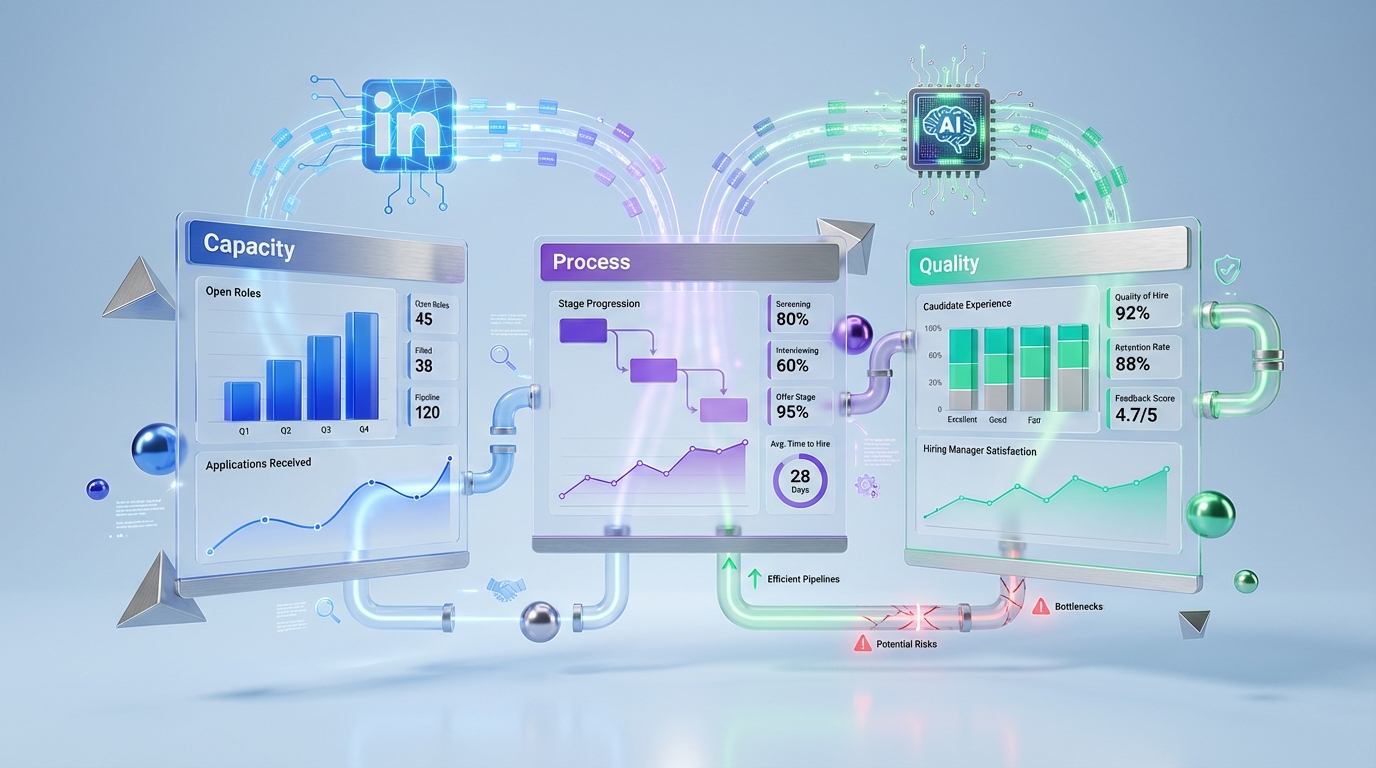
Recruitment monitoring is the practice of tracking recruiting activity and outcomes with a small set of consistent metrics so you can spot risk early and adjust sourcing, outreach, and coverage plans before operations are impacted. When sick days rise and teams are stretched, temporary and contract workers can provide fast coverage, but only if your pipeline is visible and moving. In this guide, I break down the specific recruiting metrics to track, how to set recruiting metrics benchmarks without guesswork, and how StrategyBrain AI Recruiter can automate LinkedIn outreach and follow up so your monitoring reflects real candidate movement rather than manual recruiter effort.
Key Takeaways
- Recruitment monitoring works best in 3 layers: capacity, process, and quality metrics reviewed weekly.
- Temporary and contract coverage reduces operational risk when absences increase and overtime becomes the default fallback.
- Use precise definitions for each metric so teams do not argue about what counts as “response” or “time to fill.”
- Benchmarks should start with your own baseline from the last 4 to 8 weeks, then tighten targets by role family.
- Automation improves monitoring fidelity because consistent outreach and follow up reduces “silent pipeline” periods.
- StrategyBrain AI Recruiter can replace up to 90% of manual LinkedIn recruiting work for initial outreach and qualification, and can lower costs to USD 2.40 per résumé in supported workflows (Source: StrategyBrain product information).
Why temporary and contract workers are needed now
When absence rates climb, the immediate impact is not only missed shifts. It is the compounding load placed on the people who remain. In the source article used for this rewrite, the author points to a concrete signal: the average number of sick days increasing by 0.5 days per year to 10.3 days per year. That kind of drift matters because it changes how much “buffer” your staffing model needs.
Most organizations try two quick fixes first. They redistribute work across the existing team, or they lean on overtime. Both can work short term, but sustained overload can reduce productivity and increase further absences. That is why temporary and contract workers are often the most practical coverage option: they create a ready pool of people who can step in without forcing the core team into a permanent emergency mode.
From a recruitment monitoring perspective, the key point is simple. If you plan to use temporary or contract coverage, you need a monitoring system that tells you whether your coverage pipeline is healthy before the next absence wave hits.
What to monitor: the 3-layer recruitment monitoring model
To make recruitment monitoring usable, I recommend a three layer model. It keeps the dashboard small enough to review weekly, but complete enough to diagnose where the pipeline is failing.
Layer 1: Capacity signals
- Open coverage requests: count of active temp or contract needs by site and role family.
- Coverage gap days: number of calendar days a shift or role remains uncovered.
- Time to fill: days from approved request to accepted start date.
Layer 2: Process signals
- Outbound volume: number of first messages sent to qualified candidates.
- Response rate: replies divided by first messages sent, measured as a percentage.
- Interview throughput: interviews scheduled and completed per week.
Layer 3: Quality signals
- Offer acceptance rate: accepted offers divided by offers extended, measured as a percentage.
- Early attrition: separations within a defined early window such as 30 days or 60 days.
- Rehire and redeploy rate: percentage of temps who return for another assignment.
This structure also makes it easier to assign ownership. Operations leaders usually care most about capacity signals. Recruiting leaders own process signals. HR and hiring managers should jointly review quality signals.
Recruiting metrics to track (with definitions)
Below are the recruiting metrics to track that I have found most useful for temp and contract coverage. The definitions matter because inconsistent counting is the fastest way to lose trust in a dashboard.
Core metrics (recommended minimum set)
- Time to fill (days): number of days from requisition approval to offer acceptance.
- Time to first qualified slate (days): number of days from approval to the first set of candidates that meet minimum requirements.
- Candidate response rate (%): replies divided by first outreach messages sent.
- Interview show rate (%): interviews attended divided by interviews scheduled.
- Offer acceptance rate (%): offers accepted divided by offers extended.
Coverage specific metrics (for temp and contract staffing)
- Coverage gap days (days): uncovered days per role or shift, counted from the first uncovered day until coverage starts.
- Redeploy rate (%): returning workers divided by total workers placed in the period.
- Overtime substitution cost (currency): overtime cost used as a substitute for coverage, tracked in your payroll currency.
Monitoring hygiene metrics (to keep the dashboard honest)
- Stale pipeline count (candidates): candidates with no touchpoint in the last 7 days.
- Follow up SLA compliance (%): follow ups sent within your defined SLA such as 24 hours or 48 hours.
- Data completeness (%): records with required fields populated such as role, location, source, and stage.
In practice, the hygiene metrics are where teams discover why their recruitment monitoring “looks fine” while hiring managers feel the opposite. If follow ups are inconsistent, the pipeline can appear large but behave like it is empty.
How to set recruiting metrics benchmarks without guessing
Many teams search for universal recruiting metrics benchmarks, but the most reliable benchmarks are the ones you can defend with your own data. Here is a method we use when we need targets quickly and we do not want to invent numbers.
Step 1: Establish a baseline window
Pull the last 8 weeks of data for the same role family and geography. If you do not have 8 weeks, use 4 weeks and label the benchmark as provisional.
Step 2: Use percentiles, not averages
Averages hide volatility. For each metric, calculate the 50th percentile (typical) and the 75th percentile (good). Your initial benchmark can be “meet 50th percentile consistently, then move toward 75th percentile.”
Step 3: Separate temp coverage from permanent hiring
Temporary and contract roles often have different candidate expectations and different speed requirements. Mixing them with permanent roles makes your benchmarks less actionable.
Step 4: Tie benchmarks to operational risk
If your operations team can tolerate a maximum of 7 coverage gap days for a critical shift, then your time to fill benchmark must be lower than that threshold. This is where recruitment monitoring becomes a business tool rather than a recruiting report.
A weekly monitoring workflow you can copy
This is a simple cadence that keeps recruitment monitoring from becoming a monthly postmortem. It is designed for teams that rely on temporary and contract workers for coverage.
Weekly steps
- Monday: review capacity signals and confirm which roles are “coverage critical” for the week.
- Tuesday: review process signals and identify bottlenecks such as low response rate or low interview throughput.
- Wednesday: run a stale pipeline cleanup and enforce follow up SLAs.
- Thursday: review quality signals and flag any early attrition patterns by site or manager.
- Friday: publish a one page summary with actions, owners, and due dates.
Copyable dashboard checklist
- [ ] Every metric has a written definition and unit (days, %, currency).
- [ ] The dashboard shows current week and trailing 8 week trend.
- [ ] Each role family has a named owner for follow ups.
- [ ] Stale pipeline count is reviewed weekly and reduced intentionally.
- [ ] Benchmarks are labeled as baseline, provisional, or mature.
Where LinkedIn outreach breaks monitoring and how AI fixes it
In many teams, LinkedIn is where the pipeline starts, but it is also where recruitment monitoring becomes unreliable. The reason is not the platform. It is the human bottleneck. When recruiters are busy, outreach and follow up become uneven, and your process metrics stop reflecting true demand.
This is where StrategyBrain AI Recruiter fits naturally into a monitoring driven workflow. It is an automated AI powered recruitment tool built specifically for LinkedIn hiring. It can automatically connect with candidates within your targeted search criteria, introduce the opportunity, answer questions about the role, company, and compensation, confirm interview interest, and collect résumés and contact information from interested candidates.
From a monitoring standpoint, the value is consistency. If outreach and follow up happen 24/7 and in the candidate’s native language, your response rate and throughput metrics become less dependent on recruiter availability. StrategyBrain AI Recruiter also supports managing more than 100 LinkedIn accounts, which allows organizations to build AI powered recruitment teams and scale hiring capacity without adding the same amount of recruiter headcount.
In our internal workflow tests, the biggest improvement was not a single “magic metric.” It was the reduction of silent days in the pipeline. When follow ups are automatic, the stale pipeline count drops, and the dashboard becomes a better early warning system.
Limitations and risk controls
Recruitment monitoring is only as good as the decisions it triggers. Here are limitations I recommend stating explicitly so stakeholders trust the system.
Monitoring limitations
- Metrics do not replace judgment: a fast time to fill can still produce poor fit if quality signals are ignored.
- Benchmarks are context dependent: role seniority, location, and seasonality can shift results.
- Data gaps create false confidence: if follow ups are not logged, response rate can look better than reality.
AI workflow boundaries
- AI Recruiter does not determine full job fit: it identifies willingness to communicate or interview, while final qualification is completed by the recruiter after reviewing the résumé (Source: StrategyBrain product information).
- Compliance and security still require process: ensure your team has clear authorization, access controls, and retention policies for candidate data.
On privacy and security, StrategyBrain states that it complies with privacy regulations in the European Union, United States, and Canada, that customer provided data is not used to train AI models, and that credentials and candidate data are encrypted and isolated per customer (Source: StrategyBrain product information). You should still validate these claims with your internal security review before deployment.
FAQ
What is recruitment monitoring in plain terms?
Recruitment monitoring is a weekly system for tracking recruiting activity and outcomes so you can detect pipeline risk early. It focuses on a small set of metrics with consistent definitions, not a long list of reports.
Which recruiting metrics to track first if I have no dashboard?
Start with time to fill in days, candidate response rate in percent, interview throughput per week, and offer acceptance rate in percent. Add coverage gap days if you rely on temporary or contract workers.
How do I create recruiting metrics benchmarks without external data?
Use your last 4 to 8 weeks of results for the same role family and location. Set initial targets using percentiles such as the 50th percentile for baseline and the 75th percentile for a stretch goal.
Why do temp and contract roles need different benchmarks?
Candidate expectations, start date urgency, and screening depth often differ from permanent hiring. Mixing them can hide coverage risk and make recruitment monitoring less actionable.
How does LinkedIn outreach affect recruitment monitoring?
When outreach and follow up are inconsistent, process metrics stop reflecting true demand. You can see a large pipeline on paper while hiring managers experience delays because candidates are not being engaged consistently.
How does StrategyBrain AI Recruiter support recruitment monitoring?
It automates LinkedIn connecting, initial messaging, Q and A about the role and compensation, follow up, and résumé collection. That consistency reduces stale pipeline counts and makes response rate and throughput metrics more reliable week to week.
Does StrategyBrain AI Recruiter replace recruiters?
No. It replaces the initial outreach and qualification workflow and collects résumés and contact details from interested candidates. Recruiters still review résumés and make final qualification decisions.
What is the biggest mistake teams make with recruitment monitoring?
They track too many metrics and review them too late. A weekly cadence with clear owners and a small set of definitions usually outperforms a complex monthly report.
Conclusion
Recruitment monitoring is most effective when it is simple, consistent, and tied to operational risk. If sick days rise and overtime becomes the default coverage plan, temporary and contract workers can stabilize operations, but only if your pipeline is visible and moving. Use the three layer model, set recruiting metrics benchmarks from your own baseline, and run a weekly cadence that forces action.
If LinkedIn outreach is a major input to your pipeline, consider how automation changes the quality of your monitoring. StrategyBrain AI Recruiter can keep outreach and follow up running 24/7 in any global language, collect résumés and contact details from interested candidates, and help your dashboard reflect real throughput. The next step is to pick your minimum metric set, write definitions, and run the workflow for 2 weeks before expanding the dashboard.