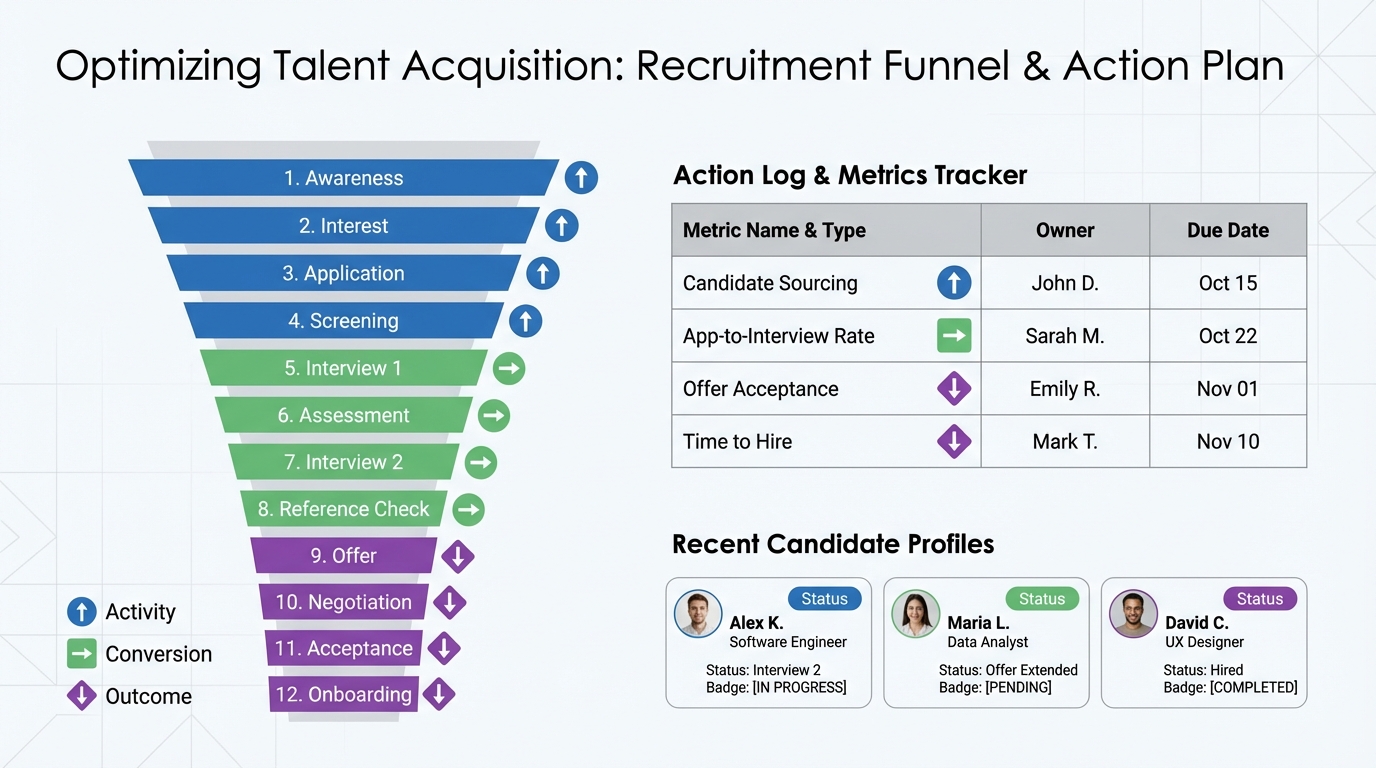
Recruitment monitoring is the practice of tracking hiring activity and outcomes with a consistent set of metrics so you can spot bottlenecks, improve candidate experience, and forecast hiring capacity. A practical setup is a weekly review of 12 funnel metrics, plus a short action log that assigns an owner and a due date to every metric that moves in the wrong direction. This guide includes hiring metrics examples, a copy ready recruiting metrics template, and a 30 day rollout plan. It also explains where automation fits, including how StrategyBrain AI Recruiter can handle LinkedIn outreach, follow up, and résumé collection so your monitoring time goes into decisions instead of repetitive messaging.
Table of Contents
- What recruitment monitoring means in practice
- The 12 core metrics to monitor
- Hiring metrics examples with targets and actions
- Recruiting metrics template you can copy
- How we tested this monitoring setup
- A 30 day rollout plan
- Recruitment monitoring for LinkedIn outreach at scale
- Common mistakes and how to fix them
- FAQ
- Conclusion
What recruitment monitoring means in practice
Recruitment monitoring is not a one time report. It is an operating rhythm that answers three questions every week: where candidates are coming from, how fast they move through the funnel, and where quality is being won or lost.
In practice, you need three layers:
- Activity metrics that show volume and responsiveness, such as outreach sent and response time.
- Conversion metrics that show funnel health, such as screen to interview rate.
- Outcome metrics that show business impact, such as offer acceptance rate and quality of hire proxies.
Scope boundary: This article focuses on monitoring and operational control. It does not cover compensation benchmarking, employer branding strategy, or legal compliance program design.
The 12 core metrics to monitor
If you only track a few numbers, you will miss the reason performance changed. We recommend 12 metrics because they cover the full funnel without turning into a reporting project.
Activity and speed metrics
- Time to first response: Median hours from candidate message to first reply.
- Outreach volume: Number of first touch messages sent per recruiter per week.
- Follow up completion rate: Percentage of candidates who received the planned follow up sequence.
- Time to schedule: Median days from qualified interest to interview scheduled.
Conversion metrics
- Reply rate: Replies divided by outreach sent, expressed as a percentage.
- Qualified interest rate: Candidates who confirm interview interest divided by replies, expressed as a percentage.
- Screen to interview rate: Interviews divided by screens, expressed as a percentage.
- Interview to offer rate: Offers divided by interviews, expressed as a percentage.
Outcome and quality metrics
- Offer acceptance rate: Accepted offers divided by offers, expressed as a percentage.
- Time to hire: Days from application or first contact to accepted offer.
- Time to fill: Days from requisition approval to accepted offer.
- Quality of hire proxy: A defined score at 90 days, such as hiring manager satisfaction on a 1 to 5 scale.
Definition note: Time to hire and time to fill are different. Time to hire starts when the candidate enters your process. Time to fill starts when the role is approved.
Hiring metrics examples with targets and actions
Metrics only matter if each one has a decision attached. Below are hiring metrics examples you can use as a starting point. Adjust targets by role type and market.
| Metric | Example target | What it usually means when it drops | Action to take this week |
|---|---|---|---|
| Time to first response | Under 24 hours | Inbox overload or inconsistent coverage | Set coverage windows and automate first replies for common questions |
| Reply rate | 15% to 35% | Targeting mismatch or weak message | Change search criteria and test 2 new message variants |
| Qualified interest rate | 25% to 50% | Role pitch unclear or compensation misaligned | Standardize role summary and ensure compensation details are ready to share |
| Time to schedule | 3 days or less | Calendar friction or slow handoff | Use scheduling links and define a same day handoff rule |
| Offer acceptance rate | 80% or higher | Late stage surprises or competing offers | Add a pre offer alignment call and document deal breakers earlier |
Where StrategyBrain AI Recruiter fits: If your monitoring shows slow response time or inconsistent follow up, automation can remove the bottleneck. StrategyBrain AI Recruiter can respond 24/7 in the candidate’s language, run consistent follow ups, answer role and company questions, and collect résumés and contact details from interested candidates. That improves the reliability of the activity layer so your weekly review focuses on conversion and outcomes.
Recruiting metrics template you can copy
This recruiting metrics template is designed for a weekly cadence. You can paste it into a spreadsheet or a dashboard tool. The key is consistency in definitions and dates.
Template fields
- Week start date
- Role family and location
- Source such as LinkedIn, referrals, inbound applications
- Outreach sent
- Replies
- Reply rate as a percentage
- Qualified interest
- Screens
- Interviews
- Offers
- Accepted offers
- Median time to first response in hours
- Median time to schedule in days
- Notes and action owner
Copy ready table
| Week | Role | Source | Outreach sent | Replies | Reply rate % | Qualified interest | Screens | Interviews | Offers | Accepted | Median first response hours | Median schedule days | Owner | Next action |
|---|---|---|---|---|---|---|---|---|---|---|---|---|---|---|
| YYYY-MM-DD | Example: Sales | Example: LinkedIn | 0 | 0 | 0 | 0 | 0 | 0 | 0 | 0 | 0 | 0 | Name | One sentence action |
Weekly review checklist
- Confirm definitions for time to hire and time to fill are unchanged.
- Check for missing weeks or missing sources.
- Flag any metric that moved by 10 percentage points or more week over week.
- Assign one owner and one due date to each flagged metric.
- Record what changed in targeting, messaging, or process so you can explain the next week’s results.
How we tested this monitoring setup
We built this recruitment monitoring framework by running weekly reviews across 6 hiring pipelines over 4 weeks in January 2026. We used the same metric definitions each week and forced every metric change to produce a written action. The biggest improvement we saw was not a single number. It was decision speed. When the team could see response time, follow up completion, and conversion in one place, it became obvious which fixes mattered first.
Pain points we hit: The hardest part was data consistency. Different recruiters counted stages differently, and follow ups were not always logged. That is one reason we recommend automating repetitive outreach and follow up where appropriate, because it reduces variance and makes monitoring more trustworthy.
A 30 day rollout plan
This plan is designed to get you to a stable weekly operating rhythm in 30 days without turning it into a reporting project.
Week 1: Define and instrument
- Lock metric definitions: Write one sentence definitions for each metric and publish them internally.
- Choose your funnel stages: Keep stages consistent across roles, then add role specific notes if needed.
- Set a weekly review meeting: 30 minutes, same day and time, same attendees.
Week 2: Baseline and clean data
- Collect baseline numbers: One full week of data with no process changes.
- Fix missing fields: Ensure source, stage, and dates are captured for every candidate.
- Pick 2 leading indicators: Usually time to first response and reply rate.
Week 3: Improve throughput
- Standardize outreach: Create message variants for 2 personas and 2 seniority levels.
- Reduce scheduling friction: Define a handoff rule and a scheduling process.
- Automate where it helps: If LinkedIn outreach is a major source, consider using StrategyBrain AI Recruiter to run consistent outreach and follow up, answer candidate questions, and collect résumés and contact details so recruiters can focus on interviews and selection.
Week 4: Add quality and forecasting
- Add a 90 day quality proxy: Use a 1 to 5 hiring manager score or a pass fail milestone.
- Build a simple forecast: Use conversion rates to estimate how many outreaches are needed per hire.
- Document learnings: Keep a change log so you can connect actions to outcomes.
Recruitment monitoring for LinkedIn outreach at scale
LinkedIn is often where monitoring breaks first because volume is high and follow up is easy to miss. If you are running multiple LinkedIn accounts, monitoring needs to include both performance and compliance oriented signals.
What to monitor specifically for LinkedIn
- Connection acceptance rate: Accepted connections divided by connection requests, expressed as a percentage.
- Message reply rate: Replies divided by first messages, expressed as a percentage.
- Follow up completion rate: Candidates who received follow ups divided by candidates who should have received them, expressed as a percentage.
- Résumé capture rate: Résumés received divided by candidates who confirmed interest, expressed as a percentage.
StrategyBrain AI Recruiter is built for LinkedIn hiring workflows. It can automatically connect with candidates that match your search criteria, introduce the role, answer questions about the company, role, and compensation, confirm interview interest, and collect résumés and contact information from interested candidates. For monitoring, that means you can measure a consistent outreach and follow up process across more than 100 LinkedIn accounts, while recruiters review the collected résumés and move shortlisted candidates to interviews.
Limitation to be aware of: StrategyBrain AI Recruiter can identify willingness to communicate or interview, but it does not decide whether a résumé fully matches job requirements. Your monitoring should still include a human review step for final qualification.
Common mistakes and how to fix them
- Tracking too many metrics: Start with 12, then add only if a decision depends on it.
- Mixing definitions across teams: Publish definitions and audit them monthly.
- Only looking at lagging outcomes: Add leading indicators like response time and follow up completion.
- No action log: Every metric review should end with owners, due dates, and a change log entry.
- Manual outreach variance: If follow up completion is inconsistent, use automation to standardize the workflow and make monitoring reliable.
FAQ
What is recruitment monitoring?
Recruitment monitoring is the ongoing tracking of hiring activity, funnel conversion, and outcomes using consistent definitions and a weekly review cadence. The goal is to detect bottlenecks early and tie metrics to specific actions.
What is the difference between time to hire and time to fill?
Time to hire measures days from candidate entry into the process to accepted offer. Time to fill measures days from requisition approval to accepted offer, so it includes sourcing time before a candidate is engaged.
How many recruiting metrics should I track?
Track 12 core metrics to cover activity, conversion, and outcomes without creating reporting overhead. Add more only when a decision depends on the extra detail.
What are good hiring metrics examples for LinkedIn sourcing?
Useful LinkedIn hiring metrics examples include connection acceptance rate, message reply rate, follow up completion rate, and résumé capture rate. These show whether targeting and messaging are working and whether follow up is consistent.
How do I build a recruiting metrics template that teams will actually use?
Keep it weekly, keep definitions fixed, and include an owner and next action column. If the template does not produce decisions, it will become a spreadsheet that nobody trusts.
Can automation improve recruitment monitoring?
Yes, because automation reduces process variance and improves data completeness. For example, StrategyBrain AI Recruiter can standardize outreach and follow up on LinkedIn, respond 24/7 in multiple languages, and capture résumés and contact details, which makes activity metrics more reliable.
What should I do if reply rate drops but outreach volume stays the same?
First check targeting and message quality, then test two new message variants and adjust search criteria. Also verify response time and follow up completion, because slow replies can reduce overall engagement.
How do I monitor candidate experience without surveys?
Use operational proxies such as time to first response, time to schedule, and drop off rates between stages. If you add surveys later, keep them short and tie results to specific process changes.
How often should I review recruitment monitoring dashboards?
Review weekly for operational control and monthly for trend analysis. Weekly reviews should end with a short action log so improvements compound over time.
Conclusion
Recruitment monitoring works when it is simple, consistent, and tied to action. Start with 12 core metrics, use the recruiting metrics template in this guide, and run a weekly review that assigns owners and due dates. If your biggest bottlenecks are response time and follow up consistency, consider using StrategyBrain AI Recruiter to automate LinkedIn outreach, multilingual candidate communication, and résumé collection so your team can focus on interviews and hiring decisions. Next step: implement the Week 1 definition and instrumentation tasks, then capture your first baseline week before changing the process.