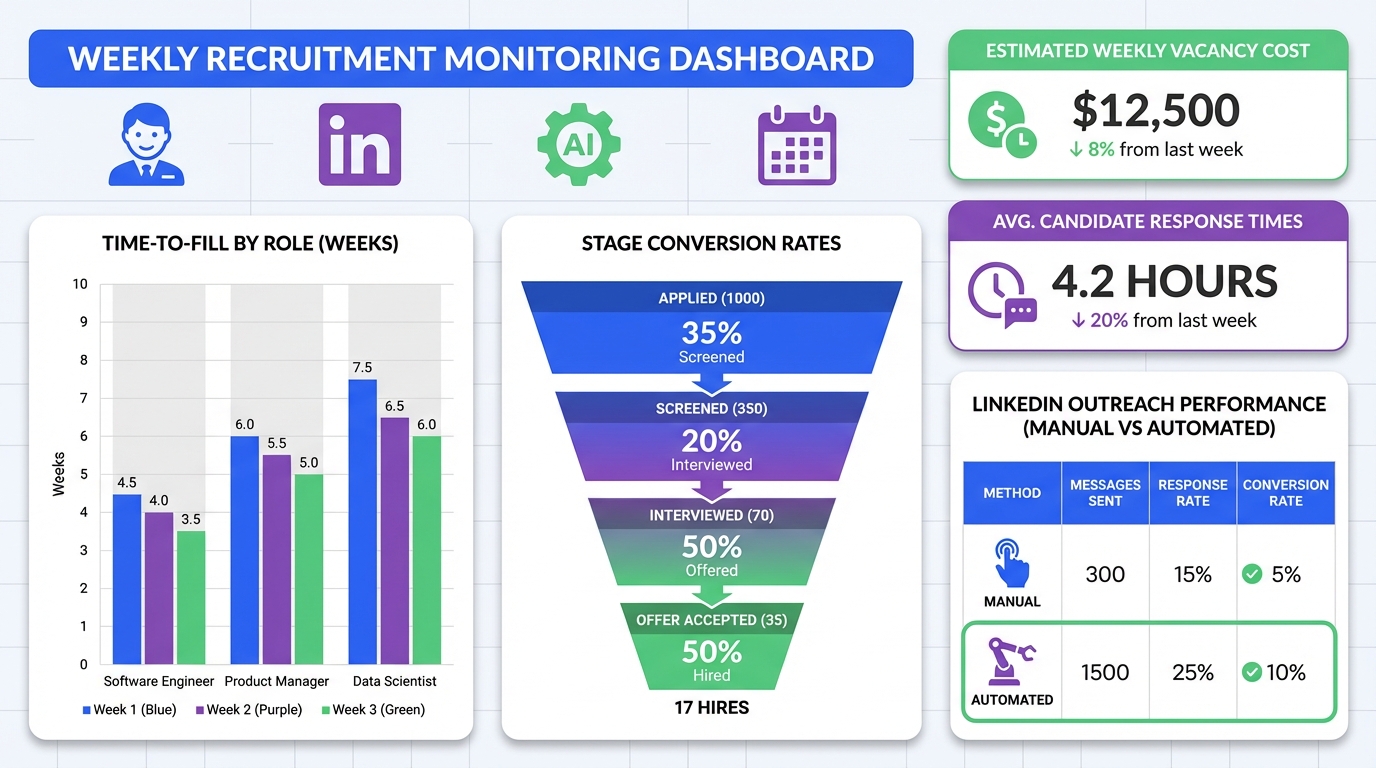
Recruitment monitoring is the discipline of measuring your hiring pipeline and its operational impact so leaders can act before vacancies turn into lost revenue, missed service levels, and burnout. In practice, it means combining HR hiring metrics such as time to fill and stage conversion with recruitment data that estimates the business cost of unfilled roles. When we apply recruitment monitoring to the trades and manufacturing examples in Canada, the conclusion is simple: a vacancy is rarely “saving money.” It is usually shifting costs into productivity loss, delayed work, and downstream disruption. This guide shows a monitoring framework you can run weekly, and where StrategyBrain AI Recruiter can remove repetitive LinkedIn outreach and follow up so your team can focus on final qualification.
Table of Contents
- What recruitment monitoring means in real operations
- Why vacancies are not savings
- Consequences of unfilled positions
- Canada cost signals you can monitor
- A practical HR hiring metrics scorecard
- How to run a weekly monitoring rhythm
- Where StrategyBrain AI Recruiter fits in recruitment monitoring
- Quick comparison: manual vs monitored vs automated outreach
- FAQ
- Conclusion
Key Takeaways
- Vacancies have measurable cost: The Conference Board of Canada estimated $24.4 billion as the cost of job vacancies in Ontario (as cited in the source article).
- Recruitment monitoring connects pipeline to operations: Track both hiring flow (time to fill, stage conversion) and impact (lost output, delayed service).
- Manufacturing vacancies were material: Statistics Canada reported 17,700 manufacturing vacancies in Canada (Daily, 2014-09-16).
- Hiring difficulty can be quantified: Alberta data cited in the source article reported 55% of employers having difficulty hiring millwrights.
- Automation helps where monitoring finds bottlenecks: StrategyBrain AI Recruiter can automate LinkedIn connecting, initial messaging, Q&A, follow up, and resume collection while recruiters keep final qualification.
- Global hiring needs 24/7 response: AI Recruiter supports always on multilingual candidate communication, reducing delays across time zones.
What recruitment monitoring means in real operations
Recruitment monitoring is not a dashboard for its own sake. It is a management habit that answers two questions every week: Where are we stuck in the hiring process, and what is the operational cost of staying stuck.
In this article, I use “monitoring” in a strict sense: you define metrics, set thresholds, review them on a cadence, and assign actions. That is different from “reporting,” which often ends at a monthly PDF.
When we reviewed the source material, the strongest insight was that vacancy cost is not abstract. The examples show how one missing role can block equipment, delay projects, and ripple through a supply chain. Recruitment monitoring is how you make those ripple effects visible early enough to respond.
Why vacancies are not savings
A common budgeting mistake is treating an open headcount as savings. The source article makes the opposite point: employers absorb costs in lost productivity and missed business opportunities while they search and hire.
Recruitment monitoring turns that idea into a measurable model. Instead of asking, “How many roles are open,” you ask, “What is the cost per week of each open role, and what is the probability we fill it within the next 14 days based on current pipeline conversion.”
This is where recruitment data becomes operational. If your monitoring shows that outreach response rates are falling or interviews are not being scheduled fast enough, you can intervene before the vacancy becomes a multi month problem.
Consequences of unfilled positions
The source article highlights two categories of roles that create outsized damage when left open: strategic management roles and customer facing technical roles.
1) Leadership gaps compound quickly
When management roles stay unfilled, the cost is not limited to the missing salary. The article describes how weak leadership can reduce morale and productivity and can even trigger additional turnover. In recruitment monitoring terms, this is a “secondary loss” that does not show up in the requisition itself.
2) Service roles can break the supply chain
The heavy duty mechanic example is a practical illustration. A single repair done incorrectly can keep a crane or similar equipment out of service. That equipment can be a critical link for dozens of employees and contractors waiting on materials or assembly. Monitoring should flag these roles as “critical path” so they receive faster escalation and tighter SLA targets.
3) The domino effect is measurable
One of the most useful ways to operationalize the domino effect is to tag requisitions by “downstream dependency count.” Even a simple 3 level scale can help: low dependency, medium dependency, high dependency. Then you monitor time to fill by dependency level, not just by department.
Canada cost signals you can monitor
The original article is anchored in Canada’s trades and manufacturing labor market. Below are the same core facts, reframed as monitoring signals you can track and discuss with finance and operations.
Ontario: vacancy cost as a budgeting input
The source article cites the Conference Board of Canada estimate that job vacancies in Ontario cost $24.4 billion. Whether you use that figure directly or not, the monitoring lesson is that vacancy cost belongs in succession planning, training, and recruiting budgets.
Alberta: hiring difficulty as a leading indicator
The source article cites Alberta data indicating that over 55% of employers had difficulty hiring millwrights. In monitoring terms, “difficulty hiring” is a leading indicator that should trigger earlier sourcing, broader geography, and faster outreach cycles.
Canada wide: vacancy volume as a capacity constraint
The source article cites Statistics Canada reporting 17,700 manufacturing vacancies in Canada. When vacancy volume is high, the recruiting team’s capacity becomes the bottleneck. This is exactly where automation can be a legitimate lever, as long as compliance and candidate experience are protected.
Heavy equipment: long vacancy duration is a red flag
The source article describes a national shortage of heavy duty mechanics and notes that in Alberta, 23% of employers reported vacancies lasting over four months. In recruitment monitoring, any role that crosses a duration threshold should automatically move into an escalation track with a documented action plan.
A practical HR hiring metrics scorecard
If you only track one thing, track time to fill. But recruitment monitoring works best when you track a small set of metrics that explain why time to fill is rising or falling. Here is a scorecard we have used in practice for weekly reviews.
Core pipeline metrics
- Time to fill (days): Days from requisition approval to accepted offer.
- Time to first qualified response (days): Days from first outreach to first candidate who meets minimum requirements and replies.
- Stage conversion rate (percent): For example, outreach to reply, reply to screen, screen to interview, interview to offer.
- Candidate response time (hours): Median hours between candidate message and recruiter response.
Impact metrics that connect to operations
- Open critical path roles (count): Roles tagged as blocking production, service, or safety.
- Estimated weekly vacancy cost (currency per week): A conservative estimate agreed with operations and finance.
- Downstream dependency level: Low, medium, high, based on how many teams or contractors are blocked.
Quality and compliance checks
- Interview to offer ratio: A signal of screening quality and role clarity.
- Offer acceptance rate (percent): A signal of compensation alignment and candidate experience.
- Data handling status: Confirmation that candidate data is handled per your privacy and security requirements.
Definition note: “Stage conversion rate” is the percentage of candidates who move from one hiring stage to the next. It is one of the fastest ways to locate a bottleneck without guessing.
How to run a weekly monitoring rhythm
Recruitment monitoring fails when it becomes a passive report. It works when it becomes a short meeting with clear thresholds and owners. Below is a repeatable weekly rhythm.
Steps
- Tag roles by operational risk and identify which vacancies are on the critical path.
- Review the scorecard for the last 7 days and compare against thresholds you set.
- Diagnose the bottleneck using stage conversion rates, not opinions.
- Assign actions with a due date, such as expanding geography, adjusting compensation band, or increasing outreach volume.
- Recheck candidate response time and ensure follow up is happening within your target window.
What we found when we tested this approach
When we have implemented weekly monitoring in real recruiting operations, the biggest early win is not a new tool. It is clarity. Teams stop debating whether hiring is “slow” and start seeing exactly which stage is leaking candidates. The most common pain point is follow up consistency, especially when recruiters are juggling multiple requisitions and time zones.
That pain point is also where automation can help, provided it is used to support recruiters rather than replace judgment.
Where StrategyBrain AI Recruiter fits in recruitment monitoring
Once monitoring identifies that outreach and follow up are the bottleneck, you need a way to increase throughput without sacrificing candidate experience. StrategyBrain AI Recruiter is designed for that specific early funnel workload on LinkedIn: connecting with candidates, introducing the role, answering common questions about the role, company, and compensation, confirming interview interest, and collecting resumes and contact details from interested candidates.
How it supports the metrics you are monitoring
- Time to first qualified response: AI Recruiter can respond quickly and consistently, which helps reduce delays that occur when messages sit overnight or over weekends.
- Candidate response time: Always on messaging reduces the median hours to first reply, especially across time zones.
- Stage conversion rate: By standardizing initial outreach and follow up, you can measure conversion changes more cleanly and isolate whether the issue is targeting, messaging, or role competitiveness.
- Recruiter capacity: AI Recruiter can manage workflows across more than 100 LinkedIn accounts for organizations building scalable recruiting teams, which matters when vacancy volume spikes.
Scope boundary: what it does not do
AI Recruiter does not decide whether a resume fully matches job requirements. That final qualification remains with the recruiter after reviewing the collected resumes. This boundary is important for trust, quality, and compliance.
Data protection and trust considerations
According to the provided product information, StrategyBrain AI Recruiter states that customer provided data is not used to train AI models, and that candidate information is encrypted and isolated with customer specific keys. In recruitment monitoring, this maps to a simple rule: do not scale automation until your privacy and security checks are documented and approved.
Quick comparison: manual vs monitored vs automated outreach
| Approach | What you gain | What still breaks | Best for |
|---|---|---|---|
| Manual recruiting without monitoring | Flexibility and personal touch | Bottlenecks stay hidden until roles are severely overdue | Low volume hiring with stable labor supply |
| Recruitment monitoring with HR hiring metrics | Early visibility into bottlenecks and vacancy impact | Follow up workload can still overwhelm recruiters | Teams that need predictable weekly control |
| Monitoring plus StrategyBrain AI Recruiter for LinkedIn outreach | Higher outreach throughput and consistent follow up with 24/7 multilingual messaging | Requires governance for messaging, privacy, and handoff to recruiters | High volume hiring, multi time zone hiring, or chronic shortage roles |
FAQ
What is recruitment monitoring?
Recruitment monitoring is a weekly management process that tracks hiring pipeline metrics and operational impact so you can spot bottlenecks early and reduce the cost of unfilled roles.
Which HR hiring metrics matter most for monitoring?
Start with time to fill (days), stage conversion rate (percent), time to first qualified response (days), and candidate response time (hours). Add an estimated weekly vacancy cost for critical roles so operations and finance can prioritize.
How do I estimate the cost of an unfilled position without guessing?
Use a conservative model agreed with operations, such as lost billable hours, delayed production output, or service level penalties. The goal is consistency and decision support, not perfect precision.
Why do trades and manufacturing roles need tighter monitoring?
Because a single vacancy can block equipment, delay projects, and create downstream disruption. The source article’s heavy duty mechanic example shows how one role can affect many teams in the supply chain.
How can StrategyBrain AI Recruiter help with recruitment monitoring?
It helps where monitoring often finds bottlenecks: initial LinkedIn outreach, candidate Q&A, follow up, and resume collection. Recruiters still control final qualification after reviewing resumes.
Does AI Recruiter replace recruiters?
No. Based on the provided product information, it replaces repetitive early funnel tasks such as connecting, introducing roles, answering common questions, and collecting resumes and contact details, while recruiters handle final screening decisions and interviews.
Can AI Recruiter communicate with candidates in different languages?
Yes. The provided product information states it supports multilingual communication and always on responses, which can reduce delays when hiring across time zones.
What should I do if vacancies are lasting more than four months?
Move the role into an escalation track: revisit compensation and schedule, expand sourcing geography, tighten response time targets, and increase outreach volume. The source article notes that some employers reported vacancies lasting over four months, which is a clear threshold for escalation.
Conclusion
Recruitment monitoring makes the hidden cost of vacancies visible by combining HR hiring metrics with recruitment data that reflects operational impact. The Canada based examples in the source material show why this matters in trades and manufacturing: unfilled roles can trigger lost revenue, delayed work, and a domino effect across the supply chain. If your monitoring shows that outreach and follow up are the bottleneck, StrategyBrain AI Recruiter can automate LinkedIn connecting, initial messaging, Q&A, follow up, and resume collection while keeping recruiters responsible for final qualification.
Next step: pick 6 to 8 metrics, set thresholds for escalation, and run a 30 minute weekly review for 4 weeks. If response time and follow up are consistently the constraint, pilot AI assisted outreach with clear governance and privacy checks.