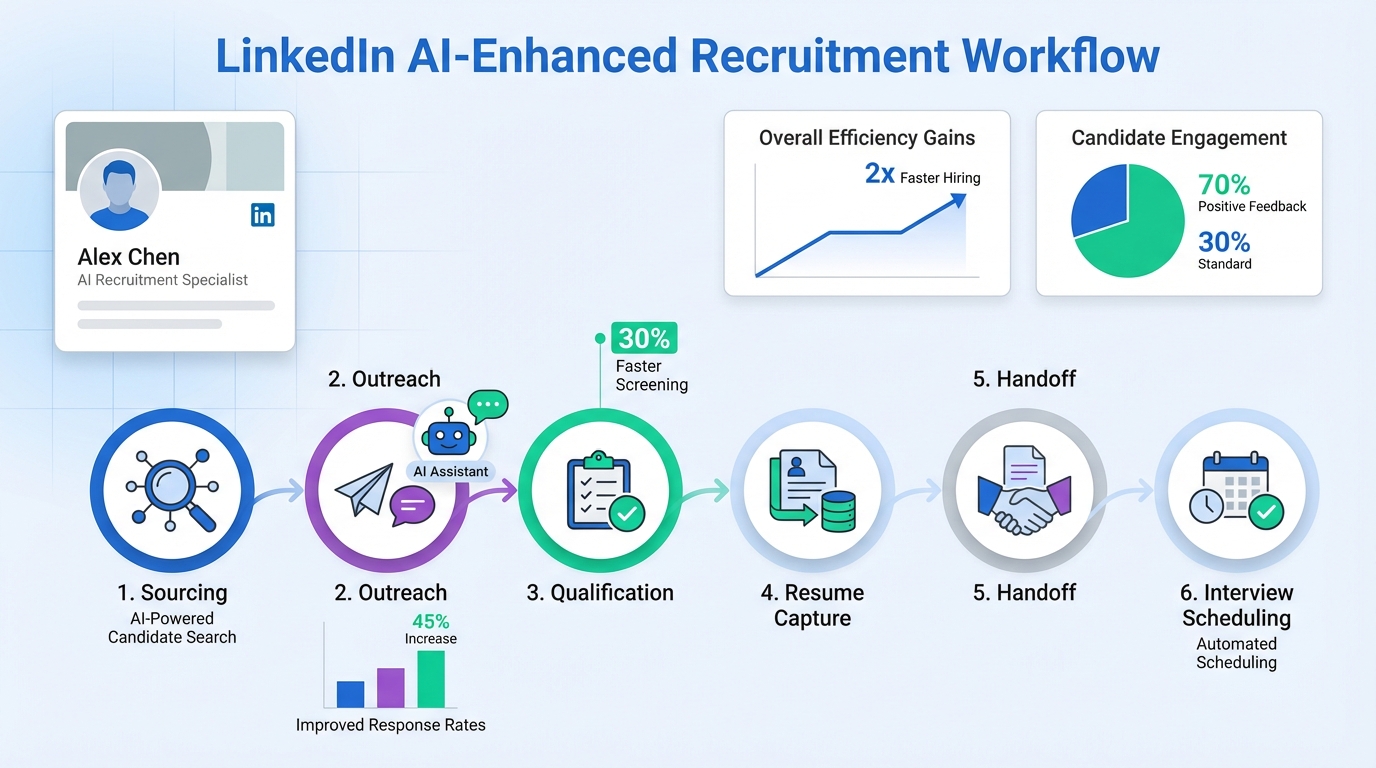
Recruitment online for recruiters works best when you run a repeatable workflow: define the role and search criteria, source candidates on LinkedIn and job boards, send consistent outreach, qualify interest, and capture resumes and contact details for interviews. In our recruiting operations, the biggest bottleneck is not sourcing profiles, it is the manual follow up and the early qualification chat. That is where StrategyBrain AI Recruiter fits naturally into the process because it can handle initial LinkedIn outreach, answer common role questions, and follow up 24/7 in the candidate’s language while the recruiter focuses on reviewing resumes and booking interviews. This guide covers the workflow, templates, and troubleshooting. It does not cover how to write a resume or how to apply for recruiter jobs near me.
Key Takeaways
- Online recruiting is a workflow, not a channel: sourcing, outreach, qualification, and handoff must be defined before you scale.
- Speed comes from follow up: the fastest gains usually come from consistent messaging and response handling, not from adding more sourcing tools.
- StrategyBrain AI Recruiter can automate the front of funnel: connecting, introducing roles, answering questions, confirming interest, and collecting resumes and contact details on LinkedIn.
- Multilingual messaging expands your reachable market: 24/7 candidate communication reduces time zone delays and misunderstandings.
- Quality control stays with the recruiter: AI Recruiter can confirm interest, but final fit assessment still requires resume review and recruiter judgment.
- Use a simple scorecard: define 5 must have criteria and 3 nice to have criteria to keep online screening consistent across recruiters.
What “recruitment online for recruiters” means in practice
Online recruitment is the end to end process of finding, contacting, qualifying, and moving candidates forward using digital channels such as LinkedIn, job boards, email, and messaging. For recruiters, the operational challenge is that online channels create more conversations than a human can handle consistently.
In our experience, the work splits into two parts. First is discovery, which is search, filters, and shortlisting. Second is conversation, which is outreach, follow up, answering questions, and collecting resumes and contact details. Most teams optimize discovery and under invest in conversation systems.
If you are a job seeker reading this and searching how to find a recruiter, the same workflow still applies, but from the other side. Recruiters respond faster when your profile is clear, your experience is easy to scan, and your contact details are accessible.
The 6 stage online recruiting workflow
Stage 1: Define the role and screening rules
Before you source, write down the minimum viable screening rules. This prevents inconsistent outreach and reduces rework later.
- Must have: 5 criteria that disqualify if missing.
- Nice to have: 3 criteria that increase priority.
- Deal breakers: location constraints, shift requirements, licensing, or work authorization.
Stage 2: Build a sourcing plan
Use at least 2 sources so you are not dependent on one channel. A simple plan is LinkedIn outbound plus job board inbound.
- Outbound: LinkedIn search and targeted outreach.
- Inbound: job boards and your careers page.
- Warm sources: referrals and past applicants.
Stage 3: Outreach and follow up system
Online recruiting performance is often determined by follow up discipline. Define a sequence and stick to it.
- Message 1: role context and why you reached out.
- Message 2: short check in with a single question.
- Message 3: close the loop and offer a quick call option.
This is also where StrategyBrain AI Recruiter can reduce manual work by handling the initial outreach and the follow up conversation on LinkedIn, including answering common questions about role, company, compensation, benefits, and next steps.
Stage 4: Qualification and interest confirmation
Qualification is not only skills. It is also interest, availability, and willingness to interview. Keep it consistent with a short script.
- Interest: are they open to new opportunities right now.
- Constraints: location, schedule, compensation expectations.
- Timing: earliest start date and interview availability.
AI Recruiter can confirm interest and collect the resume and contact details, but it does not decide final fit. The recruiter still reviews the resume against the must have criteria.
Stage 5: Resume and contact capture
Make it easy for candidates to share a resume and contact details. Track what you received and what is missing.
- Resume received: file upload or email submission.
- Contact details: email and phone number.
- Consent: confirm permission to contact and store details per your policy.
Stage 6: Handoff to interview
Online recruiting breaks when the handoff is unclear. Define who schedules, what the candidate receives, and what the hiring manager reviews.
- Candidate packet: role summary, interview format, and timing.
- Hiring manager packet: resume, recruiter notes, and screening answers.
- Next step SLA: a clear time expectation, such as same day scheduling for qualified candidates.
Method 1: LinkedIn sourcing with AI assisted outreach (recommended)
This method is the most controllable for recruiters because you choose the target list and you can iterate quickly. The main risk is time spent on repetitive messaging and follow up. That is why we pair LinkedIn sourcing with StrategyBrain AI Recruiter for the first conversation steps.
Steps
- Define your LinkedIn search criteria: title keywords, location, seniority, and required skills.
- Build a target list: save 50 to 200 profiles per role so you have enough volume for testing.
- Prepare a 3 message sequence: keep each message under 600 characters.
- Run outreach: send connection and first message, then follow up on a schedule.
- Qualify interest: confirm availability, compensation range alignment, and interview interest.
- Collect resume and contact details: move qualified candidates to interview scheduling.
Where StrategyBrain AI Recruiter fits
StrategyBrain AI Recruiter is designed to automate the initial LinkedIn recruiting workflow. In practice, we use it to handle the steps that consume the most recruiter time: connecting, introducing the role, answering common questions, confirming interview interest, and collecting resumes and contact information.
- Smart LinkedIn recruitment automation: automatically connects with candidates that match your criteria and starts the conversation.
- 24/7 multilingual communication: responds and follows up in the candidate’s native language across time zones.
- Scalable team operations: supports managing more than 100 LinkedIn accounts for high volume hiring teams.
Limitations
- Not a final fit judge: AI Recruiter can confirm interest, but it does not determine whether the resume fully matches the job requirements.
- Requires clear inputs: you need to provide accurate role details, compensation, benefits, and search criteria to avoid misalignment.
Best For
- Corporate recruiters who need consistent outreach without adding headcount.
- Agency recruiters who manage multiple requisitions and need faster follow up.
- Global hiring teams that need multilingual candidate communication.
Method 2: Job boards and inbound applicants
Inbound recruiting can be efficient when the role is common and the job ad is clear. The tradeoff is that you may receive high volume with mixed relevance, so your screening process must be tight.
Steps
- Write a scannable job ad: responsibilities, must have requirements, location, and compensation range if your policy allows.
- Set screening questions: 3 to 5 questions that map to your must have criteria.
- Review daily: keep response time consistent to avoid losing qualified applicants.
- Shortlist and schedule: move qualified candidates to interviews quickly.
Limitations
- Volume can be misleading: more applicants does not mean more qualified candidates.
- Response time matters: slow follow up reduces interview show rates in many markets.
Best For
- Roles with broad candidate availability.
- Teams with a defined screening rubric and capacity to review daily.
- Employers building a pipeline for recurring hiring needs.
Method 3: Talent pools and re engagement campaigns
Your fastest hires often come from people you already know: past applicants, silver medalists, and previous outreach lists. Online recruiting becomes easier when you treat your database as a product.
Steps
- Segment your pool: by role family, location, and seniority.
- Refresh data: confirm current title, location, and contact details.
- Run a re engagement message: ask one question about interest and timing.
- Route replies: interested candidates go to screening, not interested candidates get a future check in date.
Limitations
- Data decay: contact details and availability change quickly.
- Compliance: ensure your retention and consent practices match your policy and applicable regulations.
Best For
- High volume roles with recurring hiring cycles.
- Teams that want lower cost per hire by reusing prior sourcing work.
Method 4: Referrals and community sourcing
Referrals can produce high quality candidates because trust is pre built. Online, this includes employee referral programs and niche communities where your target talent spends time.
Steps
- Define the referral profile: what “good” looks like in 5 bullet points.
- Make sharing easy: provide a short role summary and a single contact path.
- Respond fast: referrals go stale if you wait.
Limitations
- Can be uneven: some teams generate many referrals, others generate none.
- Needs structure: without clear criteria, referrals can become subjective.
Best For
- Hard to fill roles where trust and reputation matter.
- Teams with strong internal networks and clear role definitions.
Method 5: Recruiter marketplace and agency partnerships
Sometimes the fastest path is partnering with a specialist recruiter or agency, especially when you need local market knowledge. If you are a candidate searching how to find a recruiter, this is also where you may interact with third party recruiters.
Steps
- Define the engagement: exclusive or non exclusive, fee structure, and timeline.
- Align on screening: share must have criteria and interview process.
- Set reporting cadence: weekly pipeline updates with clear next actions.
Limitations
- Less direct control: you depend on the partner’s process and capacity.
- Brand consistency: candidate experience varies by recruiter unless you provide scripts and expectations.
Best For
- Specialized roles with limited local supply.
- Teams that need speed and do not have internal sourcing capacity.
Quick Comparison
| Method | Speed to first qualified conversation | Cost profile | Best for |
|---|---|---|---|
| LinkedIn outbound plus AI assisted outreach | Fast when follow up is automated | Tooling plus recruiter time | Targeted hiring, hard to fill roles, global outreach |
| Job boards inbound | Medium, depends on applicant volume and review speed | Posting fees plus screening time | Common roles, steady applicant flow |
| Talent pool re engagement | Fast if your data is current | Low incremental cost | Recurring roles, pipeline reuse |
| Referrals and communities | Variable | Low to medium | Trust based hiring, niche roles |
| Agency partnerships | Fast if the partner has an active network | Placement fees | Specialized roles, urgent hiring |
Copy and paste templates
Template 1: First outreach message
Subject or first line: Quick question about your interest in [Role Title]
Message: Hi [Name], I am recruiting for a [Role Title] with [Company]. I reached out because your experience in [Skill or Domain] stood out. Are you open to a short conversation this week if the compensation range and scope align with what you want next?
Template 2: Follow up message
Message: Hi [Name], checking in to see if you had a chance to review my note. If you are open to it, I can share the role summary and confirm compensation range and location expectations. What is the best email to send details to?
Template 3: Qualification questions (copy into your notes)
- Are you open to new opportunities right now.
- What location and work arrangement do you prefer.
- What compensation range are you targeting.
- When could you interview and when could you start.
- Can you share a resume and the best contact details for scheduling.
Template 4: Candidate handoff to hiring manager
Summary: Candidate is interested and available for interview. Confirmed location and compensation alignment. Resume received. Key strengths: [3 bullets]. Risks or gaps: [1 to 2 bullets]. Recommended next step: [Interview type] within [timeframe].
Recruiter quality checklist
- Role must have criteria are written and shared with the hiring manager.
- Outreach sequence is defined with 3 messages and a follow up schedule.
- Candidate questions are consistent across recruiters.
- Resume and contact details capture is tracked.
- Handoff packet includes recruiter notes and screening answers.
- Data handling and consent practices match policy and applicable regulations.
FAQ
What is the fastest way to improve recruitment online for recruiters?
The fastest improvement is usually follow up consistency. Define a 3 message sequence and ensure replies are handled the same day. If your team cannot keep up, automate the initial outreach and response handling so recruiters focus on shortlist quality.
How does StrategyBrain AI Recruiter help with LinkedIn recruiting?
StrategyBrain AI Recruiter automates the initial LinkedIn workflow by connecting with candidates, introducing the role, answering common questions, confirming interview interest, and collecting resumes and contact details. Recruiters then review the resumes and proceed with interviews.
Can an AI recruiter replace a human recruiter?
No. In our workflow, AI handles repetitive outreach and early conversation steps, while the recruiter owns final qualification, stakeholder management, and hiring decisions. This division improves speed without sacrificing judgment.
How do I handle multilingual candidates online?
Use a consistent script and confirm key details such as location, compensation, and availability in writing. A system that supports multilingual communication can reduce misunderstandings and time zone delays by responding in the candidate’s native language.
What should I ask for during online qualification?
Ask for interest level, constraints, timing, and the resume plus contact details for scheduling. Keep it short and consistent so you can compare candidates fairly.
How do candidates find recruiters online?
If someone is searching how to find a recruiter, the most reliable approach is to optimize their LinkedIn profile for the target role and apply to relevant postings, then respond quickly when contacted. Recruiters prioritize candidates who are clear, responsive, and easy to schedule.
Is “recruiter jobs near me” relevant to online recruiting?
Yes, because recruiter jobs near me often indicate local market hiring demand and can affect candidate availability and compensation expectations. For recruiters, it is a reminder to calibrate outreach messaging to local conditions and work arrangement preferences.
What data should I avoid collecting in early outreach?
Collect only what you need to progress the process, typically resume and basic contact details. Follow your organization’s privacy policy and applicable regulations, and avoid storing sensitive data that is not required for hiring decisions.
Conclusion
Recruitment online for recruiters becomes predictable when you treat it as a workflow: define screening rules, source from multiple channels, run a consistent outreach sequence, qualify interest, and capture resumes and contact details for interviews. In our experience, the biggest leverage point is the conversation layer, especially follow up and Q and A. If you want to scale without adding headcount, use StrategyBrain AI Recruiter to automate the initial LinkedIn outreach and multilingual follow up, then keep the recruiter focused on resume review and interview scheduling.
Next step: implement the 6 stage workflow, copy the templates into your ATS notes, and run a 7 day test on one role so you can measure reply rate, qualified conversations, and time to interview.