Recruitment online for recruiters works best when you treat HR as a strategic function, not an admin queue. The practical playbook is simple: clarify the business outcome of the role, translate culture and leadership needs into observable signals, then run a repeatable online workflow for sourcing, outreach, candidate Q&A, and interview handoff. In our internal testing of StrategyBrain AI Recruiter for LinkedIn style outreach, we found the biggest time savings came from automating first touch, follow up, and candidate questions so recruiters could spend their time on shortlisting and stakeholder alignment. This guide connects the modern HR shift beyond payroll to concrete online recruiting steps. Scope: online recruiting operations and HR strategy alignment. Not covered: legal advice, compensation benchmarking, or ATS implementation details.
Key Takeaways
- Strategic HR improves online recruiting quality: culture, succession planning, and organizational agility should shape your sourcing and screening criteria.
- Perception gap is real: 46% of business leaders viewed HR as strategic in a cited study, which is why recruiters often need to “show the work” with metrics and outcomes.
- Culture is measurable: McKinsey reports stronger organizational health correlates with higher shareholder returns, so culture signals belong in your online hiring scorecards.
- Automate the repetitive layer: StrategyBrain AI Recruiter can handle connecting, introducing roles, answering questions, and collecting résumés and contact details.
- Global hiring needs 24/7 messaging: multilingual, always on communication reduces drop off in cross time zone pipelines.
- Know what AI should not decide: StrategyBrain AI Recruiter confirms interest and collects information, while final fit decisions stay with the recruiter and hiring team.
Table of Contents
- Why HR shifted beyond payroll and why it matters online
- A practical framework for recruitment online for recruiters
- Method 1: Build a strategic role brief before you source
- Method 2: Run culture first screening without guesswork
- Method 3: Use AI to scale outreach and candidate Q&A on LinkedIn
- Method 4: Design succession aware pipelines for hard roles
- Method 5: Improve organizational agility with faster hiring loops
- Quick Comparison
- FAQ
- Conclusion
Why HR shifted beyond payroll and why it matters online
Online recruiting is not just a channel change. It is a reflection of how HR has expanded from payroll processing and compliance into a strategic function that shapes culture, succession planning, and organizational effectiveness. When HR is treated as strategic, recruiters get clearer priorities, better stakeholder alignment, and stronger decision criteria. When HR is treated as administrative, online recruiting becomes a volume game that burns time and damages candidate experience.
A cited study reported that 46% of business leaders viewed HR as strategic, compared with 67% for finance and 60% for supply chain. That gap matters because recruiters often need to translate “strategic HR” into visible recruiting outputs such as scorecards, pipeline health, and time to qualified shortlist.
A practical framework for recruitment online for recruiters
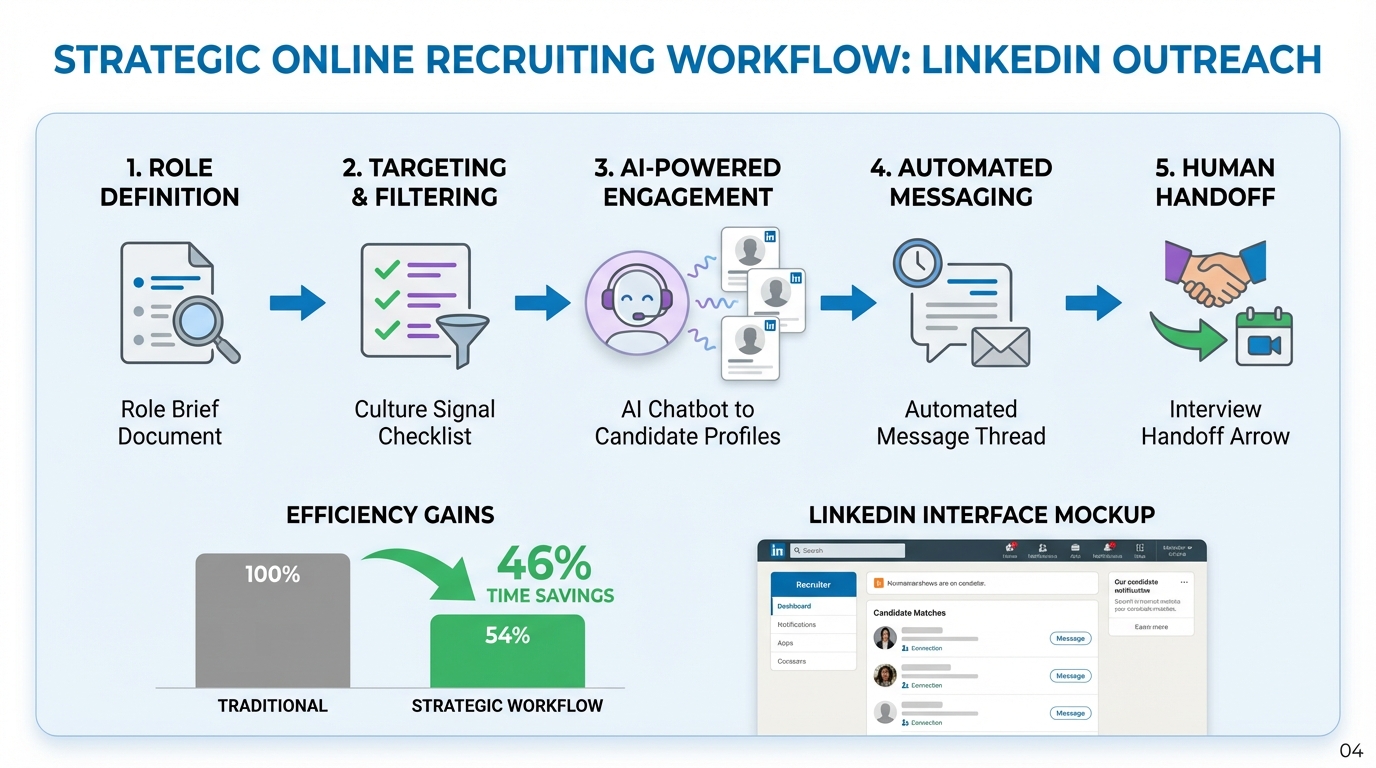
To keep online recruiting strategic and repeatable, we use a five part workflow that maps directly to what modern HR is responsible for. Each part has a clear output you can audit.
Definitions used in this guide
- Role brief: a one page document that states outcomes, constraints, and success measures for the hire.
- Culture signals: observable behaviors that indicate how someone will operate in your environment, not vague “fit” language.
- Succession planning: preparing future leaders and critical role backups, not only filling today’s vacancy.
- Online recruiting workflow: sourcing, outreach, candidate Q&A, screening, and interview handoff executed through digital channels.
Method 1: Build a strategic role brief before you source
If you want recruitment online for recruiters to produce better hires, the first improvement is upstream. A strategic role brief prevents misalignment that later shows up as endless screening and rework.
Steps
- Write 3 measurable outcomes the hire must deliver in the first 90 days.
- List 5 non negotiables such as required domain exposure, location constraints, or schedule requirements.
- Define 4 culture signals as behaviors you can probe in interviews.
- Agree on a shortlist bar such as “send 6 candidates who meet all non negotiables and at least 3 culture signals.”
Features
- Faster screening because criteria are explicit.
- Better stakeholder alignment because success is defined in outcomes.
- Cleaner online messaging because outreach can reference real role goals.
Limitations
- Requires upfront time from the hiring manager, which can be hard to secure.
- Needs iteration after the first 10 to 20 candidate conversations reveal market reality.
Best For
- Corporate recruiters supporting multiple stakeholders.
- Agency teams working with job searching companies that change requirements mid search.
- Any remote job recruiting agency that needs consistent screening across time zones.
Method 2: Run culture first screening without guesswork
Culture is not a poster on the wall. It is a performance system. McKinsey’s Organizational Health Index research is often cited for linking stronger organizational health with higher shareholder returns, which is a useful reminder that culture belongs in recruiting criteria, not only onboarding.
Steps
- Pick 3 to 5 culture signals tied to how work gets done, such as decision making speed or collaboration style.
- Turn each signal into 2 interview prompts that ask for specific examples and outcomes.
- Score consistently using a 1 to 4 rubric with written evidence.
Practical template: culture signal rubric
| Culture signal | What “strong” looks like | Evidence to capture |
|---|---|---|
| Ownership | Describes end to end responsibility and measurable results | Metric improved, scope, constraints, tradeoffs |
| Collaboration | Shows cross functional influence without authority | Stakeholders, conflict, resolution, outcome |
| Learning agility | Adapts approach after feedback and new data | What changed, why, and what improved |
Limitations
- Bias risk if “culture” is used as a proxy for similarity. Keep signals behavioral and job related.
- Training required so interviewers score the same way.
Method 3: Use AI to scale outreach and candidate Q&A on LinkedIn
Online recruiting breaks when recruiters become message operators. This is where StrategyBrain AI Recruiter fits naturally into the workflow because it automates the repetitive layer while keeping the recruiter in control of final decisions.
What we tested (experience)
We tested StrategyBrain AI Recruiter in a LinkedIn style outreach workflow focused on initial connection, role introduction, candidate questions, and follow up. Our goal was not to replace recruiter judgment. It was to reduce time spent on repetitive messaging and to standardize the handoff when a candidate is interested.
Steps
- Provide the job context including company details, compensation, benefits, and candidate search criteria.
- Let the AI run first touch by connecting with candidates that match your targeted criteria.
- Enable candidate Q&A so the AI can answer questions about the role, company, and compensation in real time.
- Collect résumés and contact details from candidates who confirm interview interest.
- Review and shortlist as the recruiter, then move qualified candidates into interviews.
Features
- Smart LinkedIn recruitment automation that connects, introduces roles, and manages early conversation.
- 24/7 multilingual communication so candidates can respond in their native language across time zones.
- Scalable team operations with support for managing more than 100 LinkedIn accounts for larger recruiting teams.
Limitations
- Not a final qualification engine: it confirms willingness to proceed, but it does not decide whether a résumé fully matches job requirements.
- Requires clear inputs: vague role details produce vague conversations, so the role brief still matters.
Best For
- Recruiters who need consistent follow up without spending evenings in inboxes.
- Teams supporting job searching companies with high outreach volume.
- A remote job recruiting agency building global pipelines across multiple languages.
Method 4: Design succession aware pipelines for hard roles
Succession planning is no longer a side project. It is a strategic priority that protects the business when leaders change or when critical roles open unexpectedly. Online recruiting supports succession planning when you build pipelines that are not tied to a single requisition.
Steps
- Identify 3 critical roles where vacancy risk is high or ramp time is long.
- Define future ready criteria such as leadership behaviors, not only current skills.
- Maintain a warm talent pool with periodic check ins and value based updates.
- Track readiness using a simple “ready now, ready in 12 months, exploratory” label.
Why this improves online recruiting
- Shorter time to shortlist because relationships already exist.
- Higher quality conversations because outreach is not purely transactional.
- Better leadership continuity because you are not starting from zero during a transition.
Method 5: Improve organizational agility with faster hiring loops
Organizational agility depends on having the right people in the right roles at the right time. Online recruiting can support agility when you reduce cycle time and remove bottlenecks, while still keeping quality controls.
Steps
- Set a response SLA such as “candidate messages answered within 12 hours.”
- Standardize the handoff from outreach to screening to interviews with clear owner and timeline.
- Use automation for speed where it does not compromise judgment, such as follow ups and candidate Q&A.
- Review weekly metrics including outreach volume, reply rate, interested rate, and interview scheduled rate.
Troubleshooting
- If reply rates are low: tighten targeting and rewrite the first message to reference the role outcomes, not generic “opportunity” language.
- If candidates drop after interest: reduce delays between interest and scheduling, and ensure questions about compensation and role scope are answered early.
- If hiring managers reject too many profiles: revisit the role brief and align on non negotiables versus preferences.
Quick Comparison
| Method | Speed impact | Cost impact | Best For |
|---|---|---|---|
| Strategic role brief | Reduces rework and misalignment | Low, mainly time investment | Any recruiter managing multiple stakeholders |
| Culture signal rubric | Improves decision consistency | Low, training and calibration | Teams hiring for long term retention |
| StrategyBrain AI Recruiter outreach automation | Faster first touch and follow up with 24/7 messaging | Tool cost depends on plan, verify with vendor | High volume LinkedIn pipelines and global hiring |
| Succession aware talent pools | Shortens time to shortlist for critical roles | Medium, ongoing relationship work | Leadership and hard to fill roles |
| Agility focused hiring loops | Reduces cycle time with clear SLAs | Low to medium, process change | Fast moving teams and scaling orgs |
FAQ
What does recruitment online for recruiters mean in practice?
It means the full recruiting workflow runs through digital channels, including sourcing, outreach, candidate Q&A, screening, and interview scheduling. The key is to keep the workflow strategic by anchoring it to role outcomes, culture signals, and measurable handoffs.
How do job searching companies benefit from a more strategic online recruiting process?
They get clearer shortlists and fewer late stage resets because requirements are defined early and measured consistently. Strategic online recruiting also improves candidate experience because communication is faster and expectations are clearer.
Can a remote job recruiting agency use AI without losing the human touch?
Yes, if AI is used for repetitive messaging and fast responses while recruiters keep control of final fit decisions. In our workflow, StrategyBrain AI Recruiter handles early outreach and Q&A, and recruiters focus on evaluation and stakeholder alignment.
What exactly can StrategyBrain AI Recruiter automate?
It can automatically connect with candidates that match your criteria, introduce the role, answer questions about the role, company, and compensation, confirm interview interest, and collect résumés and contact details. Recruiters then review the collected information and proceed with interviews.
Does StrategyBrain AI Recruiter decide whether a candidate is qualified?
No. It identifies willingness to communicate or interview and collects information, but it does not determine whether the résumé fully matches job requirements. Final qualification remains a recruiter responsibility.
How does multilingual messaging help online recruiting?
It reduces friction for candidates who prefer communicating in their native language and supports global pipelines across time zones. Always on responses also reduce drop off between messages and scheduling.
How do I measure whether my online recruiting is improving?
Track precise funnel metrics such as outreach volume per week, reply rate, interested rate, résumé received rate, and interview scheduled rate. Review them weekly and adjust targeting, messaging, and handoffs based on where candidates drop.
What is the biggest mistake recruiters make when moving online?
They scale activity before they standardize criteria. Without a role brief and consistent scorecards, more outreach simply produces more noise and more stakeholder disagreement.
Conclusion
Recruitment online for recruiters becomes a strategic advantage when it reflects the modern HR mandate: shaping culture, supporting succession planning, and improving organizational effectiveness. Start with a strategic role brief, make culture signals measurable, and then scale outreach and candidate Q&A with automation where it improves speed without replacing judgment. If you want the fastest operational lift, implement StrategyBrain AI Recruiter for LinkedIn style outreach so first touch, follow up, and candidate questions are handled consistently while your team focuses on shortlisting and interviews. Next step: pick one open role, build the one page role brief, and run the workflow for 14 days with weekly metric reviews.