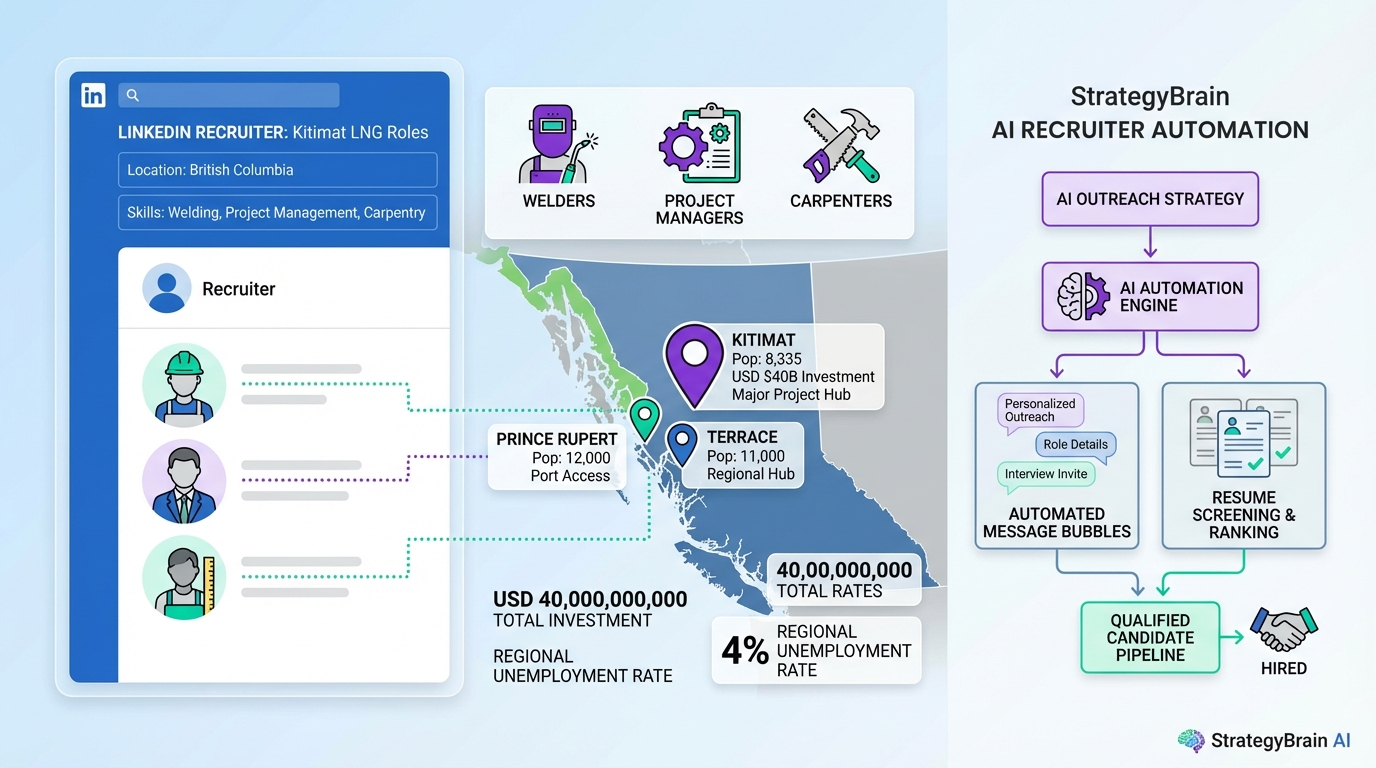
Recruitment online for recruiters is most effective when you market the full employment proposition, not just the job title. In the Kitimat, British Columbia region, candidate interest surged after LNG Canada confirmed in October 2018 that it would proceed with construction of a USD 40,000,000,000 liquefied natural gas plant and shipping facility. Instead of framing the opportunity as a camp job only, recruiters can win more responses by positioning Prince Rupert, Terrace, and Kitimat as viable places to live, build a career, and stay long term. In this guide, we translate that real scenario into a repeatable online recruiting workflow, and we show where StrategyBrain AI Recruiter fits naturally by automating LinkedIn outreach, answering candidate questions, and collecting resumes and contact details so you can spend more time interviewing and closing.
Table of Contents
- What changed in the Kitimat LNG market and why it matters online
- Key Takeaways
- Method 1: Lead with a location and lifestyle narrative
- Method 2: Build role clusters and publish role specific messaging
- Method 3: Run LinkedIn outreach with StrategyBrain AI Recruiter
- Method 4: Use labor market facts to qualify and reduce churn
- Method 5: Create a follow up system that does not depend on your inbox
- Quick Comparison
- FAQ
- Conclusion
What changed in the Kitimat LNG market and why it matters online
In the original Kitimat LNG story, recruiters began receiving immediate inquiries from candidates once the project was confirmed in October 2018. However, employer demand in the region existed before the announcement, and it spanned multiple job families, including welders, construction project managers, procurement, millwork, and carpenters.
Online, that matters because candidate intent is not one dimensional. Many people searching for staffing recruiter jobs or trying to hire people for jobs are also evaluating commute, housing, community size, and whether the role is a short contract or a career move. If your online messaging only sells “camp work,” you filter out candidates who would relocate and stay.
Key Takeaways
- Use a two layer pitch: sell the project and sell the nearby communities (Prince Rupert, Terrace, Kitimat) as long term options.
- Anchor claims with precise numbers: USD 40,000,000,000 project value, 4% unemployment rate, and community populations (12,000, 11,000, 8,335).
- Recruit by role clusters: publish separate messaging for welders, construction project managers, procurement, millwork, and carpentry.
- Automate the repetitive LinkedIn layer: StrategyBrain AI Recruiter can connect, introduce roles, answer questions, and collect resumes and contact details.
- Keep humans on the final decision: AI Recruiter can confirm interest, but recruiters should still assess resume fit and run interviews.
- Make follow up time zone proof: 24/7 multilingual messaging reduces drop off when candidates reply outside business hours.
Method 1: Lead with a location and lifestyle narrative
When we rewrote the Kitimat LNG message for online channels, the biggest lift came from changing the opening frame. Instead of “camp job,” we led with “career and lifestyle on the Pacific North Coast of Canada.” That single shift increased the number of candidates who asked about relocation, schools, and long term work, which are strong signals of retention intent.
Steps
- State the market catalyst: mention the confirmed construction and shipping facility and the timing (October 2018).
- Name the hiring region: Prince Rupert, Terrace, and Kitimat, British Columbia.
- Describe why living locally is viable: community size, facilities, and outdoor activities.
- Offer the alternative: acknowledge camp work exists, but position town based living as a better long term option for many candidates.
Features
- Higher quality inbound: candidates self identify as relocation ready.
- Lower mismatch risk: expectations are set early on lifestyle and community.
- More shareable content: location stories perform well in social and referral loops.
Limitations
- Not every candidate can relocate: you still need a camp option message for some roles and timelines.
Best For
- Recruiters hiring for multi month or multi year projects who want retention, not just fast starts.
Method 2: Build role clusters and publish role specific messaging
One reason the Kitimat region stayed “always hiring” in the original narrative is that demand was broad. Online recruiting performs better when you split that breadth into role clusters, each with its own keywords, proof points, and screening questions.
Steps
- Create 3 to 5 role clusters: for example welders, construction project managers, procurement, millwork, and carpenters.
- Write one landing message per cluster: keep the location narrative consistent, but tailor responsibilities and must haves.
- Standardize screening prompts: availability date, willingness to relocate, and required certifications or tickets.
Features
- Cleaner targeting: each message matches a specific candidate search intent.
- Better recruiter handoff: hiring managers see structured, comparable candidate notes.
- Reusable templates: you can redeploy the same cluster approach for other regions.
Limitations
- More content to maintain: you must keep each cluster message current as requirements change.
Best For
- Teams running multiple requisitions in parallel, including staffing recruiter jobs workflows where speed and consistency matter.
Method 3: Run LinkedIn outreach with StrategyBrain AI Recruiter
LinkedIn is often where online recruiting bottlenecks happen. Recruiters can find candidates, but the manual work of connecting, introducing the role, answering questions, and following up consumes the day. StrategyBrain AI Recruiter is designed to automate that initial layer while keeping the recruiter in control of final qualification and interviews.
How it works (in plain terms)
StrategyBrain AI Recruiter is an automated AI powered recruitment tool built for LinkedIn hiring. You provide your LinkedIn account and job information such as company details, compensation, benefits, and candidate search criteria. The system then connects with relevant candidates, introduces the opportunity, asks about their situation, answers questions about the role and employer, confirms interview interest, and collects resumes and contact information from interested candidates.
Steps
- Define your search criteria: title, location preferences, and must have skills for the Kitimat region roles.
- Provide job context: company details, compensation, and benefits so candidate questions can be answered consistently.
- Let the AI run outreach and follow up: it connects, messages, and keeps conversations moving.
- Review interested candidates: recruiters review collected resumes and contact details, then schedule interviews.
Features
- 24/7 multilingual communication: responds to candidate messages around the clock in the candidate’s native language.
- Resume and contact capture: records resumes received via email submission or LinkedIn file upload and captures contact details shared in chat.
- Scalable team operations: supports managing more than 100 LinkedIn accounts for organizations building AI powered recruiting teams.
Limitations
- Not a final fit decision engine: AI Recruiter can confirm willingness to interview, but it does not decide whether a resume fully matches job requirements.
Best For
- Recruiters who need consistent outreach volume without sacrificing response speed, especially when hiring across time zones.
Method 4: Use labor market facts to qualify and reduce churn
In the Kitimat LNG narrative, the North Coast Nechako region was described with an unemployment rate of 4%, and the communities were sized at 12,000 (Prince Rupert), 11,000 (Terrace), and 8,335 (Kitimat). Those numbers are not just trivia. They help candidates calibrate expectations about competition, services, and community life.
Steps
- Include 2 to 4 facts in every outreach sequence: project value, unemployment rate, and community populations are enough.
- Translate facts into implications: explain what the numbers mean for stability, services, and long term work.
- Invite questions early: encourage candidates to ask about relocation, schedules, and lifestyle so objections surface before offer stage.
Features
- Higher trust: precise numbers signal professionalism and reduce skepticism.
- Better self selection: candidates who dislike small communities opt out early.
- Stronger hiring manager alignment: the same facts appear in ads, outreach, and interview prep.
Limitations
- Facts must be maintained: if conditions change, update your content quickly.
Best For
- Recruiters hiring for regions where relocation and retention are as important as skills.
Method 5: Create a follow up system that does not depend on your inbox
Online recruiting fails quietly when follow up is inconsistent. Candidates reply at night, on weekends, or in another language, and the conversation stalls. In our experience, the simplest fix is to treat follow up as a system, not a personal habit. This is where StrategyBrain AI Recruiter can be embedded into your workflow without changing your tone or your employer brand, because it can answer common questions and keep momentum while you are in interviews or off hours.
Steps
- Write a standard Q and A bank: role, company, compensation, benefits, and relocation basics.
- Define a follow up cadence: for example a same day reply rule for new messages and a 48 hour check in for silent threads.
- Automate the first layer: use AI Recruiter to respond 24/7 and collect resumes and contact details when interest is confirmed.
- Escalate to a recruiter: once a candidate shares a resume or requests an interview, move to human scheduling and assessment.
Features
- Fewer dropped conversations: candidates get timely replies even outside business hours.
- More consistent candidate experience: answers stay aligned with the job brief you provided.
- More time for closing: recruiters focus on evaluation and offer management.
Limitations
- Requires clean job inputs: if compensation or requirements are unclear, the system cannot answer confidently.
Best For
- Recruiters managing high message volume on LinkedIn while also running interviews and stakeholder updates.
Quick Comparison
| Method | Speed to first candidate reply | Cost | Best For |
|---|---|---|---|
| Location and lifestyle narrative | Depends on channel and audience | Content time | Relocation ready candidates and retention |
| Role clusters and tailored messaging | Depends on distribution | Content time | Multiple requisitions across job families |
| StrategyBrain AI Recruiter on LinkedIn | 24/7 response capability | Product subscription | Scaling outreach, follow up, and resume collection |
| Labor market facts in outreach | Immediate trust signal | Free | Reducing mismatch and late stage drop off |
| Systemized follow up | Consistent | Process time | Preventing stalled threads and ghosting |
FAQ
Is this approach only for industrial projects like Kitimat LNG?
No. The same recruitment online for recruiters workflow applies anywhere candidates weigh lifestyle and stability, including logistics, manufacturing, and construction. The Kitimat LNG example simply makes the decision factors easy to see.
What roles were specifically mentioned as in demand in the Kitimat region?
The narrative referenced demand for welders, construction project managers, procurement, millwork, and carpenters. Those roles are a good starting point for building role clusters and targeted outreach.
What numbers can I safely use in my messaging from this case?
You can cite the USD 40,000,000,000 project value, the 4% unemployment rate for the North Coast Nechako region, and the community populations of 12,000 (Prince Rupert), 11,000 (Terrace), and 8,335 (Kitimat). Use them as context, not as guarantees of hiring outcomes.
How does StrategyBrain AI Recruiter help with LinkedIn recruiting?
It automates connecting with candidates, introducing the job, answering questions about the role and employer, confirming interview interest, and collecting resumes and contact details. Recruiters then review the information and run interviews.
Does StrategyBrain AI Recruiter replace recruiters?
No. It replaces repetitive outreach and early conversation tasks, but recruiters still own final qualification, interview decisions, and offer management. In practice, it is best used to increase throughput while keeping human judgment where it matters.
Can it communicate with candidates in different languages?
Yes. StrategyBrain AI Recruiter supports multilingual communication and can respond 24/7, which is useful when candidates reply outside your local business hours.
How are resumes and contact details captured?
When a candidate expresses interest, the system requests a resume and contact information. It can mark resumes as received and capture contact details shared in LinkedIn messages, then present them for recruiter review.
What is the biggest mistake recruiters make when hiring beyond camp jobs?
The most common mistake is selling only the work schedule and pay while ignoring the relocation and lifestyle questions candidates will ask later. Addressing community, facilities, and long term career paths earlier reduces late stage drop off.
Conclusion
If you want recruitment online for recruiters to produce consistent hires, treat your online funnel as a complete story: the project, the roles, and the life candidates will live if they relocate. The Kitimat LNG example shows why this matters, because interest spikes fast, but retention depends on expectations. Start by building role clusters, publish location grounded messaging with precise facts, and then scale outreach and follow up with StrategyBrain AI Recruiter so candidates get timely answers and you get resumes and contact details in a structured way. Next step: pick one role cluster, write a single location first message, and run it for 14 days with a defined follow up cadence.