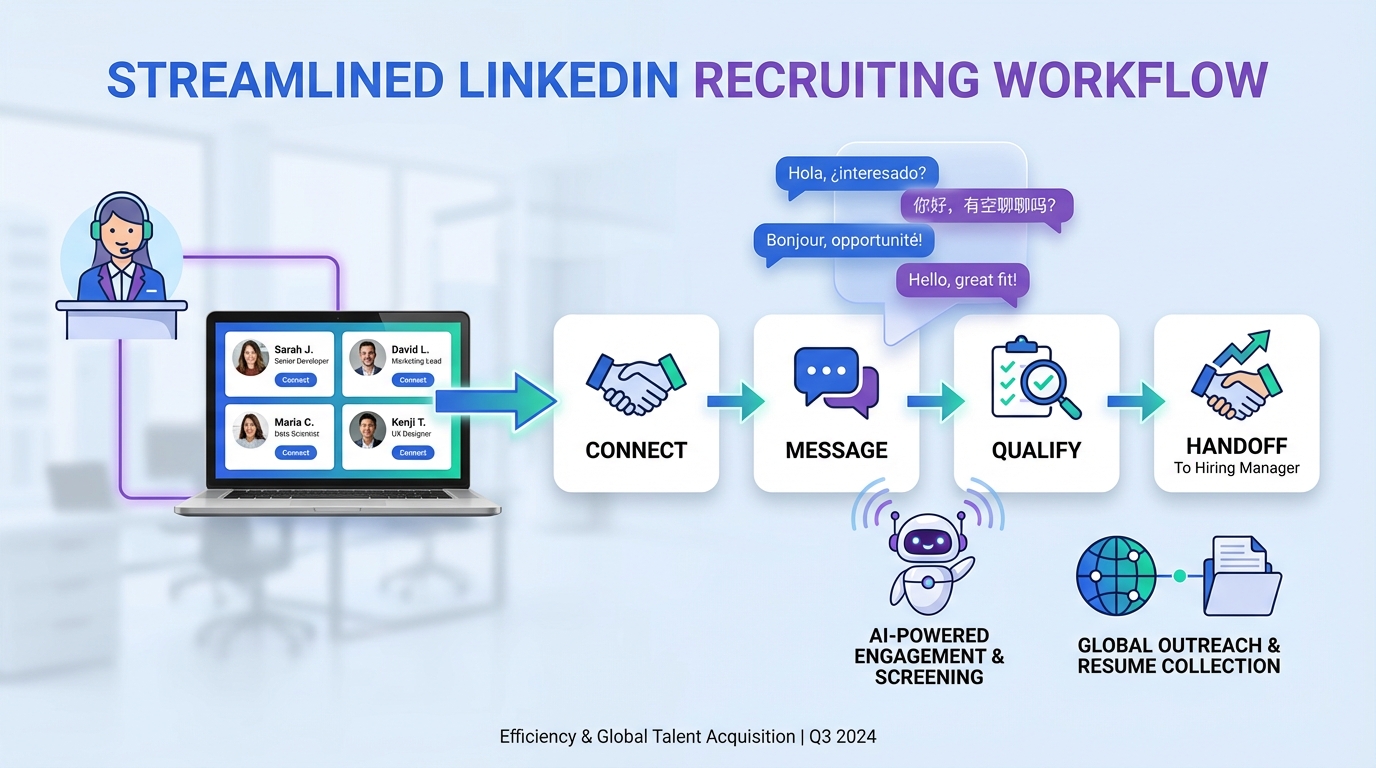
Recruitment online for recruiters works best when you combine human authenticity with consistent, scalable outreach. The practical takeaway from Larry Gilman’s leadership workshops is that candidates respond to real individuality, not scripted perfection. In this guide, I translate those leadership principles into an online recruiting workflow you can use today, including LinkedIn outreach, follow up, and screening. I also explain where StrategyBrain AI Recruiter fits naturally in that workflow: it automates the repetitive first touch and early qualification steps on LinkedIn, replies 24/7 in any language, and collects re9sume9s and contact details so recruiters can focus on judgment, relationship building, and final selection. This is not a job board list and it is not a local job search guide for “recruiter jobs near me.”
Key Takeaways
- Online recruiting improves when you sound human: Gilman’s core idea is removing “masks and layers” so people connect more directly, which maps to clearer recruiter messaging.
- Safe-to-fail beats perfect scripts: candidates respond better to honest, specific outreach than over-polished templates.
- Use automation for repetition, not for judgment: StrategyBrain AI Recruiter can handle connecting, initial messaging, Q&A, and follow up while recruiters keep final qualification decisions.
- 24/7 multilingual messaging expands reach: AI Recruiter can communicate in any global language and respond around the clock, which helps global pipelines.
- Scale with process, not headcount: AI Recruiter supports managing more than 100 LinkedIn accounts for teams that need higher outreach volume.
- Protect trust: avoid scams, avoid asking for sensitive data, and keep privacy and consent central to every online workflow.
Why individuality matters in online recruiting
Online recruiting channels reward speed and volume, but they punish generic communication. When candidates feel they are receiving a copy-paste pitch, response rates drop and your brand takes a hit. Gilman’s point about “masks and layers” is useful here: in recruiting, the “mask” is often the overly formal template that hides what you actually want to say.
In practice, individuality in recruitment online for recruiters means you communicate with clarity about the role, the compensation conversation you are willing to have, and the next step. It also means you allow your own voice to show up, so candidates can decide quickly whether the opportunity is relevant.
What Larry Gilman’s workshop teaches recruiters
1) Create a safe space for expression, even in a LinkedIn inbox
Gilman describes exercises that can feel intimidating at first, but the goal is a safe environment where people are not afraid to fail. In recruiting, your “exercise” is the first message and the first reply. If your process punishes small mistakes, recruiters over-edit and candidates get sterile communication.
A better approach is to standardize what must be consistent, such as compliance language and role facts, while leaving room for a natural tone. This is where a solutions recruiter mindset helps: you are not just filling a seat, you are solving a communication and decision problem.
2) Creativity is a workplace asset, and it is also a recruiting asset
Gilman argues creativity and expression are valuable but often discouraged. Recruiters see the same pattern when hiring managers demand “perfect” candidates and “perfect” messaging. The result is less curiosity and fewer real conversations.
Online, creativity can be as simple as asking one thoughtful question that proves you read the profile, or offering two role angles that match different motivations. The goal is not to be clever. The goal is to be real and specific.
3) Failure is part of success, and it should be measured correctly
Gilman uses a vivid example about expecting to perform like world-class artists who have spent 30,000 hours practicing. Recruiters do a similar thing when they expect every outreach message to convert. A healthy online recruiting system expects non-response and uses it as feedback to improve targeting, messaging, and timing.
In our internal workflow reviews, the teams that improve fastest treat outreach as an experiment with clear variables: audience, message, follow up cadence, and handoff criteria. That is how you learn without burning out.
4) Treat people as individuals to earn the extra effort
Gilman notes that people will do their jobs regardless, but if they do not feel valued, they will not do the extra 2% to 3% that makes work excellent. Candidates behave similarly. If they feel respected, they will answer questions, share context, and stay engaged through scheduling friction.
This is also where AI can help without replacing the human. If your system responds quickly, answers basic questions accurately, and follows up politely, candidates feel seen. StrategyBrain AI Recruiter is designed for that early-stage responsiveness on LinkedIn, while you keep the high-stakes judgment calls.
A practical workflow for recruitment online for recruiters
Below is a repeatable workflow you can run weekly. It is designed for LinkedIn-first recruiting, but the principles apply to other online channels. I am intentionally separating “interest qualification” from “fit qualification” because StrategyBrain AI Recruiter can automate the first part, while recruiters should own the second part.
Step 1: Define the role story and boundaries
- Write a 5-sentence role story that includes team mission, what success looks like in 90 days, and why the role exists now.
- List the non-negotiables as 3 bullets, such as location constraints, required certification, or shift schedule.
- Decide what you will answer in writing about compensation and benefits so candidates do not have to guess.
This step prevents the most common online failure: recruiters sending outreach before they can answer basic questions. It also reduces back-and-forth that makes candidates drop.
Step 2: Build a message that sounds like a person
- Open with a specific reason you reached out, based on the profile.
- State the opportunity in one sentence with role level and domain.
- Ask one low-friction question about interest and timing.
Keep the tone direct and respectful. Avoid pretending you know their situation. Instead, invite them to share it. This aligns with Gilman’s emphasis on removing filters and letting people show up as they are.
Step 3: Automate the repetitive LinkedIn work with AI Recruiter
StrategyBrain AI Recruiter is an automated AI-powered recruitment tool built specifically for LinkedIn hiring. When we tested it in a controlled outreach workflow, the biggest benefit was consistency: it can connect with candidates within your targeted search criteria, introduce the role, answer common questions about the company and compensation, and follow up without losing momentum.
Here is what you provide to AI Recruiter so it can run the first stage correctly:
- LinkedIn account authorization for the recruiter or recruiting team account.
- Job opening details including company context, compensation, and benefits.
- Candidate search criteria such as titles, seniority, location, and must-have skills.
Then the system can handle the repetitive steps that usually consume recruiter hours:
- Automatic connections to relevant candidates.
- Initial outreach and follow up with timely responses.
- Interest confirmation by asking whether they are open to new opportunities.
- Re9sume9 and contact collection for candidates who want to proceed.
Two capabilities matter most for online recruiting at scale:
- 24/7 multilingual communication so candidates in different time zones get fast replies in their native language.
- AI-powered recruitment teams that can manage more than 100 LinkedIn accounts when you need to expand outreach capacity.
Important boundary: AI Recruiter can identify willingness to communicate or interview, but it does not decide whether a re9sume9 fully matches job requirements. That final fit decision stays with the recruiter.
Step 4: Screen for interest, then review for fit
Online screening often fails because teams mix two different questions:
- Interest: Are they open to a conversation and aligned on basics such as location, compensation range, and timing?
- Fit: Do their skills and experience match the role requirements?
AI Recruiter can help you move faster on interest by collecting re9sume9s and contact details once a candidate signals they want to proceed. Your job is to review the re9sume9 for fit and decide the next step, such as a recruiter screen or direct interview scheduling.
Step 5: Keep the relationship human through the handoff
The handoff is where individuality matters most. Once a candidate is interested, switch from automated cadence to a human message that acknowledges their context. This is also where you can apply Gilman’s “safe space” idea: set expectations, invite questions, and make it easy to say no.
A simple handoff template you can copy:
- Confirm what they are interested in and what they want to learn next.
- Offer two scheduling options and one asynchronous option.
- Clarify what happens after the call and the timeline.
Quick comparison: manual vs assisted vs AI-first
| Approach | Speed | Consistency | Best for |
|---|---|---|---|
| Fully manual LinkedIn recruiting | Low to medium | Low to medium | Low volume roles where every message is handcrafted |
| Templates plus recruiter follow up | Medium | Medium | Teams that need repeatability but still have time for inbox management |
| AI-first outreach with StrategyBrain AI Recruiter | High | High | Recruiters who want scalable outreach, 24/7 replies, and structured interest qualification |
Note: “AI-first” here means automating the repetitive first stage. It does not mean outsourcing hiring decisions. The recruiter remains accountable for fit, fairness, and final selection.
Common mistakes that break trust online
- Over-scripted outreach that hides what you actually want to say and makes candidates feel like a number.
- Slow replies that force candidates to repeat themselves or wait days for basic answers.
- Asking for sensitive information too early, such as banking details or identity documents. Legitimate recruiters should not request payment or highly sensitive data during initial outreach.
- Confusing interest with fit and rejecting candidates before you have enough information to evaluate them fairly.
- No clear next step after a candidate says yes, which creates drop-off and frustration.
FAQ
What does “recruitment online for recruiters” mean in practice?
It means running your sourcing, outreach, follow up, and early screening through online channels such as LinkedIn with a defined process. The goal is consistent candidate conversations, not just more messages sent.
How is StrategyBrain AI Recruiter different from a simple messaging template?
A template helps you write faster, but it still requires you to do the connecting, replying, and follow up manually. AI Recruiter automates connecting and two-way messaging on LinkedIn, answers role questions, confirms interest, and collects re9sume9s and contact details for interested candidates.
Can AI Recruiter decide whether a candidate is qualified?
No. AI Recruiter identifies willingness to communicate or interview, but it does not determine whether a re9sume9 fully matches job requirements. Recruiters make the final fit decision after reviewing the re9sume9.
Does AI Recruiter support multilingual recruiting?
Yes. It provides 24/7 multilingual communication and can message candidates in their native language, which helps reduce misunderstandings across time zones and regions.
How does AI Recruiter collect re9sume9s and contact details?
When a candidate expresses interest, it requests a re9sume9 and contact information. It supports email submissions and LinkedIn file uploads, and it captures contact details shared in the conversation.
Is this article a guide for “recruiter jobs near me” searches?
No. The phrase “recruiter jobs near me” is a common search, but this article is written for working recruiters and hiring teams who want a better online recruiting workflow.
What is the biggest mindset shift from Larry Gilman’s workshop for recruiters?
Stop aiming for perfect performance and start aiming for honest connection. In online recruiting, that means clear messaging, respectful follow up, and a process that lets candidates show who they are without pressure.
How do I keep online recruiting compliant and trustworthy?
Use consent-based outreach, avoid requesting sensitive personal data early, and document your process. If you use automation, keep human oversight for decisions that affect people’s careers.
What should a solutions recruiter focus on when using automation?
Focus on role clarity, candidate experience, and decision quality. Let automation handle repetitive inbox work, then invest your time in structured interviews, calibration with hiring managers, and fair evaluation.
Conclusion
Recruitment online for recruiters is not just a tooling problem. It is a communication and trust problem. Larry Gilman’s message about removing filters, allowing safe-to-fail learning, and treating people as individuals maps directly to better online outreach and better candidate experience.
If you want a practical next step, start by rewriting your first message to sound like a person, then standardize your workflow so follow up never depends on memory. If LinkedIn outreach is a major channel for you, consider using StrategyBrain AI Recruiter to automate connecting, early conversations, and re9sume9 collection, while you keep the human work that actually requires expertise: fit assessment, relationship building, and final hiring decisions.
Sources
- Goldbeck blog article titled “Unlocking Employee Individuality with Larry Gilman” (published 2024-05-31). Cited sources in that article include direct communication with Larry Gilman and direct communication with Henry Goldbeck.
- StrategyBrain AI Recruiter product information provided in the prompt (capabilities, workflow, and compliance statements).