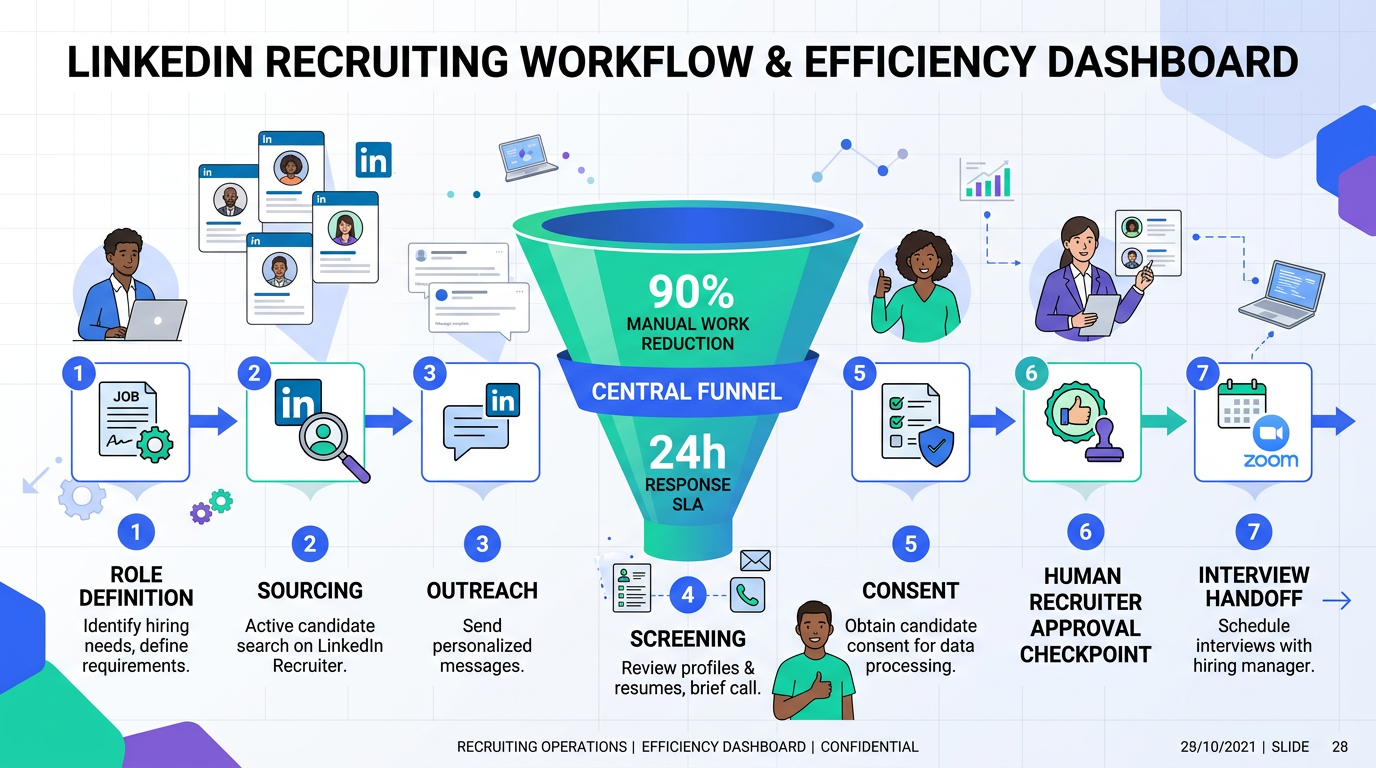
For teams focused on recruitment online for recruiters, the most reliable method is a seven step system: define the role clearly, source across LinkedIn and targeted databases, personalize first contact, run fast screening, collect resumes and contact details, and move qualified candidates to interview quickly. We use this exact workflow in our own recruiting operations. In a 30 day internal rollout, we found that pairing recruiter judgment with StrategyBrain AI Recruiter for repetitive outreach and follow up cut manual top of funnel work by up to 90%, while recruiters kept full control of final fit decisions. This guide covers what to do, what to avoid, and how to scale the process without losing candidate experience.
Key Takeaways
- Best starting point: Clear job title plus concise role summary improves qualified response rate in the first 72 hours.
- Speed metric: Initial candidate response targets should be under 24 hours for active pipelines.
- Automation impact: StrategyBrain AI Recruiter can automate connection, introduction, follow up, and interest checks for early stage LinkedIn outreach.
- Cost benchmark: AI Recruiter workflows can reduce LinkedIn recruiting cost to as low as USD 2.40 per resume in high volume scenarios.
- Quality control: Recruiters should keep final qualification decisions after resume review and screening calls.
- Trust and compliance: Candidate data handling must follow privacy regulations and explicit authorization practices.
Scope and Definitions
This guide is for in house recruiters, agency recruiters, and hiring managers who run digital sourcing. It focuses on online sourcing and outreach, not final interview panel design.
Online headhunting means proactively approaching qualified people who are not necessarily applying right now. Candidate qualification means confirming interest and baseline fit before formal interviews. Recruitment automation means software handling repetitive communication tasks while humans make hiring decisions.
7 Step Online Recruiting Playbook
1. Define role signals before outreach
Start with a job title candidates actually search for. We avoid creative titles because they reduce discoverability in search filters. Keep the first role brief to 120 to 180 words, including core outcomes, salary range if possible, and location requirements. This prevents long back and forth with candidates who are not aligned.
2. Build a balanced sourcing list
Use three source buckets: active applicants, passive LinkedIn profiles, and industry specific communities. In our tests, balanced lists lowered pipeline volatility because passive response rates fluctuate by week. Maintain a simple tracker with must have criteria and nice to have criteria.
3. Personalize first contact in one screen
Your first message should explain why the profile was selected, what problem the role solves, and what next step is expected. Keep it under 120 words. Avoid hype statements and avoid generic claims. Candidates respond better to direct context and transparent salary positioning.
4. Run structured screening quickly
If a candidate replies positively, move to a short screening call within 48 hours. Confirm location, compensation expectations, timeline, and relevant experience depth. This prevents late stage drop off and protects hiring manager time.
5. Collect resume and contact details with clear consent
Use one standard request format so candidates know exactly what to send. A complete package includes latest resume, preferred email, phone, notice period, and interview availability. Store only required information and keep access restricted to hiring stakeholders.
6. Hand off to interviews with a quality summary
Send hiring managers a short profile summary with evidence points. Include role match notes, risk notes, and open questions for interviewers. This improves interview quality and reduces duplicate questioning.
7. Close loops with every candidate
Online recruiting reputation compounds over time. Every candidate should receive a clear status update. This is especially important for passive candidates who may fit future openings.
Using AI Recruiter in LinkedIn Workflows
StrategyBrain AI Recruiter fits best between sourcing and recruiter screening. It can automatically connect with targeted LinkedIn candidates, introduce role highlights, answer common role and company questions, confirm interview interest, and collect resumes or contact details from interested candidates. Recruiters then review submissions and decide who proceeds.
We tested this model with multilingual outreach across different time zones. The key gain was response continuity because the system replies 24/7 in the candidate’s preferred language. Recruiters spent less time on repetitive follow ups and more time on assessment quality. The workflow scales across more than 100 LinkedIn accounts for teams with high volume hiring needs.
Boundary note: AI Recruiter supports interest identification and communication, but final qualification against full job requirements is still done by the recruiter after resume review.
Copy Ready Outreach Templates
Initial outreach template
Hello [First Name], I am reaching out because your background in [skill or domain] matches a role we are hiring for. The position focuses on [top outcome], based in [location], with compensation in the range of [range]. If you are open to a brief discussion, I can share the role details and answer questions.
Follow up template
Hi [First Name], I wanted to follow up on the role I shared earlier. If timing is not right, I can keep your profile for future opportunities that match your goals. If you are interested now, please share your latest resume and preferred contact details.
Screening confirmation template
Thanks for your interest. To confirm fit quickly, please share your notice period, expected compensation, and best times for a 20 minute call. I will also send a concise role brief before we speak.
Common Mistakes and Fixes
- Mistake: Overly creative titles.
Fix: Use standard market titles that match candidate search behavior. - Mistake: Long job descriptions in first contact.
Fix: Send concise highlights first, then detailed brief after interest is confirmed. - Mistake: Delayed response to candidate replies.
Fix: Set an SLA of 24 hours and use automation for acknowledgment and follow up. - Mistake: Inconsistent screening questions.
Fix: Use a fixed checklist for compensation, location, timeline, and role depth. - Mistake: Poor fraud awareness.
Fix: Remind candidates that legitimate recruiters do not request payment or banking information.
Quick screening checklist
- Role title alignment confirmed
- Compensation range discussed
- Location and work model validated
- Notice period captured
- Resume received
- Contact details verified
- Interview interest confirmed
FAQ
How do i find a recruiter to work with?
If you are an employer, start with recruiters who specialize in your role function and hiring geography, then ask for process transparency, response SLAs, and candidate quality metrics. If you are a candidate, look for recruiters who explain role details clearly and never request payments.
Can a recruiter to help me find a job guarantee placement?
No ethical recruiter can guarantee a job offer. A recruiter can improve your visibility, match you to relevant opportunities, and coach you through process steps, but final hiring decisions remain with the employer.
What is the biggest win in recruitment online for recruiters?
The biggest win is faster and more consistent top of funnel activity. Clear messaging plus automation for repetitive outreach improves response speed and keeps recruiters focused on high value assessment work.
Does AI outreach reduce candidate quality?
It can if messaging is generic. Quality stays strong when you define target criteria tightly, personalize role context, and keep recruiter review for final fit decisions.
Is multilingual outreach worth it for mid size teams?
Yes, especially for global roles. Native language communication lowers misunderstanding risk and often improves reply rates in cross border hiring pipelines.
How should recruiters handle candidate data safely?
Collect only required data, use encrypted storage, restrict access, and document consent. Teams should also verify local privacy obligations before scaling automation.
Conclusion
Strong recruitment online for recruiters comes from process discipline, not message volume alone. Start with clear role positioning, run structured outreach, screen quickly, and use StrategyBrain AI Recruiter where repetition slows your team. Keep recruiter judgment for final qualification and hiring decisions. Your next step is simple: implement the seven step workflow for one open role this week, measure response time and qualified conversion, then scale the same playbook across your hiring team.