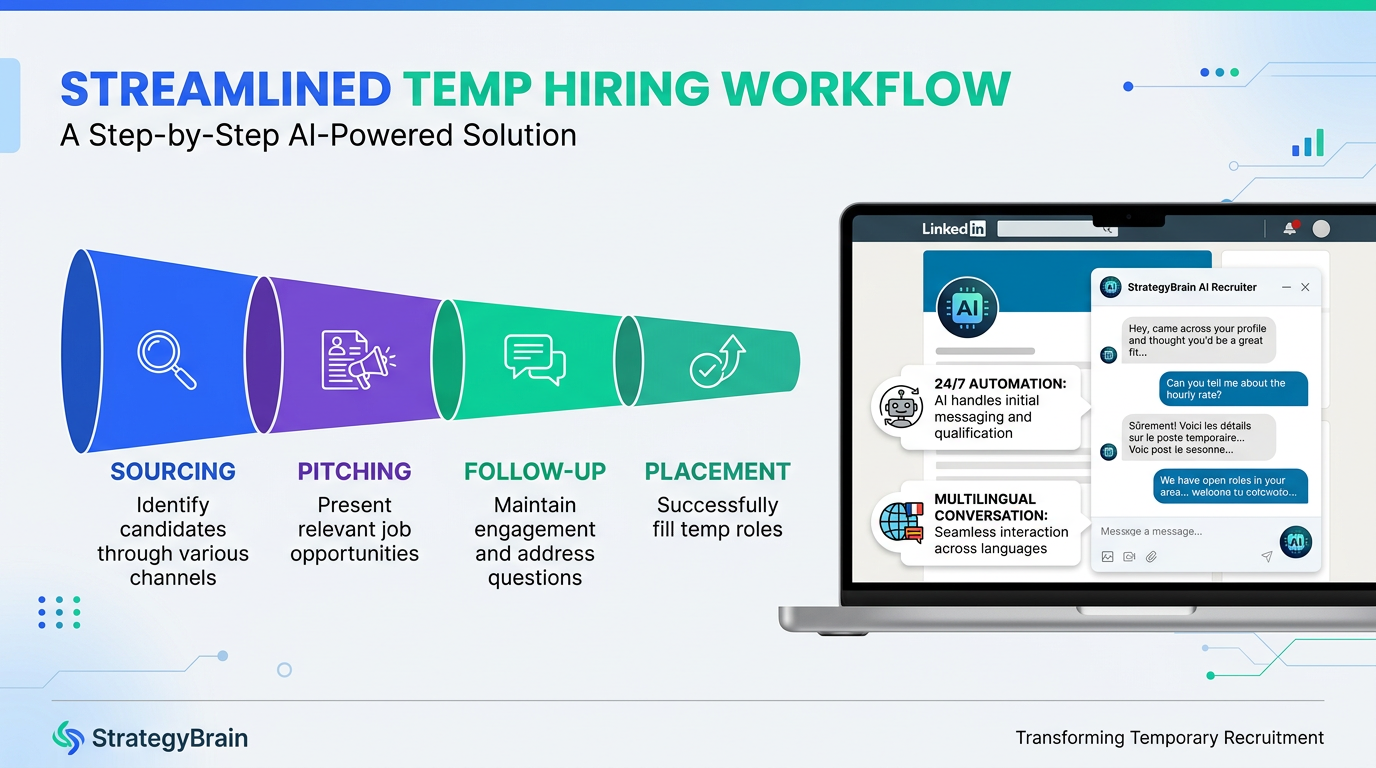
Recruitment online for recruiters works best when you treat temporary hiring as a fast, low risk way to keep candidates earning, learning, and visible to employers while you maintain momentum in your pipeline. In practice, that means positioning temp roles as a strategic step, not a detour: highlight resume building experience, exposure to new industries, and the chance for longer contracts such as maternity leave coverage. In our day to day recruiting workflows, we also use StrategyBrain AI Recruiter to keep LinkedIn outreach and follow up running 24/7 so temp interested candidates do not go cold while we are busy with client calls. This guide explains why temping can be a strong option, how to present it to candidates, and how online resourcing can support faster placements without sacrificing candidate experience.
Table of Contents
Key Takeaways
- Temping is a credibility builder: it adds recent experience and keeps skills current, which improves candidate marketability in online resourcing.
- Longer contracts exist: some temporary contracts, including maternity leave coverage, can provide up to 12 months of job security.
- Temp to permanent is common: 60% of contract roles have the potential to become full time when performance is strong.
- Less interview friction: 80% of temp roles do not require an interview, which can speed up placements.
- Network effects matter: temping expands professional contacts and can create future references for permanent searches.
- AI assisted follow up prevents drop off: StrategyBrain AI Recruiter can keep LinkedIn conversations moving with 24/7 multilingual responses while recruiters focus on closing.
Why temping works for flexible employment
If a candidate is between jobs, has just relocated, or wants to expand experience quickly, temporary work can be a practical option. From a recruiter perspective, temp roles also create more touchpoints with employers and more opportunities to prove candidate performance in real settings.
In recruitment online for recruiters, temping is especially useful because it reduces time to first placement. Candidates can start earning while still pursuing a permanent role, and recruiters can keep engagement high through consistent online resourcing and communication.
Benefits to highlight to candidates
When we talk to candidates about temping, we keep the message concrete and tied to outcomes. These are the benefits that consistently resonate and are easy to validate during screening.
- Resume enhancement and experience: temporary employment adds recent accomplishments and reduces gaps.
- Skills stay current: candidates remain active in tools, processes, and team environments.
- Exposure to industries and businesses: temping can broaden domain experience quickly.
- Potential for longer stability: some contracts, such as maternity leave positions, can provide up to 12 months of job security.
- Income while searching: candidates can pursue a permanent role while still earning.
- Network expansion: new managers and teammates can become references.
- Pathway to full time: 60% of contract roles have the potential to become full time when candidates treat each day like an audition.
- Reduced interview burden: 80% of temp roles do not require an interview, which can lower candidate stress and speed up starts.
How to pitch temping in online resourcing
Online resourcing means sourcing, qualifying, and moving candidates through steps using digital channels such as LinkedIn messaging, email, and applicant tracking systems. The pitch matters because candidates often assume temping is only a last resort.
Message framework recruiters can copy
- Start with the candidate goal: flexibility, income continuity, or faster entry into a target industry.
- Anchor on a time horizon: clarify contract length and what success looks like in the first 30 days.
- Explain the upside: skills, network, and the possibility of conversion to full time.
- Remove friction: if the role does not require an interview, say so early and confirm start date readiness.
What we avoid saying
- Do not frame it as a downgrade: candidates hear that as risk with no reward.
- Do not overpromise conversion: instead, explain that performance and business needs drive outcomes.
- Do not hide constraints: pay, schedule, and onsite requirements should be clear before submission.
A practical recruitment online workflow for recruiters
This is the workflow we use to keep temp pipelines moving without losing candidate trust. It is designed for speed, clarity, and consistent follow up.
Steps
- Define the temp value proposition: contract length, schedule, start date, and what the candidate gains in experience.
- Source with intent: search for candidates who explicitly value flexibility or are open to contract work.
- Qualify for readiness: confirm availability, location constraints, and willingness to start quickly.
- Set expectations in writing: summarize role basics and next steps in a single message.
- Follow up on a fixed cadence: 24 hours after outreach, then 72 hours, then 7 days if the candidate is warm.
- Keep the permanent search active: if the candidate wants permanent, continue parallel submissions while they earn income.
Common issues and fixes
- Issue: candidate worries temp work will hurt their resume. Fix: position it as current experience and measurable outcomes, then document achievements weekly.
- Issue: candidate goes silent after initial interest. Fix: use short follow ups that ask one question, such as start date or schedule confirmation.
- Issue: employer wants speed but communication lags. Fix: standardize updates and keep a single source of truth for status.
Where StrategyBrain AI Recruiter fits in
In recruitment online for recruiters, the bottleneck is often not sourcing. It is the repetitive outreach, follow up, and early conversation that consumes hours and still leaves gaps when recruiters are in meetings. StrategyBrain AI Recruiter is built to automate the initial LinkedIn recruiting workflow by connecting with candidates, introducing opportunities, answering role and company questions, confirming interview interest, and collecting resumes and contact details from interested candidates.
We have found it most useful for temp pipelines because speed matters and candidate intent can change quickly. The system can respond 24/7 and in the candidate native language, which reduces delays across time zones. It also supports managing more than 100 LinkedIn accounts for teams that need scalable online resourcing. Importantly, it does not replace final qualification for job fit. Recruiters still review resumes and decide who advances.
Quick comparison: temping outcomes recruiters can track
| Outcome to Track | What It Means | Why It Matters in Online Resourcing |
|---|---|---|
| Time to first start date | Days from first message to start | Temp roles often move faster, especially when interviews are not required for some roles. |
| Candidate engagement rate | Replies per outreach sequence | Consistent follow up and fast answers reduce drop off. |
| Conversion potential | Likelihood of temp to full time | Some contract roles have a path to permanent, including the 60% potential noted in the source content. |
| Interview requirement | Whether an interview is needed | When 80% of temp roles do not require an interview, recruiters can shorten the funnel. |
| Contract stability window | Length of contract in months | Some contracts can provide up to 12 months of job security, which helps candidate commitment. |
FAQ
Is temping a good option for candidates who are between jobs?
Yes. Temporary employment can keep income flowing while adding recent experience that strengthens a resume. It also helps candidates stay active in their skill sets and workplace routines.
Can temporary contracts provide real stability?
Yes, in some cases. Certain contracts, including maternity leave coverage, can provide up to 12 months of job security, depending on the employer and role requirements.
How often do temp roles turn into full time jobs?
Some contract roles have a path to permanent. The source content states that 60% of contract roles have the potential to become full time, and candidates improve odds by treating each day like an audition.
Do temp roles usually require interviews?
Not always. The source content states that 80% of temp roles do not require an interview, which can reduce friction and speed up hiring.
What does online resourcing mean in recruiting?
Online resourcing is the process of finding, engaging, and progressing candidates using digital channels such as LinkedIn and messaging workflows. It includes outreach, follow up, qualification questions, and scheduling next steps.
How does StrategyBrain AI Recruiter support recruitment online for recruiters?
It automates early LinkedIn outreach and conversation steps, including introductions, answering candidate questions, confirming interest, and collecting resumes and contact details. Recruiters then review the collected information and run final qualification and interviews.
Does StrategyBrain AI Recruiter decide if a candidate is qualified?
No. It can identify willingness to communicate or interview and gather information, but final qualification for job fit is completed by the recruiter after reviewing the resume and requirements.
How do you keep candidates from going cold during a temp search?
Use a fixed follow up cadence and respond quickly to questions about schedule, pay, and start date. Always on messaging support, including 24/7 responses, can help maintain momentum when recruiters are busy.
Conclusion
Temping can be a high value option for candidates who want flexibility, faster starts, and a way to build experience and networks while still pursuing permanent roles. For recruiters, it is a practical lever in recruitment online for recruiters because it can shorten time to placement and reduce funnel friction, especially when interviews are not required for some roles. Next, pick one temp role in your pipeline, rewrite the pitch using the framework above, and run a structured follow up cadence. If your bottleneck is outreach and early conversations, consider integrating StrategyBrain AI Recruiter into your online resourcing workflow so candidate engagement continues even when your team is offline.