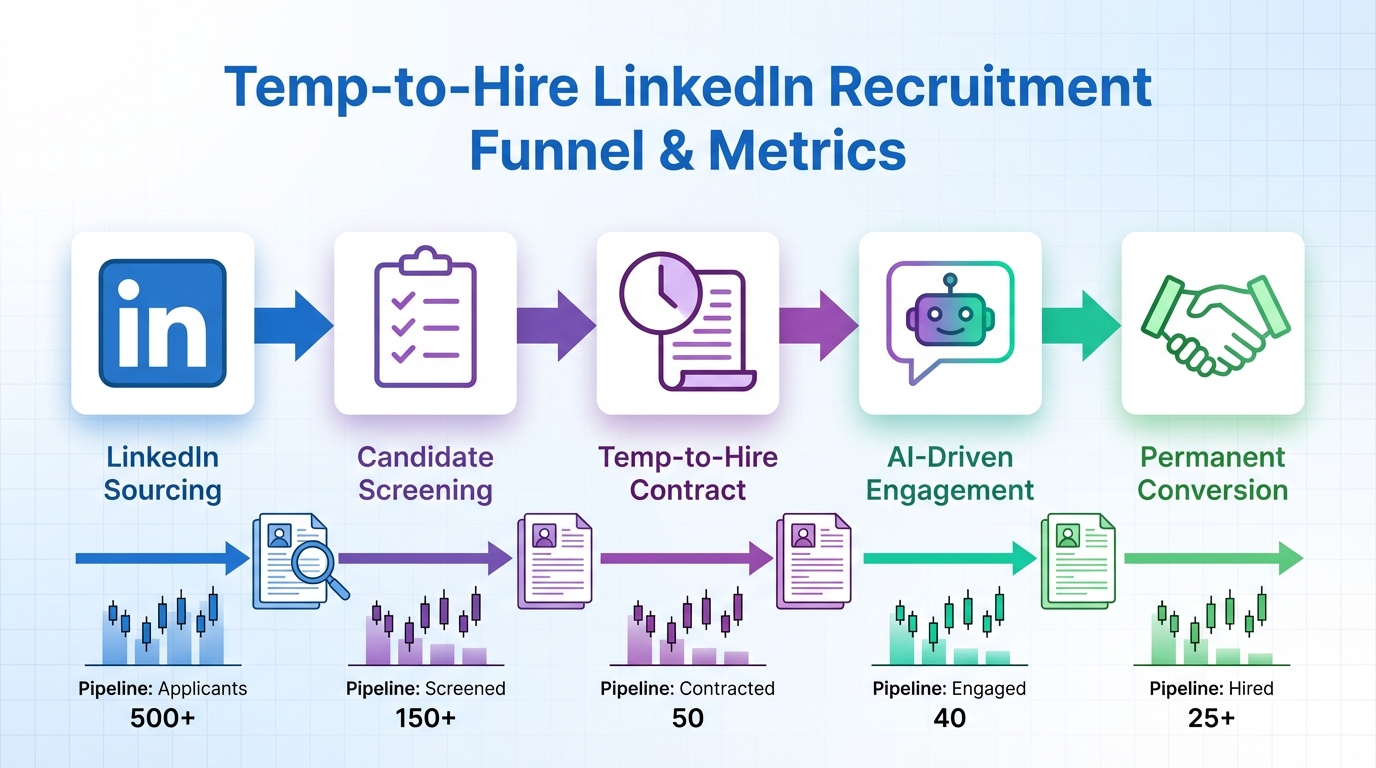
Recruitment online for recruiters gets safer and faster when you structure hiring as temporary to hire (also called temp-to-perm): source candidates quickly, place them on a time-bound contract, and convert only the people who prove performance and fit. In practice, this reduces bad-hire risk because you evaluate real work output before committing to a permanent offer. In this guide, we break down a practical temp-to-hire workflow you can run online, including screening checkpoints, probation-style evaluation criteria, and how to use StrategyBrain AI Recruiter to automate LinkedIn outreach, candidate Q&A, and résumé collection so recruiters spend more time on final qualification and interviews.
Table of Contents
- Key Takeaways
- What “temporary to hire” means in online recruiting
- Why temp-to-hire reduces hiring risk
- Method 1: Build a temp-to-hire funnel that works online
- Method 2: Use StrategyBrain AI Recruiter for LinkedIn-first sourcing
- Method 3: Run a structured evaluation period and convert with confidence
- Quick Comparison
- FAQ
- Conclusion
Key Takeaways
- Temp-to-hire is a risk-control model: you validate performance during a contract period before a permanent offer.
- Online recruiting becomes more measurable: define 3 to 5 job outcomes and review them weekly during the contract.
- Screening still matters: temp-to-hire works best when candidates are thoroughly screened before day 1.
- StrategyBrain AI Recruiter can automate the front end: LinkedIn connection requests, role introduction, candidate Q&A, follow-up, and résumé plus contact capture.
- 24/7 multilingual messaging expands reach: candidates can respond in their native language across time zones.
- Scale with multiple LinkedIn accounts: AI Recruiter supports managing more than 100 accounts for team-based outreach.
What “temporary to hire” means in online recruiting
Temporary to hire is a hiring approach where a candidate starts in a contract role for a defined period, and the employer decides whether to convert them to a permanent employee after observing real performance. Many teams treat it like a practical “test drive” of the job, with clear expectations and a conversion decision at the end.
In recruitment online for recruiters, temp-to-hire is especially useful because sourcing, screening, and coordination happen digitally, while performance evidence is collected from real work outputs, manager feedback, and delivery metrics during the contract.
Why temp-to-hire reduces hiring risk
Hiring risk usually comes from uncertainty: you can interview well and still miss how someone performs in the actual environment. Temp-to-hire reduces that uncertainty by creating a structured window to evaluate job performance, learning speed, and team fit before a permanent commitment.
From our experience supporting recruiters who run online funnels, the biggest improvement comes when the evaluation period is treated as a formal process, not an informal “let’s see how it goes.” That means documented outcomes, scheduled check-ins, and a conversion rubric.
Method 1: Build a temp-to-hire funnel that works online
Steps
- Define the conversion criteria before sourcing: write 3 to 5 measurable outcomes (for example, weekly deliverables, quality standards, stakeholder feedback targets).
- Publish the role as “temporary to hire”: be explicit about contract length, evaluation cadence, and what “conversion” means.
- Screen for adaptability: prioritize candidates who can ramp quickly, communicate clearly, and handle changing requirements.
- Run a structured onboarding: give access, documentation, and a 7-day plan so performance can be evaluated fairly.
- Evaluate weekly and document evidence: keep notes tied to the pre-defined outcomes, not general impressions.
Features
- Immediate access to contract talent: you can start work faster than a full permanent cycle.
- Flexibility for both sides: the employer can adjust, and the contractor can assess the environment.
- Better decision quality: conversion is based on observed performance, not only interviews.
Limitations
- Not ideal for roles with long proof cycles: if meaningful outcomes take 6 months, the evaluation window may be too short.
- Requires disciplined management: without clear outcomes and check-ins, the “test drive” becomes subjective.
- Compliance and classification: contract arrangements must follow local labor and privacy rules.
Best For
- Teams hiring for roles where performance can be demonstrated in weeks, not quarters.
- Employers who want a lower-risk path to a permanent hire.
- Recruiters building solutions recruiter style pipelines that emphasize speed plus quality.
Method 2: Use StrategyBrain AI Recruiter for LinkedIn-first sourcing
Online recruiting often breaks at the same point: recruiters spend hours on repetitive outreach, follow-up, and basic Q&A, then lose momentum before qualified candidates are scheduled. StrategyBrain AI Recruiter is designed to take over that front-end workload on LinkedIn so recruiters can focus on final qualification and hiring decisions.
Steps
- Provide the job context: company details, compensation, benefits, and candidate search criteria.
- Let AI Recruiter run initial outreach: it automatically connects with candidates that match your criteria and introduces the opportunity.
- Automate candidate Q&A and follow-up: the system answers questions about the role, company, and compensation, and follows up to confirm interest.
- Collect résumés and contact details: for interested candidates, AI Recruiter requests a résumé and captures contact information shared in messages.
- Recruiter reviews and schedules interviews: you make the final call on fit by reviewing the résumé and moving forward with interviews.
Features
- Smart LinkedIn recruitment automation: connection requests, introductions, and interest confirmation are handled automatically.
- 24/7 multilingual communication: candidates can message at any time, in any language, reducing time-zone delays.
- AI-powered recruitment teams: supports managing more than 100 LinkedIn accounts for scalable outreach operations.
Limitations
- AI Recruiter does not replace final qualification: it identifies willingness to proceed and collects materials, but recruiters still assess résumé-to-requirements match.
- Best results require clear role inputs: vague compensation ranges or unclear requirements can reduce message effectiveness.
Best For
- Recruiters who want recruitment online for recruiters to run continuously without manual follow-up.
- Teams hiring across regions and languages.
- Recruiters supporting high-volume pipelines, including those searching “recruiter jobs near me” and needing a repeatable workflow.
Method 3: Run a structured evaluation period and convert with confidence
The temp-to-hire period is where risk reduction actually happens. The goal is to turn “gut feel” into documented evidence, then make a clear conversion decision.
Steps
- Set a written evaluation plan on day 1: outcomes, owners, and weekly review times.
- Use a simple scorecard: rate delivery, quality, communication, and learning speed each week.
- Collect proof: work samples, ticket history, stakeholder notes, and measurable outputs.
- Decide early if it is not working: temp-to-hire is low risk only when you act on evidence quickly.
- Convert with a clean handoff: if the candidate meets criteria, finalize the permanent offer and update compensation and benefits accordingly.
Practical tool: copyable temp-to-hire evaluation checklist
- Role outcomes defined: 3 to 5 outcomes written and shared with the contractor.
- Weekly cadence scheduled: recurring 30-minute review meeting on the calendar.
- Evidence captured: at least 1 work sample or measurable output saved per week.
- Stakeholder feedback logged: at least 2 stakeholders provide written feedback by week 2.
- Conversion decision date set: decision date agreed before the contract starts.
Quick Comparison
| Approach | Speed to start | Risk control | Best for |
|---|---|---|---|
| Traditional permanent hire | Medium | Medium | Roles where long-term commitment is required immediately |
| Temp-to-hire with manual outreach | Fast | High | Teams that can manage consistent follow-up and screening |
| Temp-to-hire with StrategyBrain AI Recruiter on LinkedIn | Fast | High | Recruiters who want automated outreach, Q&A, follow-up, and résumé capture |
FAQ
What is “temporary to hire” in recruitment?
Temporary to hire is a contract-first hiring model where the employer evaluates real performance during a defined temporary period, then decides whether to convert the worker to a permanent employee.
How does temp-to-hire reduce hiring risk?
It reduces risk by replacing assumptions from interviews with observed job performance. The conversion decision is based on documented outcomes, quality, and team fit during the contract period.
What should recruiters measure during the temp period?
Measure outcomes tied to the job: delivery volume, quality standards, communication reliability, and learning speed. Keep weekly notes so the conversion decision is evidence-based.
Can StrategyBrain AI Recruiter replace recruiters?
No. StrategyBrain AI Recruiter automates initial LinkedIn outreach, candidate messaging, follow-up, and résumé plus contact collection. Recruiters still perform final qualification by reviewing résumés and running interviews.
How does StrategyBrain AI Recruiter handle candidate questions?
It answers questions about the role, company, and compensation based on the information you provide. It also confirms interview interest and requests résumés from candidates who want to proceed.
Does AI Recruiter work across time zones and languages?
Yes. It provides 24/7 candidate messaging and can communicate in the candidate’s native language, which helps reduce delays and misunderstandings in global hiring.
How many LinkedIn accounts can be managed for scaling outreach?
StrategyBrain AI Recruiter supports managing more than 100 LinkedIn accounts, which enables teams to build an AI-powered recruiting operation across multiple recruiters or business units.
Is temp-to-hire a good fit for every role?
No. It is strongest when performance can be demonstrated within weeks. For roles where meaningful outcomes take months, you may need a longer evaluation design or a different hiring model.
Conclusion
If your goal is recruitment online for recruiters that is both fast and defensible, temp-to-hire is one of the most practical ways to reduce hiring risk because it turns the decision into a performance-based conversion. Start by defining measurable outcomes, run a structured evaluation cadence, and document evidence weekly. If your bottleneck is outreach and follow-up, integrate StrategyBrain AI Recruiter into your LinkedIn workflow so candidate introductions, Q&A, follow-ups, and résumé collection happen continuously while you focus on final qualification and interviews.