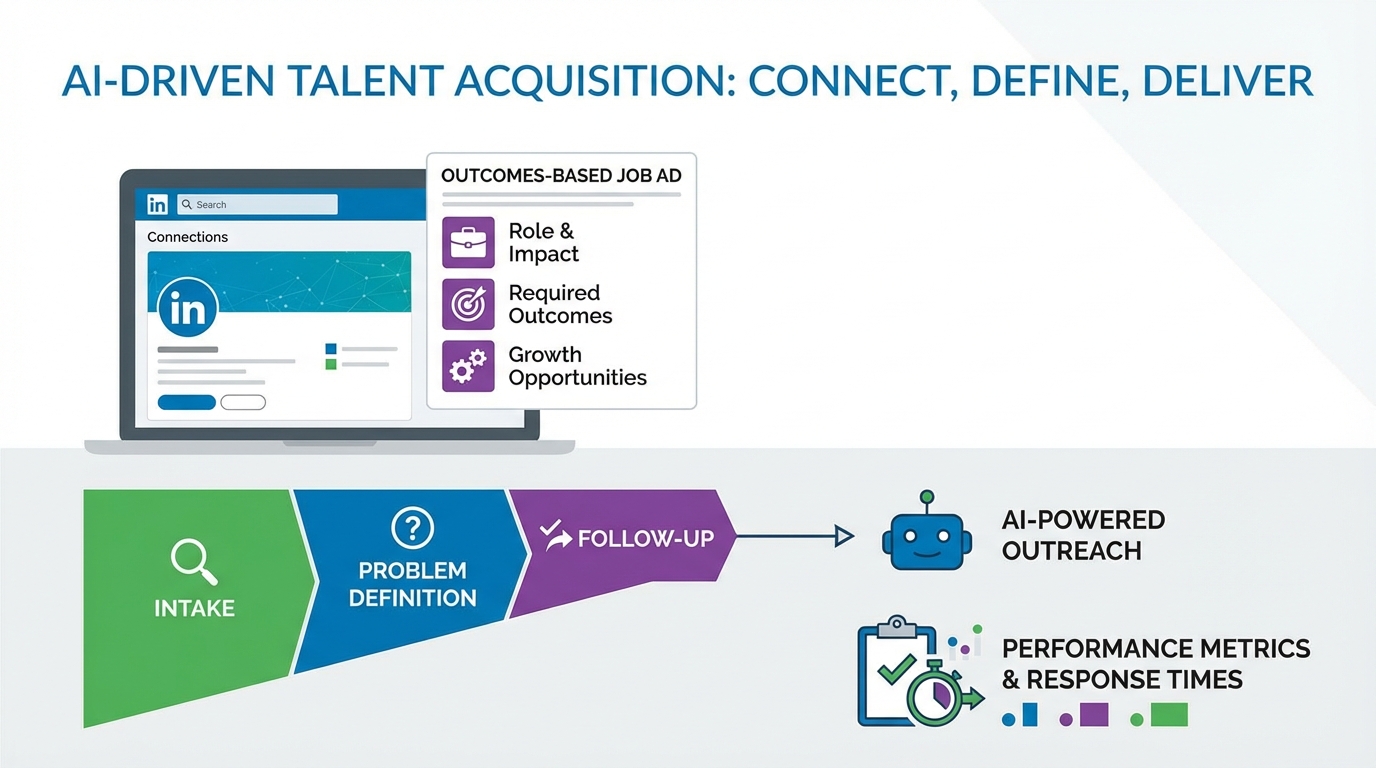
Recruitment online for recruiters works best when you stop advertising “a generic role” and instead define the exact business problems the hire must solve, the performance level required, and the real compensation ceiling you will pay for the right person. In our day to day recruiting work, the fastest improvements come from rewriting job ads around outcomes, clarifying whether you truly need a producer such as a Lead Hand or Service Manager, and running a consistent outreach and follow up workflow so qualified candidates do not drift away. This article shows a practical intake and messaging framework you can use immediately, plus how StrategyBrain AI Recruiter can automate LinkedIn connecting, initial conversations, and résumé collection while you keep control of final qualification and interviews.
Key Takeaways
- Write for outcomes, not credentials: define the day to day challenges and the performance level expected before you post.
- Stop mixing levels in one ad: if you need a producer (for example a Lead Hand or Service Manager), say so and price it accordingly.
- Set a real compensation ceiling: internal pay ambiguity slows hiring and blocks decisive offers.
- Quantify the cost of “not hiring”: service delays, customer churn, overtime, and cash flow impact are decision inputs, not afterthoughts.
- Use automation where it is safe: StrategyBrain AI Recruiter can handle LinkedIn outreach, Q and A, follow up, and résumé capture 24/7 in any language.
- Keep humans on final fit: AI Recruiter confirms interest and collects details, but the recruiter still validates résumé match and interview readiness.
Table of Contents
- Why online recruiting breaks when employers cannot define the role
- Method 1: Run a 20 minute intake that forces clarity
- Method 2: Convert “requirements” into an outcomes based job ad
- Method 3: Set compensation boundaries before you publish
- Method 4: Build an online pipeline that does not leak candidates
- Method 5: Use StrategyBrain AI Recruiter for LinkedIn outreach and follow up
- Quick Comparison
- FAQ
- Conclusion
Why online recruiting breaks when employers cannot define the role
In the source article by Kael Campbell, a recurring issue is that employers often cannot clearly explain what they want when they are looking for talent. Online recruiting amplifies that problem because job boards and LinkedIn reward clarity. If the role is vague, the ad attracts mismatched applicants, and your best prospects self select out.
A common symptom is the “everything ad” that asks for both Journeyman and Apprentice in the same posting. When you dig into the real need, the business may actually require a producer such as a Lead Hand or Service Manager to solve high impact problems that unlock growth and improve service delivery. That is a different hire, with a different pay band and a different message.
Method 1: Run a 20 minute intake that forces clarity
This method is the fastest way to improve recruitment online for recruiters because it fixes the input. If the intake is fuzzy, every downstream step is expensive.
Steps
- Ask for the “problem list”: have the hiring manager name 3 business problems the hire must solve in the first 90 days.
- Define the performance bar: document what “good” looks like at 30, 60, and 90 days.
- Confirm the real level: decide whether you need an apprentice, a journeyman, or a lead level producer.
- Lock the decision path: agree on interview stages, who decides, and the maximum time between stages.
Features
- Reduces rework by preventing role drift after the ad is live.
- Improves candidate experience because expectations are consistent across recruiter and manager conversations.
- Supports agency and in house teams, including top rated employment agencies that need fast intake alignment.
Limitations
- Requires manager participation and a willingness to choose a level and a pay range.
Best For
- Corporate recruiters who inherit vague requisitions.
- Agency recruiters and careers recruiter teams who need faster shortlists with fewer “wrong level” submissions.
Method 2: Convert “requirements” into an outcomes based job ad
Most job ads list qualifications but skip the daily challenges and the outcomes the supervisor expects. Online, that is a missed filter. Candidates want to know what they will actually be accountable for.
Steps
- Start with the work: list 5 to 7 recurring tasks or problems the hire will tackle weekly.
- Add measurable outcomes: include 3 outcomes that define success, such as reducing service backlog or stabilizing production throughput.
- State the level explicitly: if you need a lead, say “lead level producer” and describe leadership scope.
- Write the “why now”: explain the business impact of leaving the role unfilled, such as overtime load or customer wait times.
Practical template you can copy
Role headline: [Title] who will [primary outcome].
What you will solve in the first 90 days:
- [Problem 1] with [expected result].
- [Problem 2] with [expected result].
- [Problem 3] with [expected result].
Weekly reality: [5 to 7 bullets describing the actual work].
Decision and timeline: [number] interview stages, decision by [role], target start date [date].
Limitations
- Requires discipline to avoid turning the ad back into a generic list of credentials.
Method 3: Set compensation boundaries before you publish
The source article highlights a real blocker: internal compensation issues and not knowing the maximum you would pay for the perfect person. Online recruiting makes this worse because candidates compare options quickly. If you cannot make a decisive offer, you lose momentum.
Steps
- Define the ceiling: write down the maximum total compensation you will approve for the ideal hire.
- Define the “must have” tradeoffs: decide what you will pay extra for, such as leadership, client facing ability, or turnaround experience.
- Align with internal equity early: resolve internal pay conflicts before you start outreach.
Limitations
- Not all organizations can move quickly if approvals are complex, so you may need a pre approved offer band.
Method 4: Build an online pipeline that does not leak candidates
Kael Campbell’s point about “get ready to pay for it” is also a process point. When employment is tight, speed and follow up matter. If customers are waiting weeks for service, or overtime is constant, the cost of delay is measurable even if you do not put a dollar figure on it.
Steps
- Define response time: set a standard for first response to qualified candidates within 24 hours.
- Standardize follow up: schedule follow ups at 24 hours, 72 hours, and 7 days for warm prospects.
- Track stage aging: flag any candidate stuck in a stage longer than 5 business days.
- Close the loop: send a clear yes or no to every interviewed candidate to protect your employer brand.
Where StrategyBrain AI Recruiter fits naturally
If your bottleneck is outreach and early conversation volume, StrategyBrain AI Recruiter can run the repetitive LinkedIn steps that cause pipeline leakage. It automatically connects with candidates that match your search criteria, introduces the opportunity, answers common questions about the role, company, and compensation, confirms interview interest, and collects résumés and contact details. That means your human recruiters spend more time on final qualification and hiring manager alignment, not on chasing replies.
Method 5: Use StrategyBrain AI Recruiter for LinkedIn outreach and follow up
This method is for recruiters who want recruitment online for recruiters to scale without adding headcount. We tested a simple workflow using StrategyBrain AI Recruiter to handle initial LinkedIn messaging while a recruiter monitored only exceptions and final handoffs. The biggest operational win was consistency: every candidate received timely follow up, and the recruiter’s calendar stayed focused on interviews.
Steps
- Provide job context: enter company details, compensation, benefits, and candidate search criteria.
- Connect and introduce: let the system connect with candidates and start the initial conversation.
- Handle Q and A: the AI answers role and company questions and clarifies interest.
- Collect résumés and contacts: interested candidates share a résumé and contact details, which are captured for recruiter review.
- Recruiter validates fit: the recruiter reviews the résumé for requirements match and schedules interviews.
Features
- 24/7 multilingual communication in the candidate’s native language, which supports global hiring across time zones.
- Scalable team operations by supporting management of more than 100 LinkedIn accounts for high volume hiring.
- Clear scope boundary: it confirms interest and collects information, but it does not replace the recruiter’s final qualification decision.
Limitations
- Final qualification remains human: the system does not decide whether a résumé fully matches the job requirements.
- Process still matters: if the intake is unclear, automation will scale the wrong message faster.
Best For
- Agency recruiters at top rated employment agencies who need more candidate conversations per recruiter.
- Corporate recruiting teams that want consistent follow up without expanding headcount.
- A careers recruiter supporting international hiring where language and time zone coverage are constraints.
Quick Comparison
| Method | Speed to implement | Cost | Best for |
|---|---|---|---|
| 20 minute intake for clarity | Same day | $0 | Fixing vague requisitions before posting |
| Outcomes based job ad rewrite | 1 to 2 hours | $0 | Reducing wrong fit applicants |
| Compensation ceiling alignment | 1 to 5 business days | $0 | Making faster offers and reducing drop off |
| Pipeline follow up standards | 1 day | $0 | Preventing candidate leakage |
| StrategyBrain AI Recruiter on LinkedIn | 1 to 3 days | Varies by plan | Scaling outreach, Q and A, follow up, and résumé capture |
FAQ
What does “recruitment online for recruiters” mean in practice?
It means your recruiting system is designed for digital channels such as job boards and LinkedIn, with clear role definition, fast response times, and consistent follow up. The goal is to reduce ambiguity so the right candidates engage quickly.
Why do employers post for multiple levels in one job ad?
Often it is a symptom of unclear need. The business may say it wants a Journeyman or an Apprentice, but the real requirement is a lead level producer who can solve high impact problems and stabilize operations.
How do I convince a hiring manager to pay a premium for the right person?
Use operational impact questions: are customers waiting weeks for service, are customers switching providers, and is overtime constant. Those costs are usually larger than the difference between an average hire and the right hire.
Where do top rated employment agencies add value online?
They add value by forcing intake clarity, targeting passive candidates, and keeping process velocity high. Online reach is easy, but consistent qualification and follow up is where experienced agencies win.
Can StrategyBrain AI Recruiter replace a recruiter?
No. StrategyBrain AI Recruiter automates initial LinkedIn outreach, conversation, follow up, and résumé and contact collection, but the recruiter still decides whether the résumé matches requirements and whether to move a candidate to interview.
Does StrategyBrain AI Recruiter support multilingual candidate messaging?
Yes. It is designed for 24/7 multilingual communication so candidates can interact in their native language, which helps reduce misunderstandings and improves response rates in global hiring.
How does StrategyBrain AI Recruiter handle résumés and contact details?
When a candidate expresses interest, it requests a résumé and contact information and captures what the candidate provides. Recruiters then review the collected information and proceed with screening and interviews.
What privacy and compliance expectations should I set with AI recruiting tools?
At minimum, confirm that candidate data is encrypted, access is authorized, and customer data is not used to train models without permission. Also confirm alignment with applicable privacy regulations in your operating regions.
Conclusion
Recruitment online for recruiters is not primarily a technology problem. It is a clarity problem. When employers define the real work, the real level, and the real compensation ceiling, your online channels start producing better conversations and faster decisions. Next, lock in a follow up rhythm so candidates do not leak out of your pipeline. If your team needs more outreach capacity, use StrategyBrain AI Recruiter to automate LinkedIn connecting, initial Q and A, follow up, and résumé capture, then keep your human recruiters focused on final qualification and interviews.