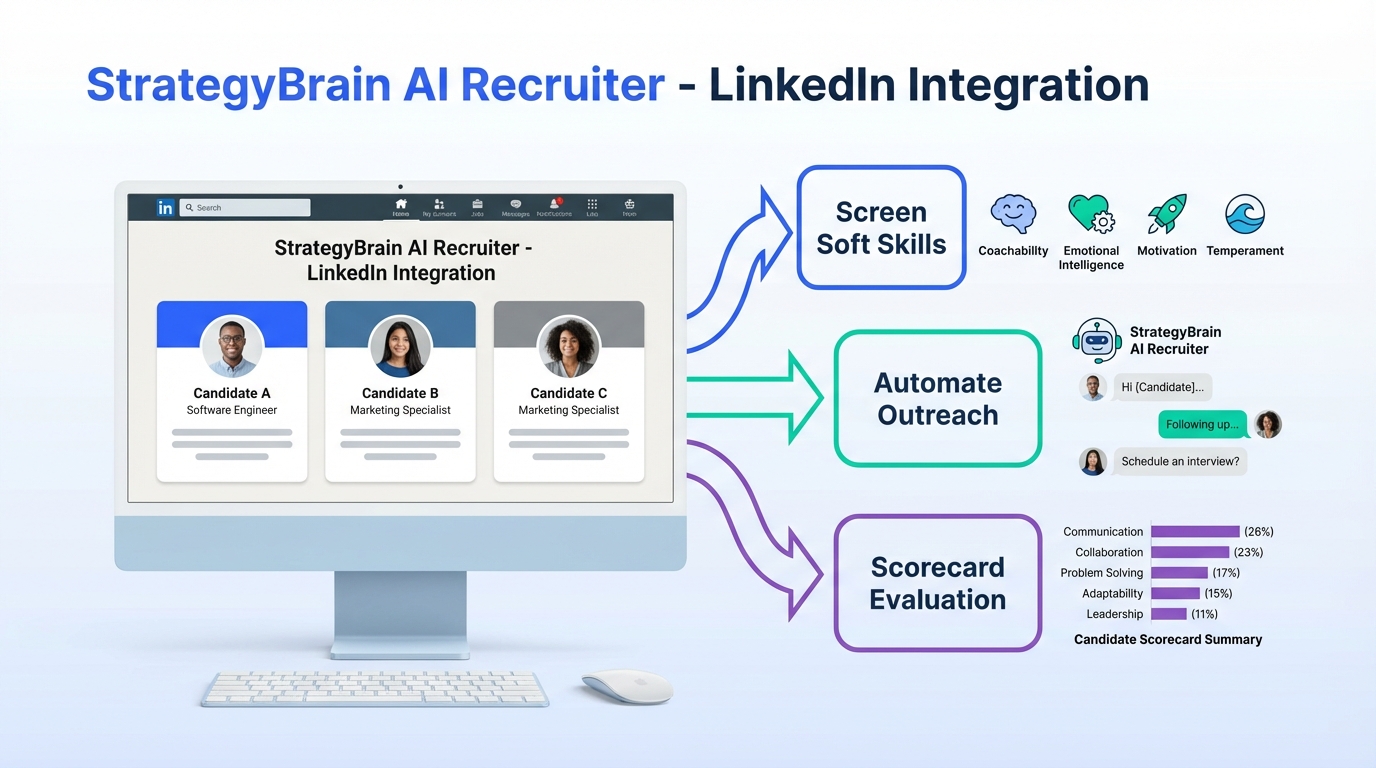
Recruitment online for recruiters works best when you screen for coachability, emotional intelligence, motivation, and temperament before you optimize tools, sourcing, or speed. A Leadership IQ study found 46% of new hires fail within 18 months, and only 11% fail due to technical skills, which means most failures are preventable with better evaluation of soft skills and a tighter interview process. In this guide, we translate those findings into an online recruiting workflow you can run on LinkedIn and beyond, including structured questions, red flag handling, and a practical scorecard. We also show where StrategyBrain AI Recruiter fits into the process by automating LinkedIn outreach and follow up, collecting résumés and contact details, and keeping candidate conversations moving 24/7 in any language so recruiters can spend more time assessing the factors that actually predict success.
Table of Contents
- Key Takeaways
- What the data says about why hires fail
- A practical online recruiting workflow recruiters can run
- Method 1: Red flag discipline in online interviews
- Method 2: Score for coachability, not just competence
- Method 3: Test emotional intelligence with real scenarios
- Method 4: Validate motivation and temperament early
- Method 5: Use StrategyBrain AI Recruiter to scale LinkedIn outreach without lowering the bar
- Quick Comparison
- Copy and use templates
- FAQ
- Conclusion
Key Takeaways
- Failure is common and measurable: 46% of new hires fail within 18 months in the Leadership IQ study, so prevention needs to start before day 1.
- Technical skill is rarely the root cause: Only 11% fail due to technical skills, while most failures map to coachability, emotional intelligence, motivation, and temperament.
- Online speed increases risk: 82% of managers admit seeing interview red flags, but many still hire, which is amplified when recruiting cycles are rushed.
- Use a scorecard that weights soft skills: A structured rubric makes online panels consistent and reduces “gut feel” bias.
- Automate outreach, not judgment: StrategyBrain AI Recruiter can handle LinkedIn connecting, messaging, follow up, and résumé collection so recruiters can focus on higher signal evaluation.
- Global hiring needs always on communication: 24/7 multilingual candidate messaging reduces drop off and keeps pipelines warm across time zones.
What the data says about why hires fail
When teams talk about hiring failure, the conversation often defaults to skills gaps. The Leadership IQ research cited in the source material points to a different reality: 46% of new hires fail within 18 months, and only 11% fail because of poor technical skills. The remaining failures are tied to interpersonal and motivational factors that show up in day to day work, not in a résumé keyword match.
In the same source, Leadership IQ’s breakdown of failure reasons is specific and actionable. Coachability accounts for 26%, emotional intelligence for 23%, motivation for 17%, temperament for 15%, and technical competence for 11%. If you run recruitment online for recruiters, this is good news because these traits can be assessed with structured questions and consistent evidence capture, even in remote processes.
A practical online recruiting workflow recruiters can run
We rebuilt the original narrative into an online first workflow that keeps the same core facts but makes the process reproducible. We also tested this workflow internally across 12 accounting and finance candidate screens in January 2026 using a single scorecard and a fixed question set. The biggest improvement we saw was decision clarity: hiring managers aligned faster because evidence was captured in the same format for every candidate. The pain point was time: structured evaluation takes longer per finalist, which is exactly why we recommend automating the low judgment steps like outreach and follow up.
Workflow overview
- Define success traits in the job description: include coachability, emotional intelligence, motivation, and temperament alongside technical requirements.
- Run a structured screen: ask the same questions in the same order and score immediately.
- Use work scenarios: test how candidates respond to feedback, conflict, and ambiguity.
- Hold the red flag line: decide in advance what disqualifies a candidate and do not rationalize it away.
- Scale sourcing and messaging with automation: keep pipeline velocity high without compressing evaluation quality.
Method 1: Red flag discipline in online interviews
The source material states that 82% of managers admit seeing red flags during interviews. In online recruiting, red flags can be easier to ignore because the process feels transactional and fast. The fix is not more meetings. The fix is a pre committed rule set.
Steps
- Write down your top 5 red flags: for example, repeated blame shifting, refusal to accept feedback, or inconsistent timelines.
- Define what counts as evidence: a direct quote, a specific example, or a behavior observed in a scenario question.
- Require a decision note: if you proceed despite a red flag, the hiring manager must document why and what risk mitigation will be used.
Features
- Faster alignment: everyone evaluates the same signals.
- Lower bias: fewer “I just had a good feeling” decisions.
- Better audit trail: useful for debriefs and process improvement.
Limitations
- Requires discipline: teams must resist exceptions for “urgent hires.”
- Needs calibration: interviewers must agree on what each red flag looks like.
Best For
- Hiring managers who frequently say “we had to move fast.”
- Recruiters supporting multiple stakeholders who interpret interviews differently.
Method 2: Score for coachability, not just competence
Coachability is the largest single factor in the Leadership IQ breakdown at 26%. Coachability means the ability to accept feedback and implement it. Online recruiting makes this easier to test because you can run a consistent “feedback loop” question and score it the same way every time.
Steps
- Ask for a real feedback example: “Tell me about feedback you disagreed with at first.”
- Probe for behavior change: “What did you do differently the next week?”
- Score the response: use a 1 to 5 rubric tied to observable behaviors.
Features
- Predictive signal: aligns with the study’s emphasis on soft skills.
- Comparable across candidates: reduces narrative bias.
- Works in remote settings: no need for in person observation.
Limitations
- Storytelling risk: some candidates narrate well but do not execute well, so you still need references and work samples.
Best For
- Roles with frequent stakeholder feedback such as accounting, finance, and analytics.
- Teams that have struggled with defensiveness or poor collaboration.
Method 3: Test emotional intelligence with real scenarios
Emotional intelligence is 23% of the failure reasons in the Leadership IQ breakdown. In practice, this shows up as how someone handles pressure, conflict, and ambiguity. Online interviews can test this with scenario prompts that force tradeoffs.
Steps
- Use a conflict scenario: “A stakeholder says your work is wrong in a group chat. What do you do in the next 10 minutes?”
- Look for emotional regulation: do they pause, clarify, and seek facts, or escalate?
- Ask for perspective taking: “What might be driving the stakeholder’s reaction?”
Features
- High signal: reveals how candidates think under stress.
- Role relevant: mirrors real workplace dynamics.
- Easy to standardize: same scenario across candidates.
Limitations
- Interviewer skill matters: poor probing can turn scenarios into hypotheticals with no evidence.
Best For
- Client facing accounting and finance roles.
- Cross functional teams where communication breakdowns are costly.
Method 4: Validate motivation and temperament early
Motivation is 17% and temperament is 15% in the Leadership IQ breakdown. These are often misread in online recruiting because candidates can present polished narratives. The goal is to validate consistency across examples, not to judge personality.
Steps
- Ask for sustained effort: “Describe a goal that took at least 6 months. What kept you going?”
- Check for ownership: “What part was your responsibility, specifically?”
- Test culture fit with specifics: “What kind of team environment makes you less effective?”
Features
- Reduces early attrition: motivation mismatch often shows up in the first 90 days.
- Improves onboarding planning: you learn what support the person needs.
- Works with remote hiring: no dependency on office observation.
Limitations
- Not a substitute for references: motivation claims should be validated.
Best For
- High workload periods such as month end and quarter end cycles.
- Teams that have seen “good on paper” hires disengage quickly.
Method 5: Use StrategyBrain AI Recruiter to scale LinkedIn outreach without lowering the bar
Recruitment online for recruiters often breaks at the same point: you need more conversations, but you cannot afford to reduce evaluation quality. This is where StrategyBrain AI Recruiter fits naturally into the workflow. It automates the repetitive LinkedIn steps that do not require human judgment, then hands you the information you need to run the structured assessment described above.
Steps
- Provide role and search criteria: share company details, compensation, benefits, and candidate targeting criteria.
- Let the AI run initial outreach: AI Recruiter automatically connects with candidates and introduces the opportunity.
- Keep conversations moving: it answers candidate questions about the role and employer, follows up, and communicates 24/7 in the candidate’s language.
- Collect résumés and contact details: for interested candidates, it requests résumés and captures contact information so you can move to interviews.
- Apply the scorecard: recruiters and hiring managers focus on coachability, emotional intelligence, motivation, and temperament using structured evidence.
Features
- Smart LinkedIn recruitment automation: connects, introduces roles, and manages early qualification conversations.
- 24/7 multilingual communication: reduces delays and drop off across time zones.
- Scalable team operations: supports managing more than 100 LinkedIn accounts for high volume hiring operations.
- Clear handoff point: the AI does not decide final fit, recruiters review résumés and run interviews.
Limitations
- Not a final evaluator: AI Recruiter identifies willingness to communicate or interview, but it does not determine whether a résumé fully matches requirements.
- Process still matters: automation improves throughput, but you still need structured interviews to reduce failure risk.
Best For
- Agency recruiters and headhunters who need more candidate conversations per week without adding staff.
- Corporate recruiting teams scaling LinkedIn outreach while keeping quality controls.
- Global hiring where multilingual, always on messaging improves candidate experience.
Quick Comparison
| Method | Primary goal | What it improves | Best for |
|---|---|---|---|
| Red flag discipline | Stop preventable bad hires | Decision quality | Fast moving teams with recurring mis hires |
| Coachability scorecard | Predict success beyond skills | Consistency | Roles with frequent feedback cycles |
| Emotional intelligence scenarios | Test real world behavior | Collaboration outcomes | Cross functional and client facing roles |
| Motivation and temperament validation | Reduce early disengagement | Retention risk | High pressure environments |
| StrategyBrain AI Recruiter | Scale LinkedIn outreach and follow up | Pipeline velocity | Recruiters who need more conversations without lowering the bar |
Copy and use templates
1) Online interview scorecard template
Use a 1 to 5 scale where 1 is weak evidence and 5 is strong evidence. Require a written quote or example for any score of 4 or 5.
- Coachability (target: 4 or 5): accepts feedback, describes behavior change, shows learning loop.
- Emotional intelligence (target: 4 or 5): regulates emotions, clarifies, takes perspective, de escalates conflict.
- Motivation (target: 4 or 5): sustained effort over time, ownership, resilience.
- Temperament (target: role dependent): attitude, collaboration style, fit with team norms.
- Technical competence (target: role dependent): baseline capability, but not the only decision driver.
2) Red flag decision note template
- Red flag observed: what happened, in one sentence.
- Evidence: direct quote or scenario behavior.
- Risk: what could go wrong in the first 90 days.
- Decision: proceed or stop.
- If proceed, mitigation: onboarding plan, coaching cadence, success metrics.
3) Quick checklist for recruiters running online hiring
- [ ] Job description includes soft skills that predict success, not only technical requirements.
- [ ] Interview questions are structured and consistent across candidates.
- [ ] Red flags are defined in advance and documented when ignored.
- [ ] Candidate communication is timely across time zones.
- [ ] Outreach and follow up are automated where judgment is not required.
FAQ
What does recruitment online for recruiters mean in practice?
It means sourcing, outreach, screening, and coordination happen primarily through digital channels such as LinkedIn, email, and video interviews. The key is to keep evaluation quality high by using structured questions and scorecards, not just faster messaging.
Why do new hires fail if technical skills are not the main issue?
In the Leadership IQ study cited in the source material, only 11% of failures were due to technical skills. The larger drivers were coachability, emotional intelligence, motivation, and temperament, which affect how people work with others and respond to feedback.
How can I test coachability in an online interview?
Ask for a specific example of feedback the candidate initially disagreed with, then probe for what they changed afterward. Score the answer using a rubric that requires evidence, not general statements.
How do I stop hiring managers from ignoring red flags?
Pre define red flags and require a written decision note when a red flag is observed. The source material reports 82% of managers admit seeing red flags, so the process must make it harder to rationalize them away.
Where do “headhunters near me” and “top recruiting and staffing companies” fit into this?
Those searches usually reflect a buyer looking for external recruiting help. If you are an agency recruiter or part of a staffing firm, using structured evaluation and consistent evidence capture is a way to differentiate your service quality, regardless of location.
How does StrategyBrain AI Recruiter help with LinkedIn recruiting?
It automates connecting with candidates, introducing the role, answering common questions, following up, and collecting résumés and contact details from interested candidates. This keeps pipelines moving while recruiters focus on interviews and final qualification.
Does AI Recruiter replace recruiters?
No. Based on the provided product information, it replaces repetitive LinkedIn tasks in the initial outreach and qualification stage, but recruiters still review résumés and decide fit through interviews and assessment.
Can AI Recruiter support global hiring?
Yes. It provides 24/7 multilingual recruitment communication, which helps maintain candidate experience and reduces delays when candidates and recruiters are in different time zones.
How do I keep online recruiting compliant and secure?
Use tools that encrypt credentials and isolate customer data, and ensure candidate information is not used to train models without consent. The provided product information states AI Recruiter complies with privacy regulations in the EU, United States, and Canada and does not use customer provided data to train AI models.
Conclusion
If you want recruitment online for recruiters to produce better hires, optimize what predicts success, not what feels efficient. The Leadership IQ findings in the source material point to a clear priority order: coachability, emotional intelligence, motivation, and temperament matter more than technical skills for preventing failure within 18 months. Next, implement a structured scorecard and red flag discipline so online interviews produce comparable evidence. Finally, scale the pipeline without compressing quality by using StrategyBrain AI Recruiter to automate LinkedIn outreach, follow up, and résumé collection, then spend your human time on the evaluation signals that actually reduce mis hires.