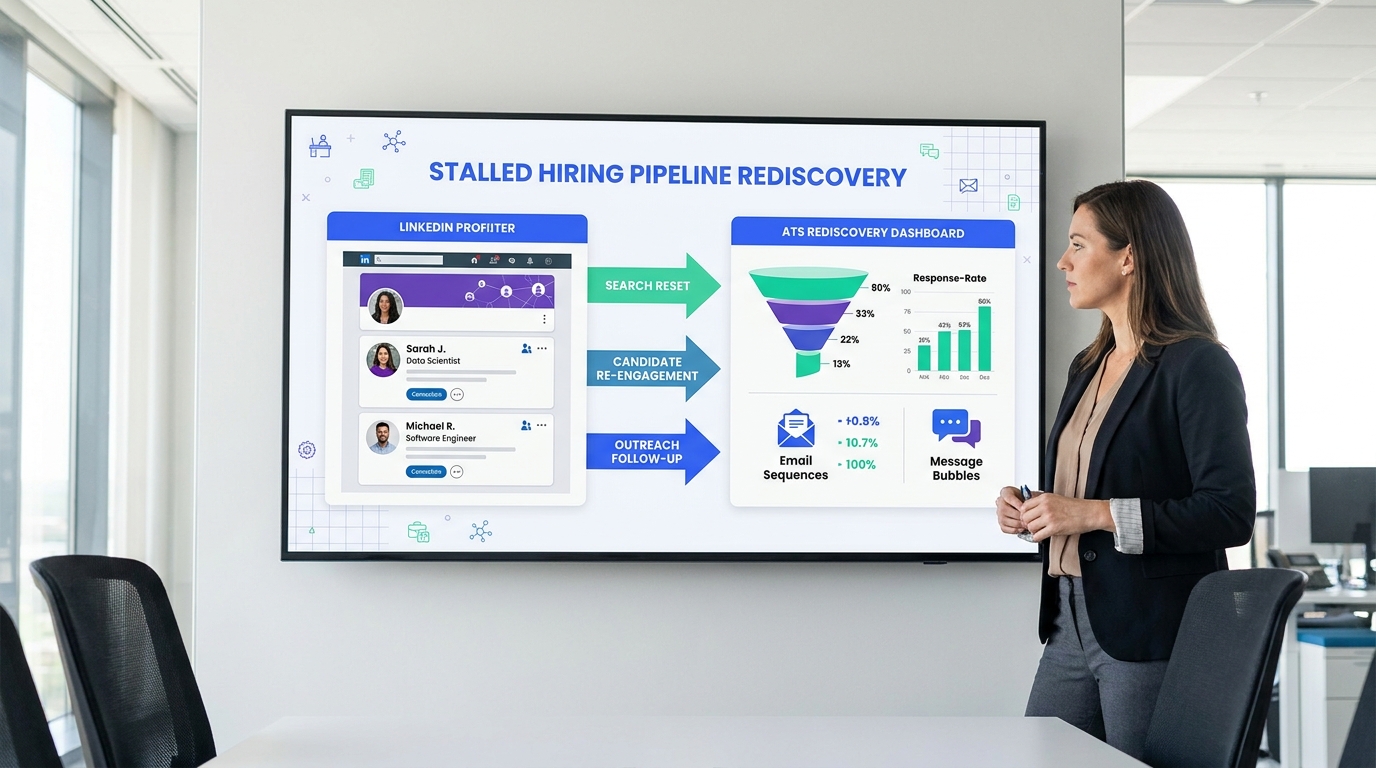
When a pipeline stalls, recruiters can use this article to judge which talent sourcing tools reset search logic, revive ATS talent, and avoid wasted outreach.
That matters most when hiring plans get shaken up by events outside the recruiting team’s control. A restructuring, a surprise vacancy, or a stalled pipeline can quickly damage recruiter confidence and operating rhythm in the same way job loss affects candidates: people second-guess the market, rely on outdated materials, miss warm contacts, and waste time starting from zero. For agency owners, that means slower placements and weaker client trust. For solo headhunters, it means more manual searching with less certainty. For in-house teams, it means extended time to shortlist and more pressure from hiring managers who expect quick recovery.
In those moments, the right workflow support matters more than another profile list. I have found that AI Recruiter is most useful when a team needs two things at once: consistent outreach without after-hours manual chasing, and a cleaner way to keep candidate conversations moving across time zones. Its always-on messaging and multilingual communication can reduce the stop-start pattern that happens when recruiters are trying to rebuild momentum, while the recruiter still owns the final resume review, fit judgment, and next-step decision.
The underlying problem is familiar from career transition itself. When someone is restructured out of a role, the first steps are not dramatic strategy moves. They usually start by regaining perspective, updating a resume that no longer reflects current strengths, refreshing a professional profile, and then reaching back into a network to understand what the market actually looks like. In recruiting, a broken search often fails for similar reasons. The team is working from stale assumptions, old candidate criteria, half-updated records, and weak follow-up discipline.
That parallel is why many talent sourcing tools disappoint in practice. Recruiters do not just need more names; they need software that helps them reset the search, refresh the inputs, reconnect with existing relationships, and move from uncertainty to structured action. When people search for the top sourcing tools for recruiters, they are usually trying to solve that broader workflow problem, not merely compare databases.
Why Sourcing Breaks After Disruption
One of the most useful lessons from career-transition coaching is that recovery starts with a reset, not with frantic activity. After a restructuring, people typically need to rebuild confidence, refresh how they present themselves, activate dormant contacts, and get market feedback. Recruiting teams face an equivalent reset whenever a search collapses, a role changes scope, or candidate response dries up.
In practice, I see four common breakdowns:
- Search logic goes stale: the original brief no longer matches the market
- Candidate records get underused: prior applicants and silver medalists stay buried in the ATS
- Outreach loses consistency: follow-up slows when recruiters juggle too many manual tasks
- Team confidence drops: recruiters and hiring managers stop trusting the shortlist quality
That is why evaluating sourcing software through a disruption-recovery lens is more useful than comparing feature lists in isolation. The best tools help a team regain momentum quickly and with less duplicated effort.
Practical takeaway: A strong sourcing workflow behaves a lot like an effective job-search recovery plan: clarify the target, update the signal, reconnect with the market, and keep activity consistent until conversations restart.
What Are Talent Sourcing Tools?
Talent sourcing tools help recruiters proactively identify, organize, contact, and re-engage candidates before they apply. In modern recruiting, they are no longer just search engines. The stronger platforms support a broader operating cycle that includes market discovery, profile filtering, contact enrichment, outreach, rediscovery inside the ATS, team collaboration, and search analytics.
That broader definition matters because many buying discussions still focus only on profile volume. In real recruiting work, sourcing quality improves when the tool helps with several connected tasks:
- Discovery: finding people across public sources, communities, resumes, or niche talent pools
- Refinement: narrowing by skills, geography, industry, seniority, or role-specific requirements
- Enrichment: surfacing usable contact details
- Outreach: managing first-touch messages and follow-up cadence
- Rediscovery: bringing prior applicants and finalists back into view
- Collaboration: keeping recruiters and hiring managers aligned on shortlist quality
- Measurement: showing which searches and channels actually create pipeline
Seen this way, sourcing software is less about hunting profiles and more about restoring flow. That is especially relevant for teams trying to rebuild after a search setback or organizational change.
When Non-LinkedIn Options Make Sense
There are several situations where non-LinkedIn sourcing tools are the better choice.
1. You need a fresh market view
After a role changes or a pipeline stalls, recruiters often need to step outside one channel and reassess where relevant talent actually sits. Some job families are underrepresented on mainstream professional networks, while others show stronger signal in specialist communities, resume databases, or past-applicant records.
2. Your ATS already holds overlooked talent
Just as a professional in career transition should revisit their strongest accomplishments before chasing brand-new options, recruiters should revisit existing candidate history before launching a completely new search. Mature teams often have years of applicants, referrals, former finalists, and prior outreach buried in the system. Rediscovery capability is one of the most practical reasons to invest in top sourcing tools for recruiters.
3. Your real bottleneck is follow-up
Many teams can find names, but they cannot maintain contact rhythm. That is where outreach-enabled sourcing matters. In my own workflow, tools that automate first-touch continuity are especially helpful when candidate replies come in after hours or across regions. For LinkedIn-heavy outreach specifically, I have used AI Recruiter to keep conversations moving, collect resumes from interested candidates, and avoid losing momentum overnight. It does not replace recruiter judgment, but it can remove some of the repetitive message handling that slows response cycles.
4. You need better search logic than manual Boolean alone
Newer systems increasingly support natural-language search, search generation from a role brief, and match explanations. That can be useful when the original job specification is messy or when the hiring manager is still calibrating. The key is transparency. Recruiters need to inspect and refine the logic, not just accept a black-box score.
The Main Categories of Non-LinkedIn Sourcing Tools
Not every sourcing tool solves the same problem. Grouping them by workflow is more useful than pretending they are interchangeable.
External sourcing databases
These tools focus on broad candidate discovery across large profile sets or public data. They are useful when coverage and speed matter most at the start of a search.
Best for: agencies, in-house sourcers, and recruiters handling multiple open searches.
Watch for: data freshness, search relevance, and whether contact details are actually usable.
CRM plus outbound sourcing platforms
These systems combine search with outreach and follow-up. They are strongest when the real issue is not finding people once, but managing repeat contact without dropping threads.
Best for: outbound-heavy teams and passive-candidate hiring.
Watch for: sequence controls, collaboration, messaging visibility, and workflow handoff.
ATS rediscovery tools
These platforms sit closer to the internal database and help recruiters reuse what the company already knows. They are often the highest-leverage option for employers with recurring hiring patterns.
Best for: organizations with an established ATS and historical talent data.
Watch for: semantic search, parsing quality, duplicate control, and note visibility.
Niche-market sourcing platforms
Some tools are built around a specific discipline, labor segment, or talent community. They matter when precision is more important than sheer database size.
Best for: specialist recruiters filling hard-to-find roles.
Watch for: role taxonomy, signal quality, and whether the pool actually reflects your target market.
How Experienced Recruiters Evaluate Talent Sourcing Tools
When I evaluate talent sourcing tools, I use a framework that mirrors the practical reset steps people take after being forced into a job search: get clarity, update the message, rebuild connections, and create a repeatable routine. That mindset produces better buying decisions than chasing feature hype.
1. Can the tool help reset a confused search?
If a role has changed, the search needs to change with it. Strong tools make it easier to turn a rough brief into a useful target list through natural-language search, suggested skills, and editable logic.
What to ask: Can recruiters see why candidates were surfaced, or only a score?
2. Can it improve your market signal?
In a job search, candidates refresh resumes and profiles so the market can understand them clearly. The sourcing equivalent is whether your recruiters can sharpen criteria and outreach using accurate data, role-relevant filters, and clean candidate records.
What to ask: Are the filters specific enough for your hardest roles, or do they flatten everyone into the same broad matches?
3. Can it reactivate existing relationships?
One of the strongest habits in both job search and recruiting is reconnecting with people who already know you. For recruiters, that means rediscovering former applicants, referrals, and silver medalists before rebuilding from scratch.
What to ask: How well does the system search historical candidate data, notes, and prior stage history?
4. Can it maintain outreach discipline?
Consistency matters. A recruiter who sends one strong message and then misses the reply window usually loses momentum. This is where workflow assistance can help. For example, in LinkedIn-based searches with global or after-hours response patterns, AI Recruiter can handle repetitive first-layer conversation, answer common role questions, and gather resumes from interested candidates so the recruiter returns to a more organized queue. The recruiter still decides who advances.
What to ask: Does the tool reduce manual follow-up work, or simply create another inbox to manage?
5. Can the team trust and adopt it?
A complicated system that only one power user understands rarely improves sourcing at scale. Teams need usable interfaces, visible activity history, and handoffs that do not create extra admin work.
What to ask: Will your team actually use this every day, or only during special projects?
How to Choose by Team and Workflow
Small teams
Lean recruiting teams usually need fewer standalone tools. Simplicity, search speed, and clean handoff matter more than edge-case customization.
Best approach: choose a system that combines sourcing essentials without adding heavy admin overhead.
Technical or specialist recruiting teams
These teams need stronger filters, better skill inference, and more nuanced candidate matching. Broad title search is rarely enough.
Best approach: test against one hard technical role, one adjacent-skill role, and one niche role with terminology overlap.
Outbound-heavy teams
If the name list is not the problem, prioritize contact quality and follow-up workflow. This is especially true when recruiters work across time zones or rely heavily on message-based outreach.
Best approach: evaluate sequencing, reply handling, and collaboration around candidate conversations.
ATS-mature organizations
If your company has years of candidate history, rediscovery deserves serious attention. Reusing prior interest is often faster and more economical than always sourcing net new leads.
Best approach: put historical search and duplicate control near the top of the checklist.
Teams rebuilding after disruption
When a restructuring, hiring freeze, or role reset has interrupted normal pipeline flow, choose tools that help recruiters regain confidence quickly. In my experience, that means clear match logic, fast search resets, and outreach continuity rather than the biggest possible profile count.
Comparison Checklist
Use this side-by-side framework when comparing top sourcing tools for recruiters.
| Evaluation Area | What Good Looks Like | Why It Matters |
|---|---|---|
| Talent access | Coverage aligned to your roles and geographies | Prevents overpaying for irrelevant reach |
| Search logic | Natural-language support, editable criteria, clear reasoning | Helps reset unclear searches faster |
| Contact quality | Usable, current enrichment data | Turns search into real outreach |
| Rediscovery | Strong search across past applicants and finalists | Recovers value already in your ATS |
| Outreach workflow | Sequencing, reply management, visibility | Protects momentum after first contact |
| Team collaboration | Shared notes, status clarity, duplicate prevention | Reduces friction across recruiters and hiring managers |
| Analytics | Source quality, response data, pipeline contribution | Shows what actually works |
| Adoption fit | Usable by the real team, not only experts | Prevents tool sprawl and low usage |
Common Mistakes Teams Make
Buying for database size alone
More profiles do not automatically produce better shortlists. Relevance and workflow fit matter more.
Skipping the reset step
Recruiters often rush into another search before revisiting the brief, prior candidate history, and current market signal.
Ignoring ATS rediscovery
Teams frequently overlook qualified people they already know, even when previous notes and stage history could shorten the search.
Separating search from follow-up
If outreach happens in another disconnected system, recruiters lose context and response windows get missed.
Trusting automation without transparency
AI can help, but recruiters still need to understand why a candidate appears relevant and retain control over advancement decisions.
FAQ
What are talent sourcing tools?
They are systems that help recruiters proactively find, organize, contact, and re-engage candidates before they apply. The best ones support more than search by adding enrichment, outreach, rediscovery, collaboration, and analytics.
Why do recruiters look for non-LinkedIn sourcing options?
Because some talent pools are easier to reach elsewhere, some teams need stronger ATS rediscovery, and some searches require broader workflow support than one channel can provide.
What should I look for in the top sourcing tools for recruiters?
Focus on role-relevant talent access, clear search logic, contact quality, rediscovery, outreach workflow, collaboration, and adoption fit. Those factors usually matter more than raw profile count.
Are AI-enabled sourcing tools worth it?
They can be, especially when they help recruiters reset vague searches, explain match logic, and maintain communication rhythm. The best use is support, not blind replacement of recruiter judgment.
Where does AI Recruiter fit if I still need non-LinkedIn tools?
It fits as workflow support for LinkedIn-based outreach when your broader stack already includes external databases, niche sources, or ATS rediscovery. In that setup, AI Recruiter can keep candidate conversations moving, collect resumes from interested contacts, and reduce repetitive message handling while the recruiter remains responsible for evaluation and selection.
Conclusion
The most useful way to compare talent sourcing tools is not to ask which platform looks biggest. It is to ask which one helps your team recover fastest when a search loses momentum, a role changes, or candidate flow dries up. That is the real lesson behind disruption, whether it happens to a job seeker or a recruiting team: progress resumes when the inputs are refreshed, the network is reactivated, and follow-up becomes consistent again.
If you are reviewing the top sourcing tools for recruiters, start with your actual bottleneck. If you need wider reach, prioritize discovery. If you need more replies, prioritize outreach workflow. If you already have years of candidate history, prioritize rediscovery. And if your team uses LinkedIn heavily as one part of that process, workflow support such as AI Recruiter can help maintain continuity without removing the recruiter from the final hiring judgment.