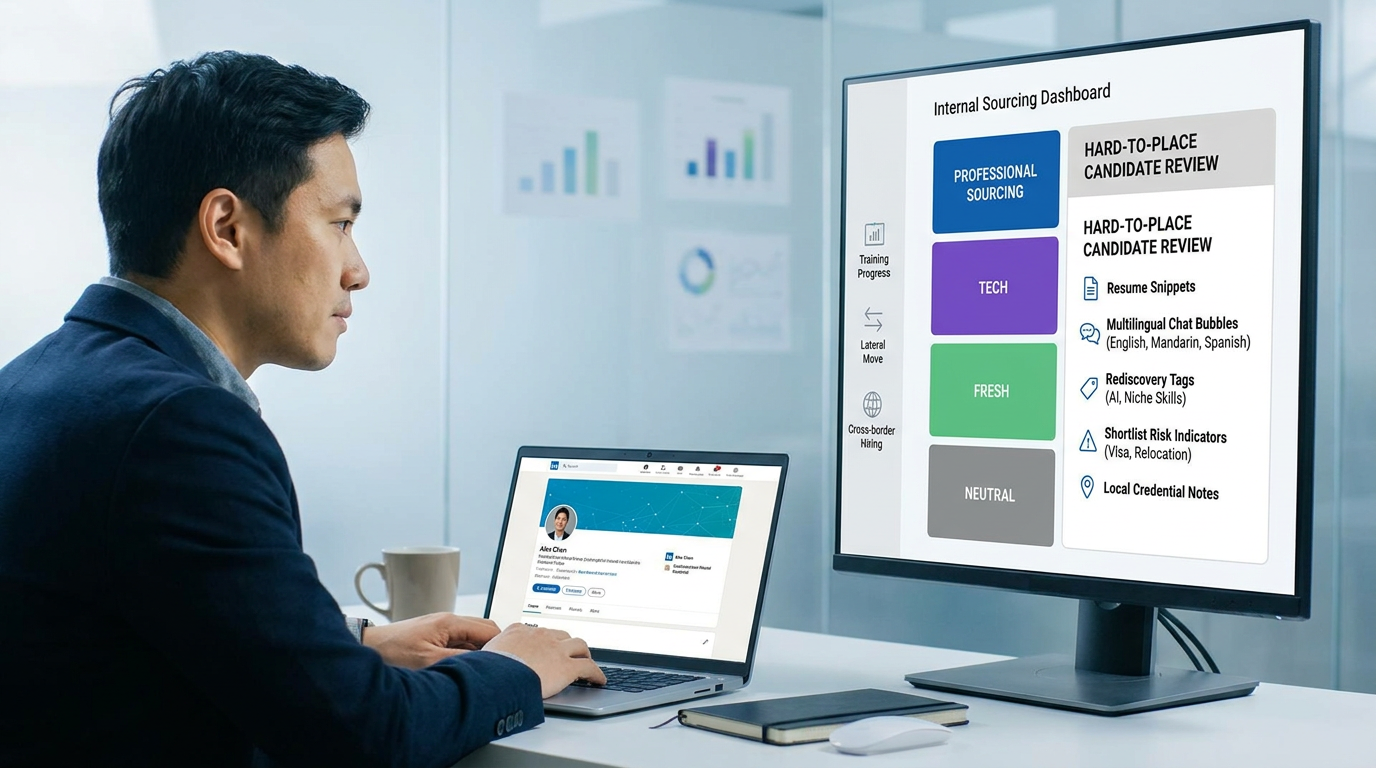
When hard-to-place profiles look strong but still stall, this article helps recruiters judge talent sourcing tools by context capture, rediscovery, and shortlist risk.
That matters most when a candidate looks strong on paper but still hesitates, lacks local signals an employer expects, or cannot show the exact kind of experience the hiring team wants to see. For a solo recruiter, that means more time lost in back-and-forth and more shortlist risk. For a small search firm owner, it can mean lower consultant capacity, weaker client confidence, and extra spend on channels that keep producing names without enough usable context. For in-house recruiting teams, the cost shows up as delayed hiring, poor rediscovery of past applicants, and hiring managers who feel sourcing is broad but not calibrated.
In that gap between discovery and real recruiting judgment, I have found StrategyBrain AI Recruiter useful as a support layer rather than a replacement for recruiter judgment. Its always-on candidate messaging, multilingual communication, and automatic collection of resumes and contact details can keep early conversations moving when candidates reply after hours or across borders. The recruiter still decides who is actually qualified, how the resume should be interpreted, and whether the next step makes sense.
That problem becomes obvious in one of the most common recruiting scenarios: a skilled professional arrives in a new market with strong experience, but employers keep asking for local credentials, local work history, and clearer proof that the person can operate inside the new business environment. The candidate starts looking at credential assessment, short training programs, volunteer work, and lateral moves just to become legible to employers. Meanwhile, a recruiter reviewing the market has to decide whether to push this person forward now, reposition them for a different level, or keep the relationship warm until the profile is easier to sell.
In practice, the work is not abstract. You review the resume, compare overseas titles with local equivalents, note whether language communication needs support, check if a hiring manager will accept adjacent experience, and decide if a nonprofit, contract, or lower-level role could create the local track record the candidate needs. Then you reach back out, ask what training is underway, confirm whether they are open to a lateral move, and document that context so the profile is not lost six months later. That is exactly where non-LinkedIn talent sourcing tools, stronger resume sourcing tools, and more usable sourcing platforms matter: they help recruiters capture the missing context that makes a hard-to-place candidate placeable.
Table of Contents
- Why Context Matters in Talent Sourcing
- What Are Talent Sourcing Tools?
- Why Non-LinkedIn Sourcing Matters
- How to Evaluate Talent Sourcing Tools
- Where Resume Sourcing Tools Fit
- A Practical Workflow Experience
- Sourcing Tools vs ATS and CRM
- How to Choose by Hiring Use Case
- Best Practices for Recruiters
- Common Buying Mistakes
- FAQ
Why Context Matters in Talent Sourcing
Some of the hardest searches are not hard because there are no candidates. They are hard because the market does not evaluate experience evenly. Candidates changing countries, industries, seniority levels, or functional tracks often need more than a keyword match. They need context that explains why a credential still matters, why a lateral move is sensible, or why volunteer or project work should count as relevant evidence.
That is the first useful lesson for evaluating talent sourcing tools. A sourcing stack should not only help you find more profiles. It should help you preserve the kind of context recruiters collect when a candidate is trying to bridge a credibility gap. Without that, the same person may be rejected today, forgotten tomorrow, and sourced again from scratch later.
In other words, the best sourcing process behaves a little like a good search consultant. It captures what the candidate is doing to become market-ready, what the hiring market is likely to question, and what adjacent path could still create a successful placement.
What Are Talent Sourcing Tools?
Talent sourcing tools are platforms that help recruiters identify, search, organize, and engage candidates before they enter later hiring stages. In real recruiting work, they usually support four connected jobs: finding talent, interpreting fit, grouping people into usable pools, and helping recruiters take the next outreach step.
That is broader than a simple resume database. Modern sourcing platforms may pull from public profiles, specialty communities, internal ATS records, prior outreach history, uploaded resumes, and other signals that help a recruiter build a more complete view of candidate readiness.
The distinction matters because recruiters often work with candidates who are not obvious fits at first glance. Someone may have strong finance experience but no local certification yet. Someone else may have excellent project work but no recent in-market title. A source-and-rank tool that cannot hold those nuances will create noise rather than clarity.
Why Non-LinkedIn Sourcing Matters
A non-LinkedIn sourcing strategy matters because many promising candidates do not present their value best on one public profile alone. That is especially true for people changing markets, building local credibility, adding certifications, volunteering in adjacent roles, or taking gig assignments to gain relevant experience.
Recruiters who depend too much on one channel tend to miss these signals. The richer trail may sit across resumes, application histories, project descriptions, training records, publications, portfolio material, or prior conversations already stored in an ATS. That is one reason non-LinkedIn talent sourcing tools are increasingly valuable. They are not just alternate search windows. They are ways to reconstruct candidate context.
This also explains why internal rediscovery often produces better short-term results than net-new search. If your database already contains candidates who were previously close but lacked one local requirement, they may be significantly more viable now. Better sourcing software helps you surface that change instead of treating every search like a blank slate.
How to Evaluate Talent Sourcing Tools
When I evaluate talent sourcing tools, I do not start with a feature grid. I start with the recruiting situations where context usually gets lost. The candidate entering a new country, the specialist making a lateral move, the strong silver medalist who was a year too early, the bilingual prospect who answered after midnight and then disappeared because no one replied. Those are the stress tests.
1. Can the tool capture market-readiness, not just resume facts?
If a candidate is pursuing licensing, finishing a training program, doing relevant volunteer work, or taking contract assignments to build local credibility, can the system store that information clearly? This is one of the biggest separators between a search tool and a workable sourcing platform.
What to test: Search for candidates using both hard credentials and softer progression signals such as coursework, certification-in-progress, volunteer role, or adjacent industry move.
2. Can recruiters search internal history as well as external profiles?
Many teams already have these candidates in their database. They just cannot find them when the market changes. Strong resume sourcing tools should search resumes, notes, old outreach, and application history well enough to support rediscovery.
What to test: Run the same role against old ATS data and compare how well the system surfaces transferable or newly relevant candidates.
3. Does the tool support nuanced fit, not just exact-match fit?
Recruiting is full of candidates who are one step away from obvious qualification. Good systems should make it easier to identify adjacent fit instead of forcing the recruiter into brittle keyword logic.
What to test: Search a role where equivalent titles differ by geography or where skills transfer across sectors. Check whether the results are interpretable or simply inflated.
4. Can it support real outreach timing?
Candidates who are exploring a new market often reply at odd hours, ask practical questions, and need time before committing to an interview. Early responsiveness matters. Tools that help maintain momentum without forcing recruiters to sit online constantly can materially improve top-of-funnel flow.
What to test: Review whether the system supports follow-up, captures resumes and contact details cleanly, and keeps the recruiter in control of the final qualification step.
5. Does it turn one-off sourcing into reusable market knowledge?
The best sourcing platforms help recruiters build talent pools around patterns: candidates gaining local credentials, candidates open to lateral moves, multilingual talent, or previous finalists worth revisiting when requirements shift.
What to test: See whether recruiters can tag, segment, and re-engage candidates based on progression, not just static skills.
Where Resume Sourcing Tools Fit
Resume sourcing tools are usually strongest when the recruiting team already has a meaningful volume of candidate history but poor searchability. They help recruiters mine resumes, notes, application records, and attachments for people who may now be relevant.
That makes them particularly useful in scenarios like the one above. A candidate who once lacked a local designation may now have completed credential assessment. Someone who previously had no local work history may now have volunteer bookkeeping, a contract assignment, or a public-sector lateral move. Resume search alone will not solve every sourcing challenge, but it can unlock value your team already owns.
| Category | Primary Job | Best For | Main Limitation |
|---|---|---|---|
| Resume sourcing tools | Search resumes and internal candidate records | ATS mining, rediscovery, stored candidate history | May not support broader discovery or outreach |
| Talent sourcing tools | Find, assess, organize, and engage candidates | Teams building active pipelines across sources | Needs clear recruiter process to avoid noise |
| Sourcing platforms | Unify discovery, workflow, and candidate organization | Search firms and recruiting teams with repeat sourcing volume | Feature overlap can complicate evaluation |
The practical takeaway is simple: if your issue is hidden value inside your own database, start with resume search and rediscovery. If your issue is hard-to-find external talent plus candidate engagement, move toward broader talent sourcing tools.
A Practical Workflow Experience
In my own sourcing workflow, one recurring challenge has been candidates who are interested but not yet fully legible to the target market. That includes internationally experienced professionals, bilingual candidates exploring a new region, and specialists who need a few practical steps before a hiring manager will take the profile seriously.
For those situations, I have used AI Recruiter to keep the front end moving while I focus on the judgment-heavy part. When candidates reply outside normal hours, ask follow-up questions, or want to send a resume later, the system can continue the conversation, collect the resume, and capture contact details without forcing me to babysit every message thread. Its multilingual support is also useful when communication clarity is part of the candidate-readiness picture rather than a side issue.
What I liked most was not automation for its own sake. It was the ability to stop losing early-stage momentum. I still reviewed the resume myself, decided whether the candidate's experience actually fit the brief, and chose whether to reposition them toward a lateral move, a contract bridge role, or a direct shortlist. But using AI Recruiter conversation handling as a support layer reduced the dead space between initial interest and usable recruiter action.
That distinction is important. Tools like this do not replace final recruiter evaluation. They help preserve the candidate signals that too often disappear before a human recruiter gets back to the thread.
Sourcing Tools vs ATS and CRM
Many buying mistakes happen because teams compare talent sourcing tools against categories that solve different problems.
Sourcing tools vs ATS
An ATS is built to manage applicants through a hiring process. It tracks stages, collaboration, records, and compliance. A sourcing tool is built to improve the top of the funnel by helping recruiters find, rediscover, and prioritize candidates before they become active applicants.
In the candidate-readiness scenarios discussed earlier, the ATS stores history, but the sourcing layer makes that history usable.
Sourcing tools vs recruiting CRM
A recruiting CRM is strongest when long-term relationship nurture is the problem. It helps maintain contact over time. Sourcing software is strongest when candidate identification, search precision, rediscovery, and first outreach are the bottleneck.
If your team keeps meeting strong candidates too early for the role, CRM matters. If your team keeps forgetting those candidates once they become viable, stronger sourcing and rediscovery matter first.
Sourcing tools vs screening platforms
Screening tools operate after a candidate has been identified. They do not solve the issue of finding market-ready prospects or understanding candidate context at the sourcing stage.
That is why the right stack is usually not the biggest one. It is the one that fixes the precise point where your process loses good candidates.
How to Choose by Hiring Use Case
For agency recruiters and headhunters
Prioritize workflow speed, candidate rediscovery, and early outreach continuity. Agency teams often deal with candidates who need repositioning, narrative framing, or market education before submission.
- Look for strong notes, tags, and segmented talent pools
- Prioritize outreach support that does not remove recruiter control
- Test whether the platform helps with adjacent-fit searches
For in-house recruiting teams
If you hire across regions or frequently see candidates who need one more market signal, focus on internal rediscovery and collaboration clarity.
- Search old applicants for updated credentials or new location readiness
- Organize talent pools around readiness stages, not only job titles
- Make shortlist rationale visible for hiring managers
For lean recruiting teams
Simplicity matters. A lighter tool that improves search and follow-up may outperform a larger suite your team never fully adopts.
- Choose usable search over long feature lists
- Make sure resume and note search actually works
- Keep the path from discovery to outreach short
For cross-border hiring
This is where responsiveness and language handling become operational, not cosmetic.
- Prioritize multilingual communication support
- Capture resumes and contact details without delay
- Preserve candidate context for final recruiter review
Best Practices for Recruiters
Start with rediscovery before new search
Many difficult searches have a near-fit candidate already in the database. Search for people whose missing requirement may no longer be missing.
Track progression signals explicitly
Credential assessment, training enrollment, volunteer experience, contract work, and lateral sector moves all matter. If your system cannot store them well, your sourcing memory will stay weak.
Separate must-have fit from market-entry fit
Not every role can flex. But many can. The recruiter should know which requirements are regulatory, which are client preference, and which are proxies for comfort.
Use automation to preserve momentum, not delegate judgment
Always-on messaging and resume capture can help, especially across time zones, but the recruiter should still own shortlist quality and candidate interpretation.
Key insight: The best non-LinkedIn sourcing motion often starts by understanding why a candidate is not yet easy to place, then uses search, rediscovery, and outreach tools to capture the signals that could change that.
Common Buying Mistakes
- Buying for volume instead of placement logic: More profiles do not help if the system cannot show readiness or transferable fit.
- Ignoring internal candidate history: Some of your best leads may already be in the ATS, just poorly indexed.
- Treating exact title match as the only signal: Geography, credential equivalency, and adjacent experience often matter more.
- Over-automating the wrong step: Early messaging can be automated, but final qualification should stay with the recruiter.
- Forgetting candidate market context: A search process that cannot reflect training, volunteering, or lateral moves will underperform on complex talent pools.
FAQ
What are talent sourcing tools used for?
Talent sourcing tools help recruiters find, organize, and engage candidates before they become active applicants. They are most useful when top-of-funnel search, rediscovery, or first outreach is the main bottleneck.
How are resume sourcing tools different from broader sourcing platforms?
Resume sourcing tools focus mainly on searching resumes and internal candidate records. Broader sourcing platforms usually add external discovery, talent pool organization, and outreach workflow support.
Why do non-LinkedIn sourcing tools matter?
Because strong candidates often leave important signals outside a single profile. Internal databases, project histories, training records, volunteer work, and prior recruiter notes can all improve sourcing quality.
Can sourcing tools help with internationally experienced candidates?
Yes, especially when the challenge is understanding transferable experience, capturing updated credentials, or preserving context around market readiness. The tool should help recruiters store and search those details clearly.
Does automation replace recruiter judgment?
No. Automation can support outreach, responsiveness, and resume capture, but recruiters should still handle final evaluation, shortlist decisions, and hiring-manager calibration.
When should a team use AI Recruiter in the sourcing workflow?
It is most useful when candidates respond after hours, across time zones, or in multiple languages, and when recruiters need help maintaining early-stage communication without losing control of qualification. More details are available at this overview of AI Recruiter workflow support.
Conclusion
The best talent sourcing tools are not just databases with prettier filters. They help recruiters understand why a candidate is placeable now, what is still missing, and how to keep valuable profiles from disappearing between first contact and future fit. That matters even more in non-LinkedIn sourcing, where candidate value is often spread across resumes, internal notes, training history, and real-world progression rather than one polished public profile.
If you are comparing resume sourcing tools and broader sourcing platforms, start with your actual breakdown point. If the issue is rediscovery, improve internal search. If the issue is early outreach continuity, support it with workflow automation. If the issue is candidate context, choose tools that let recruiters store and act on more than exact-title matches.