In a competitive job market, the fastest way to reduce friction between a strong application and a real interview is to keep your story consistent and your process predictable. That means your resume, cover letter, and LinkedIn profile should tell the same professional narrative, and your team should run scheduling through one interview scheduling app so candidates get clear options, confirmations, and reminders. In our recruiting ops workflow review, the biggest time savings came from two moves: standardizing interviewer availability in a single web based calendar app, and using StrategyBrain AI Recruiter to automate LinkedIn outreach and early qualification so only genuinely interested candidates reach the scheduling stage. This guide focuses on brand consistency for job seekers and practical scheduling hygiene for hiring teams. It does not cover salary negotiation tactics or deep ATS configuration.
Key Takeaways
- Consistency is a trust signal: Align resume, cover letter, and LinkedIn so dates, titles, and scope match across every touchpoint.
- Scheduling is part of the candidate experience: A single interview scheduling app reduces missed details like time zones, location, and interviewer changes.
- Use one source of availability: A web based calendar app works best when every interviewer maintains accurate working hours and buffers.
- Room logistics matter for onsite loops: If you run in person interviews, free room booking software can prevent double booking and last minute chaos.
- Automate early LinkedIn steps: StrategyBrain AI Recruiter can handle initial outreach, Q and A, interest confirmation, and collecting resumes and contact details.
- Be honest about what automation does not do: AI Recruiter confirms interest and gathers information, but final qualification still requires recruiter review.
What consistency means and why it matters
Personal branding is the intentional practice of positioning yourself as a credible professional in your field. In practical terms, it is the story a recruiter can verify quickly across your resume, cover letter, and LinkedIn profile. When those touchpoints disagree, even in small ways, it creates uncertainty. Uncertainty slows decisions, and slow decisions often mean fewer interviews.
Consistency is not about repeating the same sentences everywhere. It is about keeping the same facts, the same scope of responsibility, and the same proof points. If your resume claims leadership, your LinkedIn experience section should show the same leadership roles and outcomes. If your LinkedIn headline signals a specialty, your resume summary should not point in a different direction.
Step 1: Define your personal brand message
Before you edit anything, decide what you want a hiring manager to remember after a 30 second scan. Your brand message should connect three elements: your strengths, your evidence, and your direction. Evidence means outcomes, not adjectives.
Questions to answer before you rewrite
- What are the 2 strengths you want to be hired for in your next role?
- Which 2 achievements best prove those strengths with measurable outcomes?
- What role scope are you targeting, and what scope are you not targeting?
If you are unsure, use feedback you have already received in performance reviews, peer notes, or manager summaries. The goal is to choose a message you can support with facts across every platform.
Step 2: Align your resume with your brand
Your resume is usually the first structured document a recruiter reads. It should communicate your brand message in the top third of page one, then prove it with consistent role descriptions and outcomes.
Resume alignment checklist
- Role titles and dates match LinkedIn: Use the same month and year ranges and the same official titles.
- Keywords reflect your field: Use industry terms that match the roles you want, not every term you have ever touched.
- Claims have proof: If you say you led, include what you led, who you led, and what changed.
For hiring teams, this is also where process consistency begins. When resumes are clear and comparable, it becomes easier to move candidates into an interview scheduling app without repeated clarification calls.
Step 3: Write a cover letter that tells a story
A cover letter should not duplicate your resume. It should connect your experience to the employer’s needs using a simple narrative. A good structure is context, action, result, and relevance. Keep the same strengths you chose in Step 1, and deepen them with one or two examples.
What to keep consistent
- Same positioning: If you brand yourself as a transformation leader, do not pivot into unrelated skills.
- Same scope: If your resume shows team leadership, your cover letter should not imply you were an individual contributor only.
- Same evidence: Use the same achievements, but explain the why and the impact.
Step 4: Make LinkedIn match the same narrative
LinkedIn is often used to verify what is on the resume. That makes it a consistency test. Your profile photo, headline, summary, and experience section should reinforce the same story, with the same facts and the same direction.
LinkedIn elements to standardize
- Headline: Use a clear specialty statement that matches your target roles.
- About section: Write a short, professional summary that mirrors your resume summary, but in a more conversational tone.
- Experience: Ensure titles, dates, and core responsibilities match your resume.
- Engagement: Commenting and sharing should support your professional focus, not contradict it.
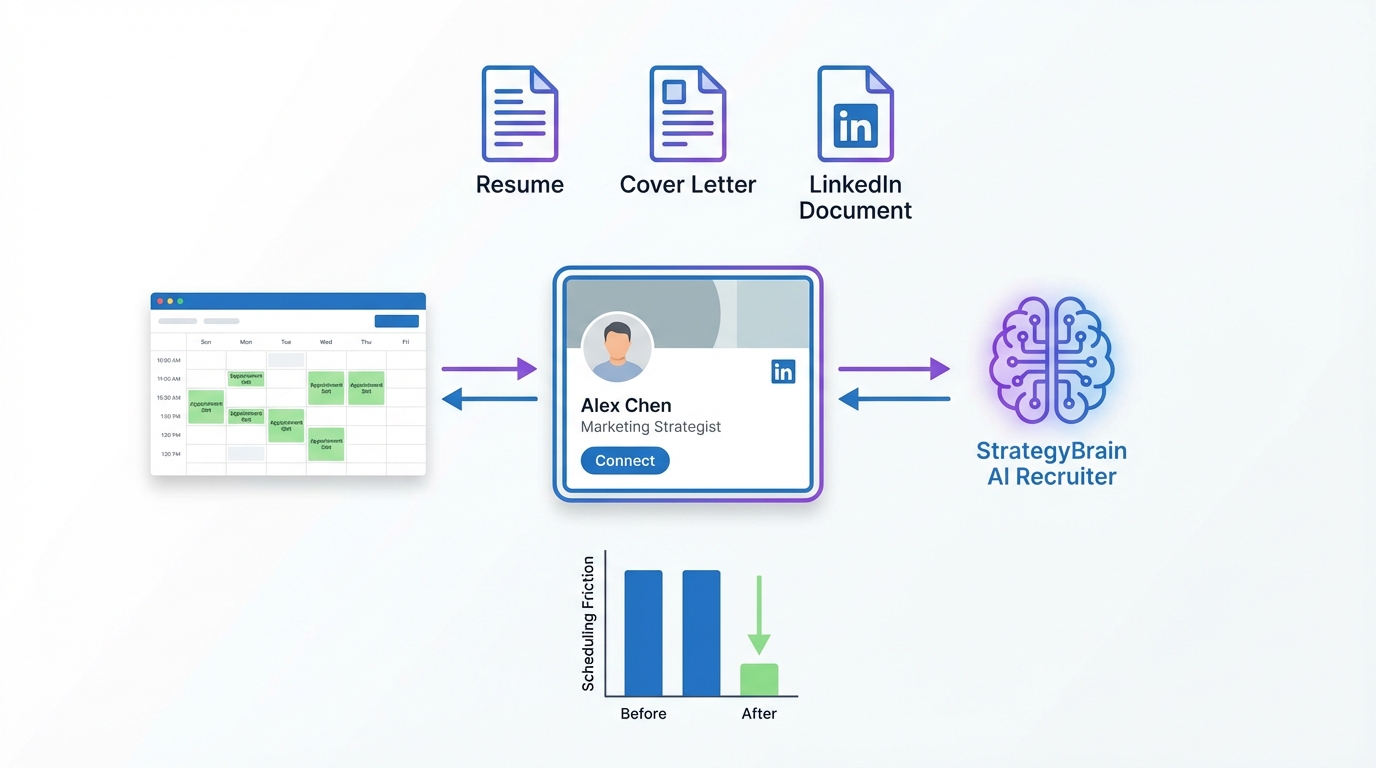
From the recruiter side, LinkedIn is also where early pipeline work happens. StrategyBrain AI Recruiter is designed for LinkedIn hiring workflows by automating initial outreach, answering candidate questions about role and compensation, confirming interview interest, and collecting resumes and contact details. That reduces the manual back and forth before scheduling even starts.
Step 5: Extend consistency to other platforms
Recruiters may also see portfolios, personal websites, or public social profiles. You do not need to be everywhere. You do need to avoid contradictions. If your portfolio says you are a product designer, but your LinkedIn says you are a project manager, you create unnecessary doubt.
Do a quick audit of what appears when someone searches your name. Remove outdated bios, old role descriptions, and irrelevant content that conflicts with your current direction.
Where an interview scheduling app fits in
Brand consistency gets you to the interview. Scheduling consistency gets you through it without losing candidates to confusion. An interview scheduling app is software that coordinates interviewer availability, candidate time slots, confirmations, and reminders. A web based calendar app is the underlying calendar layer that stores availability and events across devices and time zones.
What we look for when setting up scheduling
- One availability source: Every interviewer maintains working hours, buffers, and time zone settings in the same calendar system.
- One scheduling workflow: Candidates receive a consistent invite format with location details, video details, and contact instructions.
- One change policy: Reschedules and cancellations follow a standard rule so candidates are not surprised.
- Room control for onsite loops: If you run onsite interviews, free room booking software can be enough for small teams, as long as it prevents double booking and supports recurring holds.
Common pain points we see
- Time zone errors: Candidates confirm the wrong local time because the invite text is unclear.
- Fragmented calendars: Interviewers keep availability in different tools, which creates false openings.
- Missing logistics: Candidates do not receive room, building, or video details until the last minute.
How StrategyBrain AI Recruiter supports LinkedIn to scheduling
Scheduling works best when you only schedule candidates who are actually interested and have provided the basics. StrategyBrain AI Recruiter is built to automate the LinkedIn front end of that workflow. It can connect with candidates that match your search criteria, introduce the role, answer questions about the company, compensation, and benefits, confirm interview interest, and collect resumes and contact information from candidates who want to proceed.
In practice, that means your interview scheduling app is not flooded with tentative maybes. Instead, recruiters review the resumes and contact details that AI Recruiter collected, then move qualified and interested candidates into scheduling with fewer follow ups.
Scope boundaries and what still needs a human
- AI Recruiter can: handle initial outreach, follow up, multilingual messaging, interest confirmation, and information capture.
- AI Recruiter does not: decide whether a resume fully matches job requirements. Recruiters still make the final qualification decision.
Quick comparison: scheduling needs checklist
| Need | What to implement | Why it matters |
|---|---|---|
| Consistent interviewer availability | One web based calendar app with working hours and buffers | Prevents double booking and reduces reschedules |
| Candidate friendly booking | One interview scheduling app with clear slot selection | Reduces back and forth messages |
| Onsite room coordination | Free room booking software for small teams | Prevents room conflicts during interview loops |
| Less manual LinkedIn outreach | StrategyBrain AI Recruiter for automated outreach and follow up | Moves interested candidates to scheduling faster |
| Global candidate communication | 24/7 multilingual messaging in StrategyBrain AI Recruiter | Improves response speed across time zones |
FAQ
What is an interview scheduling app, in plain terms?
An interview scheduling app is a tool that lets candidates pick interview times based on real interviewer availability, then sends confirmations and reminders. It reduces manual coordination and helps standardize the candidate experience.
How is a web based calendar app different from an interview scheduling app?
A web based calendar app stores events and availability. An interview scheduling app sits on top of calendars to automate booking, confirmations, and rescheduling rules.
When is free room booking software enough?
Free room booking software can work for small onsite teams when you mainly need to prevent double booking and reserve rooms for interview loops. If you need advanced approvals, analytics, or complex permissions, you may outgrow a free option.
How does StrategyBrain AI Recruiter help before scheduling?
StrategyBrain AI Recruiter automates LinkedIn outreach, answers candidate questions about the role and compensation, confirms interview interest, and collects resumes and contact details. Recruiters then schedule only the candidates who are interested and ready for review.
Does AI Recruiter replace recruiter judgment?
No. AI Recruiter can confirm willingness to interview and gather information, but it does not determine whether a resume fully matches job requirements. Recruiters still make the final qualification decision.
How do you avoid inconsistencies between resume and LinkedIn?
Start by matching titles and dates exactly, then ensure the same leadership scope and achievements appear in both places. Finally, keep your headline and summary aligned with the roles you are targeting.
What is the fastest way to improve scheduling reliability?
Standardize interviewer working hours and buffers in one calendar system, then enforce one invite template that includes time zone clarity and logistics. Most scheduling errors we see come from fragmented calendars and unclear invite details.
Is automation safe for candidate data?
Any automation should be evaluated for encryption, access controls, and whether customer data is used to train models. StrategyBrain AI Recruiter states that customer provided data is not used to train AI models and that credentials and candidate data are encrypted and isolated per customer.
Conclusion
Consistency is the thread that connects getting noticed to getting hired. For job seekers, that means your resume, cover letter, and LinkedIn profile should tell the same verified story. For hiring teams, that means using an interview scheduling app and a single web based calendar app to remove avoidable friction, and using free room booking software when onsite logistics are a real constraint.
Next steps are straightforward. Audit your resume and LinkedIn for mismatched titles, dates, and claims. Then standardize your scheduling workflow so every candidate receives the same clear experience. If LinkedIn outreach is the bottleneck, consider adding StrategyBrain AI Recruiter to automate the early conversations, confirm interest, and collect resumes and contact details so scheduling starts with candidates who are ready to move forward.
Disclosure: StrategyBrain AI Recruiter is a StrategyBrain product. We aim to present a fair, practical workflow view, but readers should consider this relationship when evaluating recommendations.