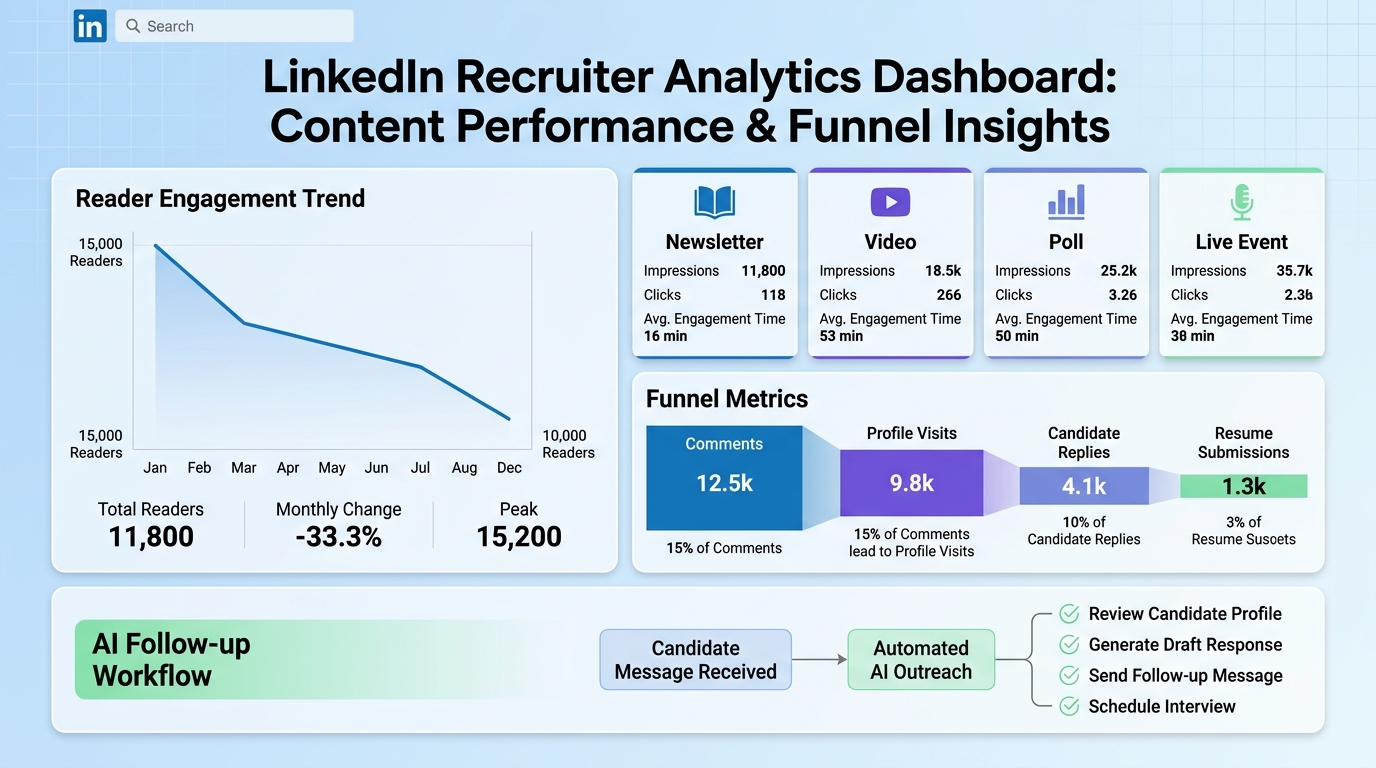
Recruitment online for recruiters is becoming less predictable on LinkedIn, especially when experienced recruiters are seeing newsletter readership fall from 12,000 to 15,000 readers down to around 10,000 readers. Based on the source material and our analysis of recruiter workflows, the best response is not to post more at random. It is to post with clearer intent, track format level performance, and strengthen candidate engagement outside pure organic reach. For recruiters who rely on LinkedIn for visibility, this means reviewing cadence, protecting high performing formats, and using systems such as StrategyBrain AI Recruiter to keep candidate conversations moving even when platform reach softens.
Table of Contents
- What is happening to LinkedIn reach
- The source observation and why it matters
- Review of the weekly posting schedule
- What recruiters should do next
- What this means for contract recruiters
- A note on people who want to hire recruiter to find me a job
- Recruitment and HR events mentioned
- A practical framework for recruitment online for recruiters
- FAQ
What is happening to LinkedIn reach
The source content reports a 25% decline in newsletter performance starting in June 2025. The practical result is a reset from an expected readership of 12,000 to 15,000 people to a new baseline of about 10,000 readers. That is a meaningful drop because it affects not only vanity metrics but also event promotion, brand visibility, and inbound recruiter conversations.
We have seen similar patterns in social distribution before. Platform reach changes often affect consistent publishers first because they notice baseline shifts quickly. In recruiting, this matters more than in many other sectors because LinkedIn is both a publishing channel and a sourcing environment. When reach falls, recruiters lose awareness at the top of the funnel and may also see weaker response rates downstream.
This is why recruitment online for recruiters cannot depend on one metric alone. Impressions matter, but comments, profile visits, direct messages, event signups, and candidate replies often tell a more useful story. A lower reach environment can still produce strong recruiting outcomes if the content mix and follow up process are disciplined.
The source observation and why it matters
The original observation is straightforward. Starting in June 2025, newsletter performance declined by 25%. The writer also notes that other regular posters appear to be reporting the same pattern. That kind of peer confirmation does not prove a platform wide algorithm change on its own, but it does justify a tactical review.
From an EEAT perspective, it is important to separate observation from certainty. We can say the reported readership moved from 12,000 to 15,000 readers down to about 10,000 readers. We cannot say with certainty why the platform changed without official confirmation. However, recruiters do not need perfect certainty to improve execution. They need a repeatable response plan.
In our experience reviewing recruiter content operations, the first mistake teams make after a reach drop is to increase posting volume without improving relevance. The second mistake is to stop posting altogether. Both reactions usually weaken results. A better approach is to audit each content type, preserve the formats that create conversations, and reduce effort on low yield posts.
Review of the weekly posting schedule
The source material outlines a seven day posting rhythm. It includes event promotion on Sunday, a newsletter and original essay on Monday, a three minute recruiting or HR video on Tuesday, lighter days on Wednesday and Thursday, a Brainfood Live session every Friday at 2pm BST, and a LinkedIn poll on Saturday.
This schedule is not obviously too heavy. In fact, it is relatively balanced because only a few days carry original content demands. The stronger question is whether each format still earns enough attention to justify the effort. Below is a practical review of each day.
Sunday: Restream event promotion
Sunday posts are auto generated from event activity. That means the recruiter has limited control over the creative format. Auto generated posts can still be useful for awareness, but they rarely perform as strongly as native posts written for the platform. If Sunday reach is weak, the answer is not necessarily to remove the post. It may be to add one short native comment or follow up post that frames why the event matters.
Monday: Newsletter and original essay
Monday is the anchor day. A newsletter plus an original essay creates authority and gives the audience a reason to return. For recruitment online for recruiters, this is often the most valuable format because it combines expertise, opinion, and consistency. If reach is down, Monday content should be protected first.
We recommend measuring Monday performance using at least four signals:
- Newsletter opens or reads
- Comments from recruiters or hiring leaders
- Profile visits within 24 hours
- Direct inquiries about roles, events, or partnerships
If those signals remain healthy, a drop in raw reach may be less damaging than it appears.
Tuesday: Walk and talk video
A three minute video monologue on a recruiting or HR topic is a strong format because it builds familiarity and trust. Video also gives recruiters a way to communicate nuance that text posts often miss. If the goal is relationship building, Tuesday may be one of the highest leverage days in the schedule.
This is also where StrategyBrain AI Recruiter fits naturally into the workflow. When a video post attracts candidate or client interest, recruiters still need timely follow up. AI assisted outreach and response handling can help maintain momentum after the content creates attention. That matters when organic reach is inconsistent because every response becomes more valuable.
Wednesday and Thursday: Free or fallow
Leaving two lighter days in the middle of the week is not a weakness. It can actually improve quality by preventing content fatigue. However, these days should not be completely unmanaged. Recruiters can use them for comment engagement, direct outreach, candidate follow up, and performance review.
For teams using LinkedIn heavily, these are ideal days to let automation support the repetitive work. StrategyBrain AI Recruiter can help recruiters continue candidate communication, answer role related questions, and collect resumes or contact details from interested candidates while the recruiter focuses on higher value screening and interviews.
Friday: Brainfood Live at 2pm BST
A fixed weekly live session creates habit. The source material notes that this happens every week at 2pm BST with no fail. That consistency is a major strength. In audience building, predictable timing often matters as much as content quality because it trains the audience to return.
For recruiters, live sessions also create secondary content opportunities. One event can become a short clip, a quote post, a poll question, and a follow up discussion prompt. If reach has declined, repurposing live content is one of the most efficient ways to maintain visibility without creating everything from scratch.
Saturday: LinkedIn poll
The source asks whether Saturday is ideal because the people logging in are likely to be other recruiters. That is a reasonable hypothesis. Polls can work well when the audience is niche and opinionated. Recruiters often are both. Still, polls should be used carefully because they can generate shallow engagement if the question is too broad.
A better Saturday poll usually has three traits:
- It addresses a current recruiting tension
- It offers answer choices that reveal real tradeoffs
- It leads naturally into a follow up post or discussion
For example, a poll about whether recruiters should prioritize content, outbound sourcing, or referral building in a lower reach environment can produce useful insight and future content ideas.
What recruiters should do next
If your LinkedIn reach has softened, the right response is structured adaptation. We recommend the following five step process based on the source material and common recruiter workflow patterns.
1. Audit by format, not just by day
Do not assume Monday is weak or Saturday is strong based only on one month of impressions. Compare newsletters, essays, videos, event posts, and polls separately. A format level review usually reveals where the real drop is happening.
2. Track business outcomes alongside reach
Recruitment online for recruiters should be measured by outcomes that matter to hiring. Useful metrics include:
- Candidate replies per post
- Inbound client messages per month
- Event registrations
- Resume submissions
- Interview interest confirmations
When recruiters use AI supported workflows, they can also track response speed and follow up completion rate.
3. Protect your authority formats
Original essays, newsletters, and live discussions usually build more authority than generic engagement posts. If time is limited, keep the formats that demonstrate expertise. Reduce low value posting before you reduce high trust content.
4. Use automation for follow up, not for thought leadership
Recruiters should still write their own opinions, lessons, and event reflections. That is where trust comes from. Automation is more useful in the operational layer. StrategyBrain AI Recruiter is especially relevant here because it can automate candidate connection, role introduction, interest checking, and resume collection on LinkedIn while recruiters stay focused on judgment based tasks.
5. Build a system that survives lower organic reach
Organic distribution is helpful, but it should not be the only engine. Strong recruiter systems combine content, direct outreach, event participation, and candidate nurturing. If one channel weakens, the whole pipeline should still function.
What this means for contract recruiters
Contract recruiters often feel reach changes faster than internal teams because they depend more heavily on personal brand visibility. A drop from 12,000 to 15,000 readers down to 10,000 readers can affect lead flow, candidate trust, and perceived market presence.
For contract recruiters, the practical response is to make every content asset work harder. One newsletter can become:
- A short opinion post
- A client facing takeaway
- A candidate facing insight
- A poll question
- A direct message conversation starter
This is also where multilingual and always on communication can create an edge. StrategyBrain AI Recruiter supports round the clock candidate messaging in global languages, which helps contract recruiters maintain responsiveness across time zones without adding staff. That does not replace recruiter judgment, but it can reduce the operational drag that often limits solo or small team recruiters.
Another important point is cost efficiency. According to product information provided for AI Recruiter, LinkedIn recruiting costs can be reduced to as little as USD 2.40 per resume in some use cases, and up to 90% of manual LinkedIn recruiting work can be replaced. Those figures are product claims and outcomes will vary by role, market, and process quality, but they illustrate why workflow efficiency matters when organic reach becomes less reliable.
A note on people who want to hire recruiter to find me a job
The keyword hire recruiter to find me a job reflects a different search intent from recruiter audience content, but it still connects to this discussion. When recruiters publish consistently online, job seekers often use that visibility as a trust signal. They look for recruiters who appear active, informed, and responsive.
That means recruiter content strategy affects candidate perception as well as peer engagement. If a recruiter disappears from the platform because reach declines, candidates may assume the recruiter is less active than they really are. A steady but focused posting rhythm helps preserve credibility.
For job seekers, it is also worth understanding that recruiters are more likely to engage when communication is clear and timely. Systems that help recruiters respond faster, collect resumes efficiently, and manage candidate conversations at scale can improve the candidate experience even if the candidate never sees the technology behind it.
Recruitment and HR events mentioned
The source material references two event related items that should be preserved as part of the original context.
- Big List of Recruitment / HR Events to Attend in 2025
- Overcoming Imposter Syndrome: Lessons from Exec Leadership Coaching with Elaine Atkinson, CPCC, ACC, Richard Ayre MSc, Tasha Cluskey
These examples matter because events remain one of the best ways for recruiters to offset weaker platform reach. Events create concentrated attention, stronger community interaction, and more reasons to follow up with attendees afterward. In practice, recruiters who combine event participation with disciplined candidate communication often outperform those who rely only on feed visibility.
That is another reason AI assisted recruiting operations are becoming more relevant. When an event, live session, or newsletter creates interest, recruiters need a reliable way to continue the conversation. StrategyBrain AI Recruiter can support that continuity by handling initial LinkedIn communication, answering role related questions, and collecting candidate details for recruiter review.
A practical framework for recruitment online for recruiters
To make this actionable, we recommend a simple weekly framework for recruiters facing lower LinkedIn reach.
Weekly operating checklist
- Publish one authority asset
Write one newsletter, essay, or deep insight post that reflects your real recruiting perspective. - Publish one relationship asset
Create one short video, live discussion, or conversational post that helps people connect with you as a recruiter. - Publish one interaction asset
Use a poll, event prompt, or comment driven post to gather market feedback. - Review performance every seven days
Track impressions, comments, profile visits, candidate replies, and resume submissions. - Automate repetitive follow up
Use AI supported systems for candidate outreach, multilingual communication, and resume capture where appropriate.
What to keep doing
- Keep a consistent publishing rhythm
- Keep sharing original recruiting insight
- Keep participating in events and live conversations
- Keep measuring outcomes beyond impressions
What to stop doing
- Stop chasing reach with random extra posts
- Stop judging performance by one metric
- Stop letting candidate follow up depend entirely on manual effort
- Stop assuming lower reach means lower value
Best fit scenarios for AI supported recruiting workflows
Based on the provided product information, StrategyBrain AI Recruiter is best suited to teams that need to scale LinkedIn recruiting activity, maintain 24/7 candidate communication, or manage outreach across multiple accounts. It is especially relevant for:
- Corporate recruiters handling high outreach volume
- Contract recruiters who need more productivity without more headcount
- Headhunters managing multiple job orders
- HR leaders expanding international hiring
It is not presented as a replacement for final recruiter judgment. The product information states that willingness to communicate or interview can be identified, but final qualification against job requirements still depends on recruiter review of the resume.
FAQ
Is LinkedIn reach really declining for recruiters?
Some recruiters are reporting lower reach, and the source material describes a 25% decline beginning in June 2025. That does not prove a universal platform change, but it is enough to justify reviewing your content mix and performance metrics.
Should recruiters post more if reach goes down?
Not automatically. In most cases, recruiters should improve content quality and format selection before increasing volume. More posts do not always solve a distribution problem.
What is the best posting cadence for recruitment online for recruiters?
The best cadence is one you can sustain with quality. A weekly mix of one authority post, one relationship building format, and one interaction post is often more effective than daily low value posting.
Are polls still useful for recruiters on LinkedIn?
Yes, if they are specific and relevant. Polls work best when they surface real recruiting tradeoffs and lead into a deeper follow up discussion.
How can contract recruiters stay visible when reach drops?
Contract recruiters should repurpose each core content asset into multiple formats, stay active in comments, and maintain fast candidate follow up. This helps preserve visibility and trust even when impressions decline.
Where does StrategyBrain AI Recruiter fit into this workflow?
It fits into the operational side of LinkedIn recruiting. Based on the provided product information, it can automate candidate connection, role introduction, interest checks, multilingual communication, and resume or contact detail collection so recruiters can focus on screening and interviews.
Can AI Recruiter replace recruiter judgment?
No. The provided product information states that it helps identify willingness to communicate or interview, but final qualification against job requirements still depends on recruiter review.
What should recruiters measure besides reach?
Recruiters should track comments, profile visits, candidate replies, event signups, resume submissions, and interview interest confirmations. These metrics are often more useful than impressions alone.
Conclusion
The key lesson from this source material is simple. Recruitment online for recruiters is still effective, but it is less forgiving when platform reach becomes unstable. A reported drop from 12,000 to 15,000 readers down to about 10,000 readers is significant, yet it does not mean recruiters should abandon LinkedIn or flood the feed with extra posts. The better move is to protect high trust formats, review performance by content type, and strengthen the follow up system behind the content. For recruiters who want more consistency, especially contract recruiters and high volume LinkedIn teams, combining thoughtful publishing with operational support from tools such as StrategyBrain AI Recruiter can create a more resilient recruiting engine.