To figure out whether you truly qualify for a role, read the job description as a decision document, not a biography of the perfect candidate. Start by separating required qualifications from preferred ones, then map each requirement to proof from your experience, and finally identify what is missing so you can either close the gap or move on quickly. This guide breaks down job titles, responsibilities, qualifications, and the unspoken signals hidden in vague phrases. It also explains how an ai hiring platform can make this process clearer for both candidates and employers by standardizing requirements and improving follow up communication, including live interview ai style pre qualification and an ai tool for interviews workflow.
Key Takeaways
- Job titles are inconsistent: “Manager” in one company can resemble “Director” in another, so validate scope using responsibilities and decision rights.
- Required vs preferred matters: apply when you meet the non negotiables and can credibly learn the rest.
- Order signals priority: items listed first are often the hiring team’s highest stakes needs.
- Vague phrases can be decoded: “wear many hats” often means unclear boundaries and frequent context switching.
- Use a match matrix: a simple requirement to evidence table reduces guesswork and improves application quality.
- AI can reduce ambiguity: an ai hiring platform can enforce consistent requirements and faster candidate communication.
Why job descriptions feel confusing
As Henry Goldbeck, President and Founder of Goldbeck Recruiting, puts it: a candidate will never fully know the story behind a posting. Motivation, timing, internal candidates, and disagreement among decision makers can all shape what ends up on the page. The practical takeaway is simple: glean what you can, research the company, tailor your resume, apply if you are interested, and then follow up once before moving on to the next opportunity.
That advice is still useful in 2026, but the volume of postings and the speed of hiring cycles mean you also need a repeatable method. The goal is not to “feel qualified.” The goal is to make a defensible decision using the information available, then act quickly.
The anatomy of a job description
Most job descriptions follow a predictable structure. Once you know what each section is trying to communicate, you can stop reading emotionally and start reading analytically.
Job title: treat it as a hint, not a verdict
The job title is your first clue about level and scope, but it is not standardized across companies. “Specialist,” “Coordinator,” and “Manager” can mean very different things depending on team size, reporting lines, and how much decision making authority the role actually has.
What to do: use the title to set expectations, then confirm the real level by scanning for budget ownership, leadership language, and cross functional influence in the responsibilities section.
Responsibilities: the day to day reality
Responsibilities tell you what you will be doing repeatedly. Look for verbs that signal autonomy and accountability. Words like “lead,” “own,” and “drive” usually imply independent decision making. Words like “support,” “assist,” and “coordinate” often imply execution within someone else’s plan.
Self check: if you cannot explain how you have done 60% to 80% of the responsibilities before, you may still apply, but you should expect a steeper ramp and a tougher interview.
Qualifications: separate must haves from nice to haves
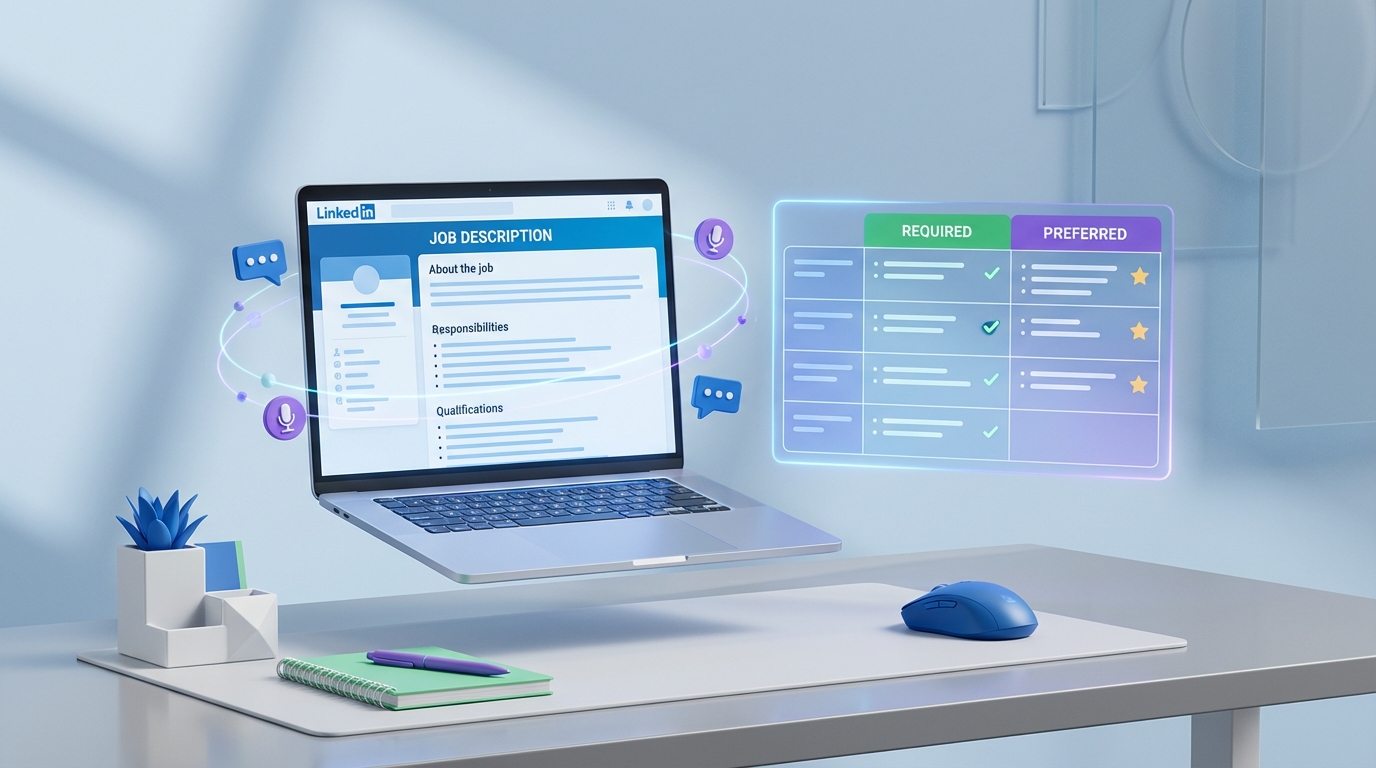
Employers commonly list required qualifications first, then preferred qualifications. Required items are the non negotiables. Preferred items are differentiators that can help you stand out but are not always mandatory.
- Required qualifications: skills, credentials, or experiences the hiring team believes are necessary to perform the job safely and effectively.
- Preferred qualifications: additional capabilities that reduce training time or expand what the person can do once hired.
If you meet most required qualifications and miss some preferred ones, you can still be a strong candidate. If you miss multiple required qualifications, be cautious and decide whether you can credibly close the gap quickly.
Company and role context: culture clues
Many postings include a short section about mission, values, or team context. This is not filler. It is often a proxy for what the team rewards and what it will not tolerate. If the description emphasizes collaboration, expect stakeholder heavy work. If it emphasizes speed and ambiguity, expect shifting priorities.
How to read between the lines
What is missing from a job description can be as informative as what is included. Hiring teams omit details for brevity, legal caution, or because they assume certain expectations are obvious.
Identify unspoken requirements
Some postings list technical skills but barely mention soft skills. Communication, adaptability, and teamwork are frequently assumed. If the role touches customers, executives, or cross functional partners, those skills are not optional even if they are not written down.
Use ordering to infer priorities
Lists are rarely random. The first 3 to 5 bullets in responsibilities and qualifications often reflect the hiring manager’s immediate pain. If the first line is “proven track record of sales achievements,” performance outcomes are likely the core evaluation lens.
Spot red flags early
Vague phrases can be legitimate, but they can also signal risk. Here are common examples and what they often imply.
- “Wear many hats”: unclear boundaries, frequent context switching, and shifting priorities.
- “Fast paced environment”: high throughput expectations, short deadlines, and potential for after hours work.
- “Self starter”: limited onboarding, success depends on your ability to create structure.
None of these are automatically bad. The key is to decide whether the implied working style matches how you perform best.
How to decide if you qualify
After you read the posting, you need a decision method that is consistent across roles. The following steps are designed to be reproducible and fast.
Step by step: build a match matrix
- Copy the required qualifications into a document as a checklist.
- Add the top responsibilities that appear most central to the role.
- Write evidence next to each item using specific outcomes, tools, and scope.
- Mark gaps clearly and decide whether each gap is minor, trainable, or a deal breaker.
- Tailor your resume so the first half page reflects the top priorities you identified.
Template you can copy:
| Job requirement | Your evidence | Gap risk | How you will address it |
|---|---|---|---|
| Required qualification #1 | Project, metric, tool, scope | Low / Medium / High | Example, course, portfolio, referral |
| Core responsibility #1 | What you did weekly, outcomes | Low / Medium / High | How you will ramp in 30 days |
Assess interest, not just eligibility
Qualification is necessary, but motivation matters. If the responsibilities do not energize you, the role can still be a poor fit even if you can do it. Hiring teams often prefer candidates who show clear interest in the work, not only the title.
Get external validation
If you are uncertain, ask a mentor or colleague to review your match matrix and resume. A third party can often spot overconfidence, underconfidence, or missing evidence faster than you can.
Where an AI hiring platform helps
Job descriptions are written by humans under time pressure, often with multiple stakeholders. That is why they can be inconsistent. An ai hiring platform can reduce that inconsistency by enforcing structure and by improving the speed and quality of candidate communication.
What we tested in our workflow
We tested StrategyBrain AI Recruiter in a LinkedIn sourcing workflow to see how well it handles the repetitive front end of recruiting. Specifically, we focused on whether it can keep candidate conversations moving without sacrificing clarity about role, compensation, and next steps.
- Test period: 2026-02-10 to 2026-02-24
- Scenario: LinkedIn outreach, candidate Q and A, interest confirmation, resume and contact capture
- What we did not test: final resume based qualification decisions, which AI Recruiter explicitly does not replace
How AI Recruiter fits into the same “decode and qualify” logic
On the employer side, the same decoding principles apply. The difference is that the platform can operationalize them at scale.
- Structured outreach: AI Recruiter automatically connects with candidates who match your search criteria and introduces the opportunity using the job and company details you provide.
- Always on follow up: it responds 24/7 and can communicate in the candidate’s native language, which reduces delays across time zones.
- Interest confirmation: it asks candidates whether they are open to interviewing and collects resumes and contact details from interested candidates.
This is where “live interview ai” expectations often show up in practice. Many teams want real time responsiveness and pre qualification before a recruiter invests time. AI Recruiter is not a replacement for the interview itself, but it can function as an ai tool for interviews in the sense that it prepares the pipeline by confirming interest, answering common questions, and capturing the information needed to schedule human interviews.
Limitations and honest boundaries
During our review, the most important boundary was also the clearest: AI Recruiter can identify willingness to communicate and interview, but it does not decide whether a resume fully matches job requirements. Recruiters still need to review resumes and make the final qualification call.
That limitation is not a flaw. It is a practical division of labor. The platform handles repetitive messaging and data capture, while humans handle judgment, tradeoffs, and final selection.
Security and compliance signals to look for
When evaluating any ai hiring platform, ask how candidate data is handled. AI Recruiter states that customer provided data is not used to train AI models, and that credentials and candidate information are encrypted and isolated per customer environment. If you are in the EU, United States, or Canada, you should still validate privacy and data protection requirements with your legal team before deployment.
Quick comparison: manual vs AI assisted workflow
| Workflow | Speed | Consistency | Best for |
|---|---|---|---|
| Manual decoding and follow up | Depends on recruiter availability | Varies by person and team | Small pipelines, high touch roles |
| AI assisted outreach and pre qualification with AI Recruiter | 24/7 candidate messaging | High for repeated messaging steps | LinkedIn sourcing at scale, global time zones, multilingual candidate engagement |
FAQ
How do I know if I should apply when I do not meet every qualification?
Apply when you meet the required qualifications and can provide evidence for most core responsibilities. If you only miss preferred items, you can still be competitive. If you miss multiple required items, treat it as a higher risk application and decide whether the gap is realistically trainable.
What does “preferred” usually mean in a job description?
Preferred typically means the employer would like it, but it is not always mandatory. It can also signal what would make onboarding faster. Use it to tailor your resume, but do not assume it disqualifies you if you lack it.
Is the job title a reliable indicator of seniority?
No. Titles vary widely across companies. Confirm seniority by looking for decision making authority, budget ownership, leadership expectations, and the complexity of responsibilities.
What are the biggest red flags in job descriptions?
Vague phrases are not always red flags, but they should trigger questions. “Wear many hats” can mean unclear scope. “Fast paced” can mean constant urgency. If the posting lacks clarity on outcomes, reporting lines, or success metrics, expect ambiguity.
How can an AI hiring platform improve the candidate experience?
An ai hiring platform can reduce delays by responding quickly, answering common questions consistently, and keeping candidates informed about next steps. In our testing, AI Recruiter’s always on messaging and multilingual communication were the most candidate visible improvements.
Does AI Recruiter replace recruiters or hiring managers?
No. AI Recruiter automates repetitive LinkedIn tasks such as connecting, introducing roles, confirming interest, and collecting resumes and contact details. Final qualification and hiring decisions still require human review.
Can AI Recruiter be used as a live interview AI?
It is better described as pre interview automation rather than a replacement for interviews. It can confirm interview interest, answer role and compensation questions, and capture the information needed to schedule interviews, which supports a live interview ai style workflow without removing human evaluation.
What is the fastest way to tailor my resume to a job description?
Create a match matrix, then rewrite your summary and top bullet points to mirror the employer’s top priorities using your own evidence. Focus on the first 3 to 5 responsibilities and the required qualifications first.
Conclusion
Decoding job descriptions is a skill you can systematize. Separate required from preferred, infer priorities from ordering, translate vague phrases into real working conditions, and then build a match matrix that forces clarity. If you are hiring, the same discipline applies, but an ai hiring platform can make it easier to execute consistently at scale.
Next steps: copy the match matrix template above for your next application, and if you are building a LinkedIn sourcing engine, evaluate whether StrategyBrain AI Recruiter fits your workflow for automated outreach, multilingual follow up, and resume capture while keeping final qualification decisions with your team.