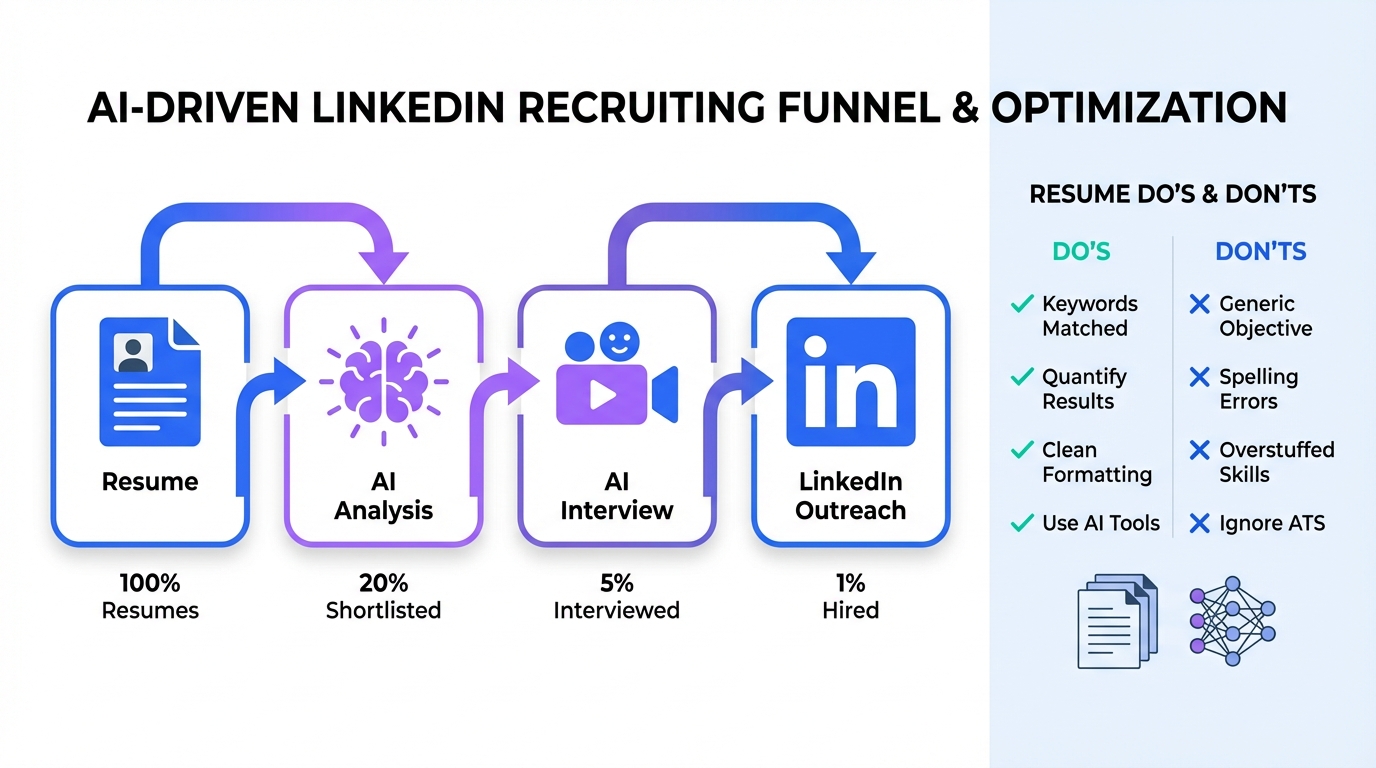
If you want your resume to perform well on an ai hiring platform, the fastest improvement is to use a clean, scannable format, quantify your impact with numbers, and tailor your content to the exact role you are applying for. In practice, that means a simple structure, measurable accomplishments, and role aligned keywords that a recruiter and an AI screener can both understand. This article keeps the classic resume do and don’t framework, then updates it for 2026 workflows where an ai interview app or interview ai may be used after initial screening. It also explains how StrategyBrain AI Recruiter fits into the same pipeline by automating LinkedIn outreach and collecting resumes and contact details so recruiters can spend time on real evaluation.
Key Takeaways
- Use clean formatting: Simple headings and consistent spacing reduce parsing errors in an ai hiring platform.
- Quantify impact: Include numbers with units such as revenue in USD, time saved in hours per week, or conversion rate in percent.
- Tailor every submission: Mirror the job’s required skills using natural language, not keyword stuffing.
- Proofread: Spelling and grammar mistakes signal low attention to detail to both humans and automated screeners.
- Avoid photos in North America: Photos can introduce bias risk and are typically not expected in US and Canada hiring.
- Keep length tight: 1 to 2 pages is the default target for most roles, unless your field expects a longer CV.
- Do not exaggerate: Inflated claims are easy to challenge in structured interviews and interview ai assessments.
What an AI hiring platform actually reads
An ai hiring platform typically ingests your resume as text, then maps it into structured fields such as job titles, dates, skills, and achievements. If the layout is overly designed, the system may misread sections or merge unrelated content. That is why “clean formatting” is not just aesthetic. It is a reliability requirement.
After screening, many teams route candidates into an ai interview app or interview ai step. That stage often checks consistency, role fit, and communication. A resume that is clear, specific, and measurable makes those later steps easier because your claims can be validated quickly.
Scope boundaries
- Covered: Resume structure, content choices, and common mistakes that affect screening and interviews.
- Not covered: Country specific legal advice, immigration guidance, or role specific portfolio reviews.
Resume Do’s
1) Use clean formatting that makes sections obvious
Use a professional font, consistent spacing, and clear section headers such as Summary, Experience, Skills, and Education. Keep alignment consistent and avoid multi column layouts unless you are sure the target system parses them correctly.
- Use one primary font family and 2 sizes at most for body and headings.
- Use standard headings that a recruiter can scan in 10 seconds.
- Export to PDF only if the employer accepts it. Otherwise use DOCX.
2) Load it with relevant accomplishments that include measurable outcomes
Accomplishments are stronger than responsibilities. When you can, include numbers with units. This helps a recruiter validate impact and helps automated scoring systems distinguish signal from noise.
- Revenue: “Increased annual recurring revenue by USD 120,000 in 12 months.”
- Efficiency: “Reduced onboarding time from 14 days to 9 days.”
- Quality: “Improved first pass QA rate from 91% to 97%.”
3) Tailor your resume to the specific job you are applying for
Tailoring means selecting the most relevant projects, skills, and achievements for that role. It does not mean copying the job description verbatim. A good rule is that your top 5 skills should match the role’s top requirements, using the same terminology where it is accurate.
In 2026 pipelines, tailoring also reduces friction later when an ai interview app asks structured questions about your experience. If your resume already frames your work in role relevant terms, you spend less time clarifying basics and more time demonstrating depth.
4) Ask someone to proofread your resume
Spelling and grammar errors are still one of the fastest ways to lose trust. They also create ambiguity for automated parsing. If you do not have a second person available, read it out loud and run a grammar check, then do a final manual pass.
Resume Don’ts
1) Don’t address the reader incorrectly
If you include a cover letter, do not guess the hiring manager’s name. If you cannot confirm it, use a neutral greeting such as “Hiring Manager” or “Recruiting Team.”
2) Don’t apply when you are clearly unqualified without explaining transferable skills
If you are pivoting industries or functions, your resume must do the translation work. Otherwise, it can look like you did not read the role requirements.
- Show the closest comparable work you have done.
- Name the transferable skills explicitly, then prove them with examples.
- Explain the “why” briefly in your summary or cover letter.
3) Don’t include a photo of yourself for North America roles
In the United States and Canada, photos are generally not expected on resumes. Many employers avoid them to reduce bias risk. If you are applying in a region where photos are common, follow local norms, but do not assume it is universal.
4) Don’t exaggerate accomplishments or skills
Inflated claims are easy to detect during reference checks, technical screens, and structured interviews. They can also backfire in an interview ai setting where answers are compared for consistency. If you contributed to a team outcome, state your role precisely.
5) Don’t make your resume too long
For most roles, 1 to 2 pages is ideal. More than 2 pages can signal that you struggle to prioritize. If you have extensive experience, keep the most recent 10 years detailed and summarize older roles.
How StrategyBrain AI Recruiter fits into the workflow
Many candidates experience the hiring process as a black box. In reality, recruiters are often constrained by time, especially during high volume sourcing on LinkedIn. StrategyBrain AI Recruiter is designed to remove repetitive steps at the top of the funnel so recruiters can respond faster and evaluate better.
What it automates on LinkedIn
StrategyBrain AI Recruiter automates initial LinkedIn recruiting tasks such as connecting with candidates, introducing the role, answering common questions about the company and compensation, confirming interview interest, and collecting resumes and contact details from interested candidates. This matters because it reduces delays between first contact and screening, which can improve candidate experience without lowering standards.
Why this matters for your resume
When an AI recruiter is collecting resumes during outreach, clarity becomes even more important. A clean, tailored resume helps the recruiter quickly confirm fit after the system captures your file and contact details. It also sets you up for the next step if the employer uses an ai interview app to standardize early interviews.
Limits to be aware of
- StrategyBrain AI Recruiter can confirm interest and collect resumes, but final qualification still requires a recruiter to review your resume against the job requirements.
- Multilingual messaging can reduce misunderstandings, but you should still keep your resume language consistent with the role’s working language unless instructed otherwise.
Quick checklist before you submit
- My resume uses a simple structure with clear headings.
- Each role includes 2 to 5 achievements with numbers and units.
- The top skills match the job requirements using accurate terminology.
- There are zero spelling and grammar errors after a final read through.
- I did not include a photo for US and Canada applications.
- The resume is 1 to 2 pages unless my field expects a longer CV.
- I can defend every claim in a structured interview or interview ai screen.
FAQ
What is the best resume format for an ai hiring platform?
A single column layout with standard headings is the safest choice because it is easiest to parse into structured fields. Use consistent dates, clear job titles, and bullet points that start with action verbs.
Should I optimize my resume for an ai interview app too?
Yes. If your resume is specific and measurable, it is easier to answer structured questions consistently later. Keep your claims precise so you can explain them clearly in an interview ai step.
How many bullet points should I include per job?
For most roles, 3 to 6 bullets per job is enough. Prioritize outcomes and measurable impact over task lists.
Is it okay to reuse the same resume for every application?
It is rarely ideal. Tailoring improves relevance and reduces the chance that your strongest experience is buried. Keep a master resume, then create a role specific version for each application.
Do I need to include a photo on my resume?
For North America roles, no. Photos are generally not expected and can introduce bias concerns. Follow local norms only when you are sure the region expects it.
How long should my resume be?
1 to 2 pages is the standard target for most candidates. If you exceed 2 pages, make sure the extra length is justified by role requirements or a CV style expectation.
What if I am underqualified but still want to apply?
Apply only if you can credibly map your experience to the role. Use your summary and bullets to explain transferable skills with concrete examples, not vague statements.
How does StrategyBrain AI Recruiter affect candidates?
It can reduce delays by handling initial LinkedIn outreach and follow up, then collecting resumes and contact details when a candidate is interested. Recruiters still make the final decision on fit after reviewing your resume.
Conclusion
To stand out on an ai hiring platform, focus on what both humans and systems reward: clean structure, measurable accomplishments, and role specific relevance. Avoid the common mistakes that create doubt, including photos in North America, exaggerated claims, and overly long resumes. Next, run the quick checklist, then prepare to explain your top achievements clearly if the process includes an ai interview app or interview ai step. If you are hiring, consider how StrategyBrain AI Recruiter can streamline LinkedIn outreach and resume collection so your team spends more time on real evaluation and less time on repetitive messaging.