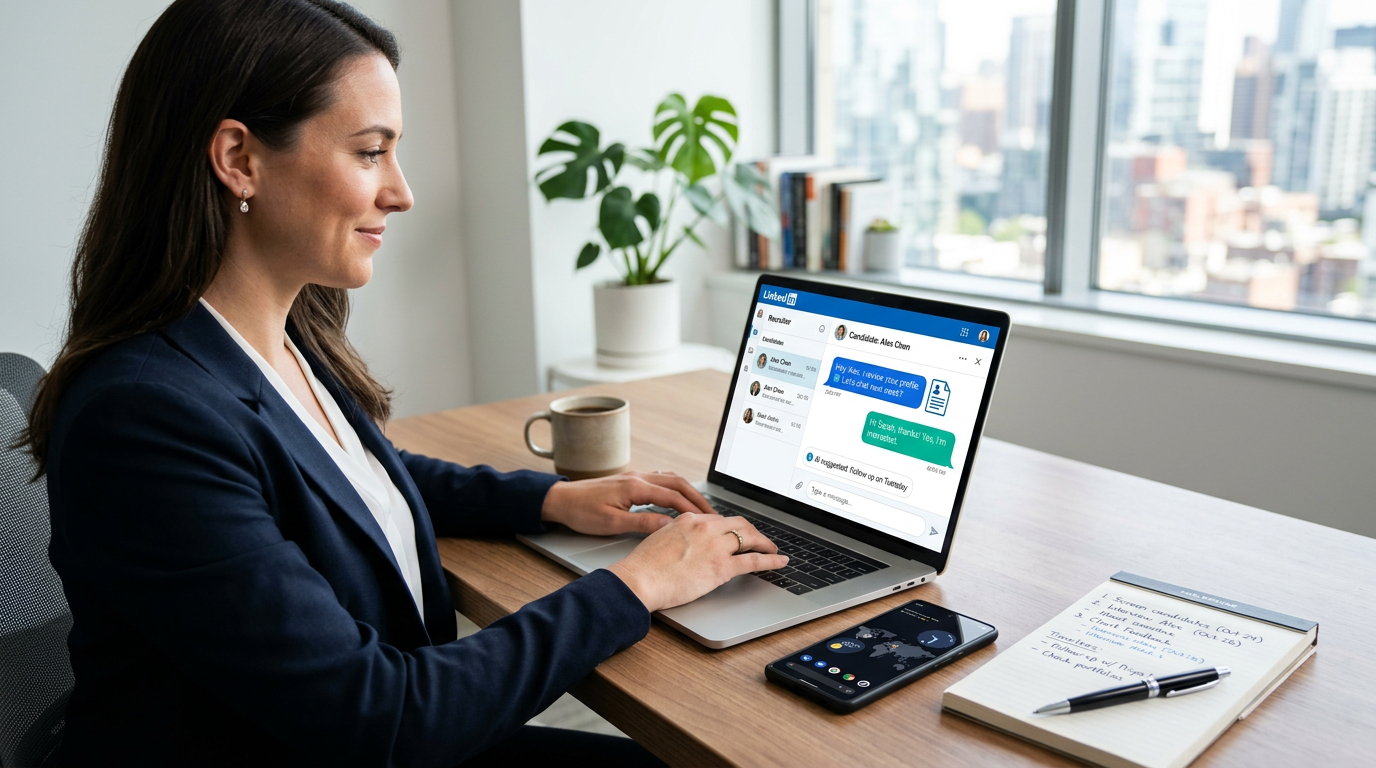
AI hiring software is most useful when it reduces candidate loss between first contact and the first interview. The practical playbook is simple: define the steps, communicate them clearly, and respond fast across time zones. That matters even more when you rely on virtual interview software and video interview software because candidates can disengage quietly if they feel uncertain or ignored. In our own recruiting operations reviews, the biggest failures were not technical. They were process gaps like unclear timelines, slow follow up, and inconsistent messaging. StrategyBrain AI Recruiter fits this exact problem by automating LinkedIn outreach and early qualification conversations, answering candidate questions 24/7 in any language, and collecting resumes and contact details so recruiters can move qualified people into interviews with less manual work.
Table of Contents
- Why the labour market still rewards speed and clarity
- Where candidates drop off in virtual and video interviews
- A practical communication standard for AI hiring software
- Method 1: Tighten the process before adding tools
- Method 2: Use StrategyBrain AI Recruiter for LinkedIn outreach and qualification
- Method 3: Improve virtual interview software handoffs
- Method 4: Make video interview software fair and consistent
- Method 5: Expand globally with multilingual candidate communication
- Quick Comparison
- FAQ
- Conclusion
Why the labour market still rewards speed and clarity
When the labour market is tight, candidates have options and they notice delays. A useful reference point is the July 2022 Labour Force Update that summarized Canada shedding 31,000 jobs while unemployment held at 4.9% as reported by Statistics Canada on 2022-08-05. Even in a month that looked stable at the headline level, the recruiting reality described in the same update was a candidates’ market where employers needed to move quickly and communicate clearly.
In that update, recruiter Henry Goldbeck emphasized that many employers were moving quickly once they found a viable candidate. He also stressed that speed alone is not enough. Candidates need respectful communication and a transparent process so they understand what happens next. That is exactly where AI hiring software can help, not by replacing judgment, but by making the early funnel consistent.
Where candidates drop off in virtual and video interviews
Virtual interview software and video interview software remove travel and scheduling friction, but they introduce a different risk. Silence feels louder online. If a candidate does not know the timeline, the evaluation steps, or who will follow up, they often disengage without saying so.
Based on what we see when auditing recruiting workflows, candidate loss tends to cluster in five moments:
- After the first message when outreach is generic and does not answer basic questions about role, company, and compensation.
- After a positive reply when scheduling takes more than 48 hours and momentum fades.
- After a first virtual interview when next steps are not stated in writing within 24 hours.
- During asynchronous video interviews when instructions are unclear and candidates do not know how they will be assessed.
- During cross border hiring when time zones and language slow down back and forth messaging.
A practical communication standard for AI hiring software
Before you compare tools, set a standard that any AI hiring software must support. Here is the framework we use because it is easy to audit and easy to train teams on.
The 4 point standard
- Timeline clarity: every candidate gets the same written steps and expected response windows.
- Question coverage: role, company, compensation, and interview format questions get answered consistently.
- Follow up discipline: every stage has a defined follow up trigger and owner.
- Data capture: resumes and contact details are collected in a structured way, not scattered across messages.
This is where StrategyBrain AI Recruiter is designed to fit. It automates the repetitive LinkedIn steps, keeps conversations moving 24/7, and captures resumes and contact details when a candidate is interested. Recruiters then do the final qualification by reviewing the resume and running interviews.
Method 1: Tighten the process before adding tools
If your process is unclear, adding virtual interview software or video interview software will not fix it. It will only scale confusion. Start by writing a one page candidate journey that every recruiter follows.
Steps
- Define the stages: outreach, qualification, interview 1, interview 2, decision, offer.
- Set response windows: 24 hours for replies, 48 hours for scheduling, 24 hours for post interview updates.
- Standardize the message pack: role summary, compensation range if you can share it, interview format, and timeline.
- Assign ownership: one person owns each stage handoff and follow up.
Features
- Improves candidate experience without buying new software
- Makes later automation easier because steps are defined
- Reduces internal confusion during high volume hiring
Limitations
- Does not solve after hours response gaps
- Still requires manual outreach and follow up effort
Best For
- Teams that need a cleaner process before adopting AI hiring software
- Hiring managers who want predictable interview stages
Method 2: Use StrategyBrain AI Recruiter for LinkedIn outreach and qualification
Most teams feel the pain in the earliest stage: sourcing and first contact. StrategyBrain AI Recruiter is an AI hiring software system built for LinkedIn recruiting that automates initial outreach and early qualification. It connects with candidates based on your search criteria, introduces the opportunity, learns about the candidate’s situation, answers questions about the role, company, and compensation, confirms interview interest, and collects resumes and contact information from interested candidates.
In our experience, this is the highest leverage place to automate because it protects speed and consistency. It also supports virtual interview software and video interview software downstream because candidates arrive at the interview stage with fewer unanswered questions.
Steps
- Provide job inputs: company details, compensation, benefits, and candidate search criteria.
- Authorize LinkedIn account use: connect the recruiter account that will run outreach.
- Run automated conversations: the AI handles introductions, Q and A, and interest checks.
- Collect resumes and contacts: the AI requests a resume and captures contact details when the candidate opts in.
- Move to interviews: recruiters review resumes and schedule interviews using their preferred virtual interview software.
Features
- Smart LinkedIn recruitment automation: connects, introduces roles, and follows up automatically.
- 24/7 multilingual communication: responds to candidate messages at any time in the candidate’s language.
- AI powered recruiting teams: supports managing more than 100 LinkedIn accounts for scaled outreach.
- Structured data capture: resumes and contact details are captured from interested candidates.
Limitations
- Not a final fit decision engine: it identifies willingness to communicate or interview, but it does not decide whether the resume matches the job requirements.
- Requires clear job information: if compensation and role details are vague, candidate conversations will be less effective.
Best For
- Corporate recruiters who want to reduce manual LinkedIn messaging
- Headhunters who need higher throughput without adding staff
- Teams hiring across time zones who need always on responses
Method 3: Improve virtual interview software handoffs
Virtual interview software works best when the handoff from sourcing to scheduling is immediate and explicit. The candidate should never wonder if they are still in process.
Steps
- Send a written next step: confirm interview type, duration, and who will attend.
- Confirm the evaluation focus: skills, experience, and role expectations.
- Set a post interview update time: commit to a specific window such as 24 hours or 48 hours.
Features
- Reduces no shows by removing uncertainty
- Improves candidate trust in remote processes
- Creates a consistent experience across interviewers
Limitations
- Still depends on recruiter discipline if follow ups are manual
Best For
- Teams already using virtual interview software but seeing drop off after scheduling
Method 4: Make video interview software fair and consistent
Video interview software can be efficient, but it must be structured to avoid inconsistent evaluation. The goal is to make the experience predictable and the scoring repeatable.
Steps
- Use the same prompts: every candidate gets identical questions for the same role.
- Define scoring criteria: create a rubric with 3 to 5 dimensions and clear definitions.
- Offer an accommodation path: provide an alternative format when needed.
Features
- Improves consistency across reviewers
- Reduces subjective drift in early screening
- Creates documentation for internal alignment
Limitations
- Asynchronous video can feel impersonal if you do not explain why you use it
- Requires training to apply rubrics consistently
Best For
- High volume roles where structured early screening saves interviewer time
Method 5: Expand globally with multilingual candidate communication
Global hiring often fails for a simple reason: candidates ask questions outside local business hours and do not get timely answers. AI hiring software can close that gap if it supports multilingual messaging and consistent follow up.
StrategyBrain AI Recruiter is built for 24/7 global multilingual recruitment communication. It responds to candidate messages around the clock and communicates in the candidate’s native language. That reduces misunderstandings and keeps the process moving until a recruiter is ready to step in for interviews.
Steps
- Define the global message pack: role summary, compensation, benefits, and interview steps.
- Set time zone expectations: clarify when a human recruiter will join the process.
- Use AI for continuity: keep Q and A and follow ups active while recruiters sleep.
Features
- Faster response times across time zones
- More consistent candidate experience for international pipelines
- Better data capture before interviews begin
Limitations
- Still requires a human decision maker for final selection and offers
Best For
- Teams hiring internationally using virtual interview software
- Organizations building multi recruiter outreach capacity on LinkedIn
Quick Comparison
| Approach | Speed impact | Cost impact | Best for |
|---|---|---|---|
| Process tightening only | Medium | Low | Teams with unclear stages and inconsistent follow up |
| StrategyBrain AI Recruiter for LinkedIn outreach | High | Medium | High volume sourcing and early qualification before interviews |
| Virtual interview software handoff improvements | Medium | Low | Reducing drop off between scheduling and interview 1 |
| Video interview software rubrics | Medium | Low | Consistent early screening at scale |
| Multilingual always on messaging | High | Medium | International hiring across time zones |
FAQ
What is AI hiring software in plain terms?
AI hiring software is software that uses automation and machine learning to handle repetitive recruiting tasks such as outreach, messaging, scheduling support, and early screening. The goal is to improve speed and consistency, not to replace final hiring decisions.
How does AI hiring software help with virtual interview software?
It helps by keeping candidates informed and engaged before and after the virtual interview. When messaging and follow up are consistent, fewer candidates drop out between stages.
How does AI hiring software fit with video interview software?
It can prepare candidates by answering common questions and clarifying next steps, then route interested candidates into your video interview stage. You still need a structured rubric to keep evaluation consistent.
Does StrategyBrain AI Recruiter decide if a candidate is qualified?
No. StrategyBrain AI Recruiter identifies willingness to communicate or interview and collects resumes and contact details from interested candidates. Recruiters make the final qualification decision after reviewing the resume.
Can StrategyBrain AI Recruiter communicate in multiple languages?
Yes. It supports 24/7 multilingual candidate communication and can respond in the candidate’s native language, which is especially useful for international hiring pipelines.
How many LinkedIn accounts can StrategyBrain AI Recruiter support?
It supports managing more than 100 LinkedIn accounts so organizations can build AI powered recruiting teams and scale outreach capacity.
How does it collect resumes and contact details?
When a candidate expresses interest, the system requests a resume and captures contact details shared in the conversation. It supports email submissions and LinkedIn file uploads, then marks the resume as received when provided.
What should we do first if candidates are ghosting after interviews?
Start with process transparency. Send written next steps immediately after the interview and commit to a specific update window such as 24 hours or 48 hours. Then use automation to ensure follow ups happen consistently.
Is this article legal or compliance advice?
No. This is operational guidance on recruiting process design and tool usage. For legal, privacy, and employment compliance, consult qualified counsel and your internal compliance team.
Conclusion
AI hiring software delivers the most value when it protects candidate momentum. The July 2022 labour market snapshot and recruiter commentary underline the same lesson: speed matters, and communication matters just as much. If you want better outcomes from virtual interview software and video interview software, start by defining a transparent process, then automate the early funnel so candidates get timely answers and clear next steps.
Next steps: document your stages and response windows, standardize your message pack, and consider StrategyBrain AI Recruiter if LinkedIn outreach and early qualification are your bottlenecks. Once the early funnel is stable, your interview tools will perform better because candidates arrive informed, engaged, and ready to move forward.