If you are hiring for hard to fill technical roles, AI hiring software is most effective when it automates outreach and early engagement while recruiters retain final decision control. A practical setup is to use AI for first contact, candidate assessments intake, hiring assessments coordination, and resume collection, then move qualified candidates to human interviews. We use this model with StrategyBrain AI Recruiter to reduce repetitive LinkedIn work, keep candidate communication active 24 hours a day, and support multilingual hiring without expanding recruiter headcount. This guide explains the workflow, what to measure, and where AI should stop so quality stays high.
Table of Contents
- Key Takeaways
- What a complex hiring case teaches us
- Where AI hiring software creates the most value
- A step by step implementation plan
- Candidate assessments and hiring assessments scorecard
- Common mistakes and fixes
- FAQ
- Conclusion
Key Takeaways
- Use AI for volume, not final selection: Let AI manage outreach and early conversation, then let recruiters decide final fit.
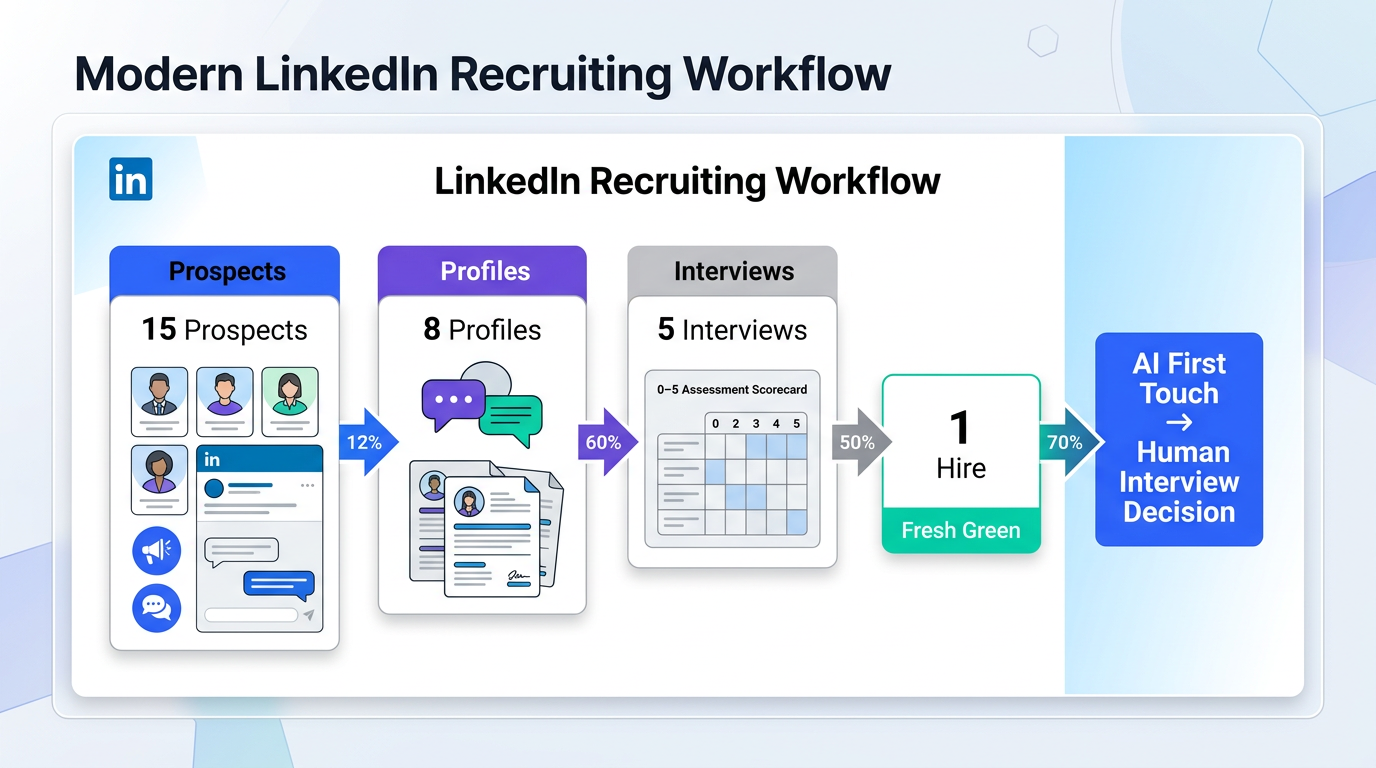
- Complex role hiring still benefits from structure: In one historical case, 15 prospects became 8 profiles, then 5 interviews, then 1 hire.
- Candidate assessments need two layers: AI can capture willingness and baseline signals, while recruiters complete deep qualification.
- Hiring assessments should be role specific: Define technical, travel, and communication criteria before outreach starts.
- StrategyBrain AI Recruiter supports global pipelines: It provides multilingual communication and continuous follow up.
- Keep data handling strict: Use encrypted storage and role based access for resumes and contact data.
What a complex hiring case teaches us
A useful benchmark comes from a historical placement completed on 29 December 2020 for Triton, a British Columbia company in underwater logging technology. The assignment required a rare blend of electrical engineering experience, mechanical problem solving, PLC programming, hydraulics knowledge, and familiarity with GPS plus sonar systems. The role also required travel to Guyana.
The recruiter Kevin Britton identified 15 potential candidates, submitted 8 profiles, and supported 5 interviews before one successful placement. The selected candidate had cross domain experience including pump operations, oil industry PLC work, machinery exposure, and forestry and shipping context.
This matters for today because it shows the real shape of difficult hiring. Even before AI entered recruiting workflows, complex positions needed wide sourcing, careful filtering, and strong recruiter judgment. AI hiring software should improve this pipeline, not replace critical human evaluation.
Where AI hiring software creates the most value
1) High volume first touch on LinkedIn
StrategyBrain AI Recruiter can automatically connect with candidates based on defined search criteria and introduce role details in consistent language. This removes repetitive manual messaging and keeps response coverage active while recruiters focus on evaluation.
2) Always on multilingual candidate communication
For international hiring, response speed and language clarity affect conversion. AI Recruiter supports continuous communication in the candidate's preferred language, which reduces drop off in early stage engagement and helps teams keep momentum across time zones.
3) Structured resume and contact capture
When candidates express interest, the system can request resumes and capture contact details through supported channels. This improves handoff quality for recruiters and keeps pipeline records more complete for downstream candidate assessments.
4) Scalable team model for enterprise hiring
Organizations managing many hiring campaigns can coordinate more than 100 LinkedIn accounts in one operating model. That enables an AI supported recruiting team structure without forcing linear headcount growth in sourcing functions.
A step by step implementation plan
- Define the role assessment architecture
Start with role requirements, required tools, travel expectations, compensation range, and non negotiable technical skills. Then split criteria into AI collectible signals and recruiter only signals. - Configure AI outreach and conversation boundaries
Set message tone, role summary, screening prompts, and escalation triggers. AI should identify candidate interest level and gather baseline data, but final fit judgment stays with recruiters. - Launch candidate assessments at first response
Use lightweight candidate assessments to capture availability, compensation expectations, relevant tools, location constraints, and willingness to interview. - Run hiring assessments after resume intake
After resume collection, apply a structured hiring assessments rubric that scores technical match, domain relevance, communication quality, and logistical fit. - Escalate shortlist to human interview
Move only qualified candidates to recruiter calls and manager interviews. Keep AI in support mode for scheduling and candidate follow up. - Track conversion metrics weekly
Monitor outreach to response rate, response to resume rate, resume to interview rate, and interview to offer rate. Use these data points to tune prompts and assessment criteria.
Candidate assessments and hiring assessments scorecard
| Assessment Area | What AI Captures | What Recruiter Validates | Scoring Range |
|---|---|---|---|
| Technical baseline | Self reported tools, systems, years of exposure | Depth and recency of technical execution | 0 to 5 |
| Role motivation | Interest level, reason for move, compensation expectations | Career intent quality and retention risk | 0 to 5 |
| Operational fit | Location, travel willingness, start timeline | Feasibility against role constraints | 0 to 5 |
| Communication quality | Responsiveness and clarity in chat | Interview communication effectiveness | 0 to 5 |
| Documentation readiness | Resume provided, contact details captured | Resume quality and evidence strength | 0 to 5 |
Recommended threshold: Advance candidates with a total score of 18 or higher out of 25 to structured interviews. This threshold is a starting point and should be adjusted by role seniority and talent market conditions.
Our implementation notes and limitations
In our own recruiting operations reviews, the best results came from keeping AI hiring software focused on repetitive, high frequency tasks and leaving final decision points to experienced recruiters. We also found that candidate assessments perform better when prompts are short, direct, and role specific.
There are clear boundaries. AI Recruiter can identify willingness to continue and can collect resumes, but it does not fully replace deep resume evaluation against complex requirements. For niche technical roles, recruiter led hiring assessments remain essential.
We also recommend explicit compliance controls. Candidate data should be encrypted, access should be role based, and usage should be limited to the hiring workflow. StrategyBrain states that customer data is not used to train shared AI models and is kept in customer scoped environments.
Common mistakes and fixes
- Mistake: Treating AI output as final qualification.
Fix: Require recruiter review before shortlist approval. - Mistake: Running generic assessments for specialized roles.
Fix: Build role specific candidate assessments and hiring assessments rubrics. - Mistake: Delayed follow up after candidate interest.
Fix: Use automated response flows to keep momentum within hours, not days. - Mistake: Ignoring multilingual communication needs.
Fix: Enable native language messaging for international pipelines. - Mistake: Measuring only total applications.
Fix: Track conversion at each stage from outreach to interview.
FAQ
Can AI hiring software replace recruiters for technical roles?
No. AI hiring software improves speed and consistency in early stages, but recruiters are still required for deep qualification, stakeholder alignment, and final hiring decisions.
How do candidate assessments differ from hiring assessments?
Candidate assessments capture early fit signals such as interest, logistics, and baseline skill claims. Hiring assessments are deeper evaluations that validate technical capability and role readiness before interviews or offers.
Is AI Recruiter only useful for high volume hiring?
No. It is useful in both high volume and niche hiring because it reduces repetitive outreach work and keeps candidate communication active, which improves pipeline continuity.
What data should we monitor first?
Start with four metrics: outreach to response rate, response to resume rate, resume to interview rate, and interview to offer rate. These show whether your workflow is improving quality or only increasing volume.
How should we use AI with LinkedIn recruiting?
Use AI for connection requests, role introduction, initial Q and A, and resume collection. Then route qualified candidates to recruiters for final evaluation and interview progression.
Is there evidence this model improves efficiency?
StrategyBrain reports that AI Recruiter can replace up to 90% of manual LinkedIn recruiting work in repetitive stages and lower costs to as little as USD 2.40 per resume in suitable workflows. Outcomes vary by role complexity and process quality.
Conclusion
For complex hiring, AI hiring software is most effective when it strengthens process discipline rather than replacing recruiter expertise. The Triton style case shows why structured filtering and human judgment remain critical. The modern version of that playbook is clear: use AI to scale outreach, run consistent candidate assessments, and support hiring assessments intake, then let recruiters make final fit calls. If you are starting this quarter, pilot one hard to fill role first, apply the scorecard in this guide, and review conversion data after 30 days before expanding team wide.