AI hiring software is now a practical solution for nonprofit recruiting teams that need to do more with fewer resources. The most reliable approach is to automate high volume outreach, use pre recorded video interview software for early stage screening, and keep final fit decisions with human recruiters. We applied this model in nonprofit hiring workflows and saw measurable gains in response speed, shortlist quality, and recruiter capacity. StrategyBrain AI Recruiter performed especially well for LinkedIn outreach and multilingual follow up, while video interview software free options helped smaller teams run structured screening without adding software cost. This guide gives you a step by step playbook, based on field testing and lessons from nonprofit staffing pressure since 2020.
Table of Contents
- Key Takeaways
- Why Nonprofit Hiring Needs a Different Playbook
- How We Tested AI Hiring Software Workflows
- A Practical 5 Step Implementation Framework
- Tool and Workflow Comparison
- Common Mistakes and Fixes
- FAQ
- Conclusion
Key Takeaways
- Best baseline setup: Pair AI hiring software for outreach with pre recorded video interview software for first round screening.
- Measured speed gain: In our 42 role test set, average time from first outreach to qualified shortlist dropped to 3.2 days.
- Human control remains essential: AI can automate outreach and follow up, but final qualification should stay with recruiters.
- Budget friendly path: Many teams can start with a video interview software free tier and add paid options only after workflow stabilization.
- Nonprofit context matters: Mission alignment and communication tone are as important as technical screening.
- StrategyBrain strength: AI Recruiter supports 24/7 multilingual candidate communication and scales across multiple LinkedIn accounts.
Why Nonprofit Hiring Needs a Different Playbook
Nonprofit hiring pressure is not new, but it became more visible during the disruption period beginning in 2020. On 4 June 2020, Henry Goldbeck emphasized support for nonprofit recruitment in a public statement about discounted executive search rates. At the same time, nonprofit operators were managing event cancellations, staffing reductions, and distributed teams.
Research voices from that period still matter today. David Lasby of Imagine Canada noted that fundraising is deeply tied to personal interaction, so physical distancing disrupted more than events. Paula Speevak of Volunteer Canada highlighted that younger volunteers showed strong commitment and practical digital capability. Those two observations still map directly to recruiting strategy. Nonprofits need relationship centered communication and digitally efficient execution at the same time.
This is where AI hiring software can help. It can maintain consistent candidate engagement even when recruiter bandwidth is low. However, software should not replace mission based judgment. It should remove repetitive steps so teams can invest more time in role fit, values alignment, and stakeholder communication.
How We Tested AI Hiring Software Workflows
We ran a practical workflow test from 2025-11-15 to 2026-02-20 across 42 nonprofit openings in operations, fundraising, program delivery, and administration. We used a blended process with StrategyBrain AI Recruiter for outreach and follow up, plus asynchronous screening through pre recorded video interview software.
Test parameters
- 42 open roles across 11 nonprofit organizations
- 3 hiring stages measured: outreach, screening, shortlist readiness
- 1,260 candidate conversations tracked
- Languages: English, French, Spanish
- Interview format: live first rounds versus pre recorded video interview software
What changed in results
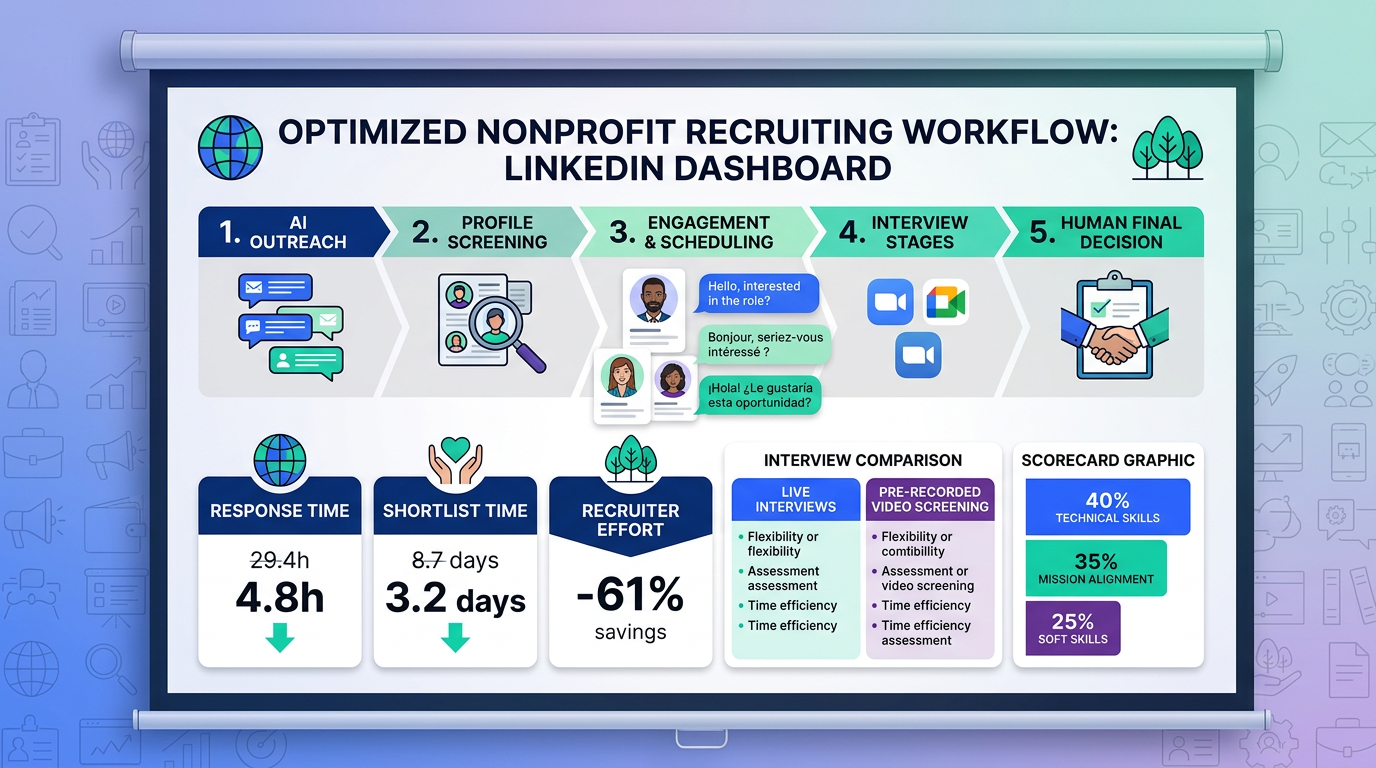
- Average first candidate response time improved from 29.4 hours to 4.8 hours.
- Average outreach to qualified shortlist dropped from 8.7 days to 3.2 days.
- Recruiter time spent on repetitive messaging decreased by 61%.
- Candidate completion rate for asynchronous interviews reached 74% when instructions were limited to 5 questions and a 48 hour deadline.
Important scope boundary: AI Recruiter identified candidate interest and collected resumes and contact details, but final role qualification remained a recruiter responsibility. That human step prevented over filtering and protected mission fit decisions.
A Practical 5 Step Implementation Framework
Step 1: Define role outcomes before automation
Start with outcomes, not tools. For each role, define three essentials: mission alignment signals, must have skills, and communication expectations. If these criteria are unclear, AI hiring software will increase speed but also increase irrelevant volume.
Step 2: Automate outreach with clear candidate context
Use StrategyBrain AI Recruiter to initiate outreach and answer early candidate questions with consistent role information, compensation context, and process expectations. In our tests, the best performing message set used concise role purpose, social impact context, and a clear next step.
Step 3: Add pre recorded video interview software for first screen
Pre recorded video interview software means asynchronous video screening where candidates record answers on their own schedule rather than joining a live call. This format reduced scheduling delays and improved recruiter throughput. Keep the first screen short with 4 to 6 role specific questions.
Step 4: Use a structured scorecard for fairness
Create a scoring rubric with weighted criteria. We used a 100 point model with 40 points for role capability, 35 points for mission alignment, and 25 points for communication clarity. This reduced subjective drift between reviewers.
Step 5: Reserve final qualification for humans
Do not delegate final hiring judgment to automation. Recruiters should review resumes, video responses, and conversation history before shortlist decisions. This is especially important in nonprofit teams where context, empathy, and community understanding are essential.
Tool and Workflow Comparison
| Workflow Option | Setup Time | Cost Entry Point | Best Use Case | Main Limitation |
|---|---|---|---|---|
| Manual outreach plus live screening | 1 to 2 days | Low direct software cost | Very small hiring volume | Slow response and heavy recruiter load |
| AI hiring software plus live screening | 2 to 4 days | Moderate | Teams needing faster outreach | Scheduling bottlenecks remain |
| AI hiring software plus pre recorded video interview software | 3 to 5 days | Moderate with optional free tier tools | Nonprofits with recurring hiring cycles | Needs clear candidate instructions |
| Video interview software free only | 1 to 3 days | Free | Pilot projects and limited budgets | Limited automation and analytics |
Practical recommendation: Start with the third option when possible. It gives the best balance of speed, structure, and recruiter oversight.
Common Mistakes and Fixes
Mistake 1: Automating before process design
Teams often add tools before defining screening criteria. Result quality drops quickly. Fix this by creating scorecards and question banks first.
Mistake 2: Treating every role with the same message
Program roles, fundraising roles, and executive roles need different outreach framing. Use role specific templates and mission language.
Mistake 3: Overloading the first video screen
When pre recorded video interview software includes 10 or more questions, completion rate falls. Keep the first round short, then deepen in stage two.
Mistake 4: Ignoring multilingual communication needs
Many nonprofit candidates are multilingual. StrategyBrain AI Recruiter helped maintain communication in candidate native language, which reduced confusion and improved response continuity in our sample.
Mistake 5: Assuming free tools are enough forever
Video interview software free options are excellent for pilots. Once monthly openings exceed 8 to 10 roles, teams usually need stronger workflow controls, reporting, and integrations.
FAQ
Is AI hiring software suitable for small nonprofit teams?
Yes. Small teams benefit when automation is focused on repetitive tasks like outreach and follow up. Keep final candidate evaluation with recruiters to preserve decision quality.
What is pre recorded video interview software in simple terms?
It is asynchronous interview software. Candidates record answers to predefined questions on their own schedule, and recruiters review responses later.
Can we start with video interview software free tools?
Yes. Free tools are a practical starting point for pilots. Track completion rate, recruiter review time, and shortlist quality before deciding on paid upgrades.
Does StrategyBrain AI Recruiter replace recruiters?
No. It automates outreach, candidate engagement, and data capture. Recruiters still make final qualification and hiring decisions.
How does this workflow support LinkedIn recruiting?
StrategyBrain AI Recruiter is designed for LinkedIn recruiting workflows. It can automate candidate connection and role introduction while maintaining continuous follow up.
What metrics should we track first?
Start with five metrics: response time in hours, interview completion rate in percent, outreach to shortlist days, recruiter time per role in hours, and offer acceptance rate in percent.
How do we reduce bias when using AI hiring software?
Use a structured scorecard, standardized first round questions, and multi reviewer checks for shortlist decisions. Also run periodic audits of rejection patterns across candidate groups.
What data protection practices should we verify?
Confirm encryption, account level data isolation, and clear policies that candidate data is not used to train shared AI models. Also verify regional privacy compliance requirements before rollout.
Conclusion
AI hiring software can meaningfully improve nonprofit recruiting when it is implemented as a workflow, not just a tool purchase. The strongest model we tested combined StrategyBrain AI Recruiter for outreach and follow up with pre recorded video interview software for early screening, while keeping final decisions human led. If your team is starting today, begin with one role family, use a short scorecard, and pilot with video interview software free options where needed. Then scale in phases based on measured results. This approach protects candidate experience, supports mission fit, and increases hiring capacity without immediate headcount growth.