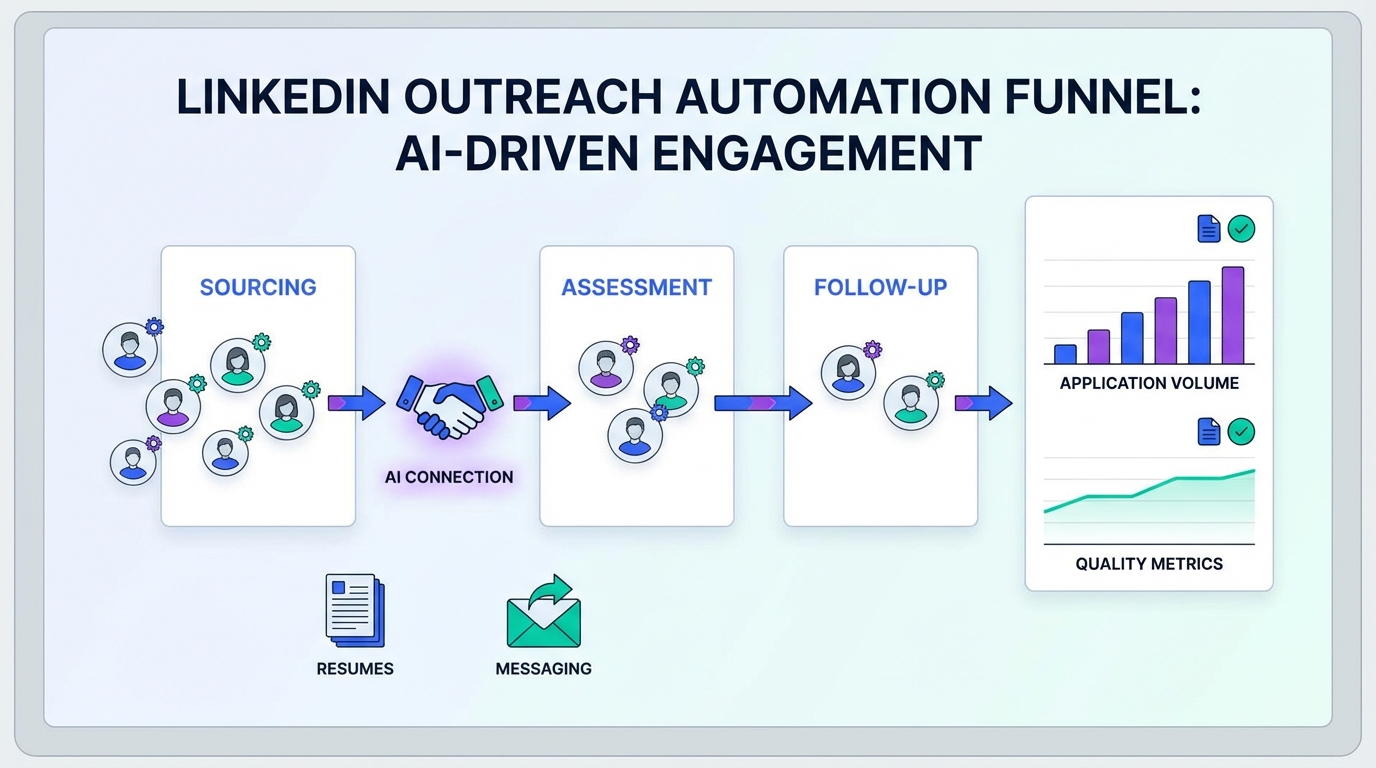
The most reliable recession hiring playbook is still the same: keep your talent bar high, avoid damaging your employer reputation, and hire with the recovery in mind. What changes in 2026 is execution. With application volume rising and teams running lean, ai hiring software helps you maintain consistent evaluation standards by structuring candidate assessments, speeding up triage, and keeping candidate communication timely. In our recruiting operations work, we see the biggest gains when automation is used for the repetitive front end of the funnel, while humans keep control of final decisions and relationship building. This article covers what to do, what to avoid, and how StrategyBrain AI Recruiter can reduce manual LinkedIn outreach and follow up without lowering hiring quality.
Key Takeaways
- Do not “strong arm” candidates: A recession can increase supply, but top candidates still have options and remember how they were treated.
- Hire for flexibility and longevity: Use contract talent tactically, but keep an eye on who can convert to full time when conditions improve.
- Expect higher application volume: Prepare your ATS and screening workflow so evaluation quality does not drop under load.
- Use structured hiring assessments: Standardized rubrics and job relevant work samples reduce noise when applicant volume spikes.
- Use AI where it is strongest: Automate outreach, scheduling friction, and first pass qualification, then keep humans on final fit decisions.
- StrategyBrain AI Recruiter fits the recession reality: It automates LinkedIn connecting, messaging, follow up, and résumé collection so recruiters can focus on interviews and final qualification.
Table of Contents
- Recession hiring mindset: think different, but stay fair
- Rule 1: Do not strong arm candidates
- Rule 2: Hire for flexibility and longevity
- Rule 3: Brace for more applications and protect quality
- Where AI hiring software helps most in a downturn
- A practical recession proof workflow (with candidate assessments)
- Common mistakes to avoid
- FAQ
- Conclusion and next steps
Recession hiring mindset: think different, but stay fair
The original “think different” idea applies well to hiring in a slump. When budgets tighten, many organizations default to sweeping freezes and ask smaller teams to do more. The risk is that you pause hiring exactly when talent is more available and when the right hire can create outsized productivity gains.
At the same time, recession hiring is not a license to cut corners. A bad hire is always expensive, but it is more painful when teams are lean and there is less capacity to absorb mistakes. The goal is a hiring system that stays selective while moving fast enough to secure strong candidates.
Rule 1: Do not strong arm candidates
Even in a buyer’s market, the best candidates still have choices. They may also be more cautious about making a big move when the economic outlook is uncertain. If you suddenly switch to hardball tactics because you think candidates have nowhere else to go, you can lose the candidate and damage your reputation with the next one.
What this looks like in practice
- Keep your pitch consistent: Explain the role, growth path, and expectations clearly, not just the compensation constraints.
- Negotiate without disrespect: If you need to adjust compensation, do it transparently and with rationale tied to scope and level.
- Protect the relationship: Candidates you “win” with pressure are often the first to leave when the market rebounds.
How StrategyBrain AI Recruiter supports this rule
Candidate experience often breaks during the follow up phase, not the first message. StrategyBrain AI Recruiter is designed to keep LinkedIn conversations responsive by handling initial outreach, answering common role questions, and following up consistently. That helps you avoid the “silent pipeline” problem that makes candidates feel undervalued, especially when recruiters are overloaded.
Rule 2: Hire for flexibility and longevity
During a downturn, organizations naturally prioritize flexibility. Contract and interim hiring can be a smart way to add capability without increasing permanent headcount. However, recession periods can also be an opportunity to hire strong people who might be harder to attract in a hotter market.
Two track approach
- Short term capacity: Use contractors for defined projects, deadlines, or temporary workload spikes.
- Future proofing: Identify candidates who can grow with the organization and remain valuable after the recovery.
- Conversion optionality: When appropriate, design contract roles with a clear path to full time conversion based on performance and business conditions.
Where AI hiring software fits
When you are hiring across multiple role types, structured hiring assessments help you compare candidates fairly. AI hiring software can support this by standardizing intake, ensuring every candidate is evaluated against the same criteria, and reducing the administrative load that causes inconsistent decision making.
Rule 3: Brace for more applications and protect quality
Recessions tend to increase applicant volume per posting. More applications can be helpful, but it also creates a screening bottleneck. If your team cannot process volume without lowering standards, you end up with slower cycles, worse candidate experience, and more hiring risk.
Operational readiness checklist
- Resume intake: Confirm your applicant tracking system and resume sorting process can handle higher volume without delays.
- Screening criteria: Define must haves and nice to haves so recruiters do not improvise under pressure.
- Assessment design: Use job relevant work samples or structured interviews to reduce reliance on gut feel.
- Communication SLAs: Set a response time target so candidates do not wait in limbo.
Where AI hiring software helps most in a downturn
AI hiring software is most valuable when it reduces repetitive work and enforces consistency. It is not a substitute for human judgment on final fit. In our experience, the best results come from using AI to keep the funnel moving and to make evaluation more structured.
High impact use cases
- Application triage: Organize candidates by minimum requirements and role alignment signals so recruiters spend time where it matters.
- Candidate assessments: Run consistent screening questions and scorecards so comparisons are apples to apples.
- Candidate communication: Maintain timely responses and follow ups, especially across time zones.
- LinkedIn outreach automation: Reduce manual connecting, messaging, and chasing for resumes.
How StrategyBrain AI Recruiter fits (LinkedIn first)
StrategyBrain AI Recruiter is built for LinkedIn hiring workflows. It can automatically connect with candidates that match your search criteria, introduce the opportunity, ask about their situation and interest, answer common questions about the role and compensation, and collect résumés and contact details from interested candidates. It also supports 24/7 multilingual communication, which is useful when you are expanding internationally or hiring across time zones.
Important boundary: AI Recruiter can identify willingness to proceed and capture materials, but it does not decide whether a résumé fully matches your requirements. Recruiters still do final qualification after reviewing the résumé, which is the right division of labor for trustworthy hiring.
A practical recession proof workflow (with candidate assessments)
This is a repeatable workflow you can implement without changing your hiring philosophy. It is designed for higher volume and leaner teams.
Step by step
- Define the role scorecard: List 5 to 7 competencies, plus 3 must have requirements. Use the same scorecard for every interviewer.
- Set the assessment plan: Choose one structured screen, one job relevant work sample, and one structured interview loop. Keep it consistent across candidates.
- Automate the front end: Use AI hiring software to manage intake, reduce duplicate work, and keep response times consistent.
- Use LinkedIn automation carefully: If LinkedIn is a core channel, use StrategyBrain AI Recruiter to handle connecting, initial messaging, follow up, and résumé collection so recruiters can focus on evaluation.
- Human review and final qualification: Recruiters review résumés and assessment outputs, then decide who advances to interviews.
- Close with respect: Communicate decisions quickly and clearly. Protect your reputation for the recovery market.
Template: recession ready screening rubric
- Role capability: Evidence of doing similar scope in the last 24 months.
- Problem solving: Work sample score using a 1 to 5 rubric.
- Communication: Structured interview rating using defined anchors.
- Motivation and stability: Candidate’s reason for change and constraints.
- Team fit: Collaboration examples tied to your operating model.
Common mistakes to avoid
- Assuming volume equals quality: More applicants increases noise. You still need structured hiring assessments.
- Over rotating on discounts: If you push compensation too aggressively, you may increase early attrition when the market improves.
- Letting response times slip: Slow follow up is a hidden reason top candidates drop out.
- Using AI as the decision maker: AI should support consistency and speed, not replace accountable human judgment.
FAQ
What is AI hiring software in practical terms?
AI hiring software is a set of tools that uses automation and machine learning to support hiring tasks like candidate sourcing, screening, communication, and structured evaluation. The safest use is to automate repetitive steps and standardize candidate assessments, while keeping humans responsible for final decisions.
How do candidate assessments help during a recession?
Candidate assessments help you compare applicants consistently when volume increases. Structured hiring assessments reduce bias from fatigue and make it easier to defend decisions with documented criteria.
Will AI hiring software reduce recruiter workload?
Yes, when it is applied to high repetition tasks such as screening coordination, follow up, and initial qualification. For example, StrategyBrain AI Recruiter can handle LinkedIn connecting, messaging, and résumé collection so recruiters spend more time on interviews and final qualification.
Can StrategyBrain AI Recruiter qualify candidates end to end?
It can identify whether a candidate is willing to proceed, answer common questions, and collect résumés and contact details. It does not determine whether the résumé fully matches the job requirements, which remains a recruiter decision.
Does StrategyBrain AI Recruiter support multilingual hiring?
Yes. It supports always on multilingual communication so candidates can interact in their native language, which can reduce misunderstandings in cross border hiring.
How many LinkedIn accounts can a team manage with StrategyBrain AI Recruiter?
It supports managing more than 100 LinkedIn accounts, which enables organizations to build an AI powered recruiting team model for scalable outreach.
How should we avoid harming candidate experience when automating?
Use automation to be faster and clearer, not colder. Keep messages accurate, respond promptly, and ensure a human can step in quickly when a candidate has nuanced questions or concerns.
What is the biggest recession hiring risk for employers?
Over correcting by freezing hiring or lowering standards due to screening overload. The organizations that keep a steady bar and improve process efficiency are better positioned when the market rebounds.
Conclusion and next steps
Hiring during a recession rewards companies that stay disciplined and humane. Do not strong arm candidates, hire with flexibility and longevity in mind, and prepare for higher application volume without lowering standards. If you need to execute that playbook with a lean team, AI hiring software can help by standardizing candidate assessments and keeping the funnel moving. For LinkedIn heavy teams, StrategyBrain AI Recruiter is a practical fit because it automates connecting, outreach, follow up, and résumé collection while leaving final qualification to recruiters.
Next steps: document your role scorecard, choose one structured assessment flow, and pilot automation on a single role family before scaling across the organization.