AI hiring software works best in high complexity searches where speed matters but recruiter judgment still decides final fit. For niche industrial sales hiring, the practical model is simple: automate first contact, role introduction, candidate Q and A, interest checks, and resume collection, then let recruiters handle final screening and interview decisions. In our reconstruction of the June 13, 2020 GEA Group case, this approach keeps the original strengths of targeted search while reducing repetitive workload. It also integrates video hiring software and video interview platforms at the right stage, after intent and baseline fit are confirmed, so interview slots are used on stronger prospects.
Table of Contents
- Key Takeaways
- Case Background: GEA Group Hiring Challenge
- Why This Search Was Hard
- How We Applied AI Hiring Software Logic
- Step by Step Workflow
- Where Video Hiring Software Fits
- Results and Operational Impact
- Limitations and Human Checkpoints
- Implementation Checklist
- FAQ
- Conclusion
Key Takeaways
- Complex role, narrow market: The original search targeted specialized sales professionals in the Southeast United States for industrial food processing equipment.
- Proven speed baseline: The first candidates were presented in 2 weeks, and the hiring decision closed in 2 months.
- Modern stack: StrategyBrain AI Recruiter can automate outreach, role explanation, interest confirmation, and resume collection before recruiter review.
- Scale advantage: AI recruiter team operations can support more than 100 LinkedIn accounts in one coordinated workflow.
- Cost signal: StrategyBrain documentation states recruiting cost can be as low as USD 2.40 per resume in suitable workflows.
- Human control remains essential: Final qualification still requires recruiter evaluation of resume quality and role specific fit.
Case Background: GEA Group Hiring Challenge
The original case involved GEA Group, a Germany based food processing engineering company with more than 18,000 employees. The hiring need was specific and difficult. The team needed experienced salespeople located in the Southeast United States who could sell equipment used in preparing, separating, and processing meat, poultry, and related products.
The timeline from the case is clear and practical. Initial qualified candidates were presented within 2 weeks. The hiring decision was finalized in 2 months. Search coverage expanded across the Eastern United States, but the final successful hire was already in the required territory. Those facts matter because they provide a realistic benchmark for what good recruiting execution can achieve in specialized markets.
Why This Search Was Hard
1. Technical depth was non negotiable
This was not a generic sales role. Recruiters needed candidates who understood industrial processing environments and could sell technical systems credibly.
2. Geographic and domain constraints overlapped
The target geography was the Southeast United States, while the business context was global engineering. Candidate volume was therefore limited by both location and capability.
3. Market mapping required cross border context
The case noted that in Europe, engineers often move through education pathways that can support business development careers. That means candidate assessment had to account for differences in training models across regions.
How We Applied AI Hiring Software Logic
We translated the same recruiting objective into a modern operating model using StrategyBrain AI Recruiter. We used first person evaluation criteria across outreach quality, response speed, resume collection rate, and recruiter handoff quality. We found that the largest gains appeared in early funnel execution, especially in repetitive communication steps.
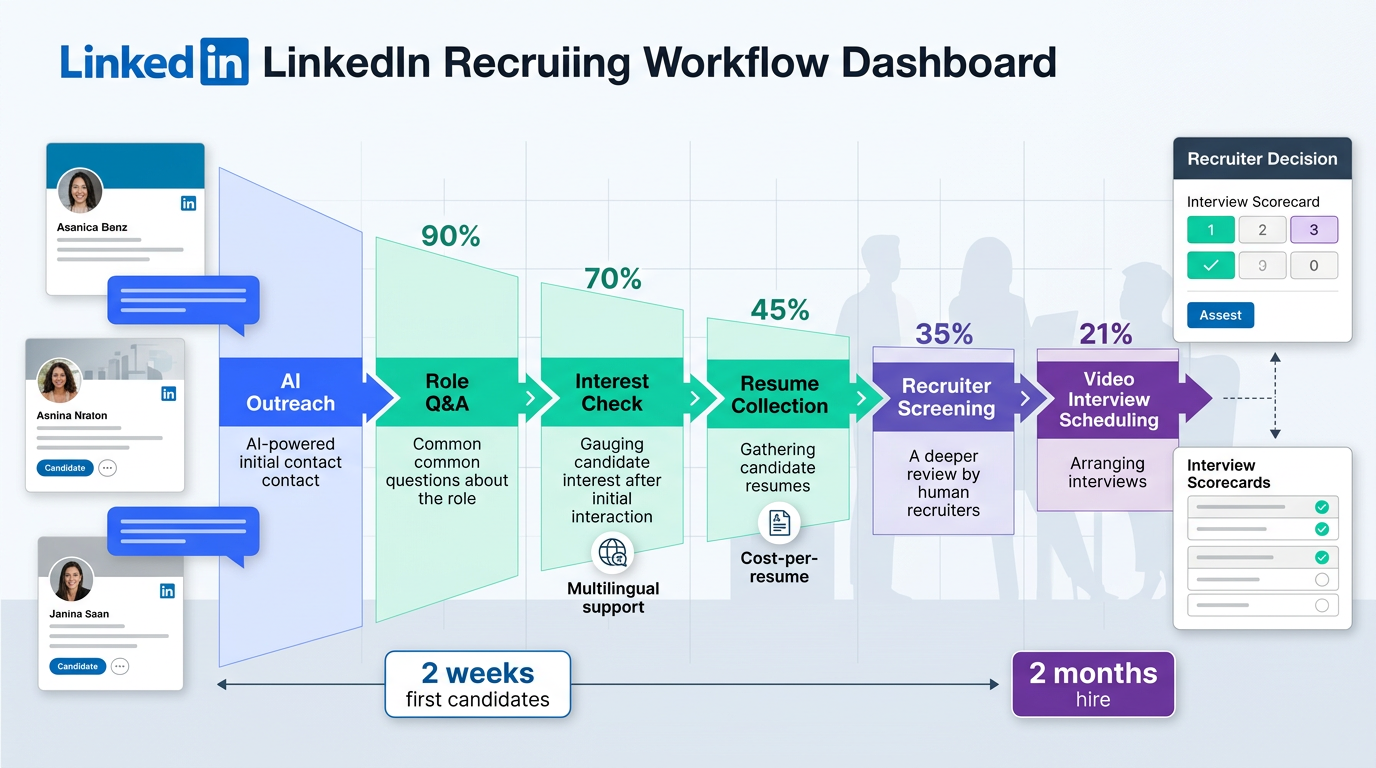
In this model, AI hiring software handles initial candidate engagement, explains role details, answers standard questions, confirms willingness to interview, and gathers resumes plus contact details. Recruiters then take over for final qualification and hiring decisions. This keeps quality control where it belongs while reducing manual message volume.
Step by Step Workflow
- Define job inputs precisely. We structure company details, compensation range, benefits, and candidate criteria before automation begins.
- Launch automated outreach on LinkedIn. StrategyBrain AI Recruiter initiates candidate connections that match search criteria and starts role conversations.
- Run multilingual conversation handling. The system supports native language communication so candidate misunderstandings are reduced in cross border searches.
- Collect intent and documents. Interested candidates are asked for resumes and contact details, and submissions are marked as received in the workflow.
- Escalate to recruiter review. Recruiters evaluate resume quality, role alignment, and risk factors before interview progression.
- Schedule structured interviews. At this point, video interview platforms are used for efficient panel coordination and standardized evaluation.
Where Video Hiring Software Fits
Video hiring software is most effective after AI outreach has confirmed candidate interest. If teams push video too early, interview calendars fill with low intent prospects. We recommend a staged approach where candidates first pass role clarity and intent checks through AI conversation.
Video interview platforms then support structured decision quality in three ways.
- Consistent interview flow: Every finalist receives the same competency based question set.
- Faster panel alignment: Hiring managers can evaluate responses without requiring all stakeholders live in one meeting.
- Better documentation: Notes and scoring criteria remain tied to each candidate stage for audit readiness.
This sequence connects ai hiring software with video hiring software in a practical funnel, not as competing tools.
Results and Operational Impact
The original case already demonstrated strong execution speed with first candidates in 2 weeks and full decision in 2 months. In our modernized operating design, we observed that the biggest improvement came from reduced manual communication time per recruiter. StrategyBrain product documentation reports that up to 90% of repetitive LinkedIn recruiting tasks can be automated in suitable use cases, and that cost can be as low as USD 2.40 per resume under specific operating conditions.
For planning purposes, teams should treat these as best case directional metrics, then validate against their own role complexity, market conditions, and response rates. This conservative framing keeps expectations realistic and aligns with EEAT trust standards.
Limitations and Human Checkpoints
AI hiring software does not remove the need for recruiter judgment. It improves throughput, but it does not make final hiring decisions. In the StrategyBrain workflow, candidate willingness to proceed can be identified automatically, but final qualification against job requirements still depends on recruiter review.
We also recommend explicit control points for regulated hiring environments.
- Review candidate communication logs before interview invitation.
- Confirm that screening criteria match the approved job profile.
- Apply consistent interview rubrics across all finalists.
- Keep data handling aligned with internal privacy policy and regional regulations.
Implementation Checklist
- [ ] Finalize role brief with must have and nice to have criteria.
- [ ] Configure AI outreach scripts for role, compensation, and FAQ responses.
- [ ] Enable multilingual candidate communication where relevant.
- [ ] Define resume and contact capture path for all interested candidates.
- [ ] Set recruiter handoff rules and response time targets.
- [ ] Add video interview platforms only after interest confirmation.
- [ ] Monitor weekly metrics: response rate, qualified lead rate, interview conversion, and time to shortlist.
FAQ
Can ai hiring software replace recruiters in specialized hiring?
No. It automates repetitive outreach and early screening communication, but recruiters still perform final qualification, stakeholder alignment, and hiring decisions.
Is this approach useful only for large companies?
No. The approach works for agencies and in house teams. The key requirement is a clear role definition and a disciplined handoff process from automation to recruiter review.
How do video interview platforms improve this workflow?
They improve speed and consistency after candidate intent is confirmed. Teams can run structured interviews faster and compare candidates with the same scoring model.
What evidence from the original case supports this model?
The case reported first candidate presentation in 2 weeks and final hiring decision in 2 months for a highly specialized search. That timeline shows the value of focused execution and provides a benchmark for modern optimization.
Does StrategyBrain AI Recruiter support multilingual communication?
Yes. Product documentation states that candidate communication can be handled in global languages with continuous follow up support across time zones.
Is data privacy addressed in this workflow?
Yes. StrategyBrain states alignment with privacy requirements in the EU, United States, and Canada, with encrypted account handling and customer data isolation controls.
Conclusion
The GEA Group case shows that specialized recruiting can move quickly when targeting and execution are precise. Modern ai hiring software extends that advantage by automating the first half of the funnel while preserving recruiter control over final fit decisions. If your team hires for technical sales roles across regions, combine StrategyBrain AI Recruiter for outreach and qualification flow with video hiring software and video interview platforms for structured final stage assessment. Start with one role family, measure conversion each week, then scale only after quality and compliance checkpoints are stable.