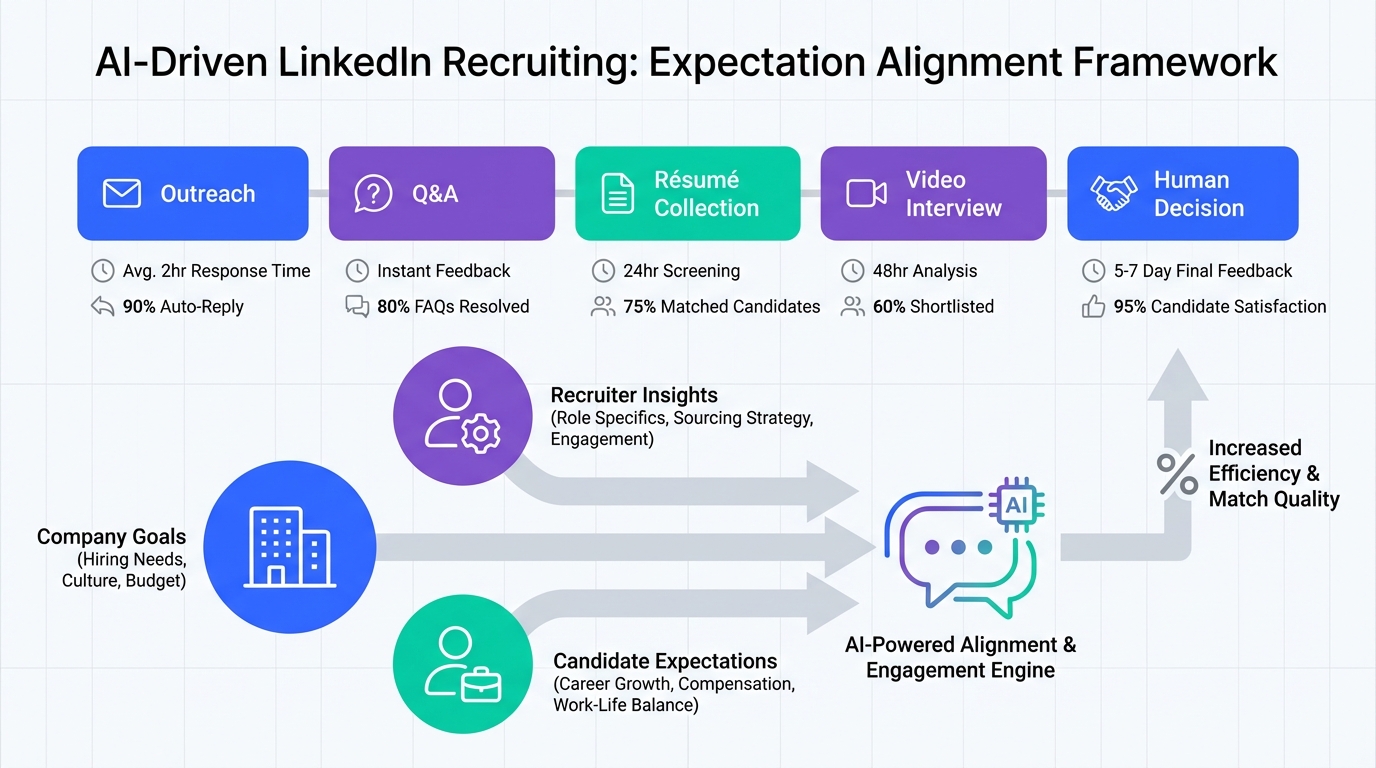
AI hiring software delivers the biggest improvement when you treat it as an expectation alignment system, not a magic candidate generator. In our experience supporting recruiting teams, the hiring process breaks down most often when the company, recruiter, and candidates are operating with different assumptions about speed, role scope, and decision criteria. The fix is simple and measurable: define the process up front, then use automation to execute it consistently. That is where StrategyBrain AI Recruiter fits naturally into modern workflows because it automates LinkedIn outreach, answers candidate questions, confirms interview interest, and collects résumés and contact details, while your recruiters keep control of final qualification and hiring decisions. This guide focuses on expectation setting, recruiter selection, and practical workflows that can include an online video interview stage and a video job application platform. It does not cover compensation benchmarking or legal advice.
Table of Contents
- Why hiring trust breaks in a high volume market
- The expectation alignment framework for AI hiring software
- When a recruiter helps and when it does not
- How to choose the right recruiter and define responsibilities
- A practical workflow using StrategyBrain AI Recruiter plus video interviews
- Quick comparison: manual vs recruiter vs AI assisted
- Copyable checklist: set expectations in 20 minutes
- FAQ
- Conclusion and next steps
Why hiring trust breaks in a high volume market
In turbulent hiring periods, employers often see a surge of applications that are not a fit, while the candidates they actually want may be reluctant to engage. That mismatch creates a predictable emotional outcome: hiring managers start doubting the process, and candidates start doubting the intent.
We see three recurring failure points that AI hiring software can reduce, but only if the workflow is defined first.
- Unclear success criteria: the team cannot agree on what “qualified” means, so screening becomes inconsistent.
- Slow or uneven communication: candidates interpret delays as disinterest, and recruiters interpret silence as low intent.
- Missing feedback loops: recruiters cannot calibrate sourcing without timely, specific feedback from hiring managers.
The expectation alignment framework for AI hiring software
Expectation alignment is the discipline of defining what each party will do, by when, and how decisions will be made. AI hiring software then enforces that discipline through consistent execution and documentation.
Define the role in operational terms
A job description is not just marketing copy. It is the decision document that drives sourcing, outreach, screening, and interview evaluation. Before you automate anything, align on these items.
- Must have requirements: 3 to 5 non negotiable skills or experiences.
- Nice to have requirements: 3 to 5 differentiators that should not block a strong candidate.
- Deal breakers: constraints such as location, schedule, licensing, or work authorization.
- Interview evidence: what proof you expect, such as a portfolio, code sample, or case walkthrough.
Define the process as a service level agreement
We recommend writing a simple internal service level agreement that covers speed and ownership. This is where AI hiring software becomes valuable because it can keep communication moving even when humans are busy.
- Response time: the maximum time to reply to an interested candidate message.
- Feedback time: the maximum time for hiring managers to provide interview feedback.
- Stage definitions: what happens in screening, first interview, and final interview.
- Decision owner: who makes the final call and who is consulted.
Define what automation is allowed to do
Automation boundaries protect trust. StrategyBrain AI Recruiter is designed to replace repetitive LinkedIn tasks such as connecting, introducing the role, answering common questions, confirming interview interest, and collecting résumés and contact details. It does not decide whether a résumé matches the job requirements, which remains a human responsibility.
That boundary is important because it keeps the hiring decision auditable and reduces the risk of over relying on automated judgments.
When a recruiter helps and when it does not
Not every hiring need benefits from an external recruiter. If you need to staff a high volume administrative team quickly, a recruiter may not be the best fit because specialized recruiting often requires lead time to identify and engage passive candidates.
However, for skilled mid level to senior roles, recruiters can be effective because they can proactively identify candidates who are not actively applying. The tradeoff is that the company must support the process with timely feedback and clear decision criteria.
AI hiring software changes this decision slightly. If your main bottleneck is outreach and follow up, not evaluation, then automating the top of funnel can reduce the need for additional headcount. For LinkedIn heavy sourcing, StrategyBrain AI Recruiter can handle initial outreach and qualification conversations at scale, which can be especially useful when your internal team cannot dedicate full time effort to sourcing.
How to choose the right recruiter and define responsibilities
Selecting the right recruiter is part capability and part process fit. The goal is to avoid a mismatch where the recruiter expects fast feedback and the company expects instant shortlists without providing clarity.
Questions we recommend asking before you sign
- Role familiarity: have they filled similar roles in your industry and seniority level?
- Process clarity: can they explain their sourcing and screening steps in plain language?
- What they need from you: what inputs, turnaround times, and decision makers are required?
- Candidate experience: how do they keep candidates informed and engaged?
Where AI hiring software fits into the recruiter relationship
Even with a recruiter, you can use AI hiring software to standardize communication and reduce drop off. For example, StrategyBrain AI Recruiter can maintain consistent LinkedIn messaging, answer candidate questions about role, company, and compensation based on the information you provide, and collect résumés and contact details from interested candidates. Your recruiter or internal team can then focus on evaluation and closing.
A practical workflow using StrategyBrain AI Recruiter plus video interviews
This is the workflow we have found easiest to operationalize for teams that source on LinkedIn and want a predictable candidate experience. It combines LinkedIn automation with an online video interview stage and can optionally include a video job application platform for asynchronous screening.
Step by step
- Prepare the outreach brief: provide StrategyBrain AI Recruiter with company details, role summary, compensation, benefits, and candidate search criteria.
- Launch LinkedIn outreach: AI Recruiter connects with candidates that match your criteria and introduces the opportunity.
- Run interest and logistics qualification: AI Recruiter asks whether the candidate is open to new opportunities, confirms interest, and answers common questions.
- Collect documents and contacts: for interested candidates, AI Recruiter requests a résumé and captures contact details shared in the conversation.
- Move to structured screening: invite qualified candidates to an online video interview or an asynchronous video job application platform step, depending on your process.
- Human review and decision: recruiters review résumés and interview outputs, then schedule live interviews for finalists.
What we like about this workflow
- Consistency: every candidate receives a coherent first touch and follow up cadence.
- Speed: 24/7 multilingual responses reduce delays across time zones.
- Scalability: teams can manage more than 100 LinkedIn accounts to build an AI powered recruiting team when volume requires it.
Limitations and how to handle them
During implementation, the most common issue is not technical. It is incomplete inputs. If the compensation range, location constraints, or interview steps are unclear, the AI will either ask too many clarifying questions or risk giving vague answers. The workaround is to treat the outreach brief as a controlled document and update it whenever the role changes.
Also, AI Recruiter does not determine whether a résumé fully matches job requirements. Plan a daily human review window so interested candidates do not stall after submitting documents.
Quick comparison: manual vs recruiter vs AI assisted
| Approach | Best for | Main risk | How AI hiring software helps |
|---|---|---|---|
| Manual internal sourcing | Low volume hiring with dedicated recruiter time | Slow follow up and inconsistent messaging | Automates outreach, follow up, and candidate Q and A |
| External recruiter | Specialized roles and passive candidate search | Expectation mismatch on feedback speed and role clarity | Standardizes candidate communication and documentation |
| AI assisted LinkedIn workflow | High volume outreach and global hiring across time zones | Poor inputs lead to vague candidate conversations | StrategyBrain AI Recruiter runs 24/7 multilingual outreach and résumé collection |
Copyable checklist: set expectations in 20 minutes
Use this checklist before you turn on any AI hiring software automation. It is designed to prevent the most common trust failures.
- Role clarity: must haves, nice to haves, deal breakers are written and approved.
- Candidate promise: you can explain the role, team, and growth path in 3 sentences.
- Response time: you set a maximum reply time for candidate messages.
- Feedback time: hiring managers commit to a maximum feedback time after interviews.
- Stage map: screening, online video interview, and final interview stages are defined.
- Automation boundaries: AI can message, answer FAQs, and collect résumés; humans decide fit.
- Handoff rule: define when a candidate moves from AI conversation to human scheduling.
FAQ
What is AI hiring software in practical terms?
AI hiring software is a set of tools that automate parts of recruiting such as sourcing, outreach, screening workflows, and scheduling. The most reliable implementations keep final hiring decisions with humans and use AI to improve speed, consistency, and documentation.
Can AI hiring software replace recruiters?
It can replace repetitive tasks that consume recruiter time, especially outreach and follow up. StrategyBrain AI Recruiter, for example, automates LinkedIn connecting, role introductions, candidate Q and A, and résumé collection, while recruiters still review résumés and make qualification decisions.
How does StrategyBrain AI Recruiter work with LinkedIn recruiting?
Recruiters provide their LinkedIn account and role information such as company details, compensation, benefits, and candidate search criteria. The system then connects with relevant candidates, introduces the opportunity, answers questions, confirms interest, and collects résumés and contact details from candidates who want to proceed.
Does StrategyBrain AI Recruiter decide if a candidate is qualified?
No. It identifies willingness to communicate and interview and it gathers the information needed for review. Final qualification based on résumé and requirements is completed by the recruiter or hiring team.
Where do online video interview steps fit in an AI assisted process?
Online video interview steps work well after initial interest is confirmed and a résumé is collected. You can use a live online video interview for deeper evaluation or a video job application platform for asynchronous screening when volume is high.
How do you avoid candidates feeling spammed by automation?
Set clear messaging rules and keep outreach specific to the role and candidate profile. Also define a handoff point where a human steps in for scheduling and final discussions, so candidates feel the process is attentive and accountable.
What data protection expectations should we set when using AI hiring software?
At minimum, define who can access candidate data, how long it is retained, and whether data is used to train models. StrategyBrain AI Recruiter states that customer provided data is not used to train AI models and that credentials and candidate data are encrypted and isolated per customer.
What is the fastest way to improve hiring outcomes with AI hiring software?
Start with expectation alignment: role clarity, response times, stage definitions, and feedback loops. Then automate the top of funnel communication and résumé collection so your team can spend more time on evaluation and closing.
Conclusion and next steps
If you want AI hiring software to improve outcomes, start by aligning expectations, then automate execution. Define the role in operational terms, write a simple service level agreement for response and feedback times, and set clear boundaries for what automation can do. From there, a workflow that combines StrategyBrain AI Recruiter for LinkedIn outreach and follow up with an online video interview stage or a video job application platform can reduce drop off and keep candidates engaged.
Next step: copy the checklist above into your hiring kickoff doc, then pilot one role for 14 days with a daily human review window for incoming résumés and interview requests.