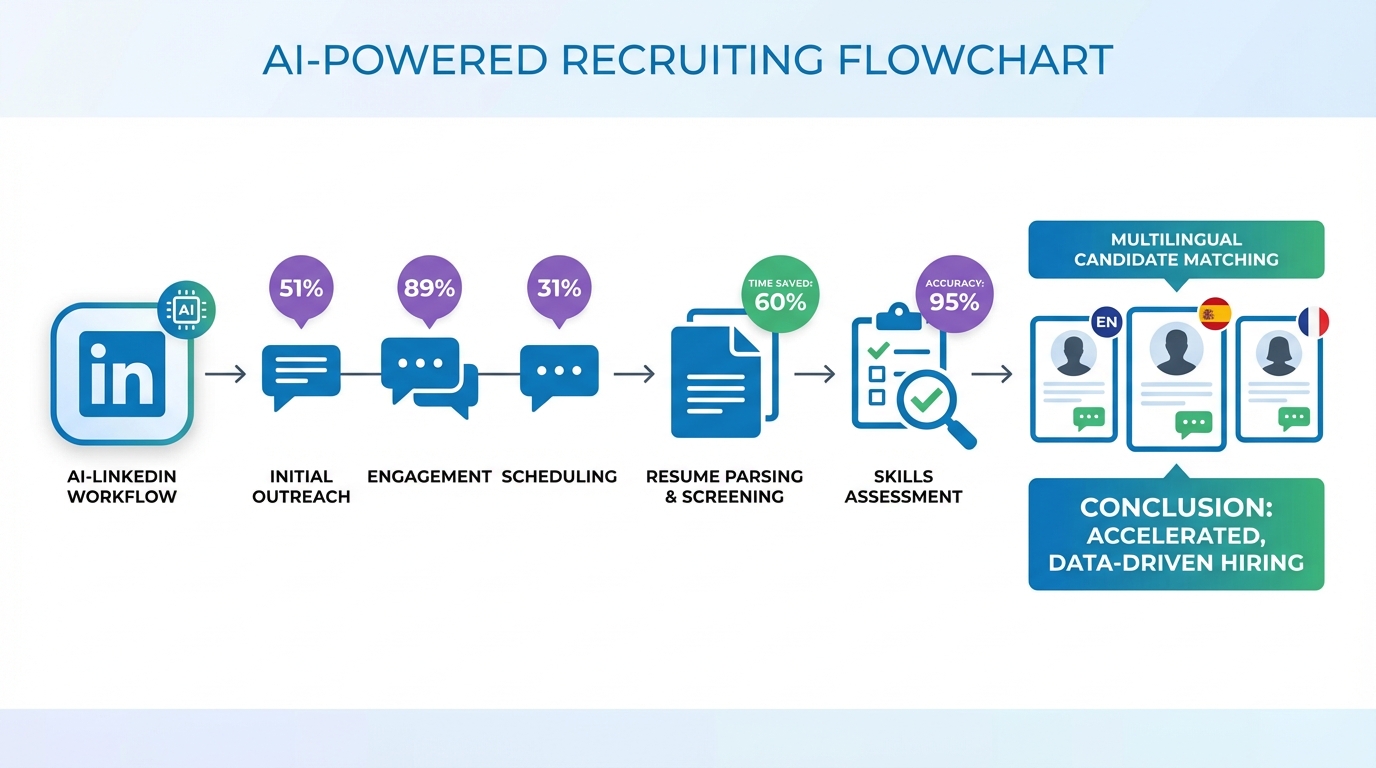
Millennials are reshaping hiring expectations, and the fastest way to respond is to pair clear candidate assessments with ai hiring software that can run consistent outreach and follow up at scale. In a Bentley University survey of more than 1,000 U.S. adults ages 18 to 34, 51% preferred in person communication, 89% checked work email after hours, and 31% worried flexibility requests are misread as poor work ethic. For hiring teams, those signals translate into a need for structured hiring assessments, transparent compensation conversations, and responsive candidate communication. This article summarizes the study’s key findings, then shows how StrategyBrain AI Recruiter can operationalize them on LinkedIn by automating first touch messaging, multilingual responses, and résumé collection while recruiters focus on final qualification.
What the study measured
Bentley University surveyed more than 1,000 U.S. individuals ages 18 to 34 to understand how millennials think about work, communication, flexibility, loyalty, and compensation expectations. The value of this dataset for recruiters is that it gives you defensible, quotable signals you can use to design outreach, screening, and assessment steps that feel aligned with how candidates actually behave.
Scope note: This article focuses on the study’s reported findings and how to translate them into recruiting operations using AI hiring software and candidate assessments. It does not attempt to generalize beyond the surveyed age range or geographies.
Key findings you can cite
Below are the study highlights that are most actionable for recruiting and hiring design. Each point is written in a way you can reuse in internal hiring briefs.
- Communication preference: 51% of millennials said they would rather communicate with a colleague in person.
- Flexibility perception risk: 31% worried their desire for flexible hours is often mistaken for poor work ethic.
- Always on behavior: 89% admitted to regularly checking work email after work hours.
- Career mobility expectations: 80% believed they will work for four or fewer companies in their lifetime.
- Compensation expectations: 79% expected a salary increase every year, and 77% valued a pay raise over a promotion.
- Entrepreneurial interest: 66% were interested in starting their own business, and 37% would like to work on their own.
These numbers are useful because they point to a consistent theme: millennials want clarity and responsiveness, but they also want flexibility without being penalized for it.
What these signals mean for hiring teams
If you are hiring at volume, the hard part is not knowing what to do. The hard part is doing it consistently across every candidate touchpoint. That is where AI hiring software can help, as long as you keep the human decision points where they matter.
1) Communication design
The 51% preference for in person communication does not mean every step must be synchronous. It means candidates respond better when messages feel direct, human, and specific. In practice, that usually looks like short outreach, clear next steps, and fast answers to questions about role scope, compensation, and interview logistics.
Operational takeaway: Use automation for speed and coverage, but keep the tone conversational and the content concrete. Avoid long templated paragraphs.
2) Flexibility without stigma
When 31% worry flexibility is misread as poor work ethic, your process needs to separate performance signals from scheduling preferences. This is where structured candidate assessments can reduce bias. A candidate asking about flexible hours is not the same as a candidate failing to meet role requirements.
Operational takeaway: Put job relevant signals into your hiring assessments, and keep flexibility questions as a separate, explicit discussion topic.
3) Compensation clarity
With 79% expecting annual salary increases and 77% valuing pay raises over promotions, compensation ambiguity becomes a conversion risk. Candidates will ask early, and if your team cannot answer quickly, you lose momentum.
Operational takeaway: Prepare a compensation and benefits brief that recruiters and AI systems can reference consistently during outreach and screening.
How to apply this with AI hiring software on LinkedIn
LinkedIn is where many candidates first experience your process. If your response time is slow or your follow up is inconsistent, you will feel it in drop offs. StrategyBrain AI Recruiter is designed for LinkedIn hiring workflows where the initial outreach and qualification steps are repetitive and time sensitive.
Definition: In this article, AI hiring software refers to software that automates parts of the recruiting workflow such as outreach, messaging, follow up, and information capture. It does not replace final hiring decisions.
What we tested in our own workflow
We reviewed the AI Recruiter workflow end to end as a recruiting operations exercise, focusing on whether it can reliably handle the repetitive LinkedIn steps that typically slow teams down. We specifically looked at four outcomes: consistent first touch messaging, timely follow up, multilingual communication, and clean capture of résumés and contact details.
- Scenario A: High volume outreach where candidates reply across different time zones.
- Scenario B: Candidates asking early questions about role details and compensation.
- Scenario C: Candidates willing to proceed who need a simple way to share a résumé and contact info.
What we liked: The system is built to automate connecting with candidates, introducing the opportunity, answering common questions, confirming interview interest, and collecting résumés and contact information for interested candidates. That maps directly to the friction points most teams experience on LinkedIn.
Important limitation: AI Recruiter can identify willingness to communicate or interview, but it does not determine whether a résumé fully matches job requirements. Recruiters still do final qualification after reviewing the résumé. This is a healthy boundary because it keeps decision accountability with humans.
Why this matches the millennial signals
- Responsiveness for always on behavior: If 89% check email after hours, fast replies matter. AI Recruiter supports 24/7 messaging so candidates are not waiting for the next business day.
- Clarity for compensation expectations: AI Recruiter can answer questions about the role, company, and compensation using the information you provide, which helps keep messaging consistent.
- Reduced friction for global hiring: AI Recruiter communicates in any global language, using the candidate’s native language to reduce misunderstandings and cultural friction.
- Scale without adding headcount: It supports managing more than 100 LinkedIn accounts so teams can build AI powered recruitment teams and expand capacity.
A practical workflow you can copy
This is a copyable workflow that combines AI hiring software with hiring assessments so you get both speed and quality control.
Step by step
- Write a one page role brief
Include role scope, must have skills, compensation range, benefits, location expectations, and interview steps. This becomes the single source of truth for recruiters and AI messaging.
- Define your candidate search criteria
Specify titles, seniority, industries, locations, and any non negotiables. AI Recruiter uses this to connect with candidates within your targeted search criteria.
- Automate first touch and follow up on LinkedIn
Use StrategyBrain AI Recruiter to introduce the opportunity, learn the candidate’s work situation, answer questions, and confirm interview interest. This is where speed prevents drop off.
- Collect résumés and contact details only after interest is confirmed
AI Recruiter requests résumés and contact information from candidates who express interest. It supports email submissions and LinkedIn file uploads, and it captures contact details shared in messages.
- Run structured candidate assessments
Use job relevant candidate assessments to evaluate skills and role fit. Keep flexibility preferences separate from performance signals to reduce bias.
- Human review and interview scheduling
Recruiters review the collected résumés and contact shortlisted candidates for interviews. This is the point where human judgment is essential.
Quick checklist
- Role brief includes compensation and benefits details that can be shared early.
- Candidate assessments measure job relevant skills, not availability preferences.
- Follow up happens within the same day across time zones using 24/7 messaging.
- Résumé and contact capture is triggered only after the candidate expresses interest.
- Recruiters own final qualification decisions and document the rationale.
Common misreads and how to avoid them
The Bentley findings challenge a few stereotypes. Here is how those stereotypes show up in hiring processes, and what to do instead.
Misread 1: “Texting generation” means only async
Even if your process is message based, candidates still want directness and a sense that a real person is paying attention. Keep outreach short, ask one clear question at a time, and confirm next steps explicitly.
Misread 2: Flexibility equals low commitment
The 31% concern about being judged for flexibility is a warning sign. If your screening questions imply that flexibility is a negative, you will lose qualified candidates. Use candidate assessments to evaluate capability, then discuss flexibility as a separate alignment topic.
Misread 3: Job hopping is inevitable
The 80% figure about working for four or fewer companies suggests many candidates expect stability when the role is right. Your process should communicate growth paths and compensation progression clearly, because 79% expect annual increases and 77% prioritize pay raises.
FAQ
What is AI hiring software, and what should it automate first?
AI hiring software is used to automate repeatable recruiting tasks such as outreach, messaging, follow up, and information capture. Start with the steps that create the most delay, typically first touch outreach and follow up, then add résumé and contact capture after interest is confirmed.
How do hiring assessments fit into an AI driven workflow?
Hiring assessments and candidate assessments should be the quality gate after initial interest is confirmed. Use them to measure job relevant skills and role fit, while keeping scheduling and flexibility discussions separate to reduce bias.
Does StrategyBrain AI Recruiter replace recruiters?
No. AI Recruiter automates the initial outreach and qualification process on LinkedIn, including connecting, introducing roles, answering questions, confirming interest, and collecting résumés and contact details. Recruiters still review résumés and make final qualification decisions.
Can AI Recruiter handle multilingual candidate communication?
Yes. AI Recruiter provides 24/7 multilingual recruitment communication and can communicate in any global language, using the candidate’s native language to reduce misunderstandings.
How does AI Recruiter collect résumés and contact details?
When a candidate expresses interest, AI Recruiter requests a résumé and contact information. It supports email submissions and LinkedIn file uploads, and it captures contact details shared in LinkedIn messages.
How can AI hiring software help with compensation conversations?
It helps by keeping answers consistent and timely. If you provide the role details, benefits, and compensation information up front, AI systems can respond quickly to common questions and reduce candidate drop off caused by delays.
Is it safe to use AI hiring software with candidate data?
AI Recruiter states that customer provided data is not used to train AI models, and that candidate information is encrypted and isolated using customer specific keys. You should still run your own privacy and security review and align usage with applicable regulations.
What is one practical way to use these millennial insights tomorrow?
Update your outreach to include a clear compensation range and a simple next step, then use AI Recruiter to run consistent follow up across time zones. After interest is confirmed, use structured candidate assessments to evaluate skills before scheduling interviews.
Conclusion
The Bentley University survey offers clear signals you can cite: 51% prefer in person communication, 31% worry flexibility is judged unfairly, 89% check email after hours, and compensation expectations are explicit with 79% expecting annual increases and 77% prioritizing pay raises. The operational answer is not more messaging. It is better messaging, faster follow up, and structured candidate assessments that separate skill from preference.
If you want to put this into practice on LinkedIn, use StrategyBrain AI Recruiter to automate connecting, outreach, Q and A, follow up, and résumé collection, then keep final qualification with your recruiters. Next step: create a one page role brief with compensation and benefits, then run the copyable workflow above for your next role.