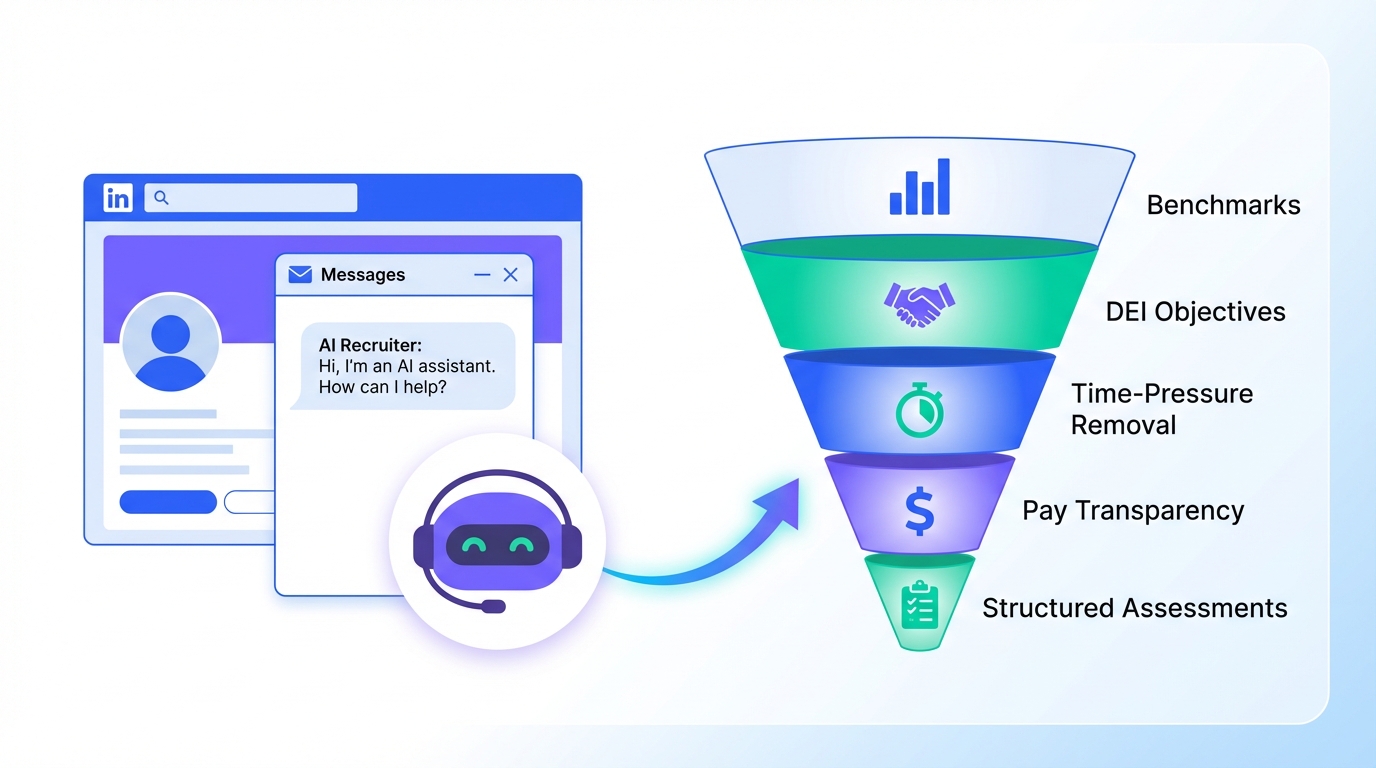
To stop bias with ai hiring software, focus on five controllable levers in your hiring funnel: set the right benchmarks for your local talent pool, translate inclusive hiring practices into measurable objectives, remove time pressure from screening, publish pay ranges, and use structured assessments before or instead of CV review. In our experience supporting recruiting teams, bias most often shows up when recruiters are rushed, the candidate pool is small, or the hiring timeline is unrealistic. The STOP THE BIAS resource summarizes these issues clearly, and this article turns them into a practical implementation plan, including where StrategyBrain AI Recruiter can help by automating consistent LinkedIn outreach and follow up while leaving final qualification to humans.
What the STOP THE BIAS resource is arguing
The original post calls out a simple point that many recruiters agree with: inclusive hiring practices should mean a candidate’s personal identity does not reduce their opportunity for the job. It also praises a practical tone: no hard quotas, no call out culture, and no virtue signalling. Instead, it focuses on operational changes that make employers more attractive to qualified candidates across society.
It then breaks the work into five areas: benchmarks, objectives, fair practices, pay transparency, and technology. The rest of this article keeps that logic, but expands it into steps you can run inside a modern hiring process that may include ai hiring software, structured assessments, and even asynchronous screening such as pre recorded video interview software.
How we apply this in real hiring funnels
When we audit hiring funnels, we map where bias is most likely to occur and where process changes will have the highest impact. The STOP THE BIAS post names three common risk points that match what we see in practice: time pressured CV review, small candidate pools, and unrealistic hiring timelines.
We treat these as system constraints, not personal failures. If your process forces rushed decisions, you will get inconsistent decisions. That is exactly where ai hiring software can help, not by making the final decision, but by enforcing consistency in outreach, follow up, documentation, and structured screening steps.
Step 1: Finding the right benchmarks
The post makes a critical benchmarking point: demography is not evenly distributed. Different identity groups are concentrated in different regions and sectors, so national averages can be misleading. A more useful benchmark is the working age population in your local talent pool for the roles you are hiring.
How to implement this in a hiring ops workflow
- Define the talent market: specify geography, seniority, and sector for each role family.
- Choose a benchmark level: local working age population where feasible, then sector specific benchmarks if available.
- Document assumptions: write down what you used and why, so your benchmark is auditable.
Where StrategyBrain AI Recruiter fits
If your sourcing channel includes LinkedIn, StrategyBrain AI Recruiter can help you execute consistent outreach against your defined search criteria by automatically connecting with candidates and running initial conversations. This supports benchmark driven sourcing because the system can apply the same outreach workflow across targeted searches, while recruiters stay responsible for defining the criteria and reviewing the resulting shortlist.
Step 2: Setting DEI objectives
The post frames DEI objectives as a translation problem: convert inclusive hiring practices into business outcomes. The premise is that an inclusive culture increases the surface area to attract and retain great talent, which should improve performance if the premise holds.
Make objectives measurable without turning them into quotas
To keep this practical and defensible, define objectives as process and outcome metrics that you can control and audit. Examples include:
- Funnel health: pass through rates by stage, reviewed monthly, with documented reasons for stage changes.
- Time to decision: median time from application to first structured screen, measured in days.
- Candidate experience: response time targets for candidate questions, measured in hours.
This is also where ai hiring software can be helpful. It can enforce response time standards and consistent messaging, which reduces the chance that some candidates receive better information or faster follow up than others.
Where StrategyBrain AI Recruiter fits
StrategyBrain AI Recruiter provides 24/7 multilingual candidate communication and follow up on LinkedIn. That matters for objectives like response time and consistency because candidates in different time zones or languages can receive timely answers without relying on a recruiter being online. Recruiters still decide who advances after reviewing resumes and details collected during the conversation.
Step 3: Implementing fair recruitment practices
The post asks a question every team should answer: where is bias most likely to occur in your funnel. It highlights three triggers: time pressure during CV review, small candidate pools, and unrealistic timelines. It also notes that stronger demand planning can alleviate these issues.
One specific operational insight in the post is worth treating as a process requirement: adding 10 more seconds of CV review can dramatically change which candidates pass through. Whether your team validates that exact number internally or not, the direction is clear: rushed review increases noise and inconsistency.
Steps to reduce bias at the screening stage
- Slow down the first screen: set a minimum review time per profile and require structured notes.
- Increase structure: use a rubric with job related criteria and a defined scoring scale.
- Fix the timeline: if the hiring timeline is unrealistic, adjust the plan rather than compressing evaluation.
- Expand the pool: invest in sourcing and outreach before you start rejecting quickly.
How video screening can help, and when it can hurt
Teams often ask whether pre recorded video interview software reduces bias. It can improve consistency if you ask the same questions and score with the same rubric. However, it can also introduce new bias if reviewers over index on presentation style, accent, or background environment.
If you use video, treat it as a structured data point, not a vibe check. For some roles, free video interview platforms can be sufficient for early stage screening, but you still need a rubric and reviewer calibration to keep outcomes fair.
Where StrategyBrain AI Recruiter fits
StrategyBrain AI Recruiter does not replace final qualification. Instead, it automates the repetitive LinkedIn steps that often create time pressure: connecting, introducing the role, answering common questions about company and compensation, confirming interview interest, and collecting resumes and contact details. By reducing manual back and forth, recruiters can spend more time on structured evaluation rather than rushed triage.
Step 4: Promoting pay transparency
The post calls pay transparency a no brainer: candidates are more likely to apply when they know the salary range. It also argues that publishing salaries increases access to candidates and can increase applicant rates from female candidates.
How to operationalize pay transparency
- Publish a range: include minimum and maximum compensation for the role, plus what drives placement in the range.
- Standardize answers: ensure recruiters and hiring managers use the same compensation narrative.
- Track drop off: measure where candidates disengage after compensation discussions.
Where StrategyBrain AI Recruiter fits
Because StrategyBrain AI Recruiter can answer candidate questions about compensation and role details during initial LinkedIn conversations, it helps keep pay communication consistent. That consistency supports trust and reduces the risk that different candidates receive different information based on who happens to be responding.
Step 5: Using technology without outsourcing judgment
The post highlights two technology levers: anonymising applications and using skills or aptitude assessment before or instead of CV review. The key idea is testable: how you assess determines who gets through the gate, so assessments should map as closely as possible to job performance.
Define key terms once, then design the workflow
- Anonymising applications: removing identifying information from applications during early review to reduce identity based bias.
- Skills assessment: a job related test that measures capability relevant to performance, scored with a rubric.
- Aptitude assessment: a standardized test intended to measure general cognitive or role adjacent abilities.
In practice, the best workflow is usually a combination: structured sourcing and outreach, then a job relevant assessment, then a structured interview. If you add asynchronous steps such as pre recorded video interview software, keep the scoring criteria job related and train reviewers to avoid proxy signals.
Where StrategyBrain AI Recruiter fits
StrategyBrain AI Recruiter is most useful at the top of funnel where inconsistency and delay create bias. It can run initial outreach and qualification conversations at scale, in any language, and it can manage large volumes across many LinkedIn accounts for teams that need to expand capacity. It also collects resumes and contact details from interested candidates so recruiters can focus on structured assessment and interviews.
Quick comparison: where tech helps most
This table is a practical way to decide what to automate and what to keep human led when you adopt ai hiring software.
| Funnel area | Bias risk trigger | Best control | Helpful tech examples |
|---|---|---|---|
| Benchmarking | Wrong comparison group | Local talent pool benchmarks | Reporting dashboards inside ATS or analytics tools |
| Outreach and follow up | Inconsistent messaging and response time | Standardized scripts and SLAs | StrategyBrain AI Recruiter for LinkedIn outreach and 24/7 multilingual responses |
| CV review | Time pressure and subjective heuristics | Rubrics and minimum review time | Structured scorecards, anonymised review workflows |
| Early screening | Vibe based decisions | Job related assessments first | Skills tests, structured screens, optional pre recorded video interview software with rubric |
| Compensation discussion | Unequal information | Pay transparency and consistent answers | Standardized compensation FAQs, automated messaging support |
Practical tools: checklists and templates
Inclusive hiring implementation checklist
- Benchmarks: We defined local talent pool benchmarks for each role family and documented assumptions.
- Objectives: We set measurable process objectives and reviewed them monthly with hiring managers.
- Screening: We use a rubric and require structured notes for every screen decision.
- Time pressure: We adjusted hiring timelines to avoid rushed CV review and last minute shortlists.
- Pay transparency: We publish salary ranges and standardize compensation messaging.
- Assessments: We run job related assessments before or instead of CV review where appropriate.
- Technology: We automate outreach and follow up, but keep final qualification decisions human led.
Structured screening scorecard template
Copy this into your ATS scorecard or interview notes. Keep criteria job related and define what good looks like.
- Criterion 1: Role relevant skill: Score 1 to 5. Evidence from assessment or work samples.
- Criterion 2: Problem solving: Score 1 to 5. Evidence from structured questions.
- Criterion 3: Communication for the role: Score 1 to 5. Evidence from structured screen.
- Criterion 4: Motivation and constraints: Score 1 to 5. Evidence from candidate responses.
- Decision: Advance, hold, or reject with a one sentence justification tied to criteria.
FAQ
What does ai hiring software actually do in a bias reduction program?
It is most effective when it enforces consistency and documentation, such as standardized outreach, structured screening steps, and measurable response times. It should not be treated as a substitute for job related rubrics and accountable human decisions.
Is anonymising applications enough to stop bias?
No. Anonymising can reduce identity cues early on, but bias can reappear later in interviews, reference checks, and compensation discussions. You still need structured assessments and consistent decision criteria across stages.
Should we use pre recorded video interview software for early screening?
You can, but only if you ask the same questions for all candidates and score with a rubric tied to job performance. If reviewers are not calibrated, video can amplify bias based on presentation style or environment.
Are free video interview platforms good enough for small teams?
Often yes for basic scheduling and asynchronous screening, as long as you pair them with structured questions and consistent scoring. The platform matters less than the process discipline around it.
How does StrategyBrain AI Recruiter reduce bias if it automates LinkedIn outreach?
It reduces inconsistency at the top of funnel by using the same outreach and follow up workflow for candidates who match your search criteria, and by responding 24/7 in the candidate’s language. Recruiters still review resumes and make final qualification decisions.
Does StrategyBrain AI Recruiter decide who is qualified?
No. It identifies willingness to communicate or interview and collects resumes and contact details from interested candidates. Final qualification is completed by the recruiter after reviewing the resume.
What is the fastest operational change to reduce bias this week?
Remove time pressure from screening by adding structure: a rubric, required notes, and a realistic timeline. This directly targets the time pressured CV review problem highlighted in the STOP THE BIAS resource.
How do we connect DEI objectives to business outcomes without making quotas?
Use measurable process objectives such as response time, structured evaluation coverage, and stage conversion consistency, then review outcomes over time. Keep the focus on improving the system that produces decisions.
Conclusion
Stopping bias is not a single tool purchase. It is a set of operational choices: benchmark locally, set objectives you can measure, remove time pressure from screening, publish pay ranges, and use job related assessments before or instead of CV review. If you adopt ai hiring software, use it to enforce consistency and speed where humans struggle most, especially outreach and follow up. If LinkedIn is a core channel, StrategyBrain AI Recruiter can automate initial conversations, multilingual responses, and resume collection so recruiters can spend their time on structured evaluation and fair decisions.
Next step: pick one role family, map your funnel stages, and implement the checklist above for 30 days. Then review where drop off and inconsistency still occur, and iterate.