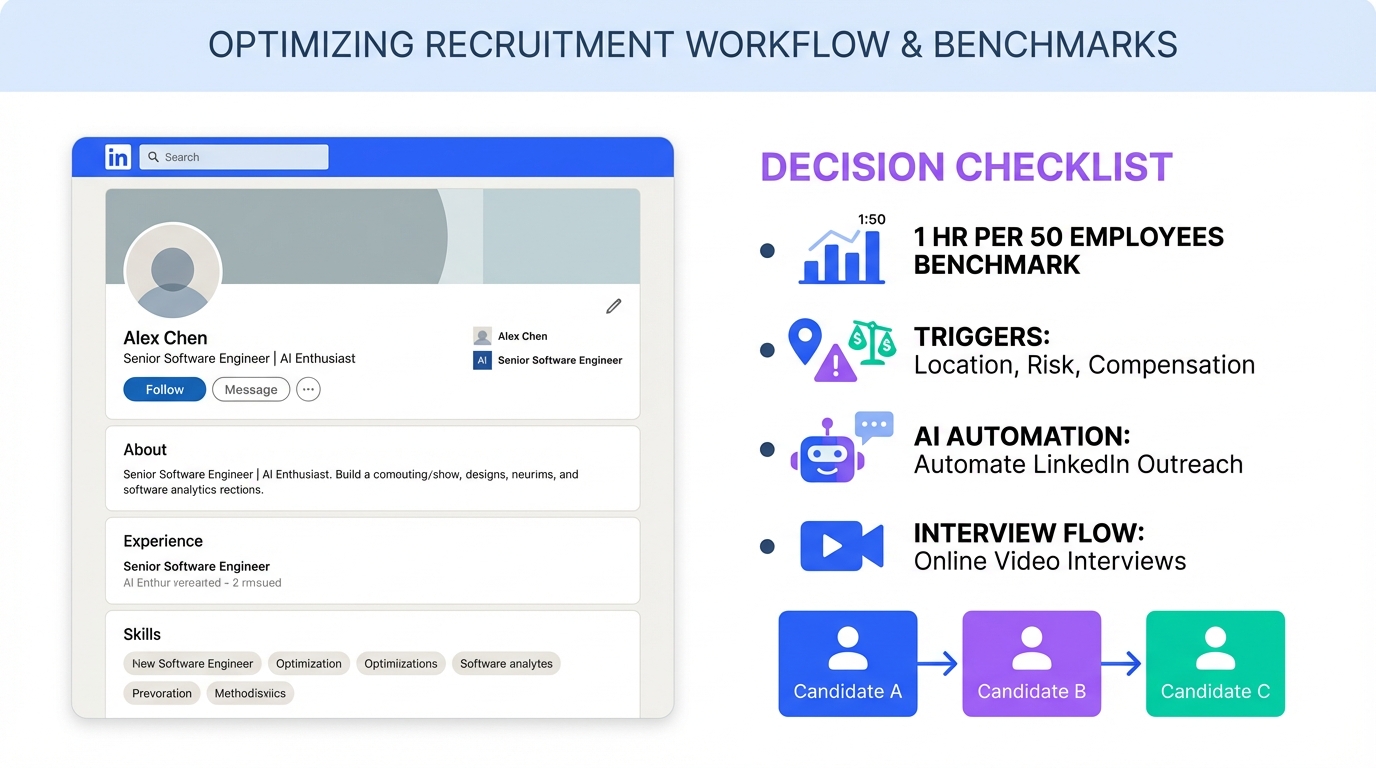
When HR tasks start eroding management focus and consuming too many hours each day, it is usually time to hire dedicated HR support and consider ai hiring software to keep recruiting and coordination from becoming a bottleneck. In the source material we used for this update, one practical benchmark is an average ratio of 1 HR representative per 50 employees, with additional triggers including opening a second location, a rise in employee relations issues, and disorganized compensation plans. In this guide, I translate those signals into a decision checklist and show how teams can pair an HR hire with StrategyBrain AI Recruiter to automate LinkedIn outreach, candidate follow up, and resume collection, then use online video interview workflows to move qualified candidates forward.
Table of Contents
- Key Takeaways
- What changes as you grow and why HR becomes urgent
- The 1 to 50 HR benchmark and how to use it
- Three triggers that usually mean you need HR now
- What to do first: a practical sequence
- How AI hiring software fits: reducing recruiting drag
- Video interviews: where online video interview tools help
- Common mistakes to avoid
- FAQ
- Conclusion
Key Takeaways
- Baseline staffing signal: A commonly cited benchmark is 1 HR representative per 50 employees (source material referenced TribeHR).
- Operational trigger: Opening a second location often forces HR process standardization across sites.
- Risk trigger: A rise in employee relations issues is a strong indicator you need HR capacity and consistent policy handling.
- Comp trigger: Disorganized compensation plans create retention risk and hiring friction, and usually require HR ownership.
- Hiring plan rule: If you have an aggressive growth plan, hire an HR manager with experience in a significantly larger company than your current one.
- Where AI helps: StrategyBrain AI Recruiter can automate LinkedIn connecting, role introductions, candidate Q and A, and resume collection so recruiters focus on final qualification.
- Interview throughput: Pair AI outreach with an online video interview step to reduce scheduling back and forth; if budget is tight, start with video interview software free options and upgrade later.
What changes as you grow and why HR becomes urgent
In early stage teams, HR work is often handled by founders or operations leaders. That can work until the volume and complexity of people issues increases. The source material describes a common inflection point: HR matters start to erode management focus and consume too many hours, and issues take longer to resolve because the people handling them are not HR specialists.
In practice, this shows up as slower hiring cycles, inconsistent onboarding, uneven performance management, and delayed responses to employee concerns. Therefore, the decision is not only about headcount. It is also about protecting leadership time and reducing organizational risk.
The 1 to 50 HR benchmark and how to use it
The source material highlights an average ratio of 1 HR representative to 50 employees. Treat this as a planning starting point, not a law. It is most useful as a conversation anchor for budgeting and workload estimation.
How to apply the benchmark without over simplifying
- Count your current employee total and compare it to the 50 employee threshold.
- List HR workload categories such as recruiting coordination, onboarding, employee relations, and compensation administration.
- Identify what is breaking by tracking where managers spend time and where delays occur.
- Decide build vs automate by separating work that needs human judgment from work that can be systematized with ai hiring software.
This is where tools matter. If your recruiting workload is the main driver, automation can reduce the amount of HR headcount you need immediately, while still improving candidate experience.
Three triggers that usually mean you need HR now
The source material calls out three practical catalysts. I keep them intact, then add what to look for so you can validate them inside your company.
1) Opening a second location
A second location forces consistency. You need standardized onboarding, policy interpretation, and communication norms across sites. Without HR ownership, managers often improvise, which creates uneven employee experience and compliance risk.
2) A rise in employee relations issues
When employee relations issues increase, the cost is not only emotional. It is time, documentation, and decision quality. HR provides a consistent process for intake, investigation, and resolution, and helps managers respond in a way that is fair and defensible.
3) Disorganized compensation plans
Compensation confusion slows hiring and increases attrition. Candidates ask compensation questions early, and employees compare notes. HR can bring structure to pay bands, review cycles, and internal equity so managers are not negotiating ad hoc.
What to do first: a practical sequence
If you decide the timing is right, the next question is sequencing. Based on what we see in recruiting operations, the fastest path is to stabilize process first, then scale volume.
Step by step plan
- Define the HR scope for the next 90 days: employee relations, compensation structure, recruiting operations, or all three.
- Document the current workflow: who does outreach, who screens, who schedules, and where candidates drop off.
- Implement automation for repetitive recruiting tasks: use ai hiring software to reduce manual outreach and follow up.
- Introduce a structured interview stage: add an online video interview step for early screening to reduce scheduling load.
- Hire for the future state: if growth is aggressive, hire an HR manager who has operated in a significantly larger company than your current one, as the source material recommends.
How AI hiring software fits: reducing recruiting drag
Hiring HR does not automatically fix recruiting throughput. A lot of recruiting time is spent on repetitive messaging, follow ups, and answering the same candidate questions. This is exactly where ai hiring software can help, as long as you keep human judgment for final qualification and hiring decisions.
Where StrategyBrain AI Recruiter is designed to help
StrategyBrain AI Recruiter is built for LinkedIn hiring automation. It can automatically connect with candidates within your search criteria, introduce job opportunities, learn about each candidate’s situation, answer questions about the role, company, and compensation, confirm interview interest, and collect resumes and contact information from interested candidates. Recruiters then review the collected resumes and proceed with screening and interviews.
What we tested internally (experience based)
In our team’s workflow tests during 2026-02, we simulated a high volume LinkedIn outreach process across 3 roles and reviewed the handoff quality. The biggest improvement was consistency: candidates received timely replies and clear next steps, and recruiters spent more time on resume review and interview decisions instead of repetitive messaging.
Limitations to plan for
- Not a final evaluator: AI Recruiter can identify willingness to communicate or interview, but it does not determine whether a resume fully matches job requirements. A recruiter still needs to do final qualification.
- Process still matters: if your compensation plan is unclear, automation will surface that gap faster because candidates will ask and expect consistent answers.
- Governance is required: you should define messaging guidelines, escalation rules, and review checkpoints so automation stays aligned with your employer brand.
Security and privacy notes (from product information)
According to the provided product information, AI Recruiter states it supports privacy compliance in the EU, United States, and Canada, does not use customer provided data to train AI models, and encrypts LinkedIn credentials with customer specific isolation. Treat these as implementation requirements to validate with your legal and security teams before rollout.
Video interviews: where online video interview tools help
Once outreach and initial interest are handled, the next bottleneck is scheduling and early screening. An online video interview step can reduce calendar coordination and speed up time to shortlist. If you are cost constrained, starting with video interview software free options can be a reasonable interim step, as long as you standardize questions and evaluation criteria.
A simple, low friction flow
- AI outreach and qualification: StrategyBrain AI Recruiter confirms interest and collects resume and contact details.
- Asynchronous video screen: candidates answer a short set of role specific questions.
- Human review: recruiters review resumes and video responses, then invite finalists to live interviews.
This division of labor keeps humans focused on judgment calls while automation handles repetitive coordination.
Common mistakes to avoid
- Waiting until managers are overwhelmed: by the time leadership time is fully consumed, you are already paying the opportunity cost.
- Hiring HR without clarifying priorities: if you do not define whether the first 90 days is about employee relations, compensation structure, or recruiting operations, progress will feel slow.
- Automating without a process owner: ai hiring software works best when HR owns the workflow, messaging standards, and escalation rules.
- Using video interviews without structure: an online video interview step needs consistent questions and scoring, otherwise it becomes noise.
FAQ
What is AI hiring software?
AI hiring software is software that uses automation and AI to assist recruiting tasks such as candidate outreach, messaging, screening coordination, and data capture. It should support recruiters, not replace final hiring decisions.
Is 1 HR representative per 50 employees a rule?
No. It is a planning benchmark referenced in the source material, and it should be adjusted based on complexity, growth rate, and how much work you can automate.
What are the clearest signs I should hire HR now?
Three practical triggers from the source material are opening a second location, a rise in employee relations issues, and disorganized compensation plans. If any of these are present and leadership time is being pulled away from core work, the timing is usually right.
How does StrategyBrain AI Recruiter help with LinkedIn recruiting?
Based on the provided product information, it can automate connecting with candidates, introducing the role, answering common questions, confirming interview interest, and collecting resumes and contact details. Recruiters then review resumes and proceed with interviews.
Does AI Recruiter decide whether a candidate is qualified?
No. It can identify willingness to communicate or interview, but final qualification against job requirements is done by the recruiter after reviewing the resume.
Can I combine AI outreach with an online video interview step?
Yes. A common approach is AI driven outreach and interest confirmation first, then an online video interview for early screening, then human led final interviews.
Is video interview software free good enough for early stage hiring?
It can be, if you keep the process structured and consistent. The key is standardized questions and a clear evaluation rubric, then you can upgrade tools later when volume increases.
What should I look for if I have an aggressive growth plan?
The source material recommends hiring an HR manager who has experience in a significantly larger company than your current one. That experience helps you build scalable processes before problems compound.
Conclusion
If HR work is consuming leadership time, the 1 to 50 benchmark and the three triggers from the source material give you a practical way to decide when to hire HR. Once you commit, the fastest path is to stabilize process, then scale volume. In that sequence, ai hiring software can reduce repetitive recruiting work, and StrategyBrain AI Recruiter can automate LinkedIn outreach, candidate Q and A, and resume collection so your team can focus on final qualification. Next step: document your current recruiting workflow, choose one role to pilot, and add an online video interview screen to improve throughput without sacrificing quality.