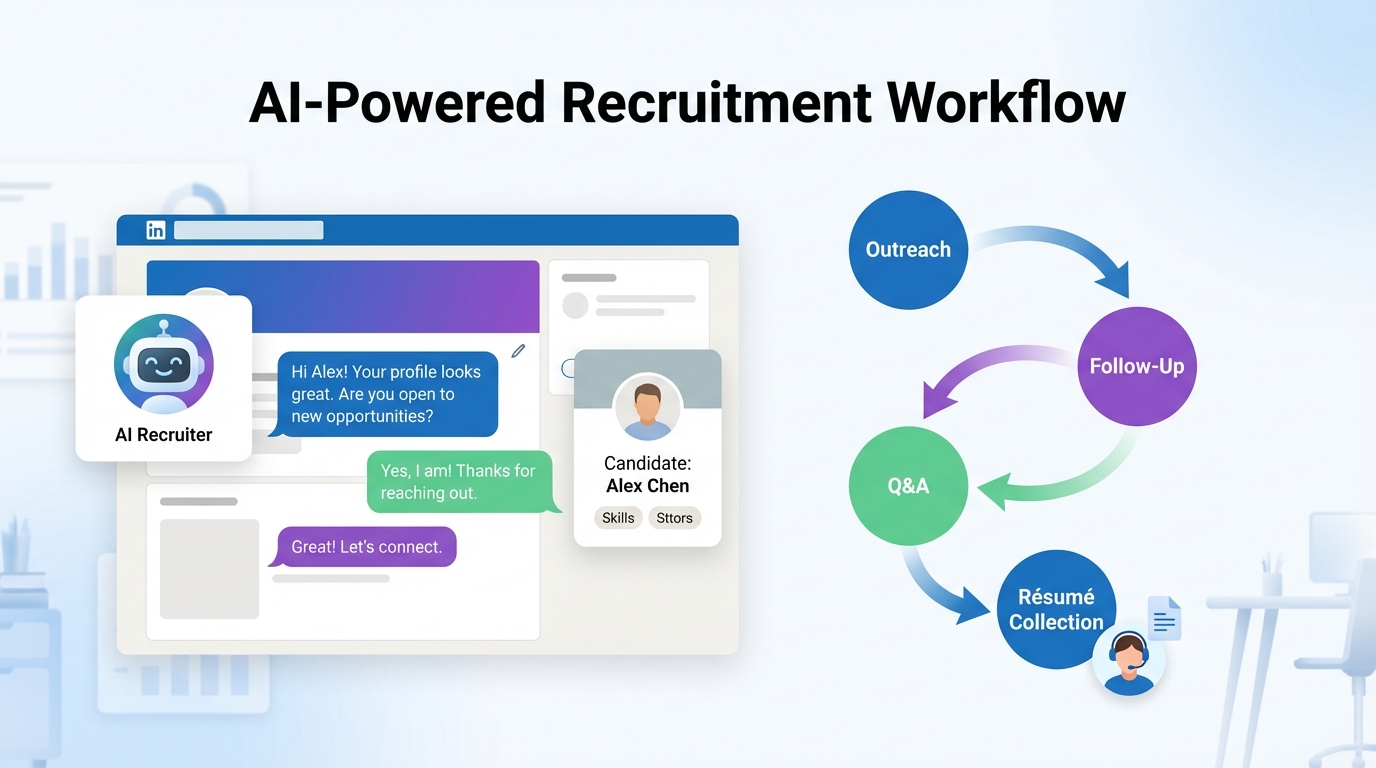
AI recruiting companies help leaders navigate uncertainty by turning hiring into a repeatable operating system: align the team around values, understand how people respond under stress, and invest in technology that keeps candidate communication consistent. We see this most clearly in recruiting teams that pair human judgment with automation. For example, StrategyBrain AI Recruiter can run the repetitive LinkedIn outreach and follow up loop, respond to candidate questions 24/7 in the candidate’s native language, and collect résumés and contact details so recruiters can spend their time on final qualification and interviews.
Why uncertainty breaks hiring first
Uncertainty compresses decision cycles. Budgets change, priorities shift, and teams feel the pressure to “do more with less.” In that environment, hiring often becomes the first process to degrade because it depends on consistent execution across many small actions: sourcing, outreach, follow up, scheduling, and candidate Q and A.
One data point that frames the leadership challenge is that 15% of executives reported confidence in their top leadership to handle unpredictable events such as pandemics, climate change, or economic downturns. This figure was cited in a leadership article that referenced Financial Post coverage of a Business Wire release.
For recruiting leaders, the practical takeaway is simple. If confidence is fragile, your hiring process must be stable. That is where the right mix of people, process, and AI enabled execution matters.
Living your values as a hiring compass
In uncertain periods, values are not a poster on the wall. They are a decision filter. When leaders consistently apply values, teams move faster because they do not renegotiate “what matters” in every meeting.
What this looks like inside a recruiting team
- Define non negotiables for candidate experience such as response time expectations, tone, and transparency about role scope.
- Make values observable by turning them into behaviors that can be coached and reviewed.
- Reward values in action by recognizing recruiters who uphold standards even when req volume spikes.
How StrategyBrain AI Recruiter fits without replacing leadership
Values fail when execution is inconsistent. StrategyBrain AI Recruiter supports consistency by handling the repetitive LinkedIn steps that are easiest to drop under pressure: connecting with candidates in your target criteria, introducing the opportunity, answering common questions about the role and company, and following up on time. Recruiters still own the final qualification decision, but the “values in action” layer becomes easier to maintain because the baseline workflow runs reliably.
Understanding your people and candidate experience
Strong leadership in uncertainty requires knowing how different people react to stress and change. Some employees want more context. Others want clear tasks and autonomy. The same is true for candidates. Some want compensation clarity early. Others want mission and growth details first.
Operationalizing “understanding people” in recruiting
- Segment candidate conversations by role family and seniority so messaging matches what candidates typically ask.
- Standardize what must be captured such as résumé receipt, contact details, and interview interest.
- Reduce friction across time zones so candidates are not waiting overnight for basic answers.
Where AI recruiting companies add leverage
Many AI recruiting companies focus on sourcing or screening. The gap we repeatedly see is the “conversation middle” where candidates ask questions and recruiters lose time to back and forth. StrategyBrain AI Recruiter is designed for that middle layer on LinkedIn. It can communicate 24/7, in any global language, and it can collect résumés and contact information from interested candidates. That reduces cultural friction and delays, while keeping the recruiter in control of final fit assessment.
Limitations to be aware of
Automation does not equal full qualification. StrategyBrain AI Recruiter can identify willingness to communicate or interview, but it does not determine whether a résumé fully matches job requirements. Leaders should plan a clear handoff point where human recruiters review résumés and make the final shortlist.
Investing in technology that keeps hiring moving
Technology is not valuable because it is new. It is valuable because it preserves throughput when conditions change. In the source material, the organization described how remote and flexible work options helped them transition to fully remote operations smoothly, including front desk functions. The leadership lesson is that systems built ahead of disruption outperform systems built during disruption.
What to look for in AI recruiting technology
- Workflow coverage that includes outreach, follow up, Q and A, and data capture, not only sourcing.
- Always on responsiveness so candidates get timely replies outside recruiter working hours.
- Multilingual capability to support global hiring without adding headcount.
- Scalability controls for teams that manage multiple LinkedIn accounts and want consistent governance.
- Security and privacy posture including encryption and clear statements about whether customer data trains models.
StrategyBrain AI Recruiter as a practical example
StrategyBrain AI Recruiter is built specifically for LinkedIn hiring. It automates initial outreach and qualification conversations, collects résumés and contact details, and supports managing more than 100 LinkedIn accounts for organizations building AI powered recruitment teams. It also states that customer provided data is not used to train AI models and that credentials are encrypted and stored independently per user with explicit authorization.
How to evaluate AI recruiting companies
If you are comparing an AI recruitment agency, a vendor platform, or a hybrid service, the fastest way to avoid a bad fit is to evaluate them against the exact failure modes that show up during uncertainty.
Evaluation checklist you can copy
- Define the bottleneck: Is your problem sourcing volume, response time, follow up consistency, or recruiter capacity?
- Map the handoff: Where does automation stop and where does human judgment begin?
- Verify data handling: Ask whether your data trains models, how encryption works, and how access is controlled.
- Test candidate experience: Run a pilot with real candidate conversations and review tone, accuracy, and escalation paths.
- Measure throughput: Track outreach sent, replies handled, résumés collected, and interviews scheduled per recruiter per week.
- Plan governance: If you use multiple LinkedIn accounts, define who approves messaging, who monitors compliance, and who audits logs.
A note on ML recruiters and “AI” claims
Some providers market “ML recruiters,” meaning machine learning systems that rank candidates or predict fit. That can be useful, but it is not the same as running the day to day communication workflow. In our experience, teams get the biggest immediate lift when they stabilize outreach and follow up first, then layer in ranking and analytics once the pipeline is flowing.
Implementation playbook for leaders
This is a practical sequence we recommend when you want AI recruiting companies to improve outcomes without creating chaos.
Step by step implementation
- Write a one page “values in recruiting” standard that defines response time, transparency, and candidate respect.
- Choose one role to pilot with clear candidate criteria and a stable hiring manager.
- Configure the AI conversation scope so it can introduce the role, answer common questions, confirm interest, and request résumé and contact details.
- Set the human review gate where recruiters review résumés and decide who moves to interview.
- Run the pilot for 14 days and review transcripts for tone, accuracy, and missed escalation moments.
- Scale to additional roles only after you have a repeatable playbook and governance owner.
Common mistakes to avoid
- Automating without a handoff which creates confusion about who owns candidate decisions.
- Over optimizing scripts too early before you have enough real conversations to learn from.
- Ignoring time zone reality which is exactly where 24/7 multilingual communication creates leverage.
- Measuring only vanity metrics such as connection counts instead of résumés collected and interviews booked.
Quick comparison
| Approach | What it stabilizes in uncertainty | What it does not solve by itself | Best for |
|---|---|---|---|
| Values led recruiting standards | Decision consistency and candidate experience | Execution capacity when recruiter workload spikes | Any team that needs alignment fast |
| People insight and fit frameworks | Better internal support and clearer hiring signals | 24/7 responsiveness and follow up throughput | Teams hiring across multiple managers |
| StrategyBrain AI Recruiter on LinkedIn | Outreach, follow up, Q and A, résumé and contact capture | Final résumé to requirements matching decision | Leaders scaling LinkedIn hiring without adding headcount |
FAQ
What do AI recruiting companies actually do?
AI recruiting companies use automation and machine learning to reduce manual recruiting work such as sourcing, outreach, screening, and candidate communication. The exact scope varies by provider, so you should confirm which steps are automated and where humans take over.
Is an AI recruitment agency the same as a software tool?
No. An AI recruitment agency typically combines services with technology, while a software tool is primarily a platform your team operates. Many teams start with software for repeatable workflows, then add services for hard to fill roles.
How does StrategyBrain AI Recruiter work on LinkedIn?
It automates initial LinkedIn recruiting by connecting with candidates in your target criteria, introducing the job, answering questions about the role and company, confirming interview interest, and collecting résumés and contact details. Recruiters then review the collected information and run interviews.
Can StrategyBrain AI Recruiter qualify candidates end to end?
No. It can identify willingness to communicate or interview, but it does not decide whether a résumé fully matches job requirements. That final qualification step remains a recruiter responsibility.
Does it support multilingual recruiting?
Yes. StrategyBrain AI Recruiter is designed for 24/7 global multilingual recruitment communication and can communicate in any global language using the candidate’s native language.
How does it capture résumés and contact details?
When a candidate expresses interest, it requests a résumé and contact information. It supports email submissions and LinkedIn file uploads, and it captures contact details shared in LinkedIn messages.
How should leaders measure success when using AI recruiting companies?
Use throughput metrics tied to hiring outcomes: replies handled, résumés collected, qualified conversations completed, and interviews scheduled per recruiter per week. Track these alongside candidate experience signals such as response time and drop off points.
What security and privacy questions should I ask?
Ask whether your data trains models, how credentials are stored, what encryption is used, and how access is authorized and audited. StrategyBrain AI Recruiter states that customer provided data is not used to train AI models and that credentials are encrypted and stored independently per user with explicit authorization.
Conclusion
In uncertain markets, leadership confidence comes from repeatable execution. AI recruiting companies can support that execution when they reinforce your values, respect the human handoff for final qualification, and keep candidate communication consistent across time zones. If your biggest bottleneck is LinkedIn outreach and follow up, StrategyBrain AI Recruiter is a practical way to stabilize the workflow by automating initial conversations, answering questions 24/7 in any language, and collecting résumés and contact details for recruiter review.
Next steps: write your recruiting values standard, pilot one role for 14 days, and measure résumés collected and interviews scheduled before scaling to additional roles.