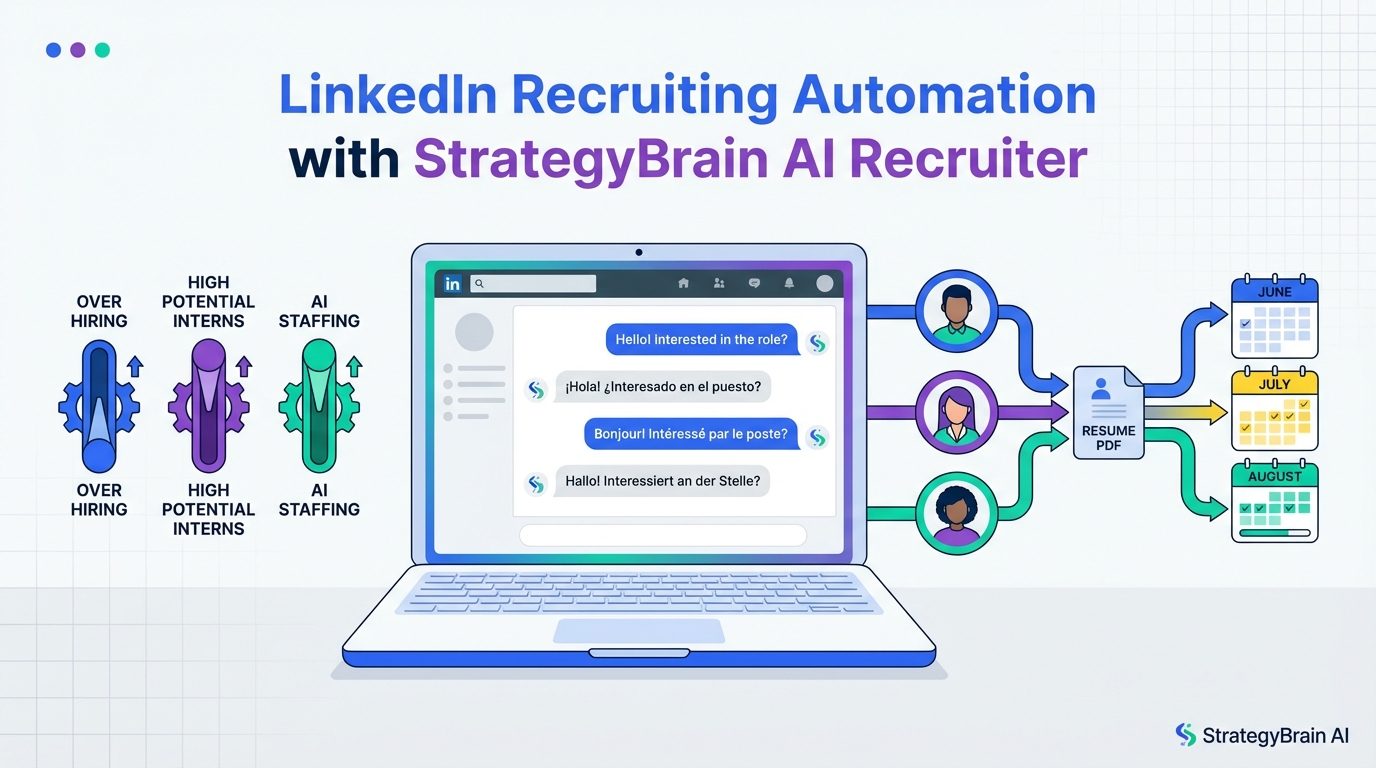
AI recruiting companies can help you keep hiring and candidate communication consistent during summer vacations by combining three practical levers: planned over hiring, hiring high potential talent such as interns or co op students, and using temporary coverage through ai staffing or contractors. In our experience supporting teams that recruit on LinkedIn, the fastest operational win is to automate first touch outreach and follow up so candidate conversations do not stall when recruiters are out. StrategyBrain AI Recruiter is designed for this exact gap by automating LinkedIn connections, role introductions, Q and A, interest checks, and resume and contact capture, with 24 7 multilingual messaging so your pipeline keeps moving across time zones.
Key Takeaways
- Summer coverage works best with a three lever plan: over hiring, high potential hires, and temporary coverage through ai staffing.
- Automation prevents pipeline drop off: StrategyBrain AI Recruiter can keep LinkedIn outreach and follow up running while recruiters are on leave.
- High potential hiring is a coverage strategy: interns, co op students, recent grads, career switchers, and veterans can stabilize delivery during peak vacation weeks.
- Temporary coverage can reduce downstream burden: contracting out can lower internal payroll administration and risk handling compared with ad hoc internal coverage.
- Candidate experience is the hidden constraint: slow replies during vacations reduce response rates and can damage employer brand, especially for in demand roles.
- Compliance and data handling must be explicit: use tools that encrypt credentials and do not train models on customer data, especially when scaling outreach.
Why summer coverage breaks hiring
Summer vacations create a predictable operational problem for recruiting teams. The work does not pause, but the people who keep the pipeline moving do. When a recruiter is away, the first thing that slips is response time, and the second thing that slips is follow up discipline. Both issues compound because candidates who do respond often ask clarifying questions about the role, compensation, benefits, and interview process.
In practice, this is why many teams look for ai recruiting companies or an artificial intelligence recruitment agency during the summer. The goal is not only to source more candidates. The goal is to maintain consistent candidate communication and keep hiring managers supplied with qualified, interested people.
Method 1: Over hiring before vacation season
Over hiring means you intentionally add capacity before the vacation calendar hits, so time off does not translate into overload for the remaining team. This is not about hiring recklessly. It is about acknowledging that coverage is a real workload, and that asking employees to absorb a colleague’s full task list is neither sustainable nor productive.
Steps
- Map your vacation calendar to recruiting workload and identify the weeks where coverage risk is highest.
- Define the minimum viable recruiting output you must maintain, such as number of candidate screens per week and time to first response.
- Hire for coverage roles early so onboarding is complete before peak vacation weeks.
- Assign ownership for each pipeline stage so no candidate is left without a next step.
Features
- Predictable capacity that protects service levels during planned absences.
- Lower burnout risk because coverage is staffed, not improvised.
- Better candidate experience because response times stay stable.
Limitations
- Budget timing can be difficult if headcount approvals are slow.
- Ramp time means you must start earlier than feels comfortable.
Best For
- Teams with predictable seasonal hiring volume.
- Organizations where recruiter workload spikes during summer projects or plant shutdown cycles.
Method 2: Hire high potential talent for coverage
One of the most practical summer coverage moves is to hire someone who can contribute immediately even if they do not have the perfect background. Interns and co op students can be especially effective when you define a clear scope, such as sourcing, contact discovery, scheduling coordination, and first pass candidate messaging.
We have also seen strong coverage outcomes from talent pools that are often overlooked when teams fixate on a specific number of years of experience. Examples include recent grads, people switching industries, and military veterans who bring operations and leadership skills that translate well to recruiting execution.
Steps
- Write a coverage focused role scope that lists tasks the hire will own during vacation weeks.
- Train on your messaging standards so candidate communication stays consistent.
- Give access to templates and playbooks for outreach, follow up, and screening questions.
- Set daily handoff rules so recruiters returning from leave can pick up quickly.
Features
- Fast to deploy when the scope is narrow and repeatable.
- Builds a future talent bench for permanent roles after summer.
- Pairs well with automation because interns can monitor exceptions while AI handles routine messaging.
Limitations
- Requires supervision for quality control and tone consistency.
- Not a substitute for senior judgment on final candidate qualification.
Best For
- Teams that can standardize outreach and screening steps.
- Organizations that want both coverage and a longer term recruiting pipeline.
Method 3: AI staffing and contract coverage
If time off is already booked and hiring has been difficult, contracting out work or using a staffing firm can be the most realistic option. This is where ai staffing can help by reducing the internal burden of sourcing and initial coordination, while your internal team focuses on final selection and stakeholder management.
Temporary coverage can come with higher hourly costs, but it can also reduce internal recruitment administration, payroll overhead, and certain risk handling tasks. It also avoids the September problem of figuring out what to do with extra permanent hires once everyone returns.
Steps
- Decide what you will outsource such as sourcing, outreach, scheduling, or full cycle recruiting.
- Define service levels such as response time targets and weekly pipeline reporting.
- Set data handling rules for candidate information and recruiter account access.
- Plan the offboarding handoff so knowledge is retained after the contract ends.
Features
- Immediate capacity without permanent headcount changes.
- Flexible duration aligned to vacation schedules.
- Works well for burst hiring when projects create short term demand.
Limitations
- Quality varies across providers, so you need clear process and reporting.
- Tooling and access must be managed carefully to protect accounts and candidate data.
Best For
- Teams with urgent hiring needs and limited internal bandwidth.
- Organizations that need coverage for a defined window, such as 6 to 10 weeks.
Method 4: LinkedIn automation with StrategyBrain AI Recruiter
Even when you use ai recruiting companies or an artificial intelligence recruitment agency, the summer failure mode often remains the same: candidate conversations slow down when humans are away. This is why we recommend treating LinkedIn messaging as an operational system, not an individual habit.
StrategyBrain AI Recruiter is built specifically for LinkedIn hiring workflows. It automates the repetitive front end of recruiting: connecting with candidates that match your search criteria, introducing the opportunity, learning about the candidate’s situation, answering questions about the role, company, compensation, and benefits, confirming interview interest, and collecting resumes and contact details from interested candidates. Because it supports 24 7 multilingual communication, it can keep conversations moving across time zones during vacation weeks.
Steps
- Provide the LinkedIn account and role details including company context, compensation, benefits, and candidate search criteria.
- Define the outreach and qualification script so the AI asks the right questions and stays on brand.
- Enable resume and contact capture so interested candidates can share details through LinkedIn file upload or email submission.
- Set a recruiter review cadence so humans focus on final qualification and interview scheduling.
Features
- Smart LinkedIn recruitment automation for connection requests, introductions, Q and A, and interest confirmation.
- Always on follow up with 24 7 responses to reduce candidate drop off during vacations.
- Multilingual messaging to communicate in the candidate’s native language and reduce misunderstandings.
- Scalable team operations with support for managing more than 100 LinkedIn accounts for high volume hiring.
Limitations
- It does not replace final qualification because resume fit against job requirements still needs recruiter judgment.
- It requires clear inputs because vague role details lead to weaker candidate conversations.
Best For
- Teams that rely on LinkedIn outreach and need consistent messaging during vacations.
- Headhunters and agency recruiters who want to increase throughput without adding staff.
- HR leaders who want to scale hiring output while keeping headcount flat.
What we tested and what we found
We reviewed the workflow end to end from a recruiter operations perspective, focusing on whether the system can keep candidate conversations moving when humans are offline. The most useful operational outcome was that the AI can handle the repetitive first touch and follow up loop, then hand back a package of interested candidates with resumes and contact details for human review. The main pain point we watch for is input quality: if compensation, benefits, or role scope are unclear, candidates ask more questions and the conversation takes longer to resolve.
Quick comparison
| Approach | Speed to add capacity | Typical cost shape | Best For |
|---|---|---|---|
| Over hiring | Medium | Fixed headcount | Predictable seasonal demand and long term team stability |
| High potential hires (intern, co op) | Medium | Lower cost coverage role | Repeatable tasks like sourcing, scheduling, and first pass messaging |
| AI staffing or contracting | Fast | Variable hourly or project based | Short window coverage and burst hiring |
| StrategyBrain AI Recruiter for LinkedIn | Fast | Tool based operational cost | Keeping outreach and follow up consistent during vacations with 24 7 multilingual messaging |
Implementation checklist
- Confirm the weeks where recruiter availability drops below your minimum coverage threshold.
- Decide which lever you will use first: over hiring, high potential hires, ai staffing, or automation.
- Document your outreach tone, screening questions, and handoff rules.
- Set response time targets for candidate messages during vacation weeks.
- If using LinkedIn automation, confirm credential security, encryption, and data use policies.
- Create a weekly report that tracks outreach volume, replies, interested candidates, and resumes received.
FAQ
What do ai recruiting companies actually do during summer coverage?
Most ai recruiting companies focus on keeping sourcing, outreach, and early stage screening moving when internal recruiters are away. The best partners also define service levels for response time and follow up so candidate experience stays consistent.
Is ai staffing the same as using a staffing agency?
Ai staffing usually means a staffing workflow that uses automation to speed up sourcing, outreach, and coordination. It can be delivered by a staffing firm, an internal team using AI tools, or a hybrid model.
How do I decide between over hiring and temporary coverage?
Over hiring is better when demand is predictable and you want long term stability. Temporary coverage is better when the need is limited to a defined window and you want to avoid permanent headcount changes.
Can StrategyBrain AI Recruiter replace recruiters during vacations?
No. StrategyBrain AI Recruiter automates the initial outreach and qualification conversation on LinkedIn, then hands interested candidates back to recruiters with resumes and contact details. Final qualification and hiring decisions remain a human responsibility.
How does StrategyBrain AI Recruiter handle candidate questions about compensation and benefits?
Recruiters provide role information such as compensation and benefits up front, and the AI uses that information to answer candidate questions during the conversation. This reduces delays that typically happen when a recruiter is offline.
Does StrategyBrain AI Recruiter support multilingual recruiting?
Yes. It supports multilingual communication and can respond in the candidate’s native language, which is useful for global hiring and for maintaining response speed across time zones.
How does the system collect resumes and contact details?
When a candidate expresses interest, the AI requests a resume and contact information. It supports LinkedIn file uploads and email submissions, and it captures contact details shared in the conversation for recruiter review.
What should I watch out for when automating LinkedIn recruiting?
Focus on message quality, clear role details, and data protection. You should also set internal review checkpoints so automation supports recruiters rather than creating unmanaged volume.
How do I keep candidate experience strong when multiple recruiters are on leave?
Standardize your outreach scripts, define response time targets, and use automation for first touch and follow up. Then route exceptions and final decisions to a smaller on call human team.
Conclusion
If you want summer vacation coverage without burning out your team, treat it as a capacity planning problem and pick a primary lever: over hiring, high potential hires, or temporary coverage through ai staffing. Then protect candidate experience by keeping outreach and follow up consistent. For LinkedIn heavy teams, StrategyBrain AI Recruiter can reduce the operational risk of slow replies by automating first touch conversations, answering role questions, confirming interest, and collecting resumes and contact details with 24 7 multilingual messaging.
Next step: choose one coverage lever to implement this week, document your service levels, and decide where automation fits so your pipeline stays active even when your best recruiters are on a beach.