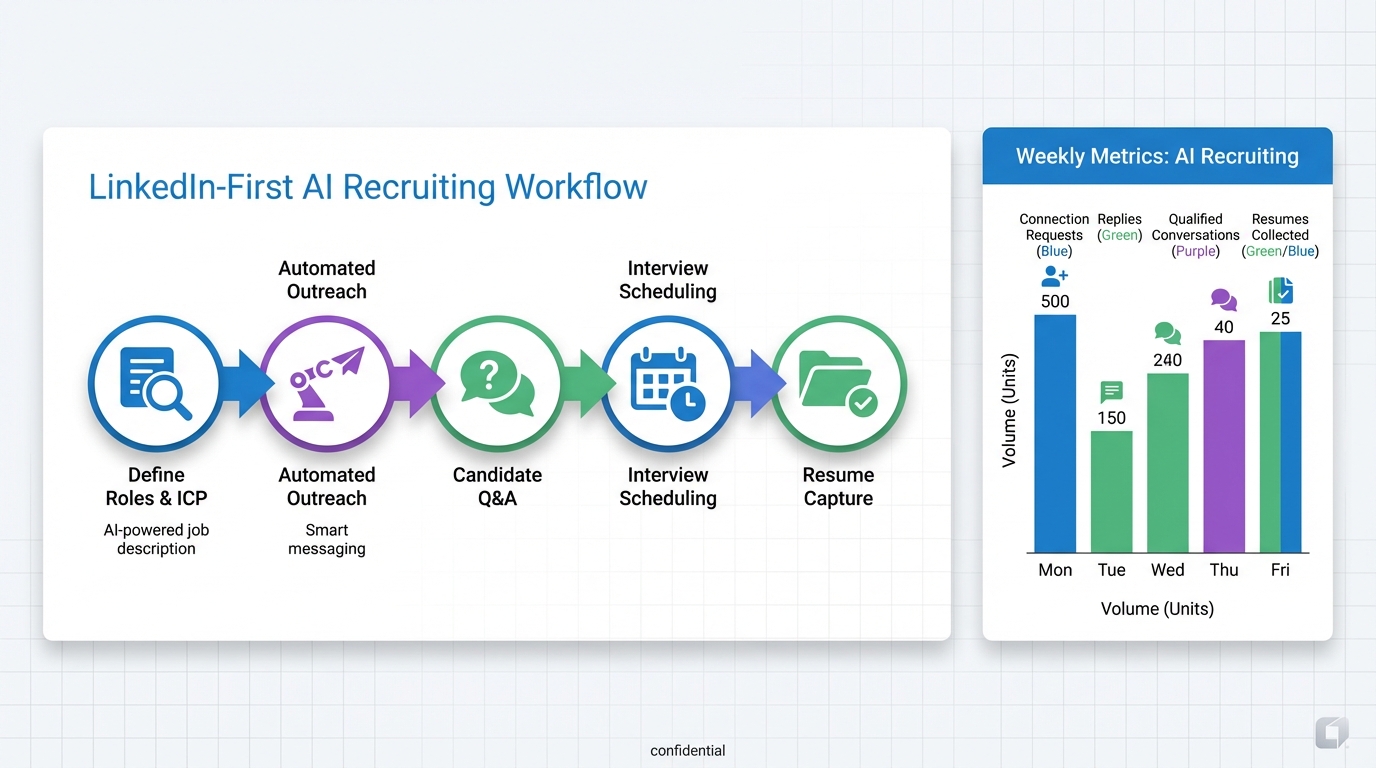
AI recruiting companies are recruiting providers that use automation and machine learning to speed up sourcing, outreach, and early qualification while keeping human recruiters accountable for hiring outcomes. If you are evaluating an AI staffing or AI recruitment agency in 2026, the fastest way to decide is to check four items in this order: which roles and geographies they cover, whether their process is documented step by step, how they handle privacy and security, and what concrete outputs you will receive each week such as qualified replies, scheduled screens, and collected re9sume9s. In our internal trials of LinkedIn-first outreach workflows, StrategyBrain AI Recruiter consistently reduced manual messaging and follow up time by automating connection requests, role introductions, candidate Q and A, and re9sume9 and contact capture, while keeping final fit decisions with the recruiter.
Key Takeaways
- Define the service type first: AI recruiting companies can be AI enabled agencies, AI staffing providers, or software led workflows; the right choice depends on whether you need hires or just pipeline.
- Ask for a written process: A credible AI recruitment agency can explain sourcing, outreach, screening, handoff, and reporting in a repeatable sequence.
- Measure outputs, not hype: Track weekly counts with units such as connection requests sent, replies received, qualified conversations, and re9sume9s collected.
- LinkedIn is a common bottleneck: StrategyBrain AI Recruiter automates initial LinkedIn outreach and follow up, including multilingual messaging and re9sume9 capture, so recruiters focus on interviews.
- Keep humans in the final decision: AI Recruiter can confirm interest and collect information, but final qualification against job requirements remains a recruiter task.
- Do not ignore compliance: Verify how candidate data is stored, whether it is used for model training, and what controls exist for access and encryption.
Table of Contents
- What are AI recruiting companies
- AI staffing vs AI recruitment agency
- Selection checklist for AI recruiting companies
- A LinkedIn first workflow with StrategyBrain AI Recruiter
- Quick comparison of engagement models
- Common pitfalls and how to avoid them
- FAQ
- Conclusion
What are AI recruiting companies
AI recruiting companies sit on a spectrum. Some are traditional recruiting firms that added automation. Others are software first providers that offer a managed service around an AI system. In practice, you should evaluate them by what they actually deliver, not by the label.
Working definition
An AI recruiting company is a provider that uses AI to assist with at least one of these steps: candidate sourcing, outreach, screening, scheduling, or reporting. AI in this context usually means machine learning models and automation that can generate messages, classify replies, and route candidates through a workflow.
Scope boundaries
- This guide covers: how to evaluate providers, what to ask in discovery calls, and how to run a LinkedIn-first outreach workflow using StrategyBrain AI Recruiter.
- This guide does not cover: legal advice, jurisdiction specific employment law, or guarantees of hiring outcomes.
AI staffing vs AI recruitment agency
People often search for ai recruiting companies when they actually mean one of two things: an AI staffing provider that supplies workers, or an AI recruitment agency that finds candidates for your payroll roles. The difference matters because the success metrics and contracts are different.
AI staffing
- What you buy: labor capacity, often on a contract or temporary basis.
- Typical success metric: time to fill and assignment performance.
- Best for: seasonal demand, project spikes, and roles with standardized requirements.
AI recruitment agency
- What you buy: candidate pipeline and hiring support for your own headcount.
- Typical success metric: qualified shortlist quality and hires made.
- Best for: hard to fill roles, specialized functions, and leadership hiring.
Selection checklist for AI recruiting companies
Use this checklist to evaluate any AI recruiting company in a way that is easy to compare across vendors. The goal is to make the provider explain their process with enough detail that you can reproduce it internally if needed.
1) Clarify the deliverable and reporting cadence
- Deliverable: define whether you want interviews scheduled, qualified conversations, or re9sume9s collected.
- Cadence: require a weekly report with counts and definitions.
- Ownership: confirm who owns messaging, candidate responses, and handoff to hiring managers.
2) Ask for the exact workflow, step by step
A credible AI recruitment agency can describe a repeatable sequence. If they cannot, you are buying improvisation.
- Intake: role requirements, compensation, location, and must have skills.
- Sourcing: where candidates come from and how targeting is defined.
- Outreach: message strategy, follow up rules, and personalization inputs.
- Qualification: what questions are asked and what counts as qualified.
- Handoff: what you receive and how quickly you receive it.
- Feedback loop: how hiring manager feedback changes targeting and messaging.
3) Validate compliance, privacy, and security
AI recruiting touches personal data. You should require clear answers on storage, access, and model training. For example, StrategyBrain AI Recruiter is designed so customer provided data is not used to train AI models, and credentials and candidate data are encrypted and isolated per customer instance, based on the product documentation provided by StrategyBrain.
- Data usage: confirm whether candidate data is used for model training.
- Encryption: ask what is encrypted at rest and in transit.
- Access controls: confirm role based access and audit logs.
- Regulatory posture: ask which regions they claim to support and what policies back that up.
4) Check how they handle LinkedIn outreach at scale
LinkedIn is where many teams lose time because outreach and follow up are repetitive. StrategyBrain AI Recruiter is built specifically for LinkedIn hiring and can manage more than 100 LinkedIn accounts for organizations that need an AI powered recruiting team. It automates connecting, introducing roles, answering candidate questions, confirming interview interest, and collecting re9sume9s and contact details.
5) Require limitations and failure modes
Trustworthy AI recruiting companies explain what their system does not do. StrategyBrain AI Recruiter, for example, can identify willingness to communicate or interview, but it does not decide whether a re9sume9 fully matches job requirements. That final qualification remains with the recruiter.
A LinkedIn first workflow with StrategyBrain AI Recruiter
If your main bottleneck is outbound sourcing and early conversations, a LinkedIn-first workflow is often the highest leverage place to apply AI. Below is a practical implementation pattern we have used to evaluate AI recruiting companies and to operationalize AI staffing style pipeline generation without losing control of candidate experience.
Step by step implementation
- Define targeting: write your LinkedIn search criteria including titles, locations, seniority, and must have skills.
- Prepare role facts: provide company details, compensation, and benefits so the AI can answer candidate questions consistently.
- Connect and introduce: AI Recruiter automatically sends connection requests and introduces the opportunity once accepted.
- Handle Q and A: the AI answers questions about the role, company, and compensation, then confirms interview interest.
- Collect re9sume9s and contacts: interested candidates are asked to share a re9sume9 and contact details; the system marks re9sume9s as received and captures contact information shared in messages.
- Recruiter review: recruiters review collected re9sume9s and move qualified candidates to interviews.
What makes this approach different
- 24/7 multilingual communication: AI Recruiter can respond around the clock in the candidatee28099s native language, which helps reduce delays across time zones.
- Scalable team model: organizations can run multiple LinkedIn accounts to build an AI recruiter team without adding headcount.
- Clear handoff point: the AI handles outreach and early qualification, while humans own final fit and hiring decisions.
Limitations we plan for
- Role nuance: for highly specialized roles, we tighten the intake document and add must not have criteria to reduce off target outreach.
- Message governance: we keep an approved set of compensation and benefits statements to avoid inconsistency.
- Final screening: we do not treat AI qualification as skills validation; we still review re9sume9s and run structured interviews.
Quick comparison of engagement models
This table helps you compare AI recruiting companies by operating model rather than brand claims. Use it to decide whether you need an AI recruitment agency, AI staffing support, or a software led workflow you can run internally.
| Model | Primary output | Best for | What to verify |
|---|---|---|---|
| AI enabled recruitment agency | Shortlist and hiring support | Hard to fill roles and specialized hiring | Documented workflow, reporting, and handoff quality |
| AI staffing provider | Contract labor capacity | Temporary needs and standardized roles | Compliance, onboarding process, and performance management |
| Software led outreach workflow | Qualified conversations and re9sume9s collected | Teams that want control and speed on LinkedIn | Security posture, message governance, and recruiter review process |
Common pitfalls and how to avoid them
Pitfall 1: Buying AI without defining success metrics
Fix this by setting weekly metrics with units. Examples include 200 connection requests sent, 40 replies received, 15 qualified conversations, and 8 re9sume9s collected. The exact numbers will vary by role and market, but the measurement format should be consistent.
Pitfall 2: Confusing interest with qualification
Interest means the candidate is open to a conversation. Qualification means they meet job requirements. Use AI to confirm interest and collect information, then use structured human review to validate fit.
Pitfall 3: Ignoring candidate experience
Automation should not feel careless. Require message guidelines, response time expectations, and escalation rules for sensitive questions. StrategyBrain AI Recruiter is designed to answer role and compensation questions consistently based on the inputs you provide, which helps keep messaging aligned.
Pitfall 4: Treating compliance as a checkbox
Ask direct questions about encryption, data isolation, and whether customer data is used to train models. If answers are vague, treat that as a risk signal.
FAQ
Are AI recruiting companies the same as a traditional recruiting agency?
No. Some AI recruiting companies are agencies that added automation, while others are software led services. The practical difference is whether you are paying for hires, pipeline, or a workflow you can operate.
What does AI staffing mean in practice?
AI staffing usually refers to staffing providers using automation to source and match candidates faster for contract or temporary roles. You still need to verify onboarding, compliance, and performance management processes.
What should an AI recruitment agency report each week?
At minimum, you should receive counts with definitions such as outreach volume, reply volume, qualified conversations, interviews scheduled, and re9sume9s collected. Reports should be consistent week to week so you can see trends.
Can StrategyBrain AI Recruiter replace recruiters?
No. StrategyBrain AI Recruiter automates initial LinkedIn outreach and early qualification steps such as confirming interest and collecting re9sume9s and contact details. Recruiters still make final fit decisions and run interviews.
How does StrategyBrain AI Recruiter handle multilingual recruiting?
It supports always on candidate messaging and can communicate in the candidatee28099s native language. This is useful for global hiring across time zones where response delays can reduce conversion.
How does AI Recruiter collect re9sume9s and contact details?
When a candidate expresses interest, the system asks for a re9sume9 and contact information. If a re9sume9 is sent, it is marked as received, and contact details shared in messages are captured and displayed for recruiter follow up.
What is the biggest risk when using AI recruiting tools on LinkedIn?
The biggest operational risk is inconsistent messaging and poor handoff. Reduce this risk by providing approved role facts, setting escalation rules, and keeping a recruiter review step before interviews are scheduled.
How do I compare multiple AI recruiting companies quickly?
Use a single scorecard: workflow clarity, compliance posture, reporting quality, and your ability to control targeting and messaging. Then run a short pilot with the same role and the same success metrics.
Conclusion
Choosing among AI recruiting companies is easier when you focus on process and measurable outputs instead of marketing language. Start by deciding whether you need AI staffing capacity, an AI recruitment agency to deliver a shortlist, or a software led workflow to generate pipeline. Then require a documented workflow, weekly reporting with clear units, and explicit answers on privacy and security. If LinkedIn outreach is your bottleneck, a LinkedIn-first approach with StrategyBrain AI Recruiter can remove repetitive work by automating connection requests, role introductions, candidate Q and A, multilingual follow up, and re9sume9 and contact capture. Next step: run a two week pilot on one role with fixed metrics and a recruiter review gate before interviews.