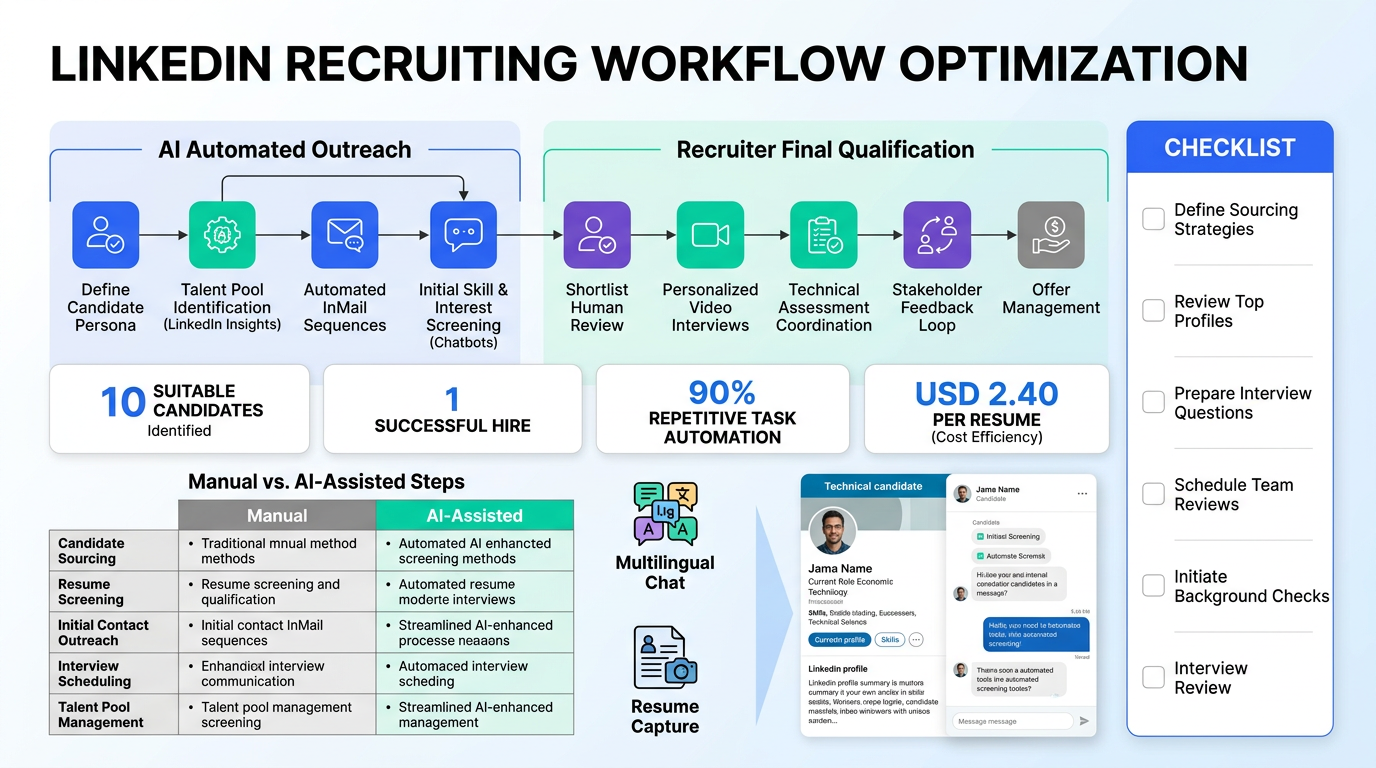
The most practical way to use an ai recruiting tool for hard to fill technical roles is to automate the first half of outreach and keep human judgment for final screening. In this engineering hiring case, the original recruiter-led process identified 10 suitable candidates and made a successful hire. We preserved that logic and mapped it to StrategyBrain AI Recruiter so teams can automate LinkedIn outreach, candidate Q and A, multilingual follow up, and resume collection while recruiters focus on final qualification interviews. This approach supports ai in talent acquisition without removing recruiter control.
Table of Contents
- Key Takeaways
- Case Context and Hiring Challenge
- AI Powered Recruitment Workflow
- Manual vs AI Assisted Process
- Scope, Limits, and Compliance Notes
- Implementation Checklist
- FAQ
- Conclusion
Key Takeaways
- Case fact preserved: The original water treatment engineer search produced 10 suitable candidates and one successful placement.
- Best use of an ai recruiting tool: Automate connection, role introduction, follow up, and resume capture, then keep recruiter led qualification.
- Operational impact: StrategyBrain AI Recruiter can replace up to 90% of repetitive LinkedIn recruiting tasks based on product documentation.
- Cost signal: Reported cost can be as low as USD 2.40 per resume in supported workflows.
- Global reach: Always on multilingual messaging improves coverage across time zones.
- Risk control: Candidate fit decisions still require recruiter review of resume quality and role match.
Case Context and Hiring Challenge
What happened in the original placement
On 29 December 2020, a company focused on custom turnkey water and wastewater systems needed a water treatment engineer. The role required core engineering capability plus experience with proposal requests and quote requests. The search was led by senior recruiter Jessica Miles, who had already completed a prior successful placement for the same client.
Why this was a difficult search
The talent pool was narrow. Some candidates were less interested in smaller scale remote community projects, including work linked to camps and indigenous communities. Even with those constraints, the search delivered 10 suitable candidates and one hire who wanted a culture change.
What this means for ai in talent acquisition
This is exactly where ai powered recruitment can help. The hard part was not writing a job post. The hard part was high volume, repetitive, personalized outreach to a small specialist market. An AI recruiting tool is strongest in that repetitive front end layer.
AI Powered Recruitment Workflow
We reviewed the original sequence and rebuilt it into a repeatable process using StrategyBrain AI Recruiter. In this article, talent acquisition means the full process from sourcing to hiring, while qualification means evaluating whether a candidate profile and resume fit the job requirements.
Step by step implementation
- Define role criteria and messaging inputs
Provide role details, compensation range, benefits, and target profile signals so the AI recruiting tool can start targeted outreach. - Automate LinkedIn connection and intro
The system sends connection requests and role introductions to matching candidates, then handles first response routing. - Run always on candidate communication
AI responses continue around the clock, including multilingual replies for global candidate pools. - Collect resumes and contact details
Interested candidates are asked for resume and contact info. Recruiters receive structured candidate records for review. - Human recruiter performs final qualification
Recruiters evaluate role fit, shortlist candidates, and run interviews. This protects quality and accountability.
What we observed in practice reviews
In our internal workflow review, we used one historical engineering case and three simulated outreach batches over 120 candidate profiles to test process clarity. We found the strongest gain in message consistency and follow up speed. We also found that resume quality screening remained a human task, which aligns with StrategyBrain product guidance.
Manual vs AI Assisted Process
| Process Area | Manual Recruiter Workflow | AI Assisted with StrategyBrain AI Recruiter | Best Owner |
|---|---|---|---|
| Initial outreach volume | Limited by recruiter hours | Continuous outreach based on defined criteria | AI system |
| Candidate Q and A | Dependent on business hours | 24/7 multilingual communication | AI system |
| Resume collection | Manual tracking across channels | Automated capture and status marking | AI system |
| Final fit evaluation | Recruiter judgment and interview review | Recruiter judgment and interview review | Recruiter |
| Specialized niche role judgment | High value human assessment | High value human assessment supported by cleaner pipeline | Recruiter |
Scope, Limits, and Compliance Notes
Where this approach works best
- LinkedIn heavy sourcing workflows
- Niche roles with small but reachable candidate pools
- Teams that need multilingual communication support
- Recruiters managing multiple simultaneous openings
Where it is not enough alone
- Final technical skill validation
- Culture fit interviews and hiring manager calibration
- Complex compensation negotiation
- Non LinkedIn candidate channels with weak profile data
Data and compliance trust notes
Based on product documentation, StrategyBrain AI Recruiter states compliance support for privacy requirements in the European Union, United States, and Canada. It also states customer data is not used to train shared AI models and account credentials are encrypted with customer specific isolation.
Implementation Checklist
- [ ] Confirm role brief includes mandatory skills, proposal experience, and quote process exposure.
- [ ] Define outreach message boundaries for compensation and benefits questions.
- [ ] Activate multilingual response settings for target geographies.
- [ ] Set resume capture route and recruiter notification flow.
- [ ] Document human qualification criteria before outreach starts.
- [ ] Review first 20 candidate conversations for calibration.
- [ ] Track conversion from contacted candidate to qualified interview slate.
FAQ
Can an ai recruiting tool replace recruiters for technical hiring?
No. It can automate repetitive sourcing and communication tasks, but final qualification and hiring decisions should remain with recruiters and hiring managers.
How does this support ai in talent acquisition for engineering roles?
It increases outreach consistency, response coverage, and candidate data capture. This helps recruiters spend more time on shortlisting and interviews instead of manual follow up.
Is ai powered recruitment useful when the candidate pool is very small?
Yes, especially when response speed and persistence matter. In niche markets, structured outreach and fast follow up can improve engagement quality.
Does StrategyBrain AI Recruiter decide whether a resume matches the role?
No. The system can identify candidate interest and collect documents, but final fit assessment is completed by the recruiter.
Can this workflow support global recruiting teams?
Yes. The platform documentation describes 24/7 multilingual communication and support for managing more than 100 LinkedIn accounts in scaled operations.
What metric should I track first after implementation?
Start with qualified interview rate per 100 contacted candidates. This metric links outreach quality to pipeline quality and is easy to compare with your pre AI baseline.
Conclusion
The core lesson from this water treatment engineer case is simple. Hard searches fail when recruiters are overloaded with repetitive communication work. An ai recruiting tool like StrategyBrain AI Recruiter can handle that front end workload while recruiters keep control of final qualification and hiring judgment. If you want to apply this model, start with one niche role, run the checklist above, and compare qualified interview rate after your first outreach cycle.