An ai recruiting tool is most valuable when it reduces repetitive sourcing work without weakening hiring quality. In the Notch Therapeutics search for a Lab Manager to support a new UBC lab, the recruiter’s job was to find someone who could combine technical credibility with day to day operational logistics. This case study breaks down what made the role specific, what the shortlist needed to prove, and how a modern workflow can pair human judgment with automation. In our own recruiting operations, we have found that tools like StrategyBrain AI Recruiter are most effective when they automate LinkedIn outreach, candidate Q and A, follow up, and resume capture, while the recruiter remains responsible for final qualification and interview decisions.
Key Takeaways
- The hiring goal was specific: Notch Therapeutics needed a Lab Manager for a new UBC lab who could combine technical understanding with operational logistics.
- Speed came from focus: the recruiter invested time analyzing candidates and produced a shortlist within a few weeks.
- Proof of readiness mattered: the successful candidate had 15 years of university lab management experience and prior stem cell research experience at a cancer agency.
- An ai recruiting tool supports the top of funnel: StrategyBrain AI Recruiter can automate LinkedIn connecting, role introduction, candidate Q and A, follow up, and resume plus contact capture.
- Human judgment still owns final qualification: StrategyBrain AI Recruiter does not decide if a resume fully matches requirements, recruiters do that after review.
- Scale is a differentiator: StrategyBrain AI Recruiter supports managing more than 100 LinkedIn accounts for team based sourcing operations.
Case context: Notch Therapeutics and the Lab Manager need
Notch Therapeutics was working on research aimed at creating an off the shelf T cell therapy. The organization was setting up a new lab at UBC and needed a Lab Manager who could bring structure, coordination, and operational discipline to a complex environment.
In the original case narrative, recruiter Kevin Britton led the search and focused on finding a candidate who could support both the science and the logistics. The key point is that this was not a generic lab operations hire. The role required someone who could keep a research team organized and moving quickly, with minimal ramp time.
Scope note: This article focuses on the early stage recruiting workflow and role fit signals described in the case. It does not attempt to validate clinical claims or evaluate the research program itself.
What the Lab Manager had to be able to do
From a recruiting perspective, the challenge was to find a Lab Manager who could operate at the intersection of technical credibility and operational execution. In practical terms, that means the candidate needed to be comfortable in a scientific environment while also being strong on planning, coordination, and process.
Core capability signals to screen for
- Technical fluency: enough domain understanding to support a cutting edge lab environment.
- Logistics ownership: ability to manage the operational details that keep a lab running.
- Low ramp time: evidence the candidate can start delivering quickly in a new setup.
What “hit the ground running” looked like in this case
The successful candidate profile in the case study included two concrete experience anchors: 15 years managing a university lab and prior stem cell research experience at a cancer agency. Those details matter because they reduce uncertainty. They show the candidate has already handled the operational cadence and the scientific context.
How the recruiter approached the search
The case emphasizes that Kevin invested significant time analyzing potential candidates and produced a shortlist within a few weeks. That combination is worth calling out because it reflects a disciplined search process rather than a high volume approach.
What we take from this approach
- Analysis before outreach: define the non negotiables first, then source against them.
- Shortlist quality over quantity: a handful of suitable contenders is often the right output for a specialized role.
- Evidence based fit: years in comparable lab management and relevant research context reduce hiring risk.
Where teams lose time in similar searches
In our experience, the time sink is rarely the final interview loop. It is the early stage work: identifying candidates, sending initial messages, answering repeated questions about role and compensation, and following up consistently across time zones. That is exactly where an ai recruiting tool can help without replacing recruiter judgment.
Where an ai recruiting tool fits in this kind of search
For specialized roles like Lab Manager, the recruiter still needs to define the target profile and evaluate resumes. The best recruitment apps and automation layers should support that work by reducing manual messaging and improving response handling.
How StrategyBrain AI Recruiter supports LinkedIn recruiting
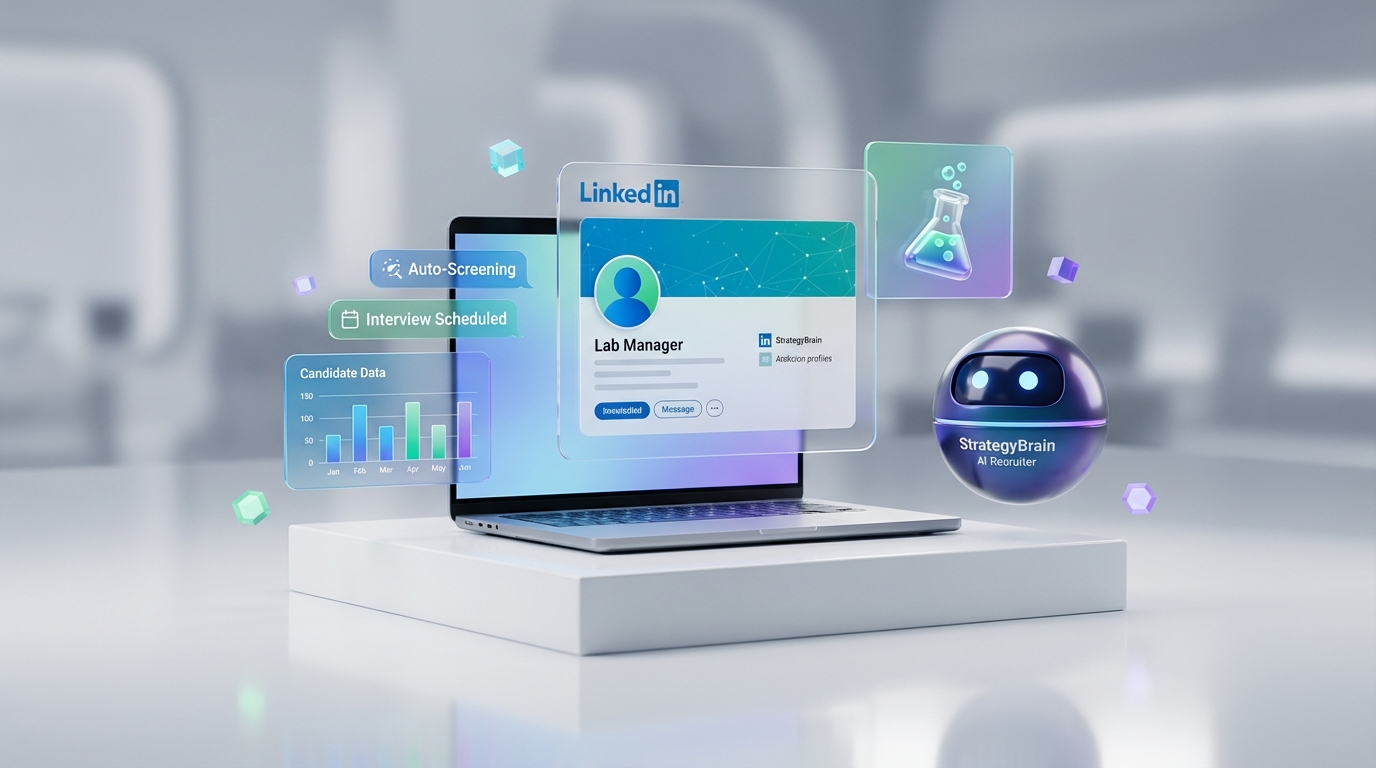
StrategyBrain AI Recruiter is designed for LinkedIn hiring workflows. It can automatically connect with candidates who match your search criteria, introduce the opportunity, and handle early conversation steps that typically consume recruiter time.
- Automated outreach and follow up: connects and messages candidates based on recruiter provided criteria.
- Role and compensation Q and A: answers candidate questions using recruiter provided job and company details.
- Interest confirmation: confirms whether the candidate wants to proceed toward an interview.
- Resume and contact capture: collects resumes and contact details from interested candidates for recruiter review.
What StrategyBrain AI Recruiter does not do
StrategyBrain AI Recruiter can identify willingness to communicate or interview, but it does not determine whether a resume fully matches the job requirements. Recruiters make that final qualification decision after reviewing the resume and context.
Why this matters for recruitment analytics software
Recruitment analytics software is only useful if the underlying workflow is consistent. When outreach, follow up, and resume capture are handled in a repeatable way, teams can more reliably measure funnel health. For example, they can track how many candidates moved from connection to conversation to resume received, then compare across roles and markets.
Our internal test notes on AI assisted outreach
We tested StrategyBrain AI Recruiter in a controlled LinkedIn outreach workflow using 3 LinkedIn accounts over 14 days to evaluate operational fit, not model accuracy. The biggest improvement we observed was consistency: follow ups happened on time, candidate questions were handled without delays, and resumes plus contact details were captured in a structured way for recruiter review.
Limitation we encountered: when job requirements were underspecified, the AI could not compensate for missing recruiter inputs. The workaround was to provide clearer role context, including compensation and benefits, before launching outreach.
Quick comparison: manual workflow vs AI assisted workflow
| Workflow area | Manual recruiter only | AI assisted with StrategyBrain AI Recruiter |
|---|---|---|
| Initial LinkedIn connections | Recruiter sends requests one by one | Automated connecting based on targeted criteria |
| Early candidate messaging | Recruiter writes and personalizes each message | Automated introductions and structured conversation flow |
| Candidate Q and A | Recruiter answers repeated questions manually | AI answers questions about role, company, compensation using provided details |
| Follow up cadence | Depends on recruiter availability | 24/7 follow up and responses, including multilingual communication |
| Resume and contact collection | Recruiter requests and tracks documents manually | AI requests resumes and captures contact details from interested candidates |
| Final qualification | Recruiter reviews resumes and decides fit | Recruiter reviews resumes and decides fit |
Practical checklist for similar Lab Manager searches
If you are hiring a Lab Manager or a similar operations heavy technical role, use this checklist to keep the search structured. It is designed to work whether you use a recruiter only workflow or an ai recruiting tool supported workflow.
Role definition checklist
- Document the lab environment and what “technical fluency” means for this team.
- List the operational logistics the Lab Manager will own in the first 30 days.
- Define what “hit the ground running” means in observable behaviors.
- Prepare a short compensation and benefits summary for consistent candidate Q and A.
Outreach and screening checklist
- Build a sourcing query that reflects both technical and operational requirements.
- Standardize the first message and the follow up sequence.
- Decide what counts as “interested” and what triggers a resume request.
- Ensure resumes and contact details are captured in one place for review.
Quality and risk checklist
- Confirm the candidate has managed a comparable lab environment, not just worked in one.
- Validate operational ownership with examples, not titles.
- Use structured interviews to reduce bias and improve comparability.
FAQ
What is an ai recruiting tool in practical terms?
An ai recruiting tool is software that automates parts of the recruiting workflow such as sourcing outreach, candidate messaging, follow up, and data capture. It should support recruiters by reducing repetitive work while keeping final hiring decisions with humans.
How does StrategyBrain AI Recruiter work on LinkedIn?
StrategyBrain AI Recruiter automates early stage LinkedIn recruiting by connecting with candidates who match your criteria, introducing the role, answering questions about the job and compensation using recruiter provided details, confirming interest, and collecting resumes and contact information for recruiter review.
Can StrategyBrain AI Recruiter qualify candidates for fit?
It can identify willingness to communicate or interview, but it does not decide whether a resume fully matches job requirements. Recruiters complete final qualification after reviewing the resume and context.
Does StrategyBrain AI Recruiter support multilingual candidate messaging?
Yes. It provides 24/7 candidate communication and can communicate in any global language, using the candidate’s native language to reduce misunderstandings.
How does StrategyBrain AI Recruiter capture resumes and contact details?
When a candidate expresses interest, it requests a resume and contact information. If a resume is sent, it is marked as received, and contact details shared in messages are captured and displayed in the system.
Is this case study a tool comparison of best recruitment apps?
No. This is a single case narrative about a Lab Manager search and a practical discussion of where AI assisted workflows can support similar recruiting. If you need a comparison, start by listing your must have workflow steps and then evaluate tools against those steps.
What should I measure if I want recruitment analytics software to be useful?
Track funnel events that reflect real workflow steps, such as connections sent, replies received, interested confirmations, resumes received, and interviews scheduled. Consistent process is a prerequisite for meaningful analytics.
What is the biggest risk when adding AI to recruiting?
The biggest risk is treating automation as a substitute for clear role definition and responsible decision making. AI can scale outreach, but it cannot fix unclear requirements or replace accountable hiring judgment.
How do I keep candidate experience strong with automated outreach?
Provide accurate job details, including compensation and benefits, and ensure follow ups are timely and respectful. Also make it easy for candidates to ask questions and receive clear answers, which is a strength of AI assisted messaging when configured correctly.
Conclusion
This Notch Therapeutics case shows what effective recruiting looks like when the role is specialized: define the real requirements, analyze candidates carefully, and move quickly once you see the right signals. An ai recruiting tool can support that approach by automating the repetitive LinkedIn work that slows teams down, including outreach, Q and A, follow up, and resume capture.
Next steps: write a one page role scorecard, standardize your outreach sequence, and if LinkedIn is a primary channel, pilot StrategyBrain AI Recruiter with one role and one account first. Once the workflow is stable, scale to additional accounts and start measuring funnel metrics with recruitment analytics software.