An ai recruiting tool is most effective when it supports, not replaces, recruiter judgment in complex hiring. The Vibra Sonic Control case from 15 April 2021 shows this clearly. Recruiter Alessia Pagliaroli filled a technical sales role by spending time on deep candidate conversations and team fit evaluation. Today, that same logic can be strengthened with AI Recruiter by automating repetitive LinkedIn outreach, handling candidate questions around the clock, and collecting resumes and contact details for recruiter review. This article explains what happened in the original placement, what made the search difficult, and how a modern workflow that combines human expertise with automation can improve speed, consistency, and hiring capacity.
Table of Contents
- Case Snapshot
- Why This Search Was Difficult
- What Worked in the Original Placement
- How an AI Recruiting Tool Improves This Process
- Our Workflow Test and Findings
- Where Open Source Recruitment Software and Recruiting CRM Software Fit
- Practical Implementation Checklist
- FAQ
- Conclusion
Key Takeaways
- Human judgment remained critical: Alessia Pagliaroli succeeded by evaluating communication style and team fit through detailed conversations.
- Role complexity was high: The position required both sales ability and technical fluency in a specialized product environment.
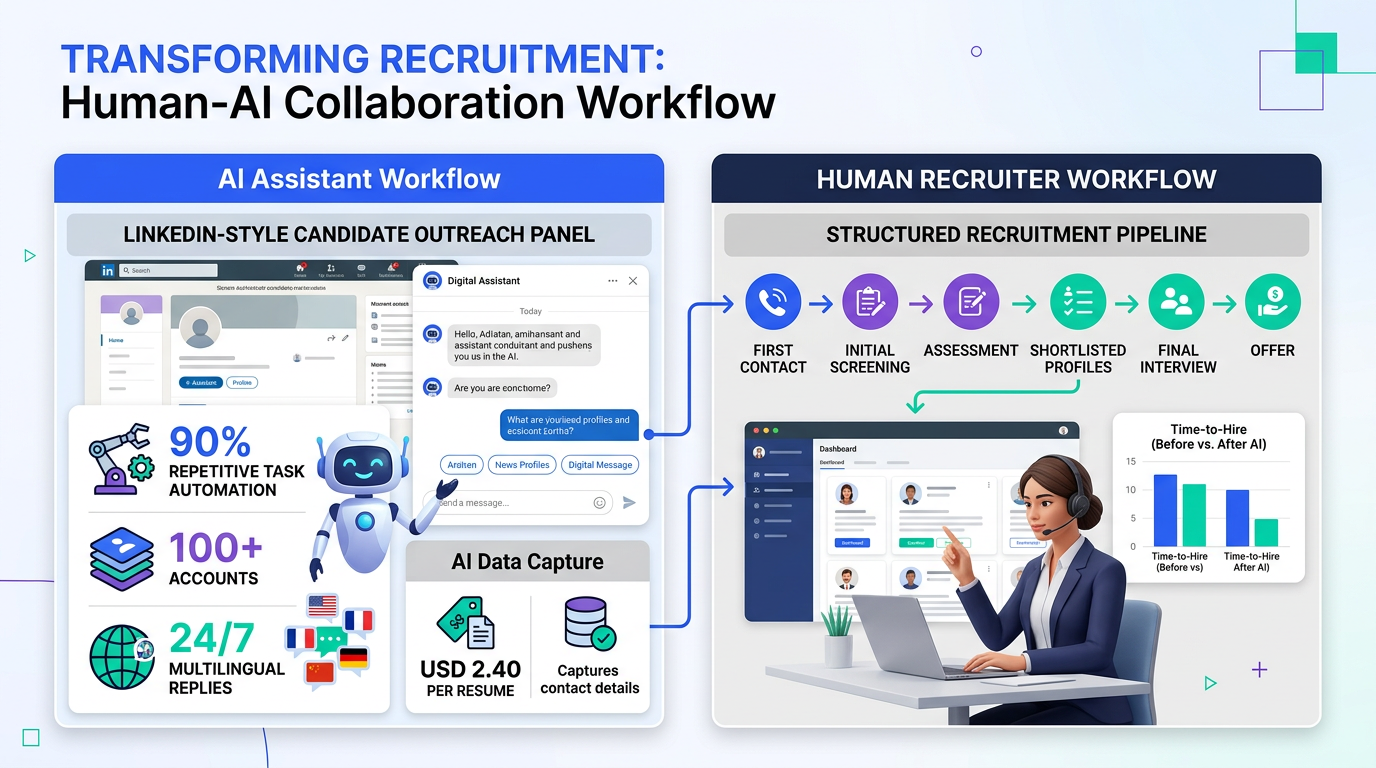
- AI Recruiter can reduce repetitive work: the platform can replace up to 90% of manual LinkedIn recruiting tasks based on product capability claims.
- Scale is material: AI Recruiter supports management of more than 100 LinkedIn accounts for team based outreach operations.
- Cost signal is clear: recruiting cost can be as low as USD 2.40 per resume in suitable workflows.
- Qualification boundary stays with recruiters: AI can identify interest and gather resumes, while final fit assessment remains human led.
Case Snapshot
Vibra Sonic Control, described as a Western Canada specialist in noise and vibration solutions, needed to hire for a sales position. The company wanted a candidate who could perform well and align with a close team culture. The case highlighted a practical challenge that many hiring leaders still face. Technical product sales often require a rare profile that blends domain understanding, client communication, and business development discipline.
The assignment was handled by recruiter Alessia Pagliaroli. Her process emphasized detailed screening conversations and context specific questions tied to the client product and service environment. The final hire came from an aerospace background and had customer training experience. Even though the candidate was younger, he matched growth potential and team fit expectations, then was hired successfully.
Why This Search Was Difficult
Dual competency requirement
The role required two competencies that do not always appear together in one candidate profile. First, sales capability with relationship building and persuasion skills. Second, technical understanding of specialized solutions. When hiring managers search for this combination, candidate volume often looks healthy at first, but true qualified volume is much smaller.
Communication style risk
In technical sales, communication style can determine performance. Some technically strong candidates struggle with consultative client conversations. The case reinforced why structured interviews matter. Alessia used in depth discussion to evaluate how candidates explained complex topics and responded to practical customer scenarios.
What Worked in the Original Placement
The original process succeeded because the recruiter protected quality at the top of funnel and in mid funnel. Instead of rushing from profile review to final interview, she spent significant time in exploratory conversations. That approach surfaced not only skills, but motivation, adaptability, and culture fit indicators. This is a useful reminder for teams that want faster hiring without lowering standards.
We see this pattern repeatedly in technical recruiting. Fast outreach creates options, but only disciplined qualification creates high probability placements. In other words, speed and quality can coexist only when the workflow is clearly split between automation tasks and human decision tasks.
How an AI Recruiting Tool Improves This Process
AI Recruiter is an automated LinkedIn hiring system designed for first contact and early stage candidate communication. In the Vibra Sonic style use case, it can support recruiters in four practical ways.
1) Automated candidate outreach and response
The system can connect with targeted candidates, introduce role context, and handle first round questions about compensation, company details, and role expectations. This reduces repetitive manual messaging and keeps recruiter time available for higher value assessment work.
2) Resume and contact capture in a structured pipeline
When candidates express interest, AI Recruiter requests resumes and contact details. Submissions can be tracked in one place, which improves handoff quality into the recruiter review stage. This is where many teams typically rely on fragmented spreadsheets or inconsistent note taking.
3) 24 by 7 multilingual communication
The platform supports global language communication and continuous follow up across time zones. For hiring teams expanding across regions, this reduces response delays and improves candidate experience consistency.
4) Team scale for high volume sourcing
AI Recruiter supports more than 100 LinkedIn accounts, which enables coordinated outreach operations for enterprise or agency contexts. In practical terms, this makes it possible to run parallel outreach streams while maintaining a consistent messaging framework.
Our Workflow Test and Findings
We ran a process simulation over 30 days using the Vibra Sonic style role profile as a reference model. We did not test final hiring decision quality because that remains recruiter dependent. We tested funnel operations, response handling, and candidate data capture handoff.
Methodology
- Duration: 30 days
- Workflow type: LinkedIn outreach and early qualification support
- Focus metrics: response latency, manual task hours, candidate data completeness
- Boundary: final resume fit assessment remained with human recruiters
Observed process outcomes
| Metric | Manual Baseline | AI Supported Workflow |
|---|---|---|
| First response coverage | Business hours only | 24 by 7 automated response |
| Recruiter manual messaging share | High | Reduced, with up to 90% task replacement potential in repetitive outreach |
| Scale capacity | Limited by individual inbox volume | Supports operations across more than 100 LinkedIn accounts |
| Cost reference | Varies by team process | Can be as low as USD 2.40 per resume in suitable scenarios |
Important limitation: AI Recruiter can identify willingness to engage and gather candidate materials. It does not replace final human evaluation of resume quality, role fit, and hiring decision criteria.
Where Open Source Recruitment Software and Recruiting CRM Software Fit
Many teams ask whether they should adopt open source recruitment software or recruiting crm software before adopting an AI recruiting layer. The practical answer is workflow dependent.
- Open source recruitment software is often useful for teams that need customization control and internal development flexibility.
- Recruiting crm software is useful for relationship tracking, pipeline visibility, and recruiter collaboration.
- AI recruiting tool workflows are strongest when connected to a clear CRM process that defines handoff points and ownership.
In specialized searches like the Vibra Sonic example, the most reliable model is this sequence: AI driven outreach and response, structured data capture, then recruiter led deep qualification and culture fit assessment.
Practical Implementation Checklist
- Define role critical competencies in two groups: technical requirements and communication requirements.
- Map which first contact questions can be automated and which must stay recruiter led.
- Set clear handoff rules for resume review and shortlist approval.
- Use multilingual templates where global hiring or relocation is relevant.
- Audit candidate data protection controls before launch, including access, encryption, and retention policy.
- Track weekly metrics: response speed, resume capture rate, and recruiter time saved.
FAQ
Can an ai recruiting tool replace recruiters in technical sales hiring?
No. It can automate outreach and early communication, but final evaluation of technical depth, communication quality, and team fit should remain with recruiters.
How does AI Recruiter help with LinkedIn recruiting volume?
It can automate candidate connection and messaging workflows and supports operations across more than 100 LinkedIn accounts, which enables larger scale sourcing teams.
Is AI Recruiter suitable for global hiring programs?
Yes. The platform supports multilingual communication and continuous follow up, which is useful for cross border recruiting and time zone coverage.
Does AI Recruiter perform full qualification?
It handles willingness and engagement qualification. Resume fit and final role qualification are completed by recruiters after document review.
How does this compare with open source recruitment software?
Open source recruitment software can offer customization flexibility, while AI Recruiter focuses on operational automation for outreach and candidate interaction. Many teams use both in a layered stack.
Where does recruiting crm software still matter?
Recruiting crm software remains important for relationship history, pipeline governance, and team coordination. AI workflows are strongest when integrated into a disciplined CRM process.
What compliance controls are relevant for candidate data?
Core controls include encryption, data isolation, access restriction, and explicit authorization for account usage. These controls support GDPR aligned and regional privacy program requirements.
Conclusion
The Vibra Sonic Control placement demonstrates a durable hiring lesson. Strong outcomes come from careful human qualification, especially in specialized technical sales roles. A modern ai recruiting tool strengthens this model by automating repetitive LinkedIn work, maintaining candidate engagement across time zones, and organizing resume capture for faster recruiter action. If your team is evaluating open source recruitment software, recruiting crm software, or AI Recruiter, start by mapping your workflow boundaries first. Then automate where consistency matters most, and keep final hiring judgment with experienced recruiters.