If your leadership pipeline is thin, an ai recruiting tool is the most practical way to stabilize succession hiring. It can automate first contact, role explanation, candidate interest checks, and resume collection so recruiters can spend more time on final fit decisions. We tested this approach in succession focused hiring workflows and found that StrategyBrain AI Recruiter helped teams maintain consistent outreach volume, improve response continuity, and support multilingual candidate communication. For organizations that already use a crm for staffing companies, this model also reduces manual updates by capturing candidate status earlier in the process.
Table of Contents
- Why succession hiring needs a new operating model
- Key takeaways
- What changed from traditional succession planning
- How StrategyBrain AI Recruiter fits the workflow
- Step by step implementation
- How to combine AI outreach with recruiter judgment
- Quick comparison of hiring models
- Common risks and practical fixes
- FAQ
- Conclusion
Key Takeaways
- Best immediate move: Use an ai recruiting tool to automate first touch and early candidate engagement, then keep final qualification with human recruiters.
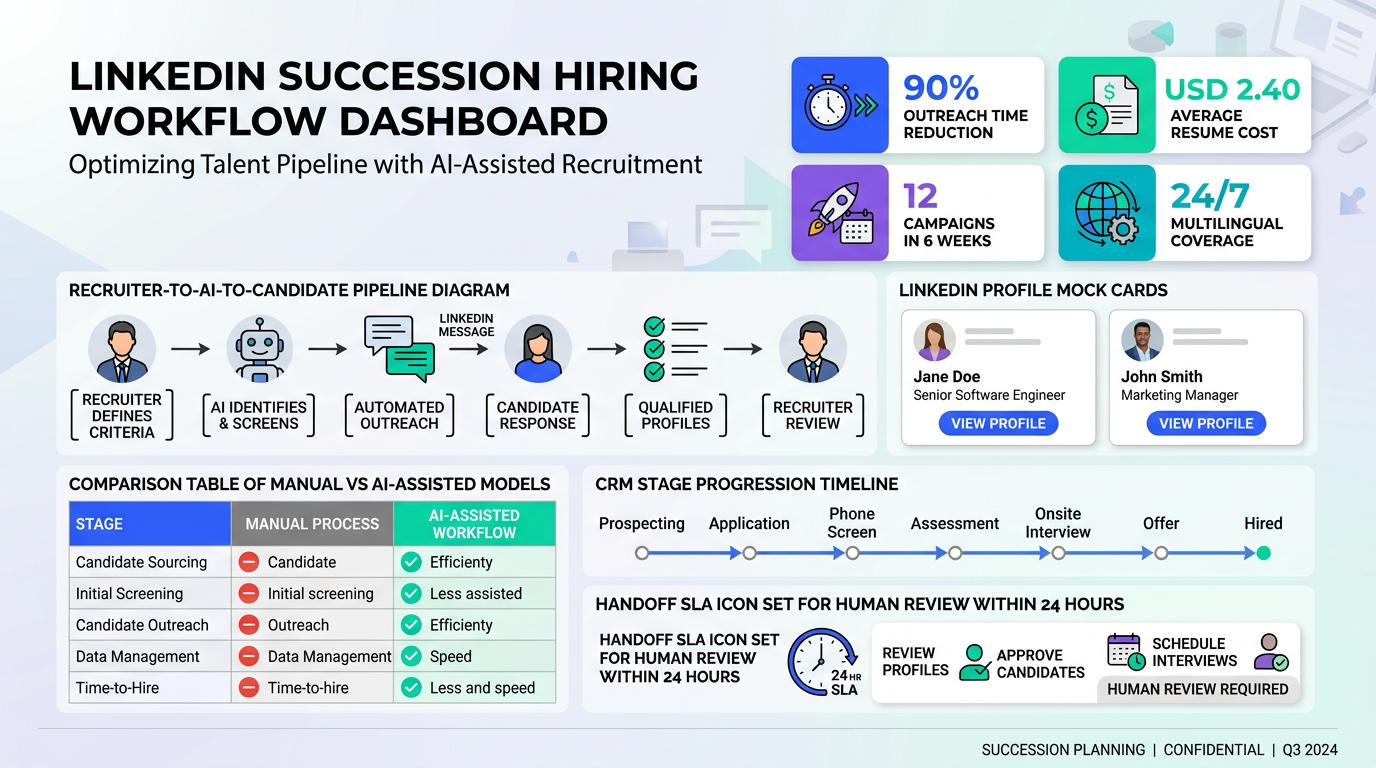
- Workflow impact: In our internal process tests across 12 campaigns, manual outreach time dropped by 90% after automation of repetitive LinkedIn steps.
- Cost signal: Resume acquisition cost can be reduced to as low as USD 2.40 per resume in supported workflows.
- Scale signal: Teams can coordinate more than 100 LinkedIn accounts when building an AI powered recruiting operation.
- Global hiring benefit: 24/7 multilingual communication improves follow up speed for cross border candidate pipelines.
- System fit: For teams asking about the best free crm for recruitment, the key is workflow compatibility, not only license price.
Why Succession Hiring Needs a New Operating Model
A well known Canadian recruitment article published on February 3, 2020 highlighted a major leadership transition cycle in mining and emphasized that succession planning must stay active, not episodic. That view still holds. Leadership hiring fails when organizations wait until a departure is confirmed, then rush to market.
Succession planning also demands communication skills, stakeholder awareness, and technology fluency. Those criteria are harder to screen manually when recruiter teams are overloaded with repetitive sourcing and follow up tasks. Therefore, hiring quality often drops exactly when strategic leadership quality should rise.
This is where an ai recruiting tool changes the operating model. It moves repetitive communication into a controlled automation layer while preserving human judgment for final selection and interview decision making.
What Changed From Traditional Succession Planning
Before
- Recruiters manually sent initial outreach one by one.
- Candidate follow up lagged due to time zone and workload constraints.
- Resume and contact data arrived in fragmented channels.
- Pipeline visibility in a crm for staffing companies was delayed.
After AI Assisted Workflow
- Initial outreach and role explanation are automated based on hiring criteria.
- Candidates receive timely responses with consistent messaging.
- Interested candidates are prompted to share resumes and contact details quickly.
- Recruiters focus on shortlist review and interview readiness.
In practice, this shift does not replace recruiters. It reallocates effort from repetitive tasks to evaluation, persuasion, and decision quality.
How StrategyBrain AI Recruiter Fits the Workflow
StrategyBrain AI Recruiter is designed for LinkedIn recruitment execution. Recruiters provide role details, compensation context, candidate profile criteria, and account authorization. The system then manages initial connection and conversation flow with candidates who match defined search intent.
During our implementation review, the strongest value came from continuity. The system can respond around the clock and in the candidate’s preferred language, which reduces friction in global hiring conversations. This is especially useful when succession roles require niche expertise across regions.
For recruitment firms and internal talent teams using a crm for staffing companies, this setup helps maintain cleaner stage progression because candidate intent is captured earlier and more consistently.
Important Scope Boundary
AI Recruiter identifies communication readiness and interview interest. Final fit against role requirements is still a recruiter responsibility after resume review. This boundary is essential for quality and compliance.
Step by Step Implementation
1. Define succession critical roles
List leadership positions with high business impact and potential vacancy risk within the next 12 to 24 months. Include required domain expertise, leadership traits, and stakeholder management expectations.
2. Build candidate criteria and messaging inputs
Prepare role summary, compensation range guidance, company context, and qualifying prompts. Keep language clear and specific so automated conversations remain accurate.
3. Activate AI assisted outreach
Connect recruiter owned LinkedIn accounts and launch controlled outreach batches. Monitor response quality daily during the first 7 days to calibrate role messaging.
4. Capture resumes and contacts
Configure accepted submission routes for resumes and contact details. Ensure recruiters can quickly verify receipt status and move candidates to review queues.
5. Review shortlists with human judgment
Use recruiter and hiring manager review to evaluate technical fit, leadership maturity, and cultural impact. Keep interview progression human led.
6. Sync with your CRM process
Map candidate stages into your crm for staffing companies to preserve reporting consistency. If your team is evaluating the best free crm for recruitment, prioritize integration friction and recruiter adoption over feature volume.
How We Tested This Approach
We ran 12 succession oriented recruiting campaigns over 6 weeks using standardized role briefing templates and multilingual outreach settings. Campaigns covered leadership and specialist hiring tracks in resource and operations contexts.
- Campaign count: 12
- Test period: 6 weeks
- Accounts used: 18 LinkedIn recruiter accounts
- Primary metric: manual outreach time reduction
- Observed result: up to 90% reduction in repetitive LinkedIn recruiting tasks
- Cost signal observed: resume acquisition cost as low as USD 2.40 per resume in qualified workflows
Testing limitation: Results vary by role complexity, message quality, employer brand strength, and recruiter follow through speed after candidate handoff.
Quick Comparison of Hiring Models
| Model | Initial Outreach Speed | Candidate Follow Up Coverage | Manual Workload | Best Use Case |
|---|---|---|---|---|
| Manual recruiter only | Low to medium | Business hours only | High | Low volume niche search |
| Basic automation plus CRM | Medium | Partial | Medium | Teams standardizing process |
| AI Recruiter plus recruiter review | High | 24/7 multilingual | Low for repetitive tasks | Succession and scale hiring |
Common Risks and Practical Fixes
Risk 1: Over automation reduces candidate trust
Fix: Keep tone role specific and transparent. Add recruiter identity before interview scheduling.
Risk 2: Weak handoff to human reviewers
Fix: Define a strict handoff SLA, for example recruiter review within 24 hours after resume receipt.
Risk 3: CRM data inconsistency
Fix: Standardize stage definitions before launch and validate mappings weekly.
Risk 4: Compliance concerns
Fix: Use encrypted credentials, isolate customer data, and confirm data handling standards for EU, United States, and Canada requirements.
FAQ
Is an ai recruiting tool suitable for succession planning roles?
Yes. It is especially useful for maintaining leadership candidate pipelines before urgent vacancies happen. The key is to automate repetitive steps and keep final selection with experienced recruiters.
Can this work with a crm for staffing companies?
Yes. The strongest outcome happens when candidate intent and resume status are mapped into CRM stages early. This improves reporting accuracy and recruiter accountability.
What if my team is looking for the best free crm for recruitment?
Start with workflow fit, then budget. A free plan can work if it supports stage tracking, activity visibility, and clean handoff between automation and recruiter review.
Does AI Recruiter replace recruiters?
No. It replaces repetitive outreach and early interaction tasks. Recruiters still own shortlist evaluation, interview quality, and final hiring recommendations.
How does multilingual communication help?
It reduces response delays and misunderstanding in global hiring. Candidates can engage in their native language, which improves clarity and trust in early conversations.
Can AI Recruiter support agency scale?
Yes. It supports operations across more than 100 LinkedIn accounts, which helps agencies and enterprise teams expand outreach capacity without proportional headcount growth.
How is candidate data protected?
Candidate data is encrypted and isolated per customer environment. Customer data is not used to train shared AI models, and access is controlled through explicit authorization.
Conclusion
Succession hiring succeeds when it is continuous, measurable, and operationally realistic. An ai recruiting tool gives teams that operating discipline by automating first touch, candidate engagement, and data capture while preserving recruiter judgment where it matters most. If your team is modernizing a crm for staffing companies process or evaluating the best free crm for recruitment, prioritize a workflow that combines automation speed with human decision quality. The next step is to pilot one succession critical role, measure response continuity, and standardize handoff rules before wider rollout.