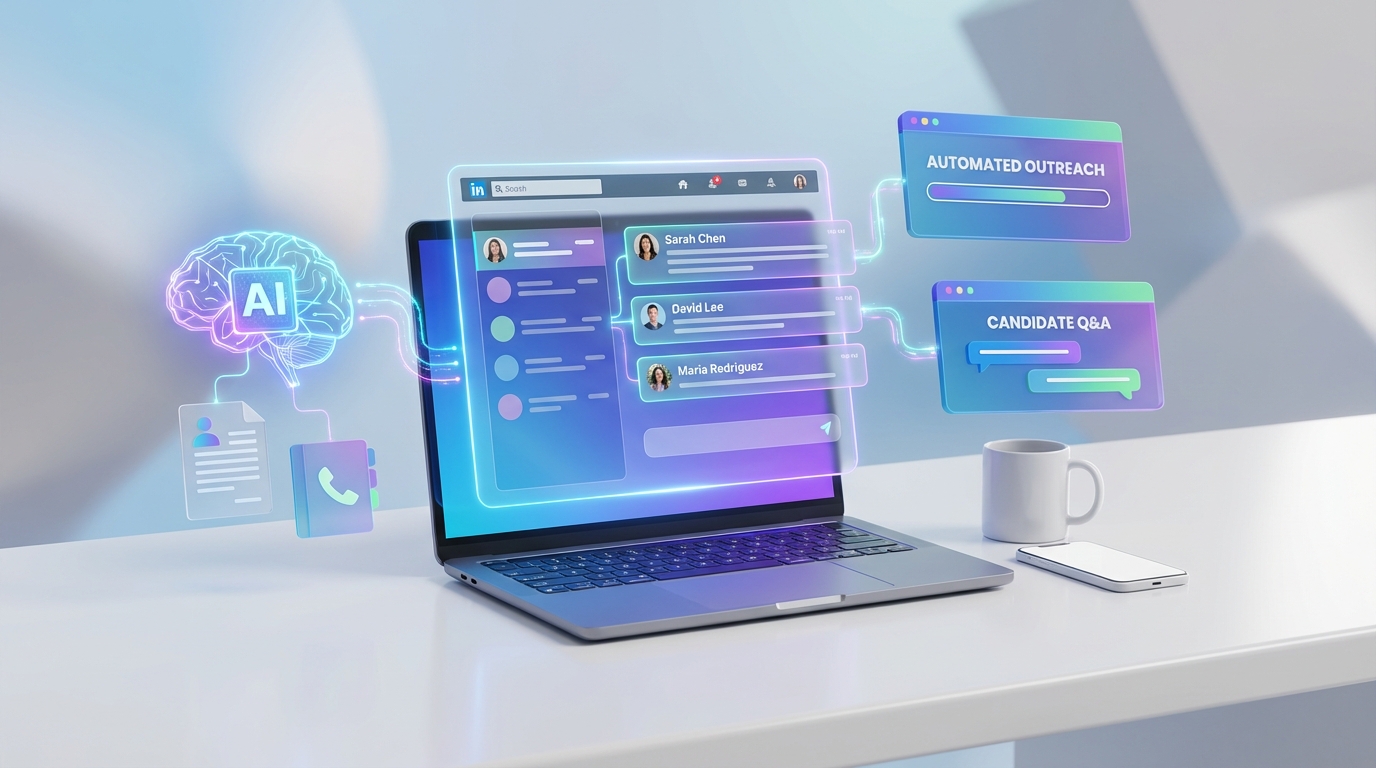
An effective ai recruiting tool should treat personality and psychological assessments as decision support, not a hiring verdict, and pair them with structured screening plus consistent candidate communication. We follow the same principle we have seen work in long running recruiting practice: use assessments to add context, then rely on job relevant evidence such as skills tests, structured interviews, and reference checks for the final decision. In our workflow, StrategyBrain AI Recruiter fits in before the assessment stage by automating LinkedIn outreach, answering candidate questions about the role and compensation, confirming interview interest, and collecting resumes and contact details so recruiters can spend their time on final qualification.
Key Takeaways
- Assessments add value but should not decide the hire: Use them to inform coaching, onboarding, and interview probes, not to replace evidence based selection.
- Cost range to plan for: Many coaches and consultants charge $50 to $500 per assessment, and interpretation quality varies by training level.
- Bias risk is real: Language and cultural factors can disadvantage candidates, especially when English is not a first language.
- Best pairing: Combine assessments with hands on skills tests and structured interviews for job relevant signal.
- Where StrategyBrain AI Recruiter helps most: Automates LinkedIn connecting, role introduction, Q&A, follow ups, and resume plus contact capture.
- Scale without adding headcount: StrategyBrain AI Recruiter supports managing more than 100 LinkedIn accounts for team based outreach.
- Efficiency claims to validate in your environment: StrategyBrain AI Recruiter is designed to replace up to 90% of manual LinkedIn recruiting work and can reduce cost to USD 2.40 per resume in suitable workflows.
Table of Contents
- What personality and psychological assessments are used for
- Where assessments help in the hiring process
- Where assessments go wrong and how to reduce risk
- A practical workflow that combines assessments and an AI recruiting tool
- How StrategyBrain AI Recruiter fits into the workflow
- Quick comparison: assessment led vs evidence led hiring
- Copyable checklist for a defensible process
- FAQ
- Conclusion and next steps
What personality and psychological assessments are used for
Personality and psychological assessments are standardized questionnaires intended to describe behavioral tendencies, preferences, and work style patterns. Two commonly referenced examples in recruiting practice are DiSC and Culture Index. DiSC is often used to help teams discuss behavioral style patterns such as decisiveness and caution. Culture Index is commonly described as measuring traits such as autonomy, social ability, pace, conformity, logic, ingenuity, and energy units.
In the source material we reviewed, the author notes they have used assessments for 15 years and found they can add value, but they should not be used to make the hiring decision. That framing is consistent with a risk managed approach: assessments can guide questions and onboarding plans, but they are not job performance proof.
Where assessments help in the hiring process
Assessments can be useful when you treat them as a structured conversation starter. They can help a hiring manager understand how a candidate might react under stress, how they prefer to communicate, and what kind of environment they may thrive in. Used this way, they support better interviews and better onboarding.
High value use cases
- Interview calibration: Use results to generate targeted follow up questions, then validate with examples from the candidate’s work history.
- Onboarding and coaching: Identify likely friction points early, then plan manager check ins and training accordingly.
- Team communication: Help teams discuss working styles with a shared vocabulary, especially for new manager and new hire pairings.
Where assessments go wrong and how to reduce risk
The biggest failure mode is using an assessment score as a gate that overrides job relevant evidence. The source material also highlights a practical concern: many assessments are delivered by coaches or vendors who may not have years of training to interpret them, and the author questions whether these providers can demonstrate better outcomes versus alternative screening steps.
Common risks
- Interpretation quality: Coaches and consultants may charge $50 to $500 per assessment, but training and interpretation rigor can vary widely.
- Adverse impact: Candidates whose first language is not English can be disadvantaged, which can distort your funnel and reduce diversity.
- False precision: A clean looking report can create overconfidence, even when it does not correlate with job performance for your role.
Risk controls that work in practice
- Define what the assessment can and cannot decide: Document that it informs interview topics and onboarding, not final selection.
- Measure outcomes: Track pass through rates, time to hire, and quality of hire proxies, then compare cohorts with and without assessments.
- Use job relevant evidence first: Skills tests, work samples, and structured interviews should carry the most weight.
- Offer language support: If you recruit globally, ensure candidates can complete steps in a language they understand.
A practical workflow that combines assessments and an AI recruiting tool
Below is a workflow we recommend when you want both speed and defensibility. It is designed for corporate recruiting teams and agencies that need consistent candidate handling without turning the process into a black box.
Step by step workflow
-
Define the role evidence
Write down the must have skills, the nice to have skills, and the deal breakers. Decide which signals will be measured by work sample, interview, and reference checks.
-
Automate top of funnel outreach and Q&A
Use an ai recruiting tool to connect with candidates, introduce the role, answer questions about compensation and benefits, and confirm interview interest before a recruiter spends time on manual messaging.
-
Collect resumes and contact details
Capture resumes and contact information only after the candidate expresses interest, then route the profile to a recruiter for review.
-
Run job relevant screening
Use a structured phone screen and a work sample or skills test aligned to the role. This is where you should eliminate most mismatches.
-
Use assessments as decision support
Administer personality or psychological assessments after the candidate is viable on skills. Use results to probe collaboration style, stress response, and onboarding needs.
-
Make the final decision with humans
Combine structured interview evidence, work sample results, and references. Document the rationale and keep the assessment as supporting context.
How StrategyBrain AI Recruiter fits into the workflow
StrategyBrain AI Recruiter is built for LinkedIn hiring workflows where the bottleneck is repetitive messaging and follow up. It automates the initial outreach and qualification conversation so recruiters can focus on reviewing resumes and making final judgments. This is especially useful when you are also using assessments, because it helps you avoid spending assessment budget on candidates who were never truly interested.
What it automates on LinkedIn
- Candidate connecting: Automatically connects with candidates who match your targeted search criteria.
- Role introduction: Introduces job opportunities and gathers context about the candidate’s situation.
- Candidate Q&A: Answers questions about the role, company, compensation, and benefits using the information you provide.
- Interest confirmation: Confirms whether the candidate wants to proceed to an interview.
- Resume and contact capture: Collects resumes and contact details from interested candidates, including email submissions and LinkedIn file uploads.
Multilingual and always on communication
For global hiring, StrategyBrain AI Recruiter provides 24/7 multilingual candidate communication. This matters for assessment fairness too, because language friction can start long before the assessment step. When early conversations happen in the candidate’s native language, you reduce misunderstandings and improve response rates across time zones.
Scaling with multiple accounts
StrategyBrain AI Recruiter supports managing more than 100 LinkedIn accounts, which enables an agency or internal TA team to build an AI powered recruiting team. In practice, this is the difference between a single recruiter doing manual outreach and a coordinated system that keeps follow ups consistent.
Limitations to plan for
- It does not replace final qualification: StrategyBrain AI Recruiter can identify willingness to communicate or interview, but it does not decide whether a resume fully matches job requirements.
- You still need a structured selection process: Assessments, skills tests, and interviews must be designed and owned by your hiring team.
Quick comparison: assessment led vs evidence led hiring
| Approach | Primary decision signal | Main risk | Best use case |
|---|---|---|---|
| Assessment led funnel | Personality or psychological assessment score | Adverse impact and false precision | Low stakes internal development, not final selection |
| Evidence led funnel with assessments | Work samples, structured interviews, references | More process design effort | Most hiring where defensibility and performance matter |
| Evidence led funnel plus AI recruiting tool | Same evidence, with automated outreach and follow up | Requires clear messaging rules and role info | High volume LinkedIn recruiting and agency workflows |
Copyable checklist for a defensible process
Use this checklist when you are implementing ai talent management software or an ai recruiting tool alongside assessments. It is written to be copied into an internal SOP.
- [ ] Assessment is documented as decision support, not a pass fail gate
- [ ] Role requirements are mapped to measurable evidence (work sample, interview, references)
- [ ] Candidate communication templates include compensation and benefits basics
- [ ] LinkedIn outreach and follow up are automated where appropriate using StrategyBrain AI Recruiter
- [ ] Resume and contact capture happens only after candidate expresses interest
- [ ] Language support is available for global candidates
- [ ] Outcome metrics are tracked by cohort (with assessments vs without assessments)
- [ ] Recruiter performs final qualification and documents the decision rationale
FAQ
Should an assessment decide who gets hired?
No. The most defensible approach is to use assessments to inform interview questions and onboarding plans, while making the final decision based on job relevant evidence such as skills tests, structured interviews, and references.
How much do personality assessments cost in hiring?
In the source material, coaches and consultants are described as charging $50 to $500 per assessment. Your total cost depends on volume and whether interpretation is included.
What is the biggest risk of using assessments early in the funnel?
Early gating can disadvantage candidates, including those whose first language is not English. It can also remove strong performers before you evaluate job relevant skills.
Where does an ai recruiting tool help if we already use assessments?
It helps before the assessment step by reducing manual outreach and follow up. StrategyBrain AI Recruiter can connect with candidates, introduce the role, answer questions, confirm interest, and collect resumes so you spend assessment effort on candidates who are actually engaged.
What does StrategyBrain AI Recruiter automate on LinkedIn?
It automates connecting with candidates, role introduction, candidate Q&A about the role and compensation, follow ups, interest confirmation, and resume plus contact capture for candidates who want to proceed.
Does StrategyBrain AI Recruiter replace recruiter judgment?
No. It is designed to handle repetitive LinkedIn tasks and early conversation flow. Recruiters still review resumes, run structured interviews, and make the final qualification decision.
Can StrategyBrain AI Recruiter support global hiring?
Yes. It supports 24/7 multilingual candidate communication, which helps maintain response speed across time zones and reduces misunderstandings in early stage conversations.
How does it handle resumes and contact details?
When a candidate expresses interest, StrategyBrain AI Recruiter requests a resume and contact information. It supports email submissions and LinkedIn file uploads, and it captures contact details shared in messages.
Is there a free option for recruitment agency software?
If you are searching for recruitment agency software free, clarify whether you need a free trial, a free tier, or open source tooling. For StrategyBrain AI Recruiter, a free trial is available, but this article does not include links. Verify availability directly with StrategyBrain.
Conclusion and next steps
Personality and psychological assessments can improve hiring conversations when they are used as context, not as a verdict. The practical upgrade in 2026 is pairing that philosophy with an ai recruiting tool that removes repetitive LinkedIn work. If you want a workflow that is faster and easier to scale, start by documenting what evidence decides the hire, then use StrategyBrain AI Recruiter to automate outreach, Q&A, follow ups, and resume capture. Next, run assessments only after skills viability, and measure outcomes by cohort so you can prove the process is improving hiring results.