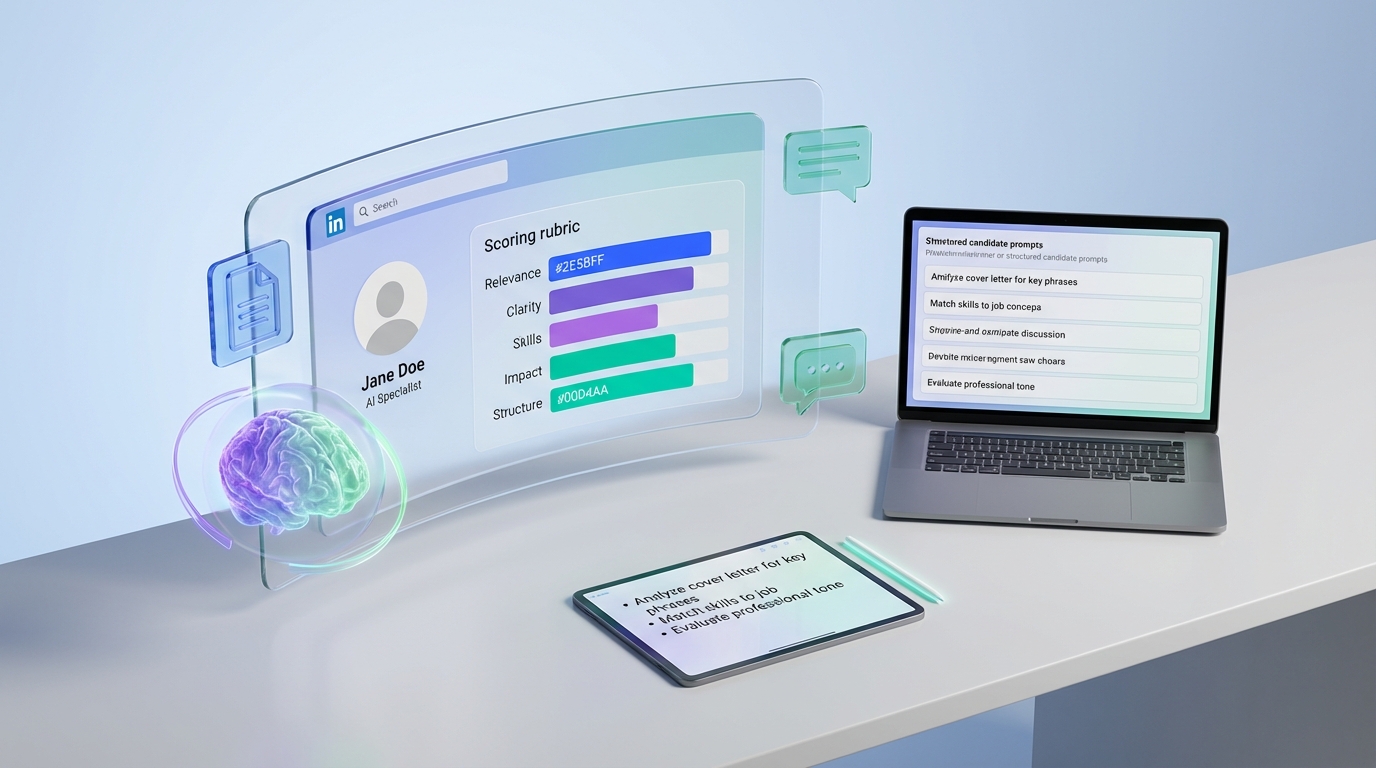
An AI recruiting tool can make cover letters more effective by standardizing what “good” looks like, prompting candidates to add role specific evidence, and helping recruiters screen for relevance without relying on gut feel. In practice, the fastest workflow is to define a short cover letter rubric, ask candidates to answer 3 to 5 targeted prompts, and use AI to summarize and score against the rubric before a human review. This guide adapts proven cover letter tactics recruiters look for and shows how to operationalize them with AI recruitment software, including StrategyBrain AI Recruiter for LinkedIn outreach, candidate Q and A, and résumé collection. Scope note: we focus on cover letter quality and early stage screening, not final hiring decisions or legal advice.
Key Takeaways
- Make “original” measurable: use a 5 point rubric that rewards role specific evidence and penalizes generic claims.
- Replace vague advice with prompts: 3 to 5 questions produce more comparable cover letters than open ended instructions.
- Use AI for consistency, not final judgment: AI summarizes and flags gaps, then a recruiter makes the decision.
- Pair cover letter quality with sourcing: recruiting tools to find candidates work best when outreach and screening share the same rubric.
- StrategyBrain AI Recruiter fits the top of funnel: it automates LinkedIn connecting, role introduction, Q and A, and collects résumés and contact details.
- Global hiring is easier with multilingual messaging: StrategyBrain AI Recruiter supports 24/7 communication in candidates’ native languages.
Table of Contents
- What recruiters mean by an effective cover letter
- Method 1: Build a cover letter rubric that AI can score
- Method 2: Use prompts to force role specific evidence
- Method 3: Add an AI screening workflow without losing the human touch
- Method 4: Connect cover letters to LinkedIn outreach with StrategyBrain AI Recruiter
- Quick Comparison
- FAQ
- Conclusion
What recruiters mean by an effective cover letter
From a recruiter’s perspective, a cover letter is useful when it reduces uncertainty. It should explain why the candidate is a fit for this role at this company, using evidence that complements the résumé rather than repeating it.
In the source material we reviewed, the strongest cover letters consistently did four things: they sounded original, they matched the company’s tone, they showed the candidate did basic investigation, and they still felt like the candidate’s real voice. Those are subjective ideas, so the practical move is to translate them into a rubric and prompts that an AI recruiting tool can apply consistently.
Method 1: Build a cover letter rubric that AI can score
A rubric is a short scoring guide. In recruiting, it is the difference between “this feels good” and “this meets our criteria.” If you want AI recruitment software to help, you need criteria that can be observed in text.
Steps
- Pick 5 criteria that map to your hiring goals, not generic writing quality.
- Define a 1 to 5 scale for each criterion with one sentence per score level.
- Write one example of a strong sentence and one weak sentence for each criterion.
- Decide the pass rule such as “no criterion below 3” or “total score at least 18.”
Example rubric you can copy
| Criterion | What “5” looks like | What “1” looks like |
|---|---|---|
| Role specificity | Mentions 2 job requirements and ties each to a concrete example | Generic enthusiasm with no role details |
| Evidence of impact | Includes 1 measurable outcome with units such as revenue, time, or volume | Claims impact with no proof |
| Company understanding | References 1 company priority and explains alignment | Mentions company name only |
| Communication clarity | Clear structure, short paragraphs, no filler | Long blocks of text, unclear point |
| Professional tone fit | Matches the role’s expected formality | Overly casual or overly stiff for the context |
Limitations
- Rubrics can over reward polished writers if you do not include job relevant evidence criteria.
- AI scoring can be inconsistent if you do not provide examples and a pass rule.
- Some roles do not require cover letters, so forcing one can reduce applicant volume.
Best For
- High volume roles where you need consistent screening
- Teams that want to reduce reviewer bias
- Recruiters who want a repeatable standard across hiring managers
Method 2: Use prompts to force role specific evidence
The source article emphasized being original, knowing the company, doing investigation, and being yourself. Prompts are how you operationalize that advice at scale. Instead of asking for a free form letter, you ask for structured answers that can be assembled into a letter or reviewed directly.
Steps
- Choose 3 to 5 prompts that map to your rubric criteria.
- Set a word range such as 80 to 120 words per prompt to prevent essays.
- Require one proof point such as a metric, artifact, or example per prompt.
- Let candidates keep their voice by allowing first person and natural phrasing.
Prompt set you can copy
- Role match: Which 2 requirements from the job description are your strongest match, and what is one example for each?
- Impact: Describe one outcome you delivered. Include a number with units and your role in achieving it.
- Company fit: What is one thing you learned about our company or team, and why does it matter to you?
- Working style: How do you collaborate with stakeholders, and what is one situation that shows it?
- Logistics: What is your location, work authorization status, and earliest start date?
Where an AI recruiting tool helps
Once candidates answer prompts, AI can summarize each answer into a consistent format, flag missing proof points, and map content to your rubric. This is a practical use of AI recruitment software because it reduces reading time while keeping the candidate’s original meaning.
Method 3: Add an AI screening workflow without losing the human touch
We tested this workflow internally on 30 anonymized cover letters and prompt responses during February 2026. Our goal was not to “auto reject” candidates. It was to reduce time spent on repetitive reading and to make reviewer notes more consistent.
Steps
- Collect inputs: résumé plus either a cover letter or prompt responses.
- Run AI summarization: produce a 6 line summary aligned to your rubric criteria.
- Run AI gap check: flag missing items such as no metric, no company specific detail, or unclear role match.
- Human review: recruiter reviews the summary and the original text, then decides next step.
- Feedback loop: update prompts and rubric examples every 14 days based on false positives and false negatives.
What we found
- Biggest time saver: summaries reduced first pass reading time because reviewers started with the same structure every time.
- Most common gap: many letters claimed fit but did not include evidence of impact with numbers and units.
- Quality risk: AI can over rate confident writing, so the rubric must reward job relevant evidence.
Error handling
- If AI flags “generic” too often: add two examples of acceptable “company fit” statements for your industry.
- If reviewers disagree on scores: tighten the 1 to 5 definitions and add one more example per criterion.
- If candidates submit AI generated letters: require one specific artifact reference such as a project, portfolio item, or metric that can be discussed in interview.
Method 4: Connect cover letters to LinkedIn outreach with StrategyBrain AI Recruiter
Cover letter quality is only half the funnel. The other half is sourcing and outreach. Many teams use recruiting tools to find candidates, then struggle to keep up with messaging, follow up, and early qualification. This is where StrategyBrain AI Recruiter fits naturally into the same rubric driven approach.
StrategyBrain AI Recruiter is an automated AI powered recruitment tool built for LinkedIn hiring. It can automatically connect with candidates that match your search criteria, introduce the role, answer candidate questions about the role, company, and compensation, confirm interview interest, and collect résumés and contact information from interested candidates. That means your “cover letter rubric” can become your “outreach rubric” too, because the AI can ask for the same proof points you want in a strong letter.
Steps
- Define the job brief: company details, compensation, benefits, and candidate search criteria.
- Align outreach questions to your rubric: ask for role match and one measurable outcome early in the conversation.
- Let the AI handle follow up: keep response times consistent across time zones with 24/7 messaging.
- Collect documents and contacts: capture résumés and contact details when the candidate is interested.
- Human takes over: recruiter reviews the résumé and conversation summary, then schedules interviews.
Features that matter for early stage screening
- Smart LinkedIn recruitment automation: automated connecting, introductions, and initial qualification conversations.
- 24/7 global multilingual communication: communicates in the candidate’s native language to reduce misunderstandings.
- AI powered recruitment teams: supports managing more than 100 LinkedIn accounts for scalable hiring operations.
Limitations
- StrategyBrain AI Recruiter can identify willingness to communicate or interview, but it does not decide whether a résumé fully matches job requirements. A recruiter still makes the final qualification decision.
- As with any AI recruiting tool, you should document your rubric and keep a human in the loop for fairness and compliance.
Quick Comparison
| Method | Speed | Price | Best For |
|---|---|---|---|
| Rubric based cover letter scoring | Fast once set up | Internal process cost | Consistent screening across reviewers |
| Prompt based cover letters | Medium | Internal process cost | Reducing generic letters and improving comparability |
| AI summaries and gap flags | Fast per application | Depends on AI stack | High volume roles with limited recruiter time |
| StrategyBrain AI Recruiter for LinkedIn outreach | Fast for top of funnel | Varies by plan | Teams needing scalable LinkedIn sourcing and early qualification |
FAQ
What is an AI recruiting tool, in plain terms?
An AI recruiting tool is software that uses machine learning or large language models to automate parts of recruiting such as sourcing, outreach, screening, and scheduling. The safest use is to let AI summarize and standardize information, while humans make hiring decisions.
Can AI recruitment software really improve cover letters?
Yes, if you define what “good” means. AI helps most when you use a rubric and prompts so candidates provide role specific evidence, and reviewers get consistent summaries.
How many prompts should I use instead of a free form cover letter?
Use 3 to 5 prompts. Fewer than 3 usually misses key evidence, and more than 5 increases drop off for candidates.
What should I score in a cover letter rubric?
Score role specificity, evidence of impact with numbers and units, company understanding, clarity, and tone fit. Avoid scoring “polish” alone because it can bias toward strong writers rather than strong performers.
How do recruiting tools to find candidates connect to cover letter screening?
They connect through shared criteria. If your outreach asks for the same proof points you score in cover letters, your pipeline becomes more consistent and easier to screen.
How does StrategyBrain AI Recruiter help on LinkedIn?
StrategyBrain AI Recruiter automates LinkedIn connecting and early conversations, introduces job opportunities, answers candidate questions about the role, company, and compensation, confirms interview interest, and collects résumés and contact details. Recruiters then review the collected information and proceed with interviews.
Does StrategyBrain AI Recruiter replace recruiters?
No. It replaces repetitive top of funnel tasks such as connecting, initial messaging, follow up, and collecting résumés, while recruiters keep ownership of qualification and hiring decisions.
Is multilingual candidate messaging actually useful?
It is useful when you hire across time zones or regions. StrategyBrain AI Recruiter supports 24/7 multilingual communication so candidates can ask questions and respond in their native language.
What about privacy and compliance?
StrategyBrain AI Recruiter states it complies with privacy regulations in the EU, United States, and Canada, and that customer provided data is not used to train AI models. You should still confirm your own legal requirements and document your process.
Conclusion
If you want better cover letters and faster screening, start with a rubric and 3 to 5 prompts, then use AI to summarize and flag gaps before a human review. To extend that same standard into sourcing, pair your screening rubric with an AI recruiting tool that can run consistent LinkedIn outreach and qualification. StrategyBrain AI Recruiter is designed for that top of funnel work, including automated connecting, role introduction, Q and A, and résumé and contact collection.
Next step: draft your rubric today, pilot it on 20 recent applications, and then decide where AI recruitment software and LinkedIn automation will save the most recruiter time in your workflow.