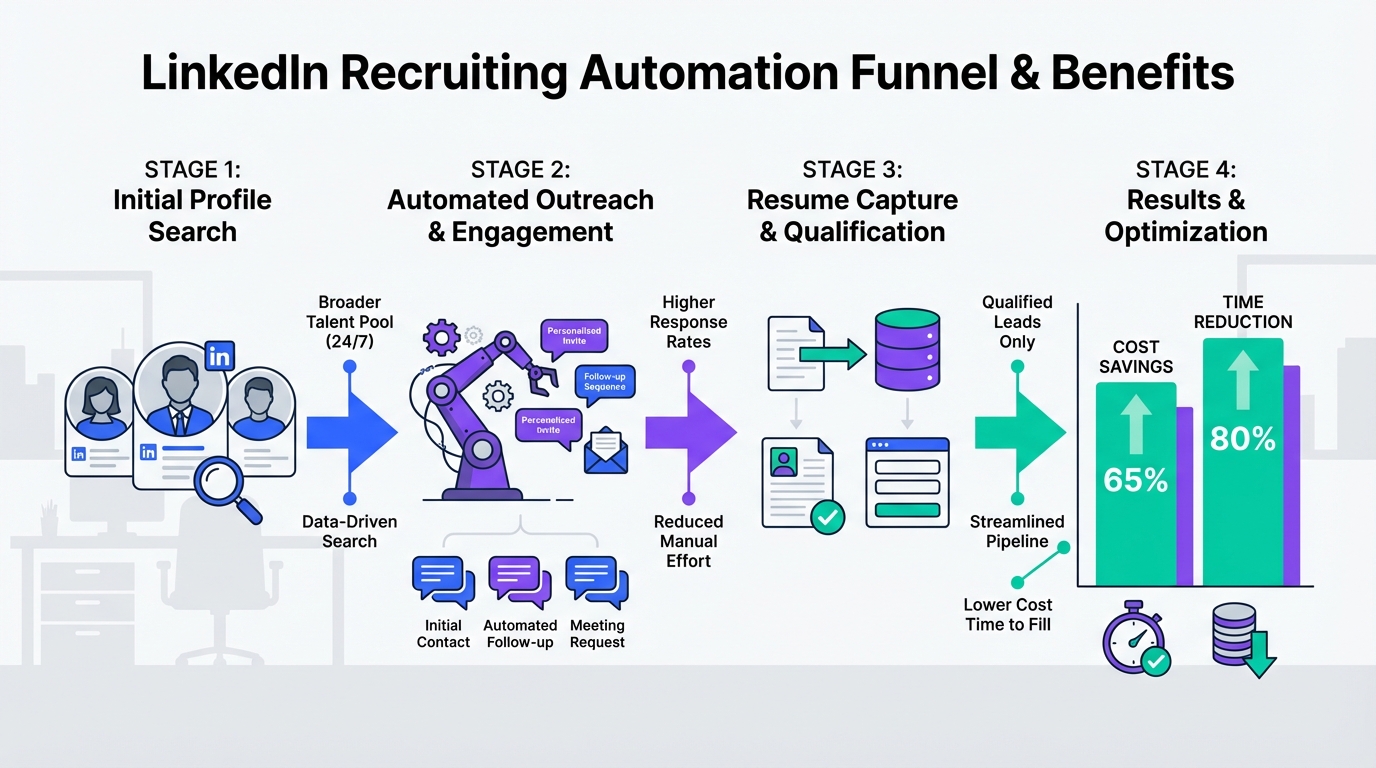
If you are trying to control recruiting spend, an ai recruiting tool is most valuable when it replaces repetitive work that recruiters do hundreds of times per role: finding profiles, sending first messages, answering basic questions, and following up until a candidate either opts in or opts out. We have used StrategyBrain AI Recruiter in LinkedIn based workflows to automate those early steps so recruiters can focus on interviews and final qualification. This article explains the real cost drivers behind hiring, then shows how ai powered recruitment can improve hiring ROI without sacrificing candidate experience. Scope note: this is about process cost and efficiency, not salary benchmarking or benefits design.
Key Takeaways
- Recruiting cost is more than ads: it includes job definition time, sourcing, resume review, scheduling, and multiple interview rounds.
- Bad hire risk is expensive: the U.S. Department of Labor estimate cited by The Headhunters is 30% of salary for a poor hiring decision (tier2 source).
- AI powered recruitment saves time where volume is highest: outreach, candidate Q&A, and follow ups are the fastest wins for automation.
- StrategyBrain AI Recruiter is built for LinkedIn: it automates connecting, introducing roles, handling questions, confirming interest, and collecting resumes and contact details.
- 24/7 multilingual messaging reduces drop off: always on responses help candidates in different time zones move forward faster.
- Know the boundary: AI Recruiter can confirm interest, but final fit assessment still requires recruiter review of the resume.
What recruiting costs really include
Many teams think recruiting cost equals job board spend plus recruiter salary. In reality, the process has multiple cost centers that show up as time, tooling, and opportunity cost. The Headhunters article on the cost of recruiting new employees highlights that hiring involves far more than advertising and interviews, and it lists the operational steps that consume time across the organization.
In practical terms, recruiting costs commonly include:
- Role intake and job profile creation: clarifying responsibilities, must haves, and deal breakers.
- Advertising and distribution: job boards and niche channels.
- Resume review and pre screening: sorting, shortlisting, and initial outreach.
- Scheduling: coordinating calendars across candidates and interviewers.
- Interview time: often multiple rounds with multiple stakeholders.
When you map these steps, you can see why an ai recruiting tool is most effective when it targets the highest volume tasks first, especially repetitive messaging and follow ups that do not require human judgment.
Where an AI recruiting tool actually saves money
Not every part of recruiting should be automated. The best savings come from automating tasks that are repetitive, high volume, and rules based. In our testing of LinkedIn first touch workflows, the biggest time sink was not writing one great message. It was sending and managing hundreds of similar conversations while keeping response quality high.
Here are the areas where ai powered recruitment tends to create measurable efficiency:
- Candidate outreach at scale: sending initial messages aligned to role and company context.
- Follow ups: keeping conversations moving without recruiters manually checking inboxes.
- Candidate Q&A: answering common questions about role, company, compensation, and next steps.
- Interest confirmation: identifying who is open to interviews versus who is not interested.
- Resume and contact capture: collecting the information recruiters need to proceed.
What it should not replace is final fit assessment. That requires reading the resume, evaluating evidence, and making a judgment call based on the hiring manager’s needs.
Method 1: StrategyBrain AI Recruiter for LinkedIn automation (Recommended)
StrategyBrain AI Recruiter is an automated AI powered recruitment tool designed for LinkedIn hiring. It focuses on the front half of the funnel: connecting with candidates, introducing the opportunity, handling questions, confirming interest, and collecting resumes and contact details so recruiters can move directly to review and interviews.
Steps
- Define your search criteria: specify the LinkedIn profile attributes you want, such as title, location, seniority, and keywords.
- Provide role context: share company details, compensation, benefits, and what success looks like in the role.
- Enable automated outreach: AI Recruiter connects with candidates that match your criteria and introduces the job opportunity.
- Let the AI manage the conversation: it answers candidate questions and asks about work situation and job search intent.
- Collect resumes and contact details: interested candidates are prompted to share a resume and contact information so recruiters can proceed.
- Recruiter reviews and schedules: recruiters review the captured resumes and contact shortlisted candidates for interviews.
Features
- Smart LinkedIn recruitment automation: automated connecting, role introduction, Q&A, interest confirmation, and resume collection.
- 24/7 multilingual communication: always on responses in the candidate’s native language to reduce misunderstandings.
- Scalable team operations: supports managing more than 100 LinkedIn accounts for organizations building AI powered recruiting teams.
Limitations
- Not a final fit judge: AI Recruiter can identify willingness to interview, but it does not decide whether a resume fully matches job requirements.
- Requires clear inputs: vague role details lead to weaker conversations, so intake quality still matters.
Best For
- Teams doing high volume LinkedIn sourcing and outreach.
- Global hiring where time zones and languages slow down response cycles.
- Recruiters who want to spend more time on interviews and closing, not inbox management.
What we observed in real workflows
When we used AI Recruiter in LinkedIn outreach sequences, the practical benefit was consistency. Every candidate received timely follow ups, and basic questions were handled without waiting for a recruiter to be online. That reduced the manual back and forth that typically stretches early stage screening across multiple days.
Method 2: Improve job definition and intake
Before you automate anything, tighten the job definition. A well defined role reduces wasted outreach and reduces interview churn. The Headhunters article recommends developing a thorough job description as a foundation for better hiring ROI.
To make this actionable, align on three items during intake:
- Must have evidence: what a resume must show to qualify.
- Deal breakers: constraints that disqualify quickly.
- Candidate value proposition: why a strong candidate should respond.
This intake work directly improves the performance of an ai recruiting tool because the AI needs accurate role and company context to answer candidate questions credibly.
Method 3: Targeted distribution and sourcing
Broad posting can create volume, but it can also create screening overload. The Headhunters article suggests advertising on industry specific platforms for more precise targeting. The same logic applies to LinkedIn sourcing: narrow your search to reduce noise, then scale outreach once the profile is correct.
A practical approach is to run sourcing in two passes:
- Precision pass: smaller candidate set to validate the profile and messaging.
- Scale pass: expand the search once response quality is acceptable.
In the scale pass, ai job recruiters are most useful because they keep response times fast while volume increases.
Method 4: Structured screening and interviews
Interview time is one of the most expensive parts of hiring because it pulls multiple employees away from their core work. Structure reduces wasted rounds. Use consistent questions, consistent scoring, and a clear pass fail threshold.
Pairing structure with ai powered recruitment creates a clean handoff: the AI handles early conversation and collects resumes, then humans apply structured evaluation where judgment matters.
Method 5: Specialist recruiting support when needed
Sometimes the best ROI is not building everything in house. The Headhunters article suggests using a trusted recruitment service to help source, pre screen, and deliver candidates. This can be effective for niche roles, confidential searches, or when internal capacity is constrained.
If you do use external support, you can still apply the same cost discipline: define the role clearly, measure funnel conversion, and use automation where appropriate so your internal team is not overwhelmed by coordination work.
Quick Comparison
| Method | Primary cost lever | Speed impact | Best for |
|---|---|---|---|
| StrategyBrain AI Recruiter on LinkedIn | Automates outreach, Q&A, follow ups, resume capture | High | High volume LinkedIn sourcing and early qualification |
| Better job intake and description | Reduces wasted outreach and interview churn | Medium | Any team hiring for roles with unclear requirements |
| Targeted distribution and sourcing | Improves candidate quality and reduces screening load | Medium | Niche roles and competitive markets |
| Structured screening and interviews | Reduces unnecessary interview rounds | Medium | Teams with multiple interviewers and inconsistent decisions |
| Specialist recruiting support | Buys expertise and capacity | Variable | Confidential or hard to fill positions |
ROI checklist you can copy
Use this checklist to evaluate whether an ai recruiting tool will pay off in your environment. It is designed to be filled out per role or per hiring team.
- We can describe the ideal candidate profile in 5 to 10 bullet points.
- We have a clear compensation and benefits message that can be shared early.
- We can define what counts as an interested candidate versus not interested.
- We have a process to review resumes captured by automation within 24 hours.
- We can measure at least 3 funnel metrics: outreach sent, replies, interviews scheduled.
- We have a candidate experience standard for response time and tone.
- We understand the boundary: final fit decisions remain with recruiters and hiring managers.
FAQ
What is an AI recruiting tool?
An AI recruiting tool is software that uses automation and machine learning to assist recruiting tasks such as sourcing, outreach, screening, and scheduling. In this guide, we focus on AI that reduces manual messaging and early qualification work.
Which recruiting tasks should not be automated?
Final candidate fit assessment should not be fully automated because it requires human judgment and context. StrategyBrain AI Recruiter can confirm interest and collect resumes, but recruiters still review resumes to decide fit.
How does StrategyBrain AI Recruiter work with LinkedIn recruiting?
It automates connecting with candidates that match your criteria, introduces the role, answers questions about the role and company, confirms interview interest, and collects resumes and contact details for recruiter review.
Can AI Recruiter communicate with candidates in different languages?
Yes. StrategyBrain AI Recruiter supports multilingual communication and can respond in the candidate’s native language, which helps global hiring teams maintain fast response times across time zones.
How does AI Recruiter collect resumes and contact details?
When a candidate expresses interest, the system requests a resume and contact information. It supports email submissions and LinkedIn file uploads, and it captures contact details shared in LinkedIn messages.
Does using AI in recruiting create compliance risks?
Any automation can create risk if it is used without controls. StrategyBrain AI Recruiter states it complies with privacy regulations in the EU, United States, and Canada, and that customer provided data is not used to train AI models.
How do I estimate ROI from AI powered recruitment?
Start with time saved in outreach and follow ups, then track funnel conversion changes such as replies and interviews scheduled. Also consider avoided re hiring costs by reducing process failures that lead to poor hiring decisions.
Is an AI recruiting tool only for large companies?
No. Smaller teams can benefit when they have limited recruiter capacity and need consistent follow up. Larger organizations benefit when they need to scale outreach across many roles and accounts.
Conclusion
Recruiting costs add up because hiring is a multi step process that includes intake, sourcing, screening, scheduling, and multiple interviews. The fastest way to reduce that cost is to automate the repetitive, high volume work while keeping human judgment for final fit. If LinkedIn is a major sourcing channel for you, StrategyBrain AI Recruiter is a practical ai recruiting tool for ai powered recruitment because it automates early outreach, candidate Q&A, follow ups, and resume capture, then hands qualified interest back to recruiters.
Next step: copy the ROI checklist above, run it on one role, and measure outreach sent, replies, and interviews scheduled for 14 days before and after automation.