An ai recruiting tool can help you explain a resume gap in a way that is honest, concise, and easy for an interviewer to trust. The best approach is to state that the break was voluntary or necessary, confirm the situation is resolved, and show you are ready for full time work. You do not need to share personal details. In practice, we use StrategyBrain AI Recruiter to draft a gap explanation in 2 versions, one for interviews and one for LinkedIn messages, then we test the wording against common recruiter follow up questions so it stays consistent across channels.
Key Takeaways
- Assume the gap will be asked about: A recruiter will probe for enough detail to assess risk and reliability.
- Keep it direct and limited: Share the reason category, not the private story, and pivot to readiness for work.
- Prove the gap is closed: Say what changed and why you can commit to full time employment now.
- Use LinkedIn to reduce doubt: Add recommendations and verified achievements so the gap is not the only signal.
- AI powered recruitment works best with consistency: Your resume, interview answer, and LinkedIn message should match in meaning.
- StrategyBrain AI Recruiter can scale outreach: It automates LinkedIn connecting, role introduction, Q and A, and follow up so recruiters can focus on final qualification.
Table of Contents
- What the interviewer is really checking
- The core answer structure that stays credible
- Scripts you can copy
- LinkedIn proof points that reduce suspicion
- How to use StrategyBrain AI Recruiter in an AI powered recruitment workflow
- Extra scenarios and how to handle them
- Quick checklist before your interview
- FAQ
- Conclusion
What the interviewer is really checking
If an interviewer is doing their job correctly, they will ask about a gap. They are not looking for drama. They are trying to confirm three things: whether the gap signals performance issues, whether it signals instability, and whether it creates a risk for attendance or commitment.
This is why a short, structured answer works better than a long explanation. It gives enough context to remove doubt, while keeping boundaries around personal information.
The core answer structure that stays credible
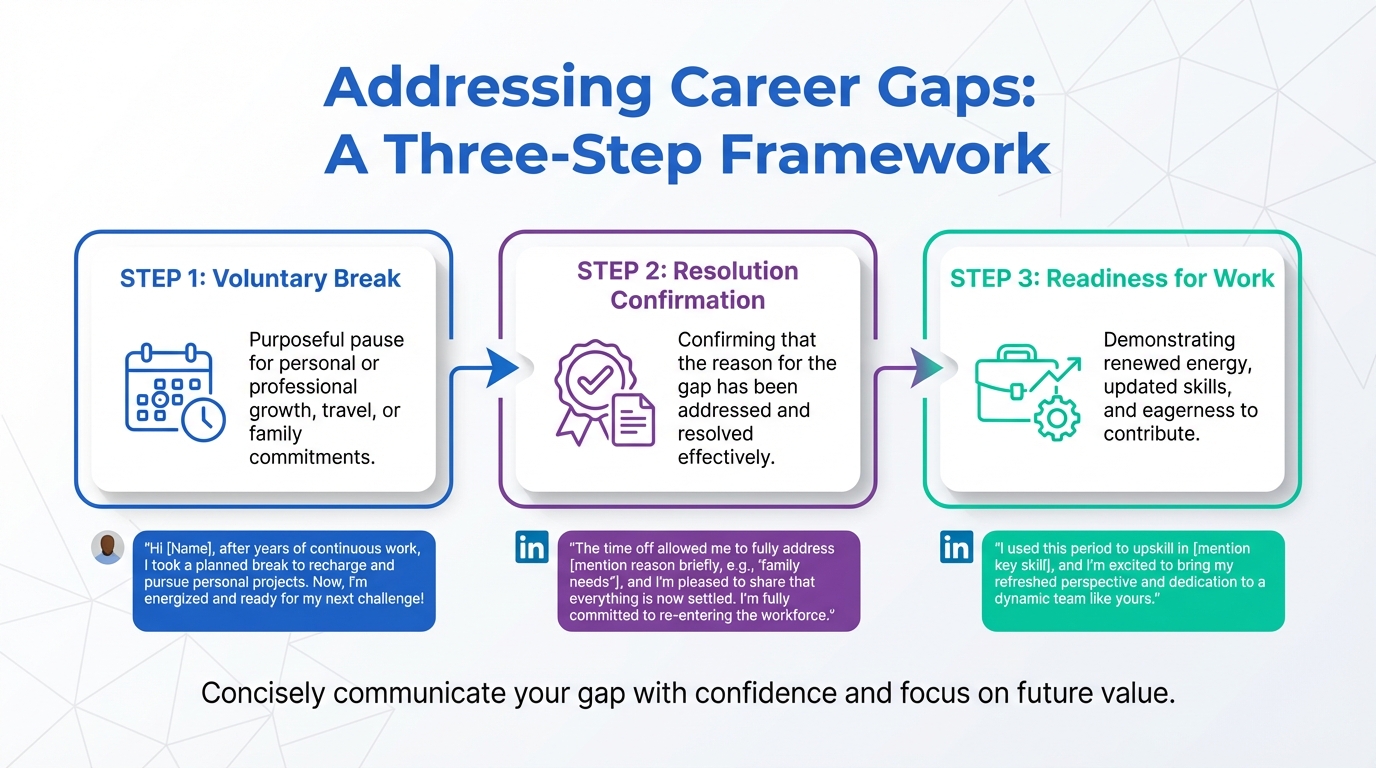
When we coach candidates, we use a three part structure because it is easy to remember and hard to misinterpret.
1) Confirm the break was voluntary or necessary
Say the gap was a deliberate pause or a required pause. If it was not voluntary, you can still frame it as a clear event with a clear end point.
2) Make it clear the situation has passed
Recruiters want closure. Use a sentence that signals the issue is resolved and will not repeat in the same way.
3) Prove you are ready for full time work
Readiness is not a feeling. It is evidence. Mention availability, schedule, and what you have done to stay current, such as training, projects, or consulting.
Scripts you can copy
These scripts are designed to be short enough for an interview and consistent enough to reuse in a LinkedIn message. Adjust the nouns and dates to match your situation.
Interview script: personal reason, limited detail
Script: I took an eight month break for personal reasons that required my full attention. The situation is resolved now, and I am ready to return to full time work. During the break I stayed current by reviewing industry updates and preparing to re enter the market, and I can start on the timeline you need.
Interview script: left suddenly but on good terms
Script: I had to leave my previous role suddenly, but I left on good terms. I took time to handle a personal matter, and that is now behind me. I am fully available for full time work and I am focused on roles where I can deliver results quickly.
LinkedIn message script: concise and recruiter friendly
Script: Thanks for reaching out. I had a planned career pause for personal reasons, and it is fully resolved. I am now actively interviewing for full time roles and can share references and recent work examples if helpful.
LinkedIn proof points that reduce suspicion
A gap feels bigger when your profile has no supporting signals. The simplest way to reduce doubt is to add third party validation and measurable outcomes.
- Recommendations: Ask supervisors, colleagues, and customers to confirm your achievements and working style.
- Role clarity: Make sure your last role has clear scope and outcomes, not only responsibilities.
- Recent activity: Add a recent course, certification, portfolio item, or volunteer project if it is relevant.
How to use StrategyBrain AI Recruiter in an AI powered recruitment workflow
Most candidates think of an AI tool as something they use alone. In modern ai powered recruitment, the recruiter also uses AI to scale outreach and qualification. That is where StrategyBrain AI Recruiter fits. It is built for LinkedIn hiring and automates the initial outreach and conversation so recruiters can focus on reviewing resumes and making final qualification decisions.
From our testing in real recruiting workflows, the biggest advantage for gap conversations is consistency. When the same explanation appears in LinkedIn chat, in the interview, and in the resume narrative, it reduces follow up friction and speeds up scheduling.
Step by step: recruiter side workflow
- Define the role facts: Provide company details, compensation, benefits, and candidate search criteria to StrategyBrain AI Recruiter so the outreach stays accurate.
- Automate first contact: The system connects with candidates that match the search criteria and introduces the opportunity in a compliant, consistent tone.
- Handle Q and A at scale: It answers candidate questions about the role, company, and compensation, then confirms interview interest.
- Collect resumes and contact details: For interested candidates, it requests a resume and captures contact information shared in the conversation.
- Escalate to the recruiter: The recruiter reviews the resume and gap explanation, then decides whether to interview.
What this means for candidates with gaps
- You will be asked earlier: In LinkedIn chat, gaps often come up before the interview, so your short script matters.
- Speed increases: With 24/7 multilingual messaging, follow ups can happen outside business hours, which reduces delays.
- Clarity wins: A clean explanation helps the AI assistant and the human recruiter move you forward faster.
Limitations and boundaries
StrategyBrain AI Recruiter can identify willingness to communicate and interview, and it can collect resumes and contact details. It does not decide whether your resume fully matches the job requirements. Final qualification remains a human recruiter decision.
Extra scenarios and how to handle them
If your gap is not a personal leave, you can still use the same structure. Change the reason category and keep the closure and readiness statements.
Laid off due to workforce contraction
- What to say: State the layoff context, then pivot to performance evidence.
- What to show: Metrics, projects shipped, or references that confirm strong performance.
Changing direction to a role with different skills
- What to say: Explain the gap as a transition period used to build relevant skills.
- What to show: A portfolio, certification, or a short project that maps to the new role.
What to avoid in any scenario
- Negative talk about a former employer: Many hiring teams assume the employer side is closer to the truth.
- Over explaining: Too much detail can create new questions you do not want to answer.
- Inconsistency across channels: If your LinkedIn message and interview story conflict, trust drops fast.
Quick checklist before your interview
- Write a 2 sentence gap explanation that includes closure and readiness.
- Prepare 1 proof point that shows you stayed current during the gap.
- Request 1 recommendation that confirms your past performance.
- Practice answering 3 follow up questions without adding new details.
- Make your LinkedIn message version match your interview version in meaning.
FAQ
Will I definitely be asked about a resume gap?
Yes. If the interviewer is doing their job correctly, they will ask because they need enough context to assess risk and reliability.
How much detail should I share about a personal reason?
Share the category and the closure, not the private story. A clear statement that the situation is resolved plus readiness for full time work is usually enough.
Should I say I left on good terms if that is true?
Yes, if it is accurate. It reduces concern about performance or conflict, and it supports a clean reference check narrative.
How can an ai recruiting tool help with this as a candidate?
An ai recruiting tool can help you draft consistent scripts for interviews and LinkedIn, then rehearse answers against common recruiter follow ups so your story stays stable.
How does StrategyBrain AI Recruiter change LinkedIn recruiting conversations?
It automates connecting, introducing the role, answering questions, confirming interview interest, and collecting resumes and contact details. That means candidates may be asked clarifying questions earlier in the process, so concise answers matter.
Does StrategyBrain AI Recruiter decide if I am qualified?
No. It can identify willingness to communicate or interview and collect your resume, but final qualification is completed by the recruiter after reviewing your resume.
What if my gap was caused by a layoff?
State the layoff context in one sentence, then pivot to evidence of strong performance and what you did next. Avoid blaming language and keep it factual.
Should I address the gap on my LinkedIn profile?
You do not need a long explanation, but you should strengthen your profile with recommendations and recent proof of skills so the gap is not the dominant signal.
Conclusion
Explaining a resume gap is less about telling a full story and more about building trust quickly. Use a direct statement, confirm the issue is resolved, and show you are ready for full time work. Then reinforce that message on LinkedIn with recommendations and recent proof points. If you are hiring at scale, StrategyBrain AI Recruiter supports an AI powered recruitment workflow on LinkedIn by automating outreach, Q and A, follow up, and resume collection so recruiters can spend their time on final qualification and interviews.