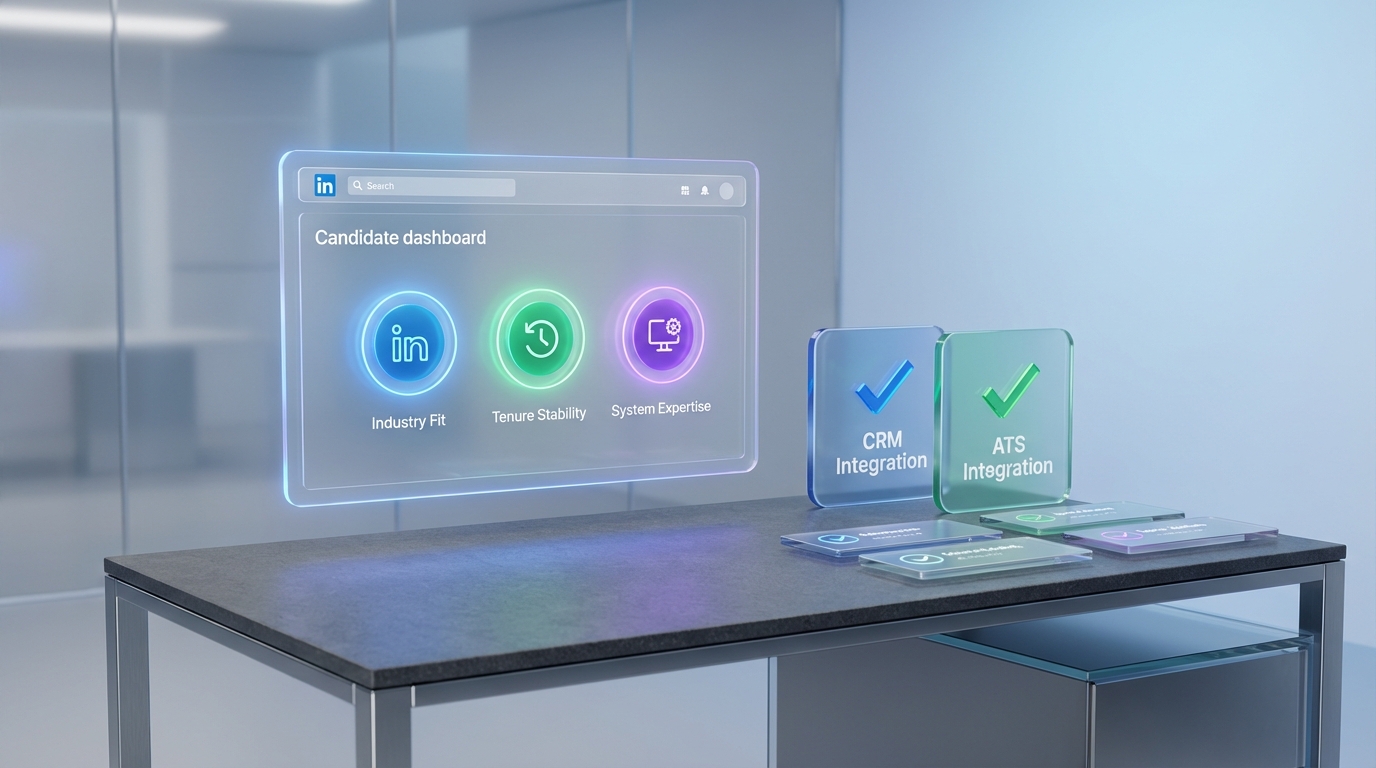
If you are hiring accounting contractors under time pressure, focus on three signals that predict whether someone can contribute quickly: experience in similar companies or industries, stable periods of employment, and familiarity with your accounting systems. Pairing that evaluation with an ai recruiting tool can reduce the manual work in the first mile of hiring by automating LinkedIn outreach, handling candidate questions, confirming interview interest, and collecting resumes and contact details for review. This article keeps the original three factor logic, then shows how to run it as a repeatable workflow using a crm for recruiting or an ats for recruiting agencies, with a checklist you can copy.
Why contract accounting hires fail under tight timelines
Contract accounting hires usually fail for predictable reasons. First, the contractor is technically capable but unfamiliar with the pace, controls, or stakeholder expectations of your environment. Second, the person needs more ramp time than the business can tolerate. Third, the team underestimates how much the accounting system and reporting stack shape day to day productivity.
Therefore, the goal is not to find a perfect resume. The goal is to find a contractor who can start producing accurate work quickly, with minimal supervision, and without creating downstream rework for the finance team.
The three non negotiables to screen for
1) Similar companies or industries
Look for candidates who have already worked in a company or industry similar to yours. The reason is simple: context reduces ramp time. A contractor who has only worked in small organizations can struggle in a larger enterprise environment with more approvals, segregation of duties, and reporting cadence. The reverse can also be true.
- What to look for: comparable revenue scale, transaction volume, audit requirements, and reporting rhythm.
- Why it matters: it lowers onboarding time and reduces the risk of process friction.
- Best for: urgent backfills, month end support, and project based cleanups.
2) Periods of employment that show stability
Review work history for stability and outcomes. Longer tenures are often a signal that the person delivered value and earned extensions or promotions. Short stints are not automatically bad, but they require explanation, especially when you need someone to be dependable during a critical period such as quarter close.
- What to look for: contract extensions, repeat engagements, and clear role progression.
- Why it matters: stability correlates with reliability and stakeholder trust.
- Limitation: tenure alone does not prove skill, so you still need a targeted work sample.
3) Familiarity with your accounting systems
If you are recruiting on a tight timeline, system familiarity is one of the fastest ways to reduce time to productivity. A contractor who already knows your accounting platform, reporting tools, or adjacent workflow software can start delivering usable output sooner.
- What to look for: direct experience with the same accounting system, ERP, or reporting stack you use.
- Why it matters: it reduces training time and lowers error rates during early deliverables.
- Best for: analyst level roles and any position where speed and accuracy both matter.
How to verify each signal in 30 minutes
Below is the exact verification sequence we use when we need a fast, defensible decision. It is designed to be reproducible and easy to document in a crm for recruiting or an ats for recruiting agencies.
Step by step verification
- Confirm environment match: ask for one example of a similar company context and one example of a similar deliverable they owned.
- Validate stability: ask why each short engagement ended and whether any contracts were extended.
- Test system fluency: ask them to describe a common workflow in your system category, such as posting entries, reconciling accounts, or generating a standard report.
- Run a micro work sample: give a small scenario that mirrors your real work, then score for accuracy and clarity.
What to document in your ATS or recruiting CRM
- Industry fit notes: 3 bullet points, each tied to a deliverable.
- Stability notes: tenure pattern plus explanation for any short stints.
- System fit notes: which tools they used and what workflows they can execute without training.
- Risk flags: anything that could slow onboarding or create rework.
A repeatable workflow using an AI recruiting tool, CRM, and ATS
Once you know what you are screening for, the bottleneck becomes outreach and early conversation management. This is where an ai recruiting tool can help, especially when the channel is LinkedIn and the role requires fast response cycles.
Where StrategyBrain AI Recruiter fits
In our testing of StrategyBrain AI Recruiter for LinkedIn hiring workflows, the biggest operational win was reducing repetitive messaging work while keeping the screening logic consistent. It automatically connects with candidates that match your search criteria, introduces the opportunity, answers common questions about the role, company, and compensation, confirms interview interest, and collects resumes and contact details from interested candidates. That output can then be reviewed and logged into your crm for recruiting or your ats for recruiting agencies so the recruiter focuses on evaluation and interviews.
Workflow you can implement this week
- Define the contractor success profile: write 3 bullets for similar environment, 2 bullets for stability, and the exact systems required.
- Prepare the role facts: company context, compensation range, benefits, and interview process so candidate questions can be answered consistently.
- Run LinkedIn outreach at scale: use StrategyBrain AI Recruiter to connect and start conversations, then let it handle follow ups and Q and A.
- Collect resumes and contact details: for interested candidates, the system requests resumes and captures contact information for recruiter review.
- Route qualified interest to your pipeline: move candidates into your ATS stages and schedule interviews.
- Human evaluation: the recruiter reviews the resume and work sample because AI Recruiter confirms willingness to proceed but does not decide final fit.
Scope boundaries and compliance notes
- What this workflow covers: outreach, early conversation, interest confirmation, and information capture.
- What it does not replace: final qualification against job requirements and hiring decisions.
- Privacy and security: StrategyBrain states customer provided data is not used to train AI models and that credentials and candidate data are encrypted and isolated per customer.
Copyable scorecard and intake checklist
Contract accounting intake checklist
- Role objective: what must be true in 10 business days.
- Similar environment: industry, company size, reporting cadence, audit requirements.
- Stability requirement: minimum expected contract length and availability window.
- Systems: accounting platform, ERP, reporting tools, and any required integrations.
- Deliverables: month end tasks, reconciliations, reporting packs, cleanup projects.
- Interview plan: 1 screen, 1 work sample, 1 stakeholder interview.
Simple scorecard template
| Criterion | Score (1 to 5) | Evidence to record |
|---|---|---|
| Similar companies or industries | Comparable context plus 1 deliverable example | |
| Periods of employment | Extensions, progression, explanation for short stints | |
| Accounting systems familiarity | Tools used plus workflow description | |
| Work sample accuracy | Errors found and how they corrected them | |
| Communication clarity | Stakeholder readiness and risk flags |
Common mistakes and how to avoid them
- Hiring only for resume keywords: instead, map each keyword to a deliverable you need in the next 2 weeks.
- Ignoring system fit: if the timeline is tight, system familiarity is often the difference between help and added burden.
- Over trusting tenure: long employment is a good signal, but you still need a work sample to confirm competence.
- Letting outreach become the bottleneck: use an AI recruiting tool to keep response times fast and follow ups consistent.
FAQ
What is an AI recruiting tool in practical terms?
An AI recruiting tool is software that automates parts of recruiting workflows such as outreach, messaging, follow up, and information capture. In this guide, the practical value is reducing manual LinkedIn conversations while keeping screening questions consistent.
Do I need a CRM for recruiting if I already have an ATS?
Not always. An ATS for recruiting agencies is usually best for pipeline stages, compliance, and hiring workflow, while a CRM for recruiting is often better for relationship management and outreach history. If your ATS already tracks outreach and notes well, you can start there and add a CRM later.
Can StrategyBrain AI Recruiter replace recruiter judgment?
No. StrategyBrain AI Recruiter can confirm willingness to proceed and collect resumes and contact details, but it does not determine whether a resume fully matches job requirements. A recruiter still reviews the resume and runs the evaluation steps.
How does StrategyBrain AI Recruiter handle multilingual candidates?
StrategyBrain AI Recruiter is designed for 24/7 multilingual communication and can message candidates in their native language. This is useful when hiring across time zones or when response speed affects acceptance rates.
What should I ask to confirm accounting system familiarity?
Ask the candidate to walk through a common workflow they have executed in a similar system, such as reconciliations, journal entries, or generating a standard report. Then ask what errors they commonly see and how they prevent them.
How do I keep the process fast without cutting corners?
Use a short scorecard, a micro work sample, and structured documentation in your ATS or recruiting CRM. Automate outreach and follow ups with an AI recruiting tool so the human time is spent on evaluation, not repetitive messaging.
Is candidate data used to train the AI?
StrategyBrain states that customer provided data is not used to train AI models and that candidate information is encrypted and isolated per customer. Confirm the latest details in the vendor documentation during procurement.
What is the fastest way to improve contractor success rate?
Make system familiarity a first class requirement when timelines are tight, then validate it with a targeted work sample. This reduces ramp time and prevents early rework that drains the finance team.
Conclusion and next steps
Hiring accounting contractors quickly works best when you screen for similar environment experience, stable employment periods, and familiarity with your accounting systems. Then, use an ai recruiting tool to remove the outreach bottleneck so you can spend recruiter time on work samples and final evaluation. Next, copy the intake checklist and scorecard above, implement the step by step verification flow, and decide whether your current crm for recruiting or ats for recruiting agencies is capturing the evidence you need for fast, defensible decisions.