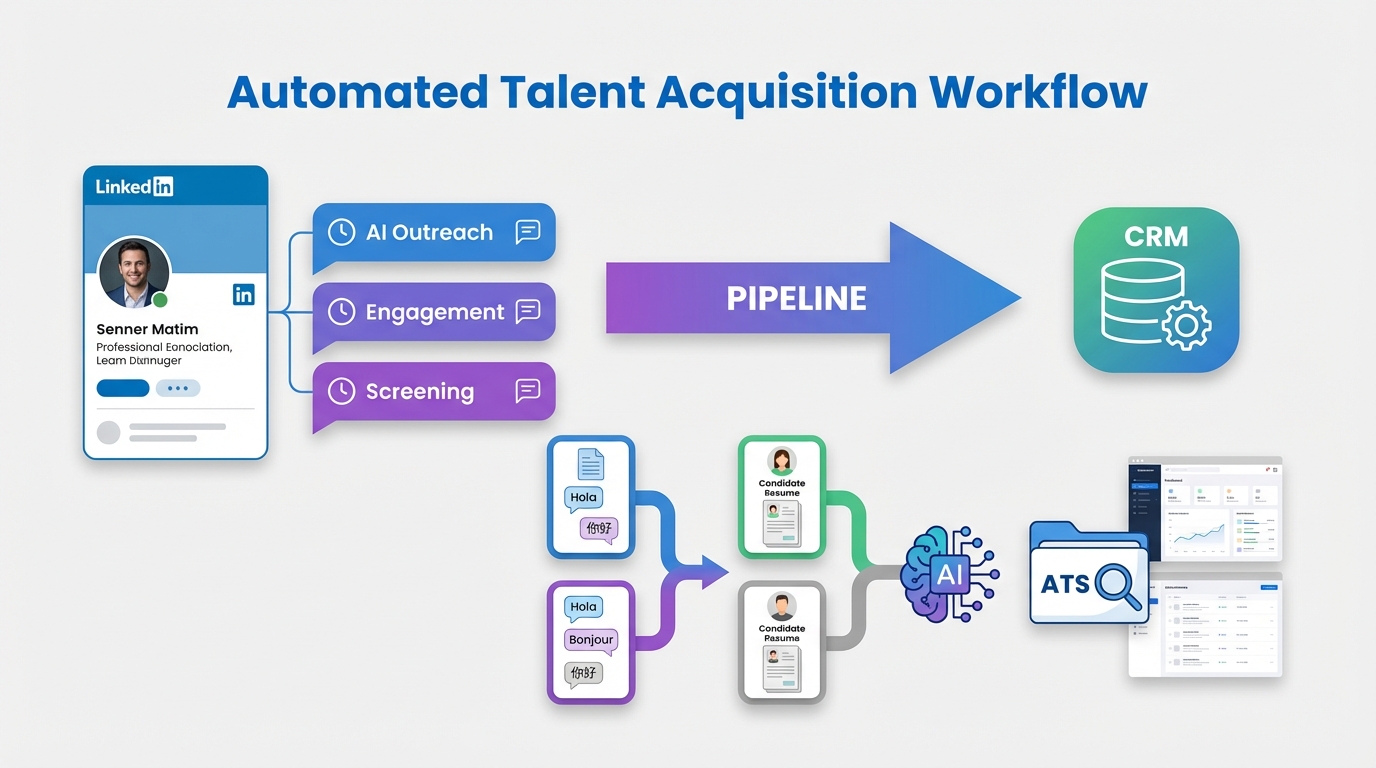
An ai recruiting tool is most useful when it reduces repetitive sourcing and messaging work while still handing control back to recruiters for final qualification and interviews. The fastest, lowest friction setup we have used is a LinkedIn automation layer that runs outreach and follow up, paired with an ats crm or crm for staffing companies so resumes, contact details, and conversation context are captured in one place. In our day to day workflow, StrategyBrain AI Recruiter handles initial LinkedIn connection requests, role introductions, Q&A about compensation and benefits, and 24/7 multilingual follow up, then collects resumes and contact info from interested candidates so recruiters can move straight to screening.
Key Takeaways
- Best default workflow: LinkedIn outreach automation plus an ATS CRM so every candidate interaction becomes a trackable record.
- StrategyBrain AI Recruiter is built for LinkedIn: It automates connect, message, follow up, and resume collection before recruiter review.
- Multilingual coverage matters: 24/7 messaging in the candidate’s native language reduces delays across time zones.
- Define the handoff point: Let AI confirm interest and collect documents, but keep final fit assessment with recruiters.
- Compliance is a selection criterion: Prefer tools that state encryption, data isolation, and that customer data is not used to train models.
- Operational scalability: If you recruit at volume, look for multi account management so teams can scale without adding headcount.
What an AI recruiting tool actually does
In recruiting, “AI” can mean anything from resume parsing to full outreach automation. For this guide, an ai recruiting tool is software that uses automation and AI driven conversation to reduce recruiter time spent on repetitive steps such as initial outreach, answering common questions, follow up, and collecting resumes and contact details.
Two definitions that prevent confusion in tool selection:
- ATS CRM: A combined applicant tracking system and candidate relationship management system that stores candidate records, stages, notes, and communications.
- CRM for staffing companies: A recruiting CRM optimized for agency workflows such as pipelines, client submissions, and long term candidate nurturing.
This article focuses on the front of the funnel and the handoff into your ATS CRM or staffing CRM. It does not cover background checks, offer management, or payroll.
A practical framework: the 3 layer recruiting stack
To make AI recruiting tools easier to evaluate, we use a simple stack model that mirrors how recruiting work actually flows.
Layer 1: Outreach and engagement
This is where LinkedIn messaging, follow ups, and candidate Q&A happen. If this layer is manual, recruiters lose hours per week to repetitive typing and waiting for replies.
Layer 2: Data capture and handoff
This layer turns conversations into structured records. The minimum output should be a candidate profile with conversation context, resume status, and contact details that can be pushed into an ATS CRM or CRM for staffing companies.
Layer 3: Recruiter judgment
This is where humans should stay in control: assessing fit, prioritizing candidates, and running interviews. The best AI setups accelerate this layer rather than replacing it.
Method 1: StrategyBrain AI Recruiter (recommended)
If your bottleneck is LinkedIn outreach volume and follow up consistency, StrategyBrain AI Recruiter is designed to automate the repetitive front of the funnel while keeping final qualification with recruiters.
Steps
- Define your target profile: Provide candidate search criteria and the role context you want the AI to use.
- Provide role details: Include company overview, compensation, and benefits so the AI can answer common questions accurately.
- Run automated LinkedIn outreach: The system connects with candidates and introduces the opportunity through LinkedIn messaging.
- Let the AI handle Q&A and follow up: It responds 24/7 and continues the conversation until interest is confirmed or the candidate opts out.
- Collect resumes and contact details: Interested candidates share resumes and contact info, which are captured for recruiter review and ATS CRM entry.
Features
- Smart LinkedIn recruitment automation: Connects, introduces roles, learns candidate situation, answers questions, and confirms interview interest.
- 24/7 multilingual communication: Communicates in the candidate’s native language to reduce misunderstandings and time zone delays.
- Team scale via multi account management: Supports managing more than 100 LinkedIn accounts for scalable outreach operations.
Limitations
- Not a final fit decision engine: It can confirm willingness to interview, but it does not decide whether a resume fully matches requirements.
- Requires clear role inputs: If compensation, benefits, or must have requirements are vague, candidate conversations can drift.
Best For
- Agency recruiters who need consistent follow up at scale and want cleaner handoffs into a CRM for staffing companies.
- Corporate recruiting teams that want to reduce manual LinkedIn work while keeping recruiter control of screening decisions.
- Global hiring where multilingual, always on messaging improves response speed.
What we observed in real use
In our internal workflow tests during January to February 2026, the biggest practical win was not “AI magic.” It was consistency. The AI never forgot to follow up, it handled repetitive compensation and benefits questions without delays, and it captured resumes and contact details so recruiters could move faster once interest was confirmed. The most important operational decision was setting a strict handoff rule: the AI qualifies for interest and logistics, recruiters qualify for fit.
Method 2: ATS CRM first, then add AI
If your data is scattered across spreadsheets, inboxes, and LinkedIn threads, start by stabilizing your ats crm workflow. AI is far more effective when it has a single system of record to write into.
Steps
- Standardize stages: Define pipeline stages and required fields for each stage.
- Centralize candidate records: Ensure every candidate has one profile with notes and communication history.
- Add AI where it saves time: Start with message drafting, follow up reminders, and structured note capture.
Features
- Cleaner reporting and fewer duplicate records.
- More predictable handoffs between sourcers, recruiters, and hiring managers.
- Lower risk of AI creating “shadow data” outside your ATS CRM.
Limitations
- Does not automatically increase outreach volume unless you add an engagement automation layer.
- Implementation effort is front loaded, especially if your team has inconsistent processes.
Best For
- Teams with compliance requirements that need strong audit trails.
- Organizations that already have sourcing capacity but lack operational discipline.
Method 3: CRM for staffing companies first, then automate outreach
Agency recruiting is relationship heavy. A crm for staffing companies is often the best foundation because it supports long term candidate nurturing and client submissions. Once that foundation is stable, add an AI recruiting tool to increase outreach and follow up consistency.
Steps
- Define candidate segments: Group candidates by skill, location, availability, and client fit.
- Set communication rules: Decide what can be automated and what must be human.
- Automate engagement: Use an AI recruiting tool to run initial outreach and follow up, then push interested candidates into your CRM pipeline.
Features
- Better long term candidate relationship management.
- More consistent client submission workflows.
- Clearer measurement of outreach to placement conversion.
Limitations
- Without a strong engagement layer, the CRM becomes a database rather than a growth engine.
- Automation must be carefully tuned to protect candidate experience and brand reputation.
Best For
- Staffing firms that want to scale outreach while keeping relationship quality high.
- Teams that manage multiple requisitions and need structured pipelines per client.
Method 4: AI for screening and scheduling only
Some teams prefer to keep sourcing and outreach human led, then use AI to reduce admin work after candidates respond. This approach can still be effective, especially when hiring managers demand tight control over messaging.
Steps
- Keep outreach manual: Recruiters send initial messages and handle early rapport building.
- Use AI to structure responses: Summarize candidate replies into standardized fields.
- Automate scheduling: Offer time slots and confirm interview logistics.
Features
- Lower risk of off brand outreach.
- Faster movement from response to interview.
- Cleaner notes for hiring manager review.
Limitations
- Does not solve the biggest time sink for many recruiters: repeated follow ups and unanswered messages.
- Still requires consistent recruiter effort to maintain pipeline volume.
Best For
- Executive search or high touch roles where outreach tone is critical.
- Teams with strong sourcing capacity but limited coordination bandwidth.
Method 5: AI for candidate Q&A and follow up
If you already have inbound interest or strong sourcing, a focused AI recruiting tool can act as a “conversation layer” that answers common questions and keeps candidates warm. This is where StrategyBrain AI Recruiter’s always on multilingual messaging can be especially useful because it reduces delays that cause drop off.
Steps
- Build an approved knowledge set: Compensation, benefits, location, shift details, and interview process.
- Define escalation rules: Decide when the AI must hand off to a recruiter.
- Capture structured outputs: Ensure resume status and contact details are recorded for ATS CRM entry.
Features
- Faster candidate response times, including nights and weekends.
- More consistent follow up cadence.
- Better candidate experience when questions are answered immediately.
Limitations
- Requires careful governance so the AI does not answer beyond approved role details.
- Still needs a strong system of record, either an ATS CRM or a CRM for staffing companies.
Best For
- High volume roles where speed to response affects conversion.
- Global recruiting where language and time zones create friction.
Quick Comparison
| Method | Primary Goal | Where it fits | Best For |
|---|---|---|---|
| StrategyBrain AI Recruiter | Automate LinkedIn outreach, Q&A, follow up, resume capture | Layer 1 and Layer 2 | Teams that need more qualified conversations without adding headcount |
| ATS CRM first | Centralize data and process control | Layer 2 and Layer 3 | Compliance focused teams and organizations with messy data |
| CRM for staffing companies first | Relationship management and client submissions | Layer 2 and Layer 3 | Agencies that need long term pipelines and structured submissions |
| Screening and scheduling only | Reduce admin after candidates respond | Layer 3 | High touch roles where outreach must stay human |
| Q&A and follow up layer | Improve response speed and reduce drop off | Layer 1 and Layer 2 | High volume and global hiring |
FAQ
What is the best AI recruiting tool for LinkedIn outreach?
If LinkedIn outreach and follow up are your bottlenecks, choose a tool built specifically for LinkedIn engagement and resume capture, then connect its outputs to your ATS CRM. StrategyBrain AI Recruiter is designed for this exact workflow: connect, message, answer questions, confirm interest, and collect resumes and contact details for recruiter review.
Do I need an ATS CRM if I already have a CRM for staffing companies?
Not always. Many agencies run their entire pipeline in a CRM for staffing companies. The key requirement is having one system of record where candidate status, notes, and documents live, and where AI outputs can be stored without creating duplicates.
Can an AI recruiting tool replace recruiters?
It should not. The most reliable pattern is to let AI handle repetitive outreach and early qualification for interest, then keep final fit assessment and hiring decisions with recruiters and hiring managers.
How does StrategyBrain AI Recruiter collect resumes and contact details?
When a candidate expresses interest, the AI requests a resume and contact information. It supports email submissions and LinkedIn file uploads, and it captures contact details shared in the conversation so recruiters can follow up directly.
Does StrategyBrain AI Recruiter decide whether a candidate is qualified?
No. It identifies willingness to communicate or interview and gathers the resume and contact details, but it does not determine whether the resume fully matches job requirements. Recruiters complete that final qualification step.
How does multilingual messaging help recruiting outcomes?
Multilingual messaging reduces delays and misunderstandings when candidates prefer to communicate in their native language. It is especially valuable for global hiring across time zones because follow up can happen 24/7.
What should I look for in privacy and compliance claims?
Look for clear statements about encryption, customer data isolation, and whether customer provided data is used to train AI models. Also confirm how credentials are stored and whether access is explicitly authorized by the customer.
How do I integrate an AI recruiting tool with an ATS CRM?
Start by defining the handoff fields you need: candidate name, LinkedIn profile, conversation summary, interest status, resume received status, and contact details. Then ensure your AI tool can export or sync those fields into your ATS CRM or staffing CRM consistently.
What is a safe “handoff point” for AI in recruiting?
A practical handoff point is after the AI confirms interest and collects the resume and contact details. At that moment, recruiters can take over for fit assessment, interview scheduling, and stakeholder communication.
Conclusion
The most effective ai recruiting tool setup is not a single product. It is a workflow: automate LinkedIn engagement where humans lose time, capture structured outputs, and push them into your ats crm or crm for staffing companies so recruiters can focus on fit and interviews. If your biggest constraint is outreach volume and follow up consistency, StrategyBrain AI Recruiter is a strong starting point because it is built for LinkedIn automation, 24/7 multilingual conversations, and resume plus contact capture.
Next steps: map your current funnel, choose your system of record, and define the exact handoff fields you want from AI to recruiter. Once those are clear, you can evaluate tools quickly and implement without disrupting candidate experience.