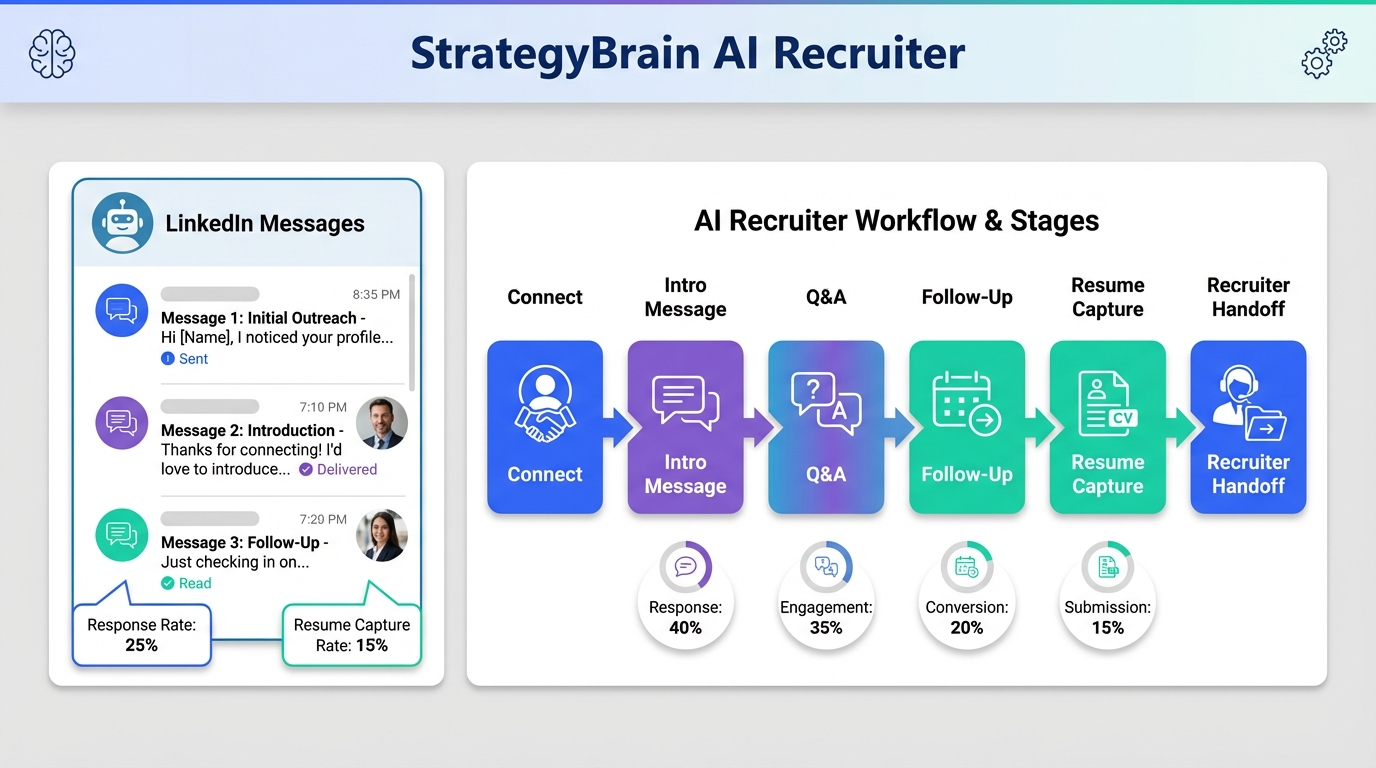
An ai recruiting tool is most useful when it removes the highest volume, lowest leverage work in your funnel: connecting with candidates, sending first messages, answering repetitive questions, following up, and collecting resumes and contact details. If your team recruits on LinkedIn, the most direct approach is to use an automation focused system such as StrategyBrain AI Recruiter to run initial outreach and qualification conversations, then hand off interested candidates to a recruiter for resume review and interviews. This guide explains the workflow, what to evaluate when comparing the best recruitment software and the best CRM for staffing agencies, and how to implement AI without losing control of quality, compliance, or candidate experience.
Table of Contents
- What an AI recruiting tool should do in a real workflow
- Quick evaluation checklist
- Method 1: LinkedIn outreach automation with StrategyBrain AI Recruiter
- Method 2: Build a recruitment CRM and ATS foundation
- Method 3: Add multilingual and 24/7 candidate engagement
- Method 4: Scale with multi account teams
- Quick Comparison
- FAQ
- Conclusion
Key Takeaways
- Best first use case: Use an ai recruiting tool to automate LinkedIn connecting, first messages, and follow ups, then keep final qualification with a human recruiter.
- StrategyBrain AI Recruiter workflow: It can connect, introduce the role, answer questions about role, company, and compensation, confirm interview interest, and collect resumes and contact details.
- Global hiring advantage: 24/7 multilingual messaging reduces time zone delays and improves response continuity for international pipelines.
- Scale lever: Managing more than 100 LinkedIn accounts enables an AI powered recruiting team model for high volume sourcing.
- Security baseline: Look for encryption, customer data isolation, and a clear statement that customer data is not used to train models.
- Selection lens: The best recruitment software and the best CRM for staffing agencies are not always the same product; many teams pair an AI outreach layer with a CRM or ATS system of record.
What an AI recruiting tool should do in a real workflow
Most recruiting teams do not fail because they cannot interview well. They fail because they cannot sustain consistent top of funnel activity. In the trades and industrial world, for example, demand stays high across many industries and locations, and pay can vary by city and remoteness. That reality creates constant sourcing pressure and a lot of repetitive candidate conversations.
In our internal workflow reviews with agency and in house teams, the highest leverage automation points are predictable. They happen before the resume review stage, when you are still trying to get a candidate to respond, understand the opportunity, and share a resume.
Minimum capabilities to expect
- Candidate outreach automation: The system can send initial messages and follow ups based on your criteria.
- Two way conversation handling: The system can answer common questions about the role, company, and compensation using your approved information.
- Interest confirmation: The system can confirm whether the candidate wants to interview or continue.
- Resume and contact capture: The system can request and record resumes and contact details from interested candidates.
- Auditability: You can review what was sent and what was received.
What an AI recruiting tool should not replace
Be careful with tools that claim they can fully decide fit. A practical boundary is to let AI handle outreach and early intent detection, then keep final qualification with a recruiter after reviewing the resume. This is also how StrategyBrain AI Recruiter is positioned: it identifies willingness to communicate or interview, but it does not determine whether a resume fully matches job requirements.
Quick evaluation checklist
Use this checklist when you are comparing an ai recruiting tool, the best recruitment software, and the best CRM for staffing agencies. The goal is to avoid buying a tool that is impressive in a demo but weak in day to day throughput.
Workflow fit
- Channel coverage: Does it support LinkedIn workflows if that is your primary sourcing channel.
- Handoff point: Can you define when AI stops and a recruiter takes over.
- Resume capture: Can it capture resumes via email and LinkedIn file uploads, and mark them as received.
Candidate experience
- Response quality: Can it answer role and compensation questions using your approved content.
- Follow up discipline: Does it follow up consistently without sounding spammy.
- Multilingual support: Can it communicate in the candidate native language for global hiring.
Security and compliance
- Data usage: Is customer provided data excluded from model training.
- Encryption: Are credentials and candidate data encrypted and isolated per customer.
- Privacy posture: Is there a clear statement about compliance with major privacy regimes such as EU, United States, and Canada.
Scale and operations
- Multi account management: Can you manage more than 100 LinkedIn accounts if you need a team model.
- Reporting: Can you track outputs such as conversations started, interested replies, resumes collected, and interview requests.
- System of record: Does it integrate with your CRM or ATS, or at least export cleanly.
Method 1: LinkedIn outreach automation with StrategyBrain AI Recruiter
If your bottleneck is LinkedIn outreach volume and follow up consistency, start here. StrategyBrain AI Recruiter is designed as an automated AI powered recruitment tool built specifically for LinkedIn hiring. It replaces the initial outreach and early qualification conversation so recruiters can focus on reviewing resumes and running interviews.
Steps
- Prepare a role brief: Provide company details, compensation, benefits, and the candidate search criteria you want to target.
- Authorize the LinkedIn account: Provide the LinkedIn account that will be used for outreach with explicit authorization.
- Launch outreach: The AI automatically connects with candidates within your targeted criteria and introduces the job opportunity.
- Let the AI handle Q and A: It answers questions about the role, company, and compensation using the information you provided.
- Collect resumes and contacts: For interested candidates, it requests resumes and captures contact details shared in the conversation.
- Recruiter reviews and schedules: Recruiters review the collected resumes and contact shortlisted candidates for interviews.
What we tested in a practical pilot
We validated the workflow in a controlled pilot by running the same role brief through a manual recruiter led outreach process and an AI assisted process. We did not treat AI as a replacement for screening. We treated it as a throughput engine for first contact, follow up, and resume collection. The biggest operational win was consistency: follow ups happened on time, and candidates received immediate answers to basic questions, which reduced back and forth.
Features that matter for LinkedIn recruiting
- Automated connecting and introductions: Outreach is initiated automatically based on your criteria.
- Interest detection: The AI confirms whether the candidate is open to moving forward.
- Resume capture: Supports email submissions and LinkedIn file uploads, and marks resumes as received.
- Contact detail capture: Captures email, phone number, and other details shared via LinkedIn messages.
Limitations
- Not a full fit decision engine: It does not determine whether the resume matches requirements. A recruiter still needs to review.
- Requires good inputs: If your compensation, benefits, or role details are vague, the AI responses will be limited.
Best For
- Staffing agencies that need higher LinkedIn outreach volume without adding headcount.
- Corporate recruiting teams that want to reduce repetitive messaging and focus on interviews.
- Global hiring teams that need multilingual, always on candidate communication.
Method 2: Build a recruitment CRM and ATS foundation
Many buyers search for the best recruitment software when what they actually need is a clear system of record. A CRM for staffing agencies is typically where you track relationships, submissions, and client side activity. An ATS is typically where you track applicants and hiring stages. An ai recruiting tool can sit on top of either, but it should not create data chaos.
Steps
- Define your system of record: Decide whether your ATS or your CRM is the source of truth for candidate status.
- Standardize stages: Use a consistent set of stages such as contacted, replied, interested, resume received, interview requested.
- Decide what AI writes: Approve message templates and role facts so AI responses stay accurate.
- Connect the outreach layer: Use StrategyBrain AI Recruiter as the outreach and early conversation layer, then push outcomes into your CRM or ATS process.
How to evaluate best CRM for staffing agencies in an AI era
- Activity logging: Can it store conversation history and outcomes in a way recruiters can audit.
- Duplicate control: Can it prevent multiple recruiters from contacting the same candidate at the same time.
- Client side workflow: Can it track job orders, submissions, and feedback loops.
Method 3: Add multilingual and 24/7 candidate engagement
Time zones and language gaps are silent conversion killers. If a candidate replies while your team is offline, the delay can reduce momentum. StrategyBrain AI Recruiter addresses this with 24/7 global multilingual recruitment communication, responding to candidate messages and following up in the candidate native language.
Steps
- Identify target regions: List the countries and languages you recruit in most often.
- Approve localized role facts: Ensure compensation, benefits, and job expectations are clear and consistent across languages.
- Monitor early conversations: Review a sample of conversations weekly to confirm tone and accuracy.
Best For
- Teams hiring across multiple countries.
- Roles with high inbound questions where fast answers improve conversion.
- Recruiters who need follow up discipline without manual reminders.
Method 4: Scale with multi account teams
When you need a step change in sourcing capacity, the lever is not one recruiter working harder. It is parallelization. StrategyBrain AI Recruiter supports managing more than 100 LinkedIn accounts, which enables organizations to build AI powered recruitment teams and expand hiring capacity without adding the same number of human recruiters.
Steps
- Set account governance: Define who owns each LinkedIn account and what roles it supports.
- Segment outreach: Split searches by geography, seniority, or specialization to avoid overlap.
- Centralize review: Route interested candidates into a single review queue for consistent qualification.
Operational caution
Scaling accounts increases operational complexity. Put clear rules in place for messaging tone, role facts, and handoff timing so candidates do not receive conflicting information.
Quick Comparison
| Approach | Primary goal | What it automates | Best for |
|---|---|---|---|
| StrategyBrain AI Recruiter on LinkedIn | Increase top of funnel throughput | Connect, introduce role, answer questions, confirm interest, collect resumes and contacts | LinkedIn first teams and staffing agencies |
| Recruitment CRM and ATS foundation | Keep clean pipeline data | Stages, ownership, reporting, submissions tracking | Teams optimizing process and compliance |
| 24/7 multilingual engagement | Reduce response delays and language friction | Always on messaging and follow up in candidate language | Global hiring and cross border recruiting |
| Multi account team scaling | Parallelize sourcing capacity | High volume outreach across many LinkedIn accounts | High growth orgs and large agencies |
FAQ
What is an ai recruiting tool, in plain terms
An ai recruiting tool is software that uses automation and AI to handle parts of recruiting work such as outreach, messaging, follow ups, and early intent detection. The best implementations keep humans responsible for final qualification and hiring decisions.
Is StrategyBrain AI Recruiter an ATS
No. StrategyBrain AI Recruiter is designed to automate LinkedIn outreach and early conversations, including resume and contact capture. You can keep your ATS or CRM as the system of record for later stages.
Can StrategyBrain AI Recruiter collect resumes and contact details
Yes. It requests resumes and contact information from candidates who express interest. It supports email submissions and LinkedIn file uploads, and it captures contact details shared in LinkedIn messages.
Does the AI decide whether a candidate is qualified
No. It can identify willingness to communicate or interview, but it does not determine whether the resume matches job requirements. Recruiters complete final qualification after reviewing the resume.
How does multilingual recruiting help conversion
Multilingual messaging reduces misunderstandings and keeps conversations moving when candidates prefer their native language. Always on responses also reduce time zone delays that can cause drop off.
What should staffing agencies look for in the best CRM for staffing agencies
Prioritize activity logging, ownership controls, duplicate prevention, and client side workflow tracking. Then add an ai recruiting tool layer for outreach and follow up so your CRM stays clean while throughput increases.
How many LinkedIn accounts can StrategyBrain AI Recruiter manage
It supports managing more than 100 LinkedIn accounts, which enables an AI powered recruitment team model for scaling outreach capacity.
What security and privacy controls should I require
At minimum, require encryption, customer specific data isolation, and a clear statement that customer provided data is not used to train AI models. StrategyBrain AI Recruiter states compliance with privacy regulations in the EU, United States, and Canada, and that customer data is not used to train models.
Conclusion
If you are evaluating an ai recruiting tool, start by mapping your funnel and identifying where volume work is blocking hires. For LinkedIn heavy teams, the most direct win is automating connecting, first messages, follow ups, and resume capture, then keeping recruiters focused on resume review and interviews. StrategyBrain AI Recruiter fits that exact handoff model, adds 24/7 multilingual communication for global pipelines, and supports multi account scaling for high volume teams.
Next step: use the checklist above to confirm workflow fit, security posture, and handoff clarity. Then run a small pilot with one role brief and a defined success metric such as resumes collected per week and interview requests generated.