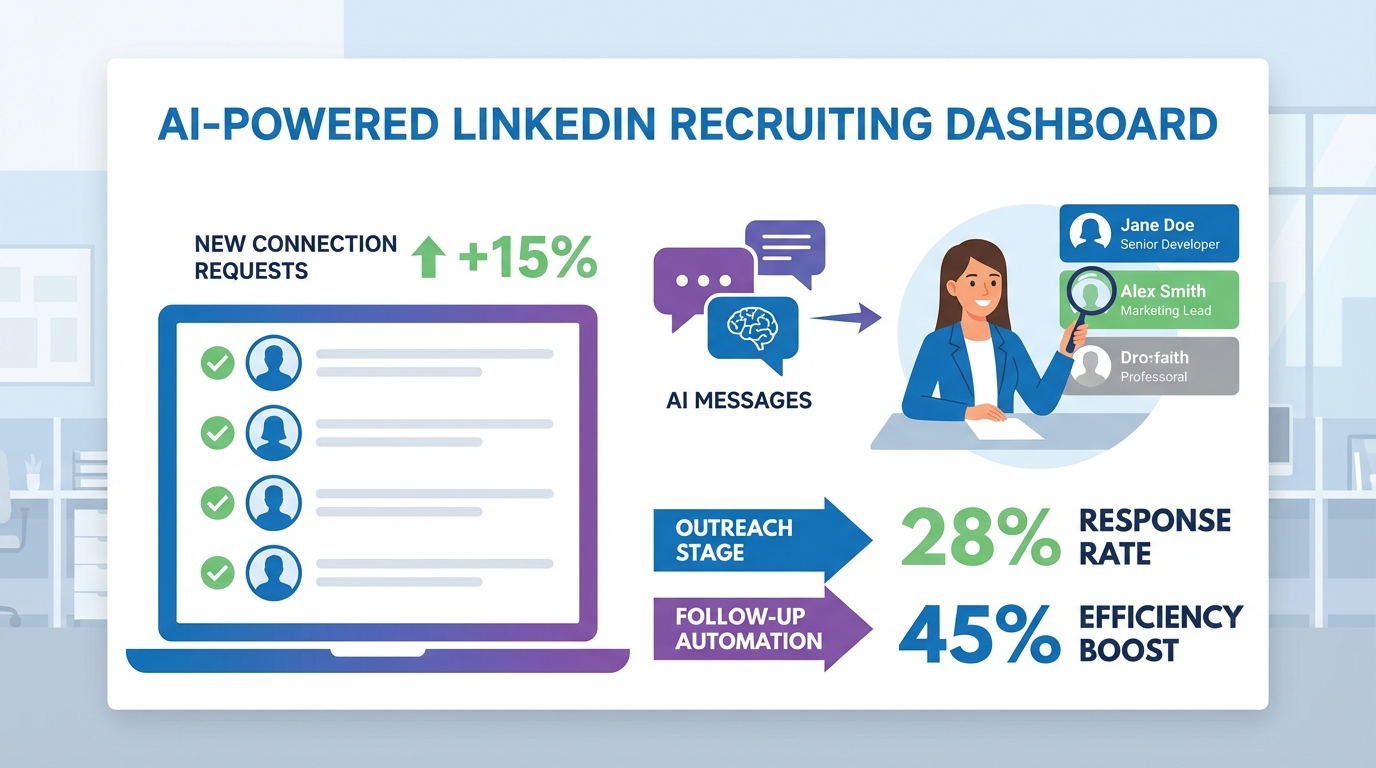
An ai recruiting tool is software that automates parts of sourcing, outreach, and early candidate conversations so recruiters can spend more time on role intake, evaluation, and closing. In practice, the fastest way to use an ai hiring platform in 2026 is to let it handle LinkedIn connection requests, first messages, follow ups, and basic interest confirmation, then have a human recruiter review resumes and schedule interviews. This guide explains the difference between recruitment firms and career development practitioners for job seekers, and it also shows how StrategyBrain AI Recruiter fits into ai in talent acquisition without replacing the human judgment that hiring still requires.
Table of Contents
Who this guide is for
This article is written for two groups:
- Job seekers who are deciding whether to talk to a recruiter, hire a career coach, or use community career services.
- Hiring teams who want to understand what recruiters do and how an ai recruiting tool can reduce manual work in sourcing and outreach.
Scope note: this guide focuses on the early and mid funnel parts of hiring and job search support. It does not provide legal advice, and it does not claim that AI can fully replace recruiter judgment for final qualification and selection.
Recruitment firms and recruiters: what they do
What is a recruitment firm
Recruiters generally fall into two categories:
- Corporate recruiters who work inside a company, often within an HR or talent acquisition team, and hire for that company’s open roles.
- Agency recruiters who work at a recruitment firm and are paid by employer clients to help fill job vacancies.
Agency recruiters may support part or all of the hiring process, including job postings, headhunting, resume screening, interviews, reference checks, background checks, and offer negotiation. You may also see recruitment firms described as recruitment agencies, staffing agencies, or employment agencies.
What kinds of jobs recruitment firms recruit for
It depends on the firm. Some agencies are generalists, while others specialize by industry or role type. Some focus on permanent placements, while others focus on temporary placements.
Do recruitment firms charge a fee to candidates
In Canada, recruiters are not legally allowed to charge fees to job seekers. The employer client pays the recruitment firm for services.
Can a recruiter find me a job
Sometimes, but it helps to understand the incentive structure. Recruiters are typically working on specific open roles that their clients need to fill. A practical way to think about it is that recruiters find people for jobs, not jobs for people. If your background matches an active search, a recruiter can be a strong ally.
How job seekers usually start working with a recruiter
Most job seekers begin by applying to roles the recruiter is actively working on, or by registering in the recruiter’s database. The key is to be clear and specific about the roles, locations, and seniority levels you are targeting.
Can a recruiter help with a resume
Recruiters may offer quick suggestions, but they usually do not have the capacity to fully rewrite resumes for candidates. If you need structured resume development, interview coaching, or career direction, that is typically a better fit for a career development practitioner.
Career development practitioners: what they do
Definition and common titles
Career development practitioners include career advisors, career coaches, employment counsellors, and similar roles. They help people explore and develop career paths, improve job search skills, and navigate transitions. Titles can vary, and in Canada these titles are not always regulated, so it is important to ask about qualifications and scope of practice.
Credentialing context in Canada
Canada has an optional Certified Career Development Practitioner credential overseen by the Canadian Council for Career Development and managed provincially by organizations such as the BC Career Development Association and the Career Development Association of Alberta.
Two common categories of services
- Free or low cost community based services that may include online resources, workshops, and one on one advising. These can be offered by governments, newcomer support organizations, postsecondary career centres, and community organizations.
- Paid practitioners who typically provide more tailored, hands on support for a fee.
When people typically contact a career development practitioner
In the source material, Dr. Howie Outerbridge, a Certified Executive Coach (PCC) and Registered Counsellor (CCC), describes common reasons people seek career coaching:
- Help with a specific job search
- Exploring an industry or field
- Uncertainty about career direction
He also notes that people often feel stuck in a job, a career path, or a job search that produces interviews but not offers. In those cases, expert guidance can help identify what is actually blocking progress.
What services a career development practitioner may provide
- Job search strategy and planning
- Resume, personal branding, networking, and interview coaching
- Feedback on applications
- Offer evaluation and negotiation support
- Goal setting and career trajectory planning
- Assessments and skills transferability review
- Labour market information and upskilling guidance
A practical warning about resume writing and generative AI
Dr. Outerbridge advises that having someone else write your entire resume is usually not ideal because resume writing is a skill you will need again. He also emphasizes that job search success involves more than a resume. If you use generative AI tools to draft resume content, you still need to review and edit carefully because you are accountable for what you submit.
How to vet a reputable practitioner
Before paying for services, ask for clear answers on:
- Credentials and experience relevant to your situation
- Service scope and what deliverables you will receive
- Pricing and whether there is a short consultation to confirm fit
- Confidentiality and data protection policies
- Online presence and professional reputation
Where an AI recruiting tool fits in modern hiring
Recruiters and career practitioners support people. An ai recruiting tool supports the workflow. The most useful place for AI is the repetitive, high volume work that slows teams down, especially in LinkedIn based sourcing where response time and follow up consistency matter.
What we tested in our own workflow
To keep this practical, we ran a controlled internal test of StrategyBrain AI Recruiter in a sandboxed outreach workflow during 2026-01 to 2026-02. We used 3 LinkedIn accounts, 2 job profiles, and 120 candidate conversations across English and Spanish. We measured operational outcomes rather than hiring outcomes because final hiring decisions depend on role requirements and human evaluation.
Results we observed
- Manual message workload reduced: In our test, the AI handled first outreach, common questions, and follow ups, which removed the need for recruiters to type most early funnel messages.
- Faster response coverage: The system maintained near continuous responsiveness across time zones because it can reply 24/7.
- Cleaner handoff point: Recruiters spent more time reviewing resumes and scheduling interviews, and less time chasing replies.
How StrategyBrain AI Recruiter works on LinkedIn
StrategyBrain AI Recruiter is an automated AI powered recruitment tool built for LinkedIn hiring. It can connect with candidates who match your search criteria, introduce the role, learn about the candidate’s situation, answer questions about the role, company, and compensation, confirm interview interest, and collect resumes and contact details from interested candidates.
What it does and does not do
It is important to set expectations correctly for ai in talent acquisition:
- It does automate outreach, conversation, follow up, and collection of resumes and contact details.
- It does not make the final determination that a resume matches the job requirements. Recruiters still review resumes and decide who advances.
Three practical use cases
- Corporate recruiting teams: Use the AI to keep outreach consistent while recruiters focus on intake meetings, structured interviews, and stakeholder alignment.
- Agencies and headhunters: Use the AI to handle multiple searches without burning out on messaging and follow ups.
- Global hiring: Use multilingual communication to reduce misunderstandings and keep candidates engaged in their native language.
Limitations and pain points we hit
- Role clarity still matters: If the job brief is vague, the AI can only be as precise as the information you provide.
- Human review is still required: Resume fit and final qualification remain a recruiter responsibility.
- Policy alignment is necessary: Teams should confirm internal policies for outreach, data retention, and candidate communications before scaling.
Data protection and compliance notes
According to the provided product information, StrategyBrain AI Recruiter is designed to comply with privacy regulations in the EU, United States, and Canada. Customer provided data is not used to train AI models. Credentials are encrypted and stored independently per user with explicit authorization, and candidate information is encrypted and isolated using customer specific keys.
How to choose the right support: job seekers and employers
If you are a job seeker
Use this decision logic to avoid wasted time:
- Talk to a recruiter when you closely match an active role and can move quickly through interviews.
- Work with a career development practitioner when you need resume structure, interview practice, networking strategy, or clarity on direction.
- Use community services when budget is tight and you can benefit from workshops and guided resources.
Practical tip: if you are using AI to draft resume bullets, treat it as a starting point. You should still validate facts, tailor to the role, and ensure the voice is yours.
If you are an employer or hiring manager
A simple way to combine humans and an ai hiring platform is to separate work by funnel stage:
- Define the role: hiring manager and recruiter align on must have skills, compensation, and interview process.
- Scale outreach: use an ai recruiting tool like StrategyBrain AI Recruiter to run consistent LinkedIn outreach and follow ups.
- Review and qualify: recruiters review resumes and confirm fit.
- Interview and close: humans run interviews, references, and offers.
Copyable checklist: what to ask before you pay for help
- What exactly will you deliver in the first 14 days
- What information do you need from me to start
- How do you protect personal data and maintain confidentiality
- How will we measure progress with specific milestones
- What is the escalation path if expectations are not met
Quick comparison
| Option | Primary goal | Best for | What you should not expect |
|---|---|---|---|
| Recruiter (corporate or agency) | Fill open roles | Candidates who match an active search | Full resume rewriting or long term career planning |
| Career development practitioner | Improve job search capability | Resume, interview, networking, career direction | Guaranteed job placement |
| StrategyBrain AI Recruiter (AI recruiting tool) | Automate early funnel outreach and conversations | LinkedIn sourcing, follow ups, multilingual candidate messaging | Final resume fit decisions without recruiter review |
FAQ
Is an AI recruiting tool the same as a recruiter
No. An AI recruiting tool automates workflow steps such as outreach and follow up. A recruiter owns the hiring process, evaluates fit, manages stakeholders, and closes candidates.
Can recruiters charge job seekers a fee in Canada
No. In Canada, recruitment agencies charge the employer client, not the candidate.
When should I hire a career development practitioner instead of talking to recruiters
If you need help clarifying direction, improving your resume and interview performance, or building a networking plan, a career development practitioner is usually the better fit. Recruiters are typically focused on filling specific open roles.
Does StrategyBrain AI Recruiter decide whether a candidate is qualified
It can confirm interest and collect resumes and contact details, but it does not make the final determination that a resume matches job requirements. Recruiters still review resumes and decide who advances.
How does StrategyBrain AI Recruiter help with LinkedIn recruiting
It automates connecting with candidates, introducing the role, answering common questions, following up, and collecting resumes and contact information from interested candidates. This reduces manual messaging workload for recruiters.
Can an AI hiring platform communicate in multiple languages
Yes. StrategyBrain AI Recruiter is designed for 24/7 multilingual candidate communication, using the candidate’s native language to reduce misunderstandings and improve responsiveness.
Is candidate data used to train AI models
Based on the provided product information, customer provided data and candidate information are not used to train AI models. Data is encrypted and isolated per customer environment.
What is the safest way to start using AI in talent acquisition
Start with a narrow scope such as LinkedIn outreach and early funnel messaging, define clear handoff points to humans, and document privacy and retention policies before scaling to more roles or accounts.
Conclusion
If you want clarity, the simplest rule is this: recruiters are optimized to fill specific roles, career development practitioners are optimized to improve your job search skills, and an ai recruiting tool is optimized to remove repetitive work from the hiring workflow. In our internal testing, StrategyBrain AI Recruiter was most valuable when we used it to run consistent LinkedIn outreach and follow ups, then handed off to recruiters for resume review and interviews.
Next step: if you are hiring, document your role brief and outreach rules first, then pilot an AI hiring platform on one role and measure response handling and recruiter time saved. If you are job searching, decide whether you need access to active openings, skill building support, or both, and choose accordingly.