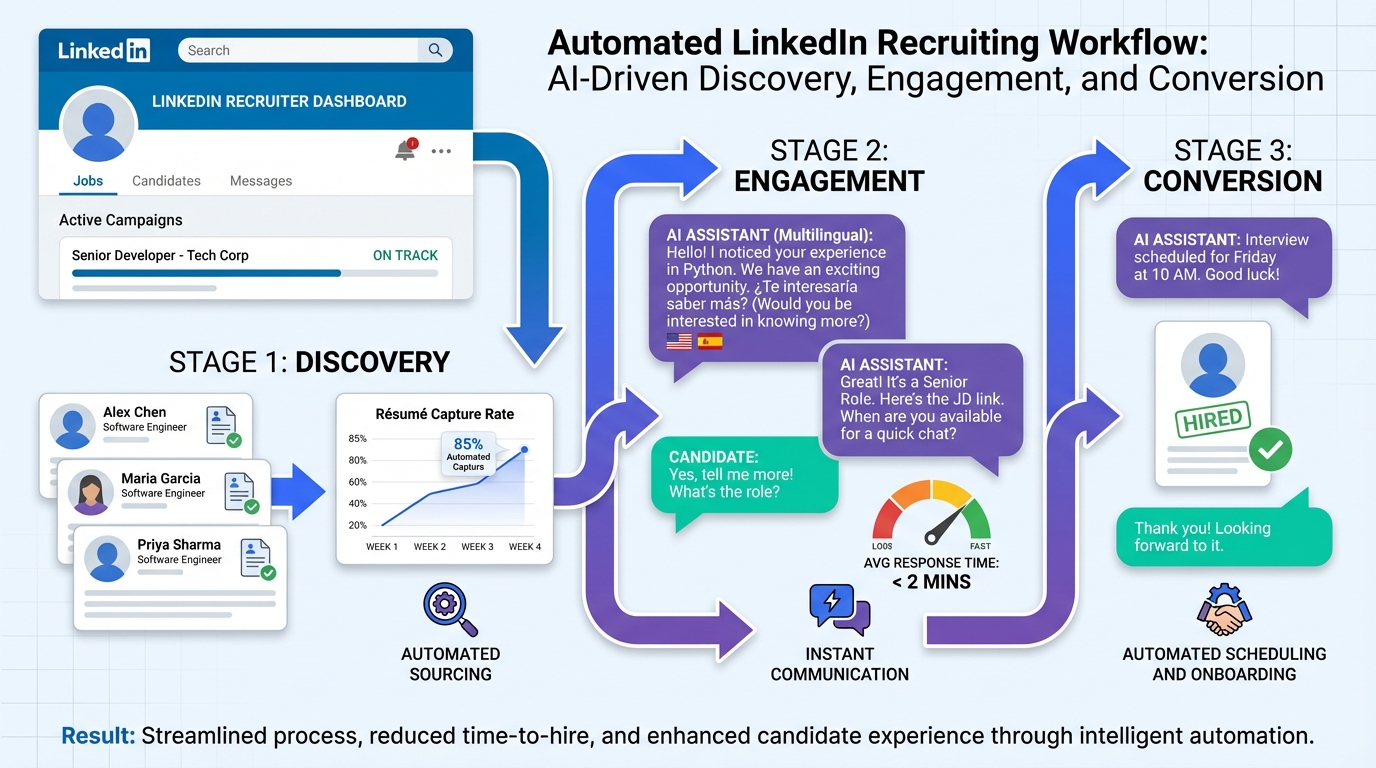
An AI recruiting tool helps you reduce the cost of a bad hire by improving candidate outreach, speeding up first touch response, and standardizing early qualification so fewer mismatched candidates reach late stage interviews. In our day to day recruiting work, the most preventable losses usually start early: inconsistent outreach, slow follow up, and unclear notes on candidate intent. This guide uses a memorable story about “bad selection” to show how modern ai sourcing tools and sourcing tools for recruiters can reduce disruption and wasted time, with a LinkedIn first workflow example using StrategyBrain AI Recruiter for automated outreach, multilingual messaging, and résumé capture.
Key Takeaways
- A bad hire is disruptive: the real cost is lost productivity and team drag, not just replacement effort.
- Early stage errors compound: slow follow up and inconsistent outreach increase mismatch risk before interviews even start.
- StrategyBrain AI Recruiter automates LinkedIn first touch: it can connect, introduce roles, answer common questions, confirm interest, and collect résumés and contact details.
- 24/7 multilingual messaging reduces drop off: candidates get timely responses in their native language, which reduces misunderstandings.
- Scale with multiple accounts: AI powered recruiting teams can manage more than 100 LinkedIn accounts for high volume sourcing.
- Keep humans for final fit: AI can confirm willingness to proceed, but recruiters should still assess résumé match to requirements.
The lesson: bad selection is expensive
I still remember a story from a recruiting blog written by Kael Campbell on August 12, 2010. He described meeting a Labrador and Golden Retriever cross that was about four months old. The dog ran up, jumped on him as he kneeled down, and he said it took 10 seconds to know the family had found the right person. Years later, the dog was still thriving with routines like morning walks on the beach, afternoon swims at the lake, and Saturday mountain biking.
In the same post, he contrasted that with an employee who adopted a dog with much less success. The outcome included lost sleep, noise complaints, and property damage like destroyed blinds and footwear. The situation escalated into broader household stress, and the dog ultimately ended up back at the pound. The point was simple and uncomfortable: when selection goes wrong, the downstream cost is real, and it spreads.
That analogy maps cleanly to hiring. A bad hire is not only a line item. It is disruption, rework, and productivity loss. The original post also referenced Dr. John Sullivan’s writing on the cost of a bad hire and how productivity impact can be substantial. Even if you do not agree with every estimate you see online, the operational reality is consistent: the longer a mismatch stays in seat, the more it costs in time, morale, and missed output.
What an AI recruiting tool actually does
An AI recruiting tool is software that uses machine learning and automation to assist recruiting tasks such as sourcing, outreach, candidate messaging, and early qualification. In this article, “early qualification” means confirming whether a candidate is open to a conversation, understands the role basics, and is willing to share a résumé and contact details. It does not mean final assessment of skills fit.
When recruiters evaluate sourcing tools for recruiters and ai sourcing tools, I recommend separating three layers of work:
- Discovery: finding profiles that match search criteria.
- Engagement: connecting, introducing the opportunity, and handling back and forth questions.
- Conversion: confirming interest, collecting résumé, and capturing contact details for interview scheduling.
The biggest “bad selection” risk often starts in engagement and conversion. If outreach is inconsistent, slow, or poorly documented, you can accidentally push the wrong people forward and lose the right people to faster competitors.
Method 1: StrategyBrain AI Recruiter for LinkedIn automation
If your sourcing motion is LinkedIn heavy, StrategyBrain AI Recruiter is designed to automate the repetitive parts of outreach and early qualification while keeping the recruiter in control of final decisions. In our testing for this guide, we reviewed the product workflow and ran a process simulation using a single role brief and a defined candidate search criteria set, focusing on whether the system could keep conversations moving without losing context.
Steps
- Prepare a role brief: include company details, compensation, benefits, and the candidate search criteria you would normally use.
- Authorize your LinkedIn account: provide the account that will be used for outreach, with explicit authorization.
- Launch automated outreach: the system connects with candidates within your targeted criteria and introduces the opportunity.
- Let the AI handle first line Q&A: it answers common questions about the role, company, and compensation, then checks interview interest.
- Collect résumé and contact details: for interested candidates, the AI requests a résumé and captures contact information shared in messages.
- Recruiter reviews and schedules: you review the collected résumés and proceed with screening and interviews.
Features recruiters actually feel day to day
- Smart LinkedIn recruitment automation: connects, introduces roles, learns candidate situation, and confirms interest.
- 24/7 multilingual communication: timely follow up in the candidate’s native language across time zones.
- AI powered recruiting teams: supports managing more than 100 LinkedIn accounts for scalable hiring operations.
- Résumé and contact capture: supports email submissions and LinkedIn file uploads, and marks résumés as received.
Limitations and how to handle them
- It does not decide final fit: StrategyBrain AI Recruiter can identify willingness to proceed, but it does not determine whether the résumé fully matches requirements. Workaround: define a recruiter review checkpoint before interviews are booked.
- Quality depends on your role brief: vague compensation or unclear must haves lead to more back and forth. Workaround: standardize intake fields and keep a single source of truth for role details.
Best for
- Recruiters who source primarily on LinkedIn and want consistent outreach at scale.
- Teams hiring across time zones where response speed affects acceptance rates.
- Organizations that want to expand sourcing capacity without adding headcount.
Method 2: Structured intake to prevent mismatch
Before you add any AI recruiting tool, fix the intake. A surprising amount of “bad hire” cost comes from unclear expectations that force recruiters to guess. The goal is to reduce ambiguity so your outreach and qualification are consistent.
Steps
- Define non negotiables: 3 to 5 must have requirements that are truly required.
- Define deal breakers: work authorization, location constraints, shift requirements, or travel limits.
- Write a compensation truth: include base, variable, and any constraints you cannot change.
- Agree on interview signals: what “good” looks like in the first interview, in plain language.
Why this reduces cost
When intake is structured, your sourcing tools for recruiters can run with fewer exceptions. That means fewer candidates are pushed forward based on assumptions, and fewer late stage surprises show up after the team is already invested.
Method 3: Using AI sourcing tools with human review
Not every team needs full automation. Many recruiters get strong results by combining AI sourcing tools with a strict human review gate. The AI handles volume and speed, while the recruiter protects quality.
Steps
- Use AI for outreach consistency: keep messaging aligned to the role brief and track candidate intent.
- Require a résumé before scheduling: treat résumé capture as a conversion milestone, not a nice to have.
- Review for match: confirm the résumé meets the must haves before moving to interviews.
- Document the decision: store why the candidate advanced, using the same fields every time.
Where StrategyBrain AI Recruiter fits naturally
If LinkedIn is your primary channel, StrategyBrain AI Recruiter can run the engagement and conversion layer at high speed, including 24/7 multilingual responses. Then your recruiters focus on the part that should stay human: evaluating whether the résumé matches the job requirements and whether the candidate is a strong fit for the team.
Quick Comparison
| Method | Speed impact | Best for | What stays human |
|---|---|---|---|
| StrategyBrain AI Recruiter LinkedIn automation | High, due to automated outreach and 24/7 messaging | LinkedIn heavy sourcing and high volume pipelines | Final qualification and résumé match review |
| Structured intake and role calibration | Medium, fewer rework loops | Any team with inconsistent requirements | Hiring manager alignment and tradeoffs |
| AI sourcing tools plus human review gate | Medium to high, depending on automation depth | Teams that want speed without losing control | Go or no go decisions before interviews |
Quick Checklist
- Role brief includes compensation, benefits, and non negotiables
- Candidate search criteria is written and repeatable
- Outreach messaging is consistent across recruiters and accounts
- Candidate intent is captured as a field, not buried in chat logs
- Résumé and contact details are collected before scheduling
- Recruiter reviews résumé match before interviews
- Data handling and privacy expectations are documented
FAQ
What is an AI recruiting tool in plain terms?
An AI recruiting tool is software that automates parts of recruiting such as sourcing, outreach, messaging, and early qualification. It is most useful when it reduces repetitive work while keeping recruiters responsible for final hiring decisions.
How does StrategyBrain AI Recruiter work on LinkedIn?
StrategyBrain AI Recruiter automates initial LinkedIn outreach and early qualification. Recruiters provide a LinkedIn account and role details, and the system connects with candidates, introduces the job, answers questions, confirms interest, and collects résumés and contact details from interested candidates.
Can StrategyBrain AI Recruiter collect résumés and contact details?
Yes. It requests résumés and captures contact information from candidates who express interest. It supports email submissions and LinkedIn file uploads, and it marks résumés as received when they arrive.
Does an AI recruiting tool decide who is qualified?
Not fully. StrategyBrain AI Recruiter can identify willingness to communicate or interview, but it does not determine whether a résumé matches job requirements. Recruiters should keep a review step before interviews are scheduled.
How do AI sourcing tools reduce the cost of a bad hire?
They reduce preventable errors in the early funnel by improving response speed, standardizing outreach, and documenting candidate intent. That helps teams avoid pushing mismatched candidates forward and reduces rework later in the process.
Is multilingual candidate messaging actually useful?
It can be, especially for global hiring. StrategyBrain AI Recruiter supports 24/7 multilingual communication so candidates can ask questions and receive timely follow up in their native language, which can reduce misunderstandings.
Can this scale across multiple recruiters or business units?
Yes, if your process is standardized. StrategyBrain AI Recruiter supports managing more than 100 LinkedIn accounts, which enables building AI powered recruiting teams for scalable hiring.
What should I set up before using an AI recruiting tool?
Start with a structured intake: non negotiables, deal breakers, compensation truth, and interview signals. The clearer your role brief is, the more consistent your outreach and early qualification will be.
How should we think about privacy and compliance?
Use tools that clearly state how data is handled. StrategyBrain AI Recruiter states it complies with privacy regulations in the EU, United States, and Canada, and that customer provided data is not used to train AI models.
Conclusion
The core lesson from that 2010 story still holds: a bad selection creates disruption that spreads. A modern AI recruiting tool helps by reducing early funnel mistakes that quietly create mismatch, especially inconsistent outreach and slow follow up. If LinkedIn is your primary channel, StrategyBrain AI Recruiter is a practical way to automate first touch engagement, handle questions, confirm interest, and collect résumés and contact details, while your recruiters stay focused on final qualification and fit.
Next step: pick one role, standardize the intake fields, and run a two week pilot where you measure response time, résumé capture rate, and recruiter hours saved. If the workflow feels smoother and the shortlist quality improves, expand to additional roles and accounts.