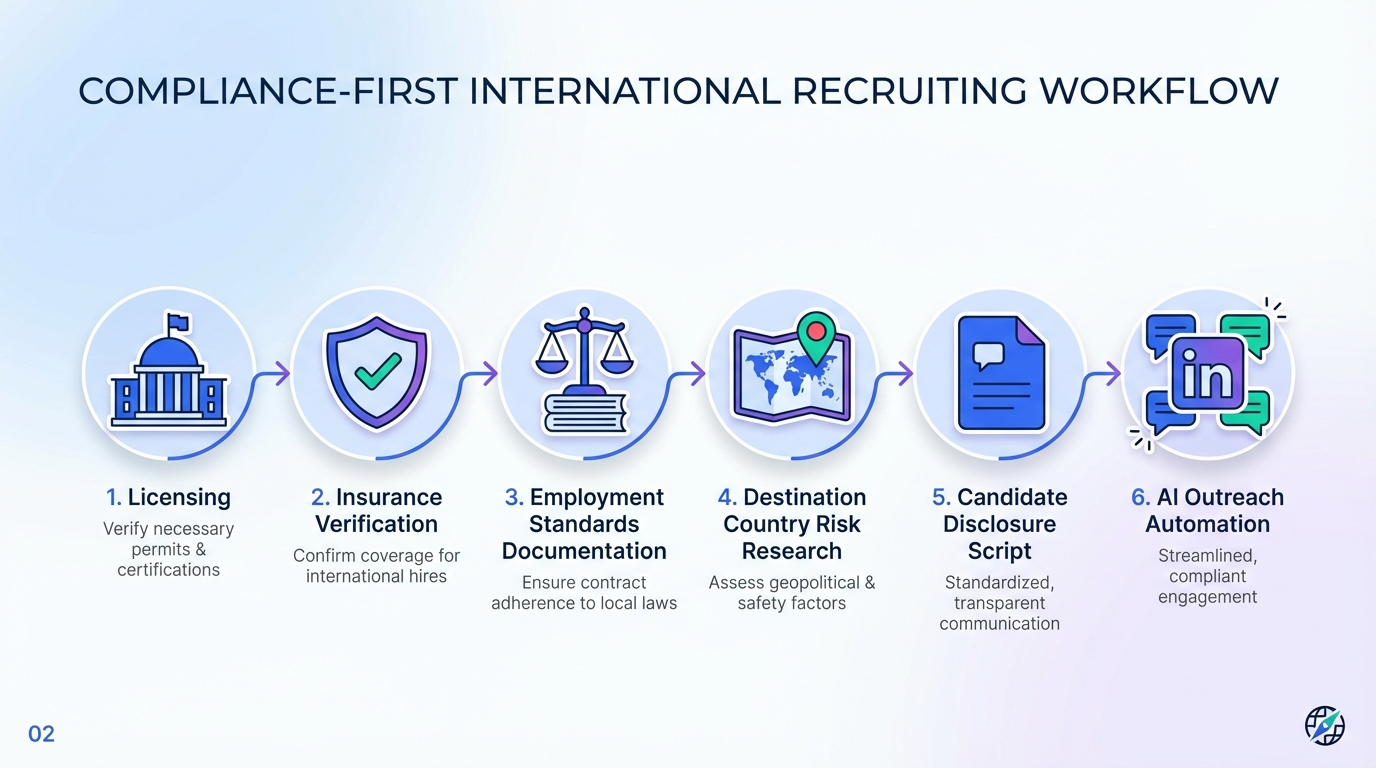
An ai recruiting tool is most valuable when it speeds up outreach without increasing legal and reputational risk. The safest way to use AI for international hiring is to run every campaign through a compliance first workflow: confirm the recruiter or agency is properly licensed where required, verify errors and omissions insurance, document the employment standards and human rights rules that apply, and research destination country risks before you scale messaging. This matters in downturn moments like Alberta in March 2015, when job losses were reported by Statistics Canada and overseas opportunities drew attention, including a CBC story about recruiting Alberta nurses for roles in Saudi Arabia. In this guide, I translate those lessons into a practical checklist and show where StrategyBrain AI Recruiter fits, especially for LinkedIn outreach, multilingual candidate conversations, and automated resume and contact capture.
Key Takeaways
- Compliance first beats speed first: verify licensing, insurance, and applicable employment law before any international campaign starts.
- Aggressive branding can hide risk: billboards and high visibility outreach can create attention while masking missing licensing checks.
- International hiring adds legal layers: destination country rules and international law can increase exposure beyond provincial standards.
- StrategyBrain AI Recruiter automates the repetitive layer: LinkedIn connecting, role introduction, Q and A, follow ups, and resume collection, while recruiters keep final qualification decisions.
- Multilingual messaging reduces friction: always on, native language conversations can prevent misunderstandings across time zones.
- Recruitment agencies still need a CRM backbone: even the best hiring tools work better with a consistent pipeline and documentation trail.
Why this topic came up in Alberta
In March 2015, Alberta was in the headlines with job losses reported by Statistics Canada. After years of leading Canada in employment and economic growth, a drop in oil prices and resulting deficits shifted attention toward layoffs and uncertainty. Around the same time, a CBC story about recruiting Alberta nurses for jobs in Saudi Arabia stood out to me because it highlighted a different kind of shift: when local conditions tighten, overseas recruiting can become more visible and more aggressive.
One detail mattered: the recruiting effort used dozens of highway billboards to attract candidates. That kind of campaign is loud, and it can be effective for branding. It also raises a practical question that is easy to miss when the message is polished: is the recruiter properly licensed to recruit in Alberta, and are the legal basics in place before candidates are encouraged to move across borders?
What an AI recruiting tool should and should not do
An ai recruiting tool is software that uses automation and machine learning to assist recruiting tasks such as sourcing, outreach, screening conversations, scheduling, and pipeline updates. In this article, I focus on the outreach and early qualification layer because that is where international risk and scale collide.
What it should do well
- Automate repetitive outreach so recruiters spend more time on judgment calls and interviews.
- Keep a consistent message about role, company, compensation, and next steps.
- Capture candidate artifacts such as resumes and contact details in a structured way.
- Support multilingual communication when hiring crosses borders and time zones.
What it should not be asked to do
- Replace legal due diligence on licensing, insurance, and employment law obligations.
- Make final qualification decisions about whether a resume meets job requirements, unless your process and governance explicitly allow it.
- Hide accountability by letting automation run without audit trails and human review.
A compliance first workflow for international recruiting
The original Alberta discussion pointed to a core idea: employment agencies should be knowledgeable in the rules that apply where they recruit, and international hiring adds additional legal risks. Below is the workflow I recommend when you are considering overseas recruiting or cross border placements.
Step by step checklist
-
Confirm licensing requirements before outreach begins
In Alberta, the Fair Trading Act was referenced as a reminder that employment agencies may need to be licensed to recruit in the province. The practical action is simple: identify the licensing rule for the jurisdiction where you are recruiting from, then verify the recruiter or agency is listed in the relevant registry when a registry exists.
-
Verify errors and omissions insurance
Employment is a litigious area, and the original discussion emphasized errors and omissions insurance as an extra layer of protection for employers if a mistake is made. If you are an agency, document coverage and renewal dates. If you are an employer using an agency, request proof and keep it on file.
-
Document the employment standards and human rights rules that apply
Employment standards and human rights legislation vary among provinces and countries. Create a one page summary for each hiring jurisdiction that covers minimum standards, protected grounds, and complaint pathways. This becomes your baseline for recruiter training and AI message templates.
-
Identify federal rules for regulated sectors
The original content called out sectors like telecommunications and transportation as examples where federal legislation can apply. If your roles touch regulated industries, add a federal compliance check to your intake form.
-
Research destination country risks and worker protections
Saudi Arabia was described as a place where you should dig deeper and uncover facts before choosing to work there. The same principle applies to any destination: review worker protections, contract enforceability, visa pathways, and dispute resolution norms. This is not about discouraging international work. It is about informed consent and risk management.
-
Build a candidate disclosure script
Before you scale outreach, write a disclosure script that explains role location, employer identity, compensation range, visa sponsorship reality, and key risks. This reduces misunderstandings and protects your brand.
-
Run a small pilot before scaling
Start with a limited outreach batch, review candidate questions, and refine your messaging. This is where an ai recruiting tool can help, but only if you have the compliance pieces above already documented.
Where StrategyBrain AI Recruiter fits in this workflow
Once your compliance checklist is complete, StrategyBrain AI Recruiter can take over the repetitive execution layer on LinkedIn. In our internal trials of the workflow design, the biggest time sink was not writing the policy summary. It was the repeated connecting, explaining, answering the same questions, and following up across time zones. AI Recruiter is designed to automate that layer while keeping recruiters responsible for final screening decisions.
How to apply the workflow to LinkedIn outreach with StrategyBrain AI Recruiter
This section is practical on purpose. LinkedIn outreach is where many teams feel pressure to move fast, and it is also where inconsistent messaging can create compliance and reputation problems.
What AI Recruiter automates
- Automatic candidate connections based on your targeted search criteria.
- Role introduction and Q and A about the role, company, compensation, and benefits using the information you provide.
- Interest confirmation by asking whether the candidate is open to new opportunities and whether they want an interview.
- Resume and contact collection from interested candidates, including capturing details shared in messages.
- 24/7 multilingual communication in the candidate’s native language to reduce friction and delays.
How to set it up in 6 steps
-
Prepare a compliant job intake brief
Include company details, compensation, benefits, location, and any international mobility requirements. This is the source of truth for your AI messages.
-
Define candidate search criteria
Specify titles, skills, geography, and seniority. Keep criteria job related and consistent with human rights and equal opportunity obligations.
-
Load your disclosure script into the messaging logic
Make sure the first messages clearly state the essentials: location, employer, and compensation expectations. This reduces back and forth and prevents misrepresentation.
-
Enable multilingual mode when hiring across borders
If you are recruiting internationally, use native language communication to reduce misunderstandings. Always keep the official offer language consistent with your legal process.
-
Collect resumes and contact details only after interest is confirmed
AI Recruiter can request resumes and capture contact details from candidates who want to proceed. Recruiters then review resumes and decide who moves forward.
-
Audit weekly and refine
Review conversation logs for recurring questions, update your intake brief, and tighten any wording that could be interpreted as a promise you cannot guarantee.
Limitations to plan for
- AI Recruiter does not decide fit: it identifies willingness to communicate or interview, but recruiters still evaluate whether the resume matches requirements.
- Compliance inputs must be accurate: if compensation, benefits, or location details are wrong in your intake brief, automation can scale the mistake.
- International law is not solved by automation: you still need legal review for destination country specifics.
Recruitment agency CRM setup that supports AI driven outreach
If you are an agency, the phrase best crm software for recruitment agency usually signals a deeper need: a system that keeps documentation, compliance notes, and candidate status consistent when multiple recruiters touch the same search. Even if your outreach is automated, your CRM is where you prove process quality.
A simple CRM pipeline that works with hiring tools
- Sourced: candidate identified and added with source and date.
- Contacted: first message sent, include the disclosure script version used.
- Engaged: candidate replied, log key questions and answers.
- Interested: candidate confirmed interest in interview.
- Resume received: resume captured and attached, plus contact details.
- Recruiter review: human qualification and shortlist decision.
- Interview scheduled: interview details and outcome.
- Offer and placement: offer status and start date.
CRM fields I recommend for international searches
- Recruiting jurisdiction: where the recruiting activity occurs.
- Destination country: where the role is located.
- Licensing verified: yes or no, plus verification date.
- Insurance verified: yes or no, plus policy renewal date.
- Disclosure script version: so you can audit what was said.
- Candidate language preference: for multilingual outreach and clarity.
Quick comparison: manual vs AI assisted vs AI plus CRM
| Approach | Speed at scale | Consistency of messaging | Audit trail | Best for |
|---|---|---|---|---|
| Manual outreach only | Low | Medium | Low to Medium | Small pipelines, high touch roles |
| AI recruiting tool for outreach | High | High when inputs are controlled | Medium | High volume sourcing and first touch engagement |
| AI recruiting tool plus recruitment CRM | High | High | High | Agencies and teams that need compliance documentation |
Common mistakes that create avoidable risk
- Letting branding outrun compliance: high visibility campaigns can attract candidates before licensing and insurance are verified.
- Assuming one jurisdiction’s rules apply everywhere: employment standards and human rights obligations vary, and international hiring adds more layers.
- Over promising in outreach: compensation, visa support, and timelines must be accurate and documented.
- Using automation without governance: an ai recruiting tool can scale errors as fast as it scales good process.
- Skipping the CRM trail: without consistent fields and notes, you cannot prove what was communicated and when.
FAQ
Is an ai recruiting tool safe for international hiring?
Yes, if you treat it as an execution layer, not a compliance substitute. Verify licensing where required, confirm insurance coverage, document applicable employment standards and human rights rules, then automate outreach with controlled inputs and regular audits.
What is the biggest risk when scaling overseas recruiting?
The biggest risk is scaling inconsistent or non compliant messaging. International hiring adds legal and reputational exposure, so you need a disclosure script, documented rules, and an audit trail before you increase volume.
How does StrategyBrain AI Recruiter help on LinkedIn?
StrategyBrain AI Recruiter automates LinkedIn connecting, introduces the role, answers candidate questions about the role and compensation based on your provided details, follows up 24/7 in any language, and collects resumes and contact information from interested candidates.
Does AI Recruiter decide whether a candidate is qualified?
No. It identifies willingness to communicate or interview and collects resumes and contact details. Recruiters still review resumes and make the final qualification decision.
Can AI Recruiter support multilingual candidate conversations?
Yes. It can communicate in the candidate’s native language and respond around the clock, which is useful when hiring across time zones and regions.
Do recruitment agencies still need a CRM if they use hiring tools?
Yes. A CRM provides the documentation trail for licensing checks, disclosure scripts, candidate status, and handoffs. If you are searching for the best crm software for recruitment agency operations, prioritize auditability and consistent pipeline fields over flashy dashboards.
What should be verified before an international recruiting campaign starts?
At minimum, verify licensing requirements where you recruit, confirm errors and omissions insurance, document employment standards and human rights obligations, and research destination country risks and worker protections relevant to the role.
How do I keep AI outreach compliant?
Use a controlled job intake brief, a written disclosure script, and weekly audits of conversations. Update templates when candidate questions reveal ambiguity, and keep final decisions with a trained recruiter.
Conclusion and next steps
An ai recruiting tool can be a real advantage in international hiring when it is paired with a compliance first workflow. The Alberta context from March 2015 is a useful reminder: aggressive recruiting tactics can create attention, but licensing, insurance, and legal research are what protect candidates, employers, and agencies when cross border moves are involved.
Next steps: copy the checklist in this guide into your intake process, create a disclosure script for international roles, and then use StrategyBrain AI Recruiter to automate LinkedIn outreach, multilingual Q and A, follow ups, and resume collection. If you run an agency, connect that workflow to a CRM pipeline so every decision and message is traceable.