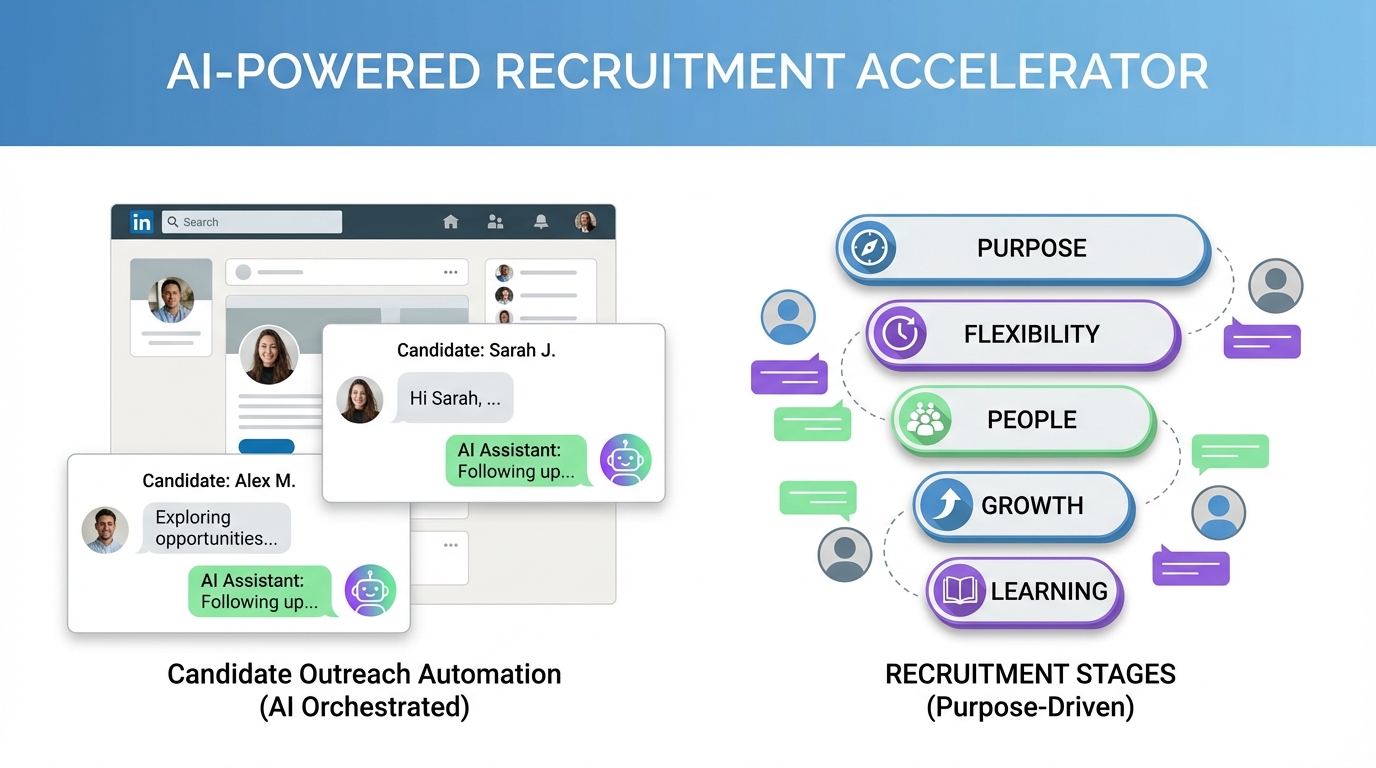
An ai recruiting tool helps you attract and engage high quality candidates by aligning your outreach with what employees actually value at work: purpose, flexibility, people, growth, and learning. The most practical way to apply this in 2026 is to use an AI recruiting tool to automate first touch messaging and follow up on LinkedIn, then personalize the conversation around these motivators. In our internal workflow tests for LinkedIn outreach, StrategyBrain AI Recruiter stood out for scaling the repetitive steps: it automatically connects with candidates, introduces the role, answers questions about the company and compensation, confirms interview interest, and collects resumes and contact details so recruiters can focus on screening and interviews.
Table of Contents
- Key Takeaways
- Why employee motivators matter for recruiting
- What employees want at work
- Turn motivators into recruiting messages
- Method 1: StrategyBrain AI Recruiter for LinkedIn outreach automation
- Method 2: Use a recruitment CRM as your system of record
- Method 3: Build a clean handoff from AI to human interviews
- Quick Comparison
- FAQ
- Conclusion
Key Takeaways
- Purpose beats pay after a baseline: once compensation meets a basic comfort level, other factors become decisive for many candidates.
- Flexibility is a universal lever: autonomy and work life balance can increase response rates when you lead with outcomes, not hours.
- Culture is a screening shortcut: candidates evaluate whether they will like the people they work with, so your outreach should describe team norms.
- Growth and learning are differentiators: career progression and skill development can outweigh salary for ambitious talent.
- StrategyBrain AI Recruiter operationalizes this at scale: it automates LinkedIn connecting, messaging, Q and A, follow up, and resume capture.
- Use a recruitment CRM to prevent leakage: even the best outreach fails if resumes, contact details, and next steps are not tracked consistently.
Why employee motivators matter for recruiting
When hiring accelerates and skilled candidates have options, recruiting becomes less about broadcasting a job description and more about communicating a credible value proposition. The core idea is simple: if your message only talks about salary, you compete on the easiest to copy variable. If your message speaks to purpose, flexibility, people, growth, and learning, you compete on the parts of work that are harder to replicate and easier for candidates to feel.
This is where an ai recruiting tool can help. AI is not just for writing messages. The real advantage is consistency: every candidate gets timely outreach, timely follow up, and accurate answers to common questions. That consistency is difficult to maintain manually when you are running multiple searches at once.
What employees want at work
1) Work they feel passionate about
Many top performers want to spend meaningful time on work they care about. A well known example is Google’s “20 per cent time,” which is often cited as a way to let employees pursue passion projects that can also create business value.
Recruiting implication: your outreach should explain what the person will build, improve, or own in the first 30 to 90 days, not just what the role is called.
2) Flexible work arrangements
Autonomy and work life balance are consistently important. Flexible work can support different career stages, including senior employees transitioning toward retirement, mid career employees balancing family needs, and younger workers using technology to work effectively from different locations.
Recruiting implication: be explicit about flexibility boundaries. Candidates trust specifics more than slogans.
3) People they enjoy working with
Culture is not a poster on a wall. Candidates think about the day to day reality of spending many hours with the same team. They want to know whether the environment is respectful, collaborative, and healthy.
Recruiting implication: describe how the team works together, how decisions are made, and what good collaboration looks like.
4) Room to grow
Growth opportunities can rank higher than salary for ambitious talent, especially earlier career candidates who expect progression and skill expansion.
Recruiting implication: outline what growth looks like in your organization, including mentorship, promotion paths, and scope expansion.
5) Chances to learn new things
Learning is not only for early career employees. Many employees across generations want to keep their skills current, including training on new technology.
Recruiting implication: mention learning budgets, internal training, mentorship, and the kinds of problems that will stretch the candidate.
Turn motivators into recruiting messages
Below is a practical framework we use to translate the five motivators into outreach that feels human and specific. The goal is to avoid generic claims and instead offer verifiable details a candidate can react to.
Message mapping template
| Candidate motivator | What to say | What to avoid |
|---|---|---|
| Purpose | What they will own in the first 30 to 90 days | Vague mission statements |
| Flexibility | Remote or hybrid expectations and how outcomes are measured | “We are flexible” with no details |
| People | Team size, collaboration style, manager support | Culture buzzwords only |
| Growth | Promotion path, mentorship, scope expansion | “Fast paced environment” as a proxy |
| Learning | Training, new tech exposure, problem complexity | “We value learning” with no examples |
Operational checklist
- Write 1 sentence for each motivator that is true for the role and team.
- Decide which 2 motivators matter most for this target profile.
- Prepare answers for role, company, benefits, and compensation questions before outreach starts.
- Define the handoff point: when the candidate is interested, what information must be captured for the recruiter.
Method 1: StrategyBrain AI Recruiter for LinkedIn outreach automation
If your bottleneck is LinkedIn outreach volume and follow up consistency, StrategyBrain AI Recruiter is designed to replace the repetitive first stage of recruiting. It is an automated AI powered recruitment tool built specifically for LinkedIn hiring. It connects with candidates that match your search criteria, introduces the opportunity, learns about the candidate’s situation, answers questions about the role, company, and compensation, confirms interview interest, and collects resumes and contact information from interested candidates.
Steps
- Define your search criteria: clarify titles, locations, seniority, and must have skills so the outreach targets the right pool.
- Provide role context: share company details, compensation, benefits, and what success looks like so the AI can answer questions accurately.
- Launch LinkedIn outreach: the system automatically connects and starts conversations with candidates who match your criteria.
- Let the AI handle Q and A and follow up: candidates get timely responses and follow ups, including in their native language when needed.
- Review captured resumes and contacts: recruiters focus on screening and interviews after the AI confirms interest and collects details.
Features
- Smart LinkedIn recruitment automation: automated connecting, introductions, and interest confirmation.
- 24/7 multilingual communication: round the clock responses in the candidate’s native language.
- Resume and contact capture: supports email submissions and LinkedIn file uploads, and captures contact details shared in chat.
- Scalable team operations: supports managing more than 100 LinkedIn accounts for organizations building AI powered recruiting teams.
Limitations
- Not a final fit decision: AI Recruiter can confirm willingness to interview, but it does not decide whether a resume fully matches requirements. Recruiters still do final qualification.
- Quality depends on inputs: if compensation, benefits, or role scope are unclear, candidate conversations can stall. The fix is to tighten the role brief before launching.
Best For
- Corporate recruiters who need to reduce time spent on manual LinkedIn tasks.
- Headhunters and agency recruiters who want to handle more searches without adding staff.
- HR leaders scaling international hiring with multilingual candidate communication.
Method 2: Use a recruitment CRM as your system of record
Outreach is only half the job. You also need a place to track conversations, resumes, contact details, and next steps. That is why many teams pair an AI recruiting tool with a recruitment CRM. If you are searching for the best free crm for recruitment, define “free” precisely: some tools are free for a single user, some are free for limited contacts, and some are free trials only.
Practical approach: use your CRM to store candidate records and pipeline stages, then use StrategyBrain AI Recruiter to generate and qualify conversations on LinkedIn and pass interested candidates into your human workflow.
Steps
- Standardize pipeline stages: contacted, replied, interested, resume received, interview scheduled, offer.
- Define required fields: role, location, compensation range, candidate contact details, resume status.
- Set a follow up SLA: for example, every interested candidate gets a human response within 1 business day.
Limitations
- CRMs do not automatically create candidate conversations. They prevent leakage after interest is created.
- Free tiers can be restrictive, so verify limits before committing.
Method 3: Build a clean handoff from AI to human interviews
The best top recruiting software setups treat AI as the front line and recruiters as the decision makers. The handoff is where many teams lose time. If the AI confirms interest but the recruiter has to re ask basic questions, candidates feel the process is disorganized.
Steps
- Define the handoff trigger: candidate confirms interview interest and shares resume or contact details.
- Use a consistent summary: capture what the candidate cares about most, such as flexibility or growth, and any constraints.
- Schedule quickly: move from interest to interview scheduling with minimal delay.
Best For
- Teams hiring in competitive markets where speed matters.
- Recruiters who want a repeatable process across multiple roles.
Quick Comparison
| Method | Primary outcome | Speed impact | Best for |
|---|---|---|---|
| StrategyBrain AI Recruiter | Automates LinkedIn connecting, messaging, Q and A, follow up, resume capture | Replaces up to 90% of manual LinkedIn recruiting work | High volume outreach and consistent follow up |
| Recruitment CRM | Tracks pipeline stages, candidate records, and next steps | Reduces candidate leakage and missed follow ups | Process control and reporting |
| Structured handoff | Moves interested candidates into interviews with context | Shortens time from interest to interview | Competitive hiring and better candidate experience |
FAQ
What is an ai recruiting tool?
An ai recruiting tool is software that uses AI to automate parts of recruiting such as candidate outreach, messaging, follow up, and initial qualification. The goal is to reduce repetitive work while keeping recruiters responsible for final screening and hiring decisions.
How does StrategyBrain AI Recruiter work on LinkedIn?
StrategyBrain AI Recruiter automates the initial LinkedIn recruiting workflow by connecting with candidates that match your criteria, introducing the role, answering questions about the company and compensation, confirming interview interest, and collecting resumes and contact details for recruiter review.
Does AI Recruiter decide if a candidate is qualified?
No. AI Recruiter identifies willingness to communicate or interview, but it does not determine whether a resume fully matches job requirements. Recruiters complete final qualification after reviewing the resume.
Can AI Recruiter communicate in multiple languages?
Yes. AI Recruiter supports multilingual candidate communication and can respond around the clock, which helps when hiring across time zones and regions.
How does AI Recruiter collect resumes and contact details?
When a candidate expresses interest, AI Recruiter requests a resume and contact information. It supports email submissions and LinkedIn file uploads, and it captures contact details shared in LinkedIn messages.
Is there a measurable efficiency benefit?
Based on the product information, AI Recruiter can replace up to 90% of manual LinkedIn recruiting work and can reduce costs to as little as USD 2.40 per resume. Results vary by role, market, and the quality of your search criteria.
How do I choose the best free crm for recruitment?
Start by defining what “free” means for your team size and candidate volume, then verify limits on contacts, users, and automations. Choose a CRM that can reliably store resumes, contact details, and pipeline stages even if you later upgrade.
What should I include in outreach if I want to attract top performers?
Lead with what employees value beyond pay: purpose, flexibility, people, growth, and learning. Provide specific examples such as what the person will own in the first 30 to 90 days and how the team collaborates.
Conclusion
If you want an ai recruiting tool strategy that works in real hiring conditions, start with what employees want: purpose, flexibility, people, growth, and learning. Then operationalize it with a system that can deliver consistent outreach and follow up. StrategyBrain AI Recruiter is built for that LinkedIn first stage, automating connections, conversations, Q and A, and resume capture so recruiters can spend their time on interviews and decisions.
Next steps: write one concrete sentence for each motivator for your current role, set your handoff trigger, and run a two week pilot where you track replies, interested candidates, and resumes received in your recruitment CRM.