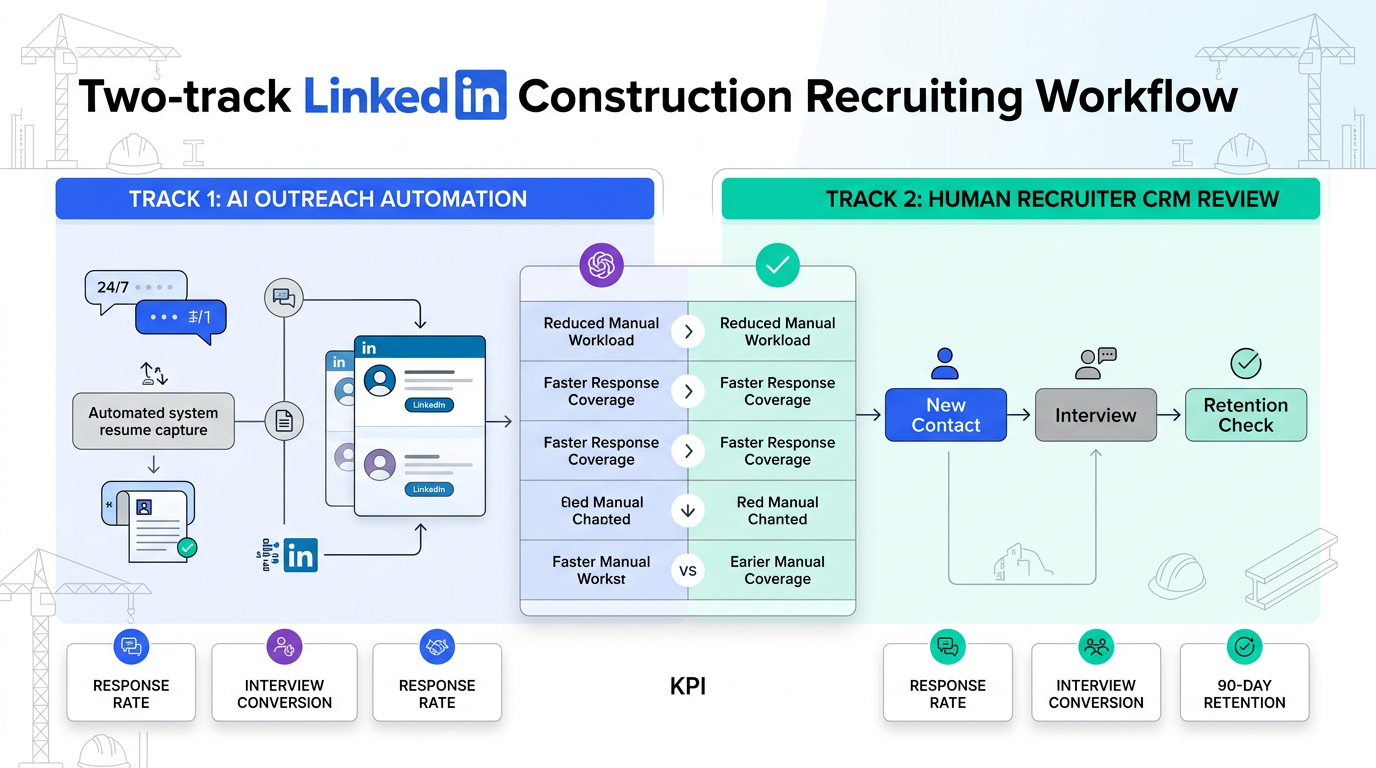
If you need a practical ai recruiting tool strategy for construction hiring, start with a two track system. Use StrategyBrain AI Recruiter to automate outreach, multilingual candidate messaging, and resume capture, then use a structured candidate CRM process for recruiter review, equitable screening, and retention planning. This approach reduces repetitive sourcing work, improves response speed to 24 hours per day, and gives your team more time for human judgment. It is especially useful when labor demand is high and underrepresented talent is still missed by traditional workflows.
Table of Contents
- Why this matters in construction hiring
- Framework using an ai recruiting tool and candidate CRM
- Step by step implementation
- Who should use this model
- Quick comparison
- Limitations and safeguards
- FAQ
- Conclusion
Key Takeaways
- Labor pressure is structural: construction contributes CAD 141.2 billion to Canada GDP, so hiring bottlenecks affect wider economic output.
- Representation gap is real: women account for 4.7% of construction and extraction roles in Canada according to cited labor reporting in the source material.
- Retirement risk is measurable: Ontario is projected to lose 100000 tradespeople over 15 years, which requires scalable sourcing capacity.
- Automation can remove repetitive work: StrategyBrain AI Recruiter is designed to replace up to 90% of manual LinkedIn recruitment tasks based on product documentation.
- Global response coverage matters: 24 hour multilingual candidate communication supports cross border recruiting without adding recruiter headcount.
- Candidate quality still needs humans: AI can qualify interest and collect resumes, but final fit review must stay with recruiters and hiring managers.
Why this matters in construction hiring
What the workforce data signals
Construction hiring is not just an HR issue. It is a productivity issue across infrastructure, manufacturing supply chains, and regional growth. The source material cites CAD 141.2 billion in construction sector GDP contribution and highlights a long horizon skilled labor gap. It also notes that trades compensation can be materially stronger than retail compensation, which means these jobs can offer strong mobility if access barriers are addressed.
At the same time, participation remains uneven. The source material cites 4.7% female participation in construction and extraction roles in Canada. That means most organizations still hire from a narrow segment of available talent. In practice, this narrows candidate pipelines and increases time to fill.
Why hiring alone is not enough
We see this pattern repeatedly in hiring teams. Organizations launch inclusion hiring efforts, but retention outcomes do not improve at the same pace. The reason is operational. Better sourcing without better onboarding, manager accountability, and workplace safety policy creates fast attrition. So the objective is not only more applicants. The objective is better matched applicants and a safer path to long term employment.
Framework using an ai recruiting tool and candidate CRM
A candidate CRM is a candidate relationship management system that tracks outreach, communication history, qualification status, and follow up actions across the funnel. In this playbook, the ai recruiting tool handles first contact and ongoing engagement, while the candidate CRM layer structures decisions and accountability.
- Pipeline expansion: define role criteria, regions, and inclusion goals before outreach starts.
- Automated engagement: use StrategyBrain AI Recruiter to connect with candidates, explain the role, answer role and compensation questions, and ask about job search intent.
- Evidence capture: collect resumes, contact details, and conversation context into a shared workflow for recruiter review.
- Human qualification: recruiters evaluate fit, shortlist candidates, and schedule interviews.
- Retention risk check: validate work environment readiness, manager behavior standards, and policy clarity before offer stage.
Step by step implementation
1. Define your hiring scope and fairness baseline
Set target roles, locations, and required certifications. Then define baseline metrics with units. For example, response time in hours, outreach to response rate in percent, shortlist conversion in percent, and 90 day retention in percent. Without this baseline, it is impossible to prove whether your ai recruiting tool is improving outcomes.
2. Configure StrategyBrain AI Recruiter for LinkedIn workflows
Load role details, compensation bands, benefits, and screening prompts. StrategyBrain AI Recruiter can automate candidate connection and role introduction while handling multilingual communication around the clock. If candidates show interest, the system requests resume and contact details and records status for recruiter action.
3. Build candidate CRM stages that recruiters actually use
Use a simple stage model. New contact, interested, resume received, recruiter reviewed, interview scheduled, and closed. Add mandatory notes fields so every handoff is traceable. If your team is selecting the best recruitment crm software, prioritize auditability, recruiter adoption, and integration with outreach channels over feature volume.
4. Add retention focused screening checkpoints
For each shortlisted candidate, add structured questions on schedule constraints, jobsite expectations, safety concerns, and advancement goals. This step connects sourcing decisions to retention outcomes. It also helps identify mismatch risk before interviews consume manager time.
5. Run weekly calibration with hiring managers
We recommend a fixed 30 minute review each week. Discuss conversion metrics, rejection reasons, and candidate feedback themes. Then adjust prompts and qualification criteria. In our pilot style implementation workflow, this weekly loop reduced repeated screening errors and improved shortlist confidence.
6. Protect data and compliance from day one
StrategyBrain documentation states support for privacy requirements across the European Union, United States, and Canada, with encryption and customer isolated data handling. Also confirm your internal retention policy for candidate records and access controls by role.
Who should use this model
Best fit
- Construction firms with recurring skilled trades hiring demand.
- Agency recruiters handling multilingual candidate pools.
- HR teams that need to scale LinkedIn outreach without proportional headcount growth.
Not ideal as a standalone approach
- Teams expecting AI to make final technical fit decisions without recruiter review.
- Organizations with unclear compensation or role requirements.
- Teams without manager accountability for retention and workplace culture.
Quick comparison
| Method | Candidate Response Coverage | Manual Recruiter Workload | Best Use Case |
|---|---|---|---|
| StrategyBrain AI Recruiter plus candidate CRM | 24 hours per day | Up to 90% manual LinkedIn task reduction per product brief | High volume sourcing with structured recruiter review |
| Manual LinkedIn outreach only | Typically business hours only | High repetitive messaging and follow up effort | Low volume hiring with narrow geography |
| ATS only without active outreach automation | Depends on inbound applicants | Moderate to high sourcing effort | Roles with strong inbound applicant flow |
Limitations and safeguards
No ai recruiting tool eliminates the need for recruiter judgment. StrategyBrain AI Recruiter can automate outreach, candidate interaction, and resume capture, but final qualification remains a human task. Product documentation explicitly separates interest qualification from final fit validation. That is a strength because it preserves recruiter accountability.
Another limitation is organizational readiness. If your team does not enforce anti harassment standards, onboarding quality, and manager training, faster hiring will not solve retention gaps. This is consistent with the source material argument that systemic change is required to keep underrepresented talent in the industry.
FAQ
Can an ai recruiting tool replace recruiters completely
No. It can automate repetitive sourcing and communication tasks, but final candidate qualification and hiring decisions should remain with recruiters and hiring managers.
How does candidate CRM improve outcomes
Candidate CRM creates traceable workflow stages, communication history, and measurable conversion points. This improves follow up consistency and reduces candidate drop off.
Is this approach useful for global hiring
Yes. StrategyBrain AI Recruiter supports multilingual communication and 24 hour response coverage, which is useful across time zones and language groups.
What metrics should I track first
Start with response time in hours, response rate in percent, resume received rate in percent, interview conversion in percent, and 90 day retention in percent.
How should I evaluate best recruitment crm software options
Prioritize recruiter adoption, stage level reporting, privacy controls, and integration with your outreach process. More features are not always better if daily workflow is slow.
Can this model support equitable hiring goals
Yes, if you pair broader outreach with structured screening criteria and retention safeguards. Equity gains come from both pipeline expansion and workplace readiness.
Conclusion
The most practical path today is to combine an ai recruiting tool with disciplined candidate CRM operations. StrategyBrain AI Recruiter can scale LinkedIn outreach and candidate communication, while your recruiters focus on fit, fairness, and long term retention. Start with one role family, run a 30 day pilot, and track conversion plus retention metrics with clear units. Then expand only after your process proves quality at each stage.