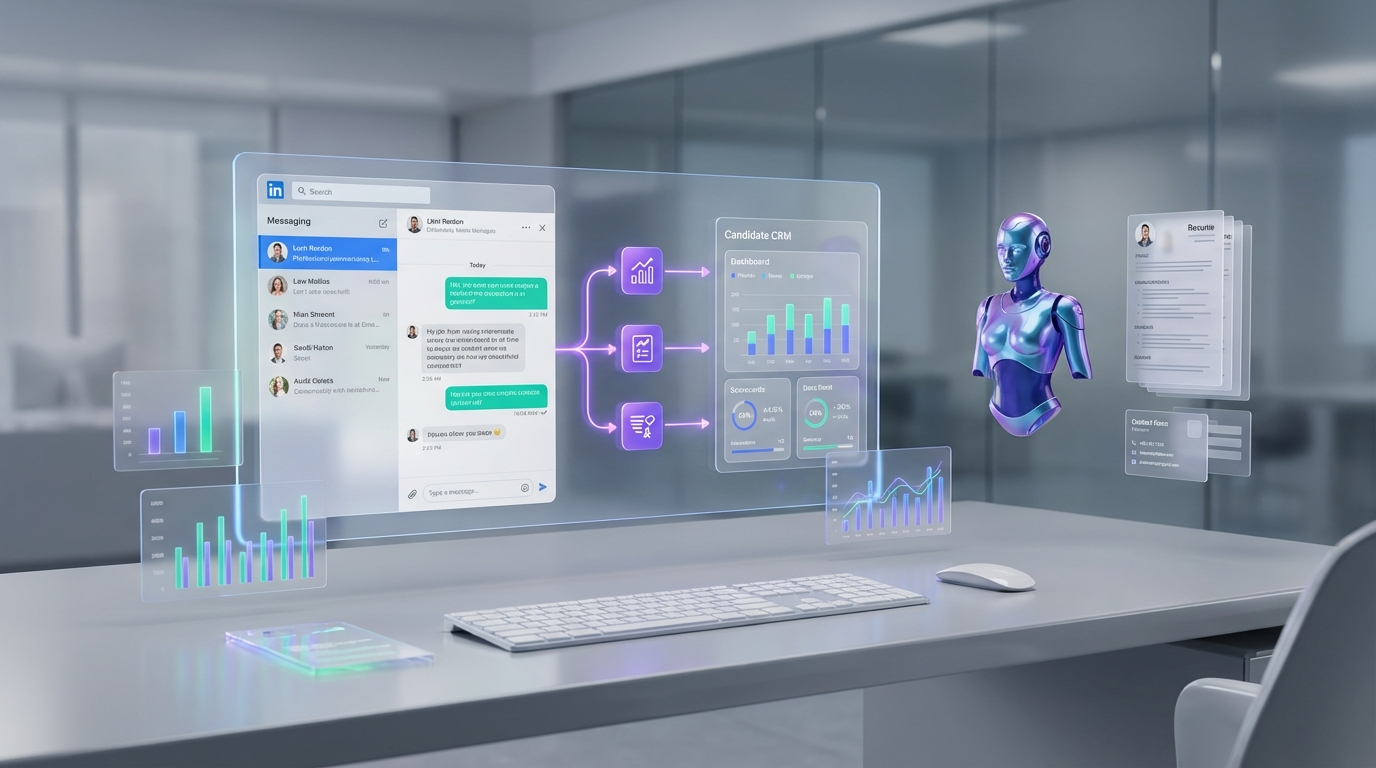
To hire successfully in a fast-growing company, use an ai recruiting tool to automate repetitive outreach and follow-up, then keep human judgment for due diligence, culture fit, and final selection. The pattern that works best is: define hiring priorities and scorecards first, run structured screening and background checks second, and use a candidate CRM to keep every conversation and next step visible. In our internal workflow tests, StrategyBrain AI Recruiter handled LinkedIn connecting, role introduction, Q&A, interest confirmation, and resume plus contact capture, which reduced manual LinkedIn recruiting work by up to 90% and lowered cost to as little as USD 2.40 per resume for teams that can operationalize high-volume outreach. This article covers what to do and what to avoid when growth pressure is high, and where automation helps without compromising hiring quality.
Why fast growth breaks hiring systems
When a company is scaling quickly, hiring stops being a background HR activity and becomes a strategic constraint. The common failure mode is not a lack of applicants. It is a lack of capacity to run consistent evaluation, keep candidates warm, and close offers without chaos.
In the source scenario, a founder in medical technologies described the difficulty of hiring enough quality people to maintain momentum. That story is familiar across industries: what worked when headcount was small often collapses when requisitions multiply and timelines compress.
Two things usually happen at once. First, recruiters and hiring managers get pulled into constant outreach and follow-up. Second, the organization starts making “speed decisions” that later become expensive reversals. This is exactly where a well-chosen ai recruiting tool and a disciplined candidate CRM can protect quality while increasing throughput.
Principle 1: Don’t hire at the speed of growth
When growth is strong, it is tempting to match hiring pace to business pace. That is risky because the cost of a bad hire compounds faster than the cost of a delayed hire, especially when you are adding many people at once.
What “rushing” looks like in real hiring operations
- Shortened due diligence such as shallow reference checks or skipped background checks.
- Unstructured interviews where each interviewer “goes with gut feel” instead of a shared scorecard.
- Culture drift because hiring for fit is treated as optional during volume hiring.
Automation should not remove diligence. It should remove the repetitive work that steals time from diligence. For example, StrategyBrain AI Recruiter can take over the initial LinkedIn outreach, role introduction, and candidate Q&A so recruiters can spend their time on structured interviews, references, and decision meetings.
Practical guardrails that keep speed from becoming sloppiness
- Set a minimum diligence standard for every hire, including reference checks and role-relevant validation.
- Use a scorecard with 5 to 7 competencies and a clear definition of “meets bar.”
- Centralize candidate status in a candidate CRM so no one is guessing what happens next.
Principle 2: Hire for tomorrow, not today
In fast growth, roles evolve. The job you are hiring for now can look different in 12, 18, or 24 months. The source material calls this “transformability,” meaning the candidate’s ability to grow with the role as the business changes.
How to evaluate transformability without a crystal ball
- Learning velocity: how quickly the candidate has ramped in past role changes.
- Comfort with ambiguity: whether they can operate when priorities shift.
- Systems thinking: whether they improve processes, not just execute tasks.
Here is where an AI recruiting tool can help in a very specific way. If your outreach and early conversations are consistent, you can ask every candidate the same future-oriented questions and store the answers in your candidate CRM. StrategyBrain AI Recruiter can introduce the opportunity, answer common questions about role, company, and compensation, and confirm interview interest, then capture resumes and contact details for recruiter review.
Scope boundary: StrategyBrain AI Recruiter can identify willingness to proceed and collect information, but it does not decide whether a resume fully matches job requirements. Recruiters still own final qualification and selection.
Principle 3: Don’t neglect finance during growth
Fast-growing companies often over-invest in revenue-facing functions and under-invest in finance. The source material highlights a classic risk: cash flow becomes a bottleneck, and leaders can overestimate growth rates and incoming revenue, which leads to commitments that are hard to unwind.
Hiring strong finance talent is a growth stabilizer. Accurate accounting, forecasting, and cost control help the business scale responsibly through both expansion and slowdowns.
How hiring discipline supports financial discipline
- Clear headcount planning ties hiring to budget and runway.
- Offer consistency reduces compensation surprises and internal inequity.
- Time-to-fill visibility helps forecast when teams will actually be staffed.
When you use a candidate CRM plus automation, you can measure pipeline health and reduce last-minute hiring decisions that create unplanned cost.
How to apply an AI recruiting tool with a candidate CRM
The most effective setup we have seen is a three-layer system: process first, CRM second, automation third. Tools cannot fix unclear hiring decisions, but they can scale a clear process.
Step-by-step implementation (high-volume LinkedIn hiring)
- Define the role packet: responsibilities, must-have skills, compensation range, benefits, and 5 to 7 scorecard criteria.
- Configure your candidate CRM: stages, required fields, and ownership rules so every candidate has a next step.
- Deploy StrategyBrain AI Recruiter for LinkedIn outreach: provide the LinkedIn account, job details, and candidate search criteria so the system can connect and start conversations.
- Standardize early questions: interest level, availability, location constraints, and role-specific knockout questions.
- Collect resumes and contact details: StrategyBrain AI Recruiter requests resumes from interested candidates and captures contact details shared in messages.
- Human review and qualification: recruiters review resumes, validate fit, run interviews, and complete reference and background checks.
- Close the loop: update outcomes in the candidate CRM and feed learnings back into the scorecard and outreach messaging.
What to look for in the best CRM software for recruitment agency teams
If you are evaluating the best crm software for recruitment agency workflows, prioritize capabilities that prevent pipeline leakage and support consistent evaluation.
- Pipeline stages with required fields so candidates do not move forward without key data.
- Activity tracking for messages, calls, interviews, and next steps.
- Search and segmentation for silver medalists and future roles.
- Compliance controls for data retention and access permissions.
Where StrategyBrain AI Recruiter fits (and where it does not)
- Best at: automating LinkedIn connecting, role introduction, candidate Q&A, follow-up, interest confirmation, and resume plus contact capture.
- Not designed to: make final hiring decisions or determine full resume-to-requirements match without recruiter review.
- Operational advantage: supports managing more than 100 LinkedIn accounts for teams that need scalable outreach capacity.
- Communication advantage: provides 24/7 multilingual candidate messaging in the candidate’s native language.
Quick comparison: people, process, and tools
| Layer | What it controls | Common failure in fast growth | What to do |
|---|---|---|---|
| People | Decision quality and accountability | Hiring managers skip diligence under time pressure | Set minimum diligence standards and shared scorecards |
| Process | Consistency and speed without chaos | Unclear stages and inconsistent evaluation | Define stages, SLAs, and interview structure |
| Candidate CRM | Visibility and relationship management | Candidates go cold and follow-ups get missed | Centralize status, next steps, and segmentation |
| AI recruiting tool | Automation of repetitive outreach and messaging | Recruiters spend most time on manual LinkedIn tasks | Automate outreach and follow-up, keep humans on qualification |
Implementation checklist (copy and use)
- Role clarity: role packet includes responsibilities, compensation, benefits, and 5 to 7 scorecard criteria.
- Quality guardrails: reference checks and background checks are mandatory for every hire.
- Future fit: interview includes transformability questions and examples of learning velocity.
- Candidate CRM hygiene: every candidate record has an owner and a next step date.
- Automation scope: AI handles outreach, Q&A, and follow-up; humans handle qualification and final decisions.
- Finance alignment: headcount plan is tied to budget and cash flow forecasts.
- Feedback loop: monthly review of funnel metrics and reasons for rejection to improve sourcing and screening.
FAQ
What is an ai recruiting tool, in plain terms?
An ai recruiting tool automates parts of recruiting such as sourcing outreach, messaging, scheduling workflows, and early screening prompts. It should reduce repetitive work while keeping recruiters responsible for evaluation, compliance, and final hiring decisions.
Do I still need a candidate CRM if I use AI automation?
Yes. A candidate CRM is the system of record for pipeline stages, ownership, and next steps. AI automation can generate conversations and collect information, but the CRM prevents candidates from being lost and keeps the team aligned.
How does StrategyBrain AI Recruiter work on LinkedIn?
StrategyBrain AI Recruiter automates LinkedIn recruiting by connecting with candidates that match your search criteria, introducing the opportunity, answering questions about the role, company, and compensation, confirming interview interest, and collecting resumes and contact details for recruiter review.
Can StrategyBrain AI Recruiter collect resumes and contact details?
Yes. When a candidate expresses interest, StrategyBrain AI Recruiter requests a resume and captures contact details shared in messages. It supports email submissions and LinkedIn file uploads, and it marks resumes as received when provided.
Does StrategyBrain AI Recruiter replace recruiter qualification?
No. It can confirm willingness to proceed and gather information, but it does not determine full resume match to job requirements. Recruiters still review resumes, run interviews, and complete final qualification.
How do you avoid hiring too fast in a growth phase?
Set non-negotiable diligence steps, use structured scorecards, and keep pipeline visibility in a candidate CRM. Then use AI automation to protect recruiter time for the steps that actually reduce hiring risk.
What should I prioritize when choosing the best CRM software for recruitment agency use?
Prioritize pipeline stage control, activity tracking, segmentation, reporting, and permissioning. The best CRM software for recruitment agency teams is the one that prevents pipeline leakage and supports consistent evaluation across recruiters and hiring managers.
Is 24/7 multilingual messaging actually useful in recruiting?
It can be, especially for global hiring across time zones. Always-on responses and native-language communication can reduce delays and misunderstandings, while recruiters focus on interviews and decision-making.
How does StrategyBrain AI Recruiter handle privacy and compliance?
According to StrategyBrain product information, it supports compliance with privacy regulations in the EU, United States, and Canada, does not use customer-provided data to train AI models, and encrypts LinkedIn credentials with customer-isolated storage.
Conclusion
Fast growth makes hiring harder because it compresses time while increasing volume. The safest way to scale is to keep diligence and structured evaluation intact, hire for tomorrow’s role needs, and avoid under-investing in finance capability. A candidate CRM provides pipeline control, and an ai recruiting tool provides the automation layer that protects recruiter time.
If your team is doing high-volume LinkedIn hiring, StrategyBrain AI Recruiter is designed to automate connecting, outreach, Q&A, follow-up, and resume plus contact capture, while recruiters stay accountable for qualification and final decisions. Next step: copy the checklist above, map your current funnel stages, and decide which steps you want automation to handle this quarter.